How to Identify Different Irish Tune Types: A Practical Listening Guide
A fast Irish tune isn’t automatically a reel. A jig can race, a hornpipe can lift its heels, and two tunes at a similar speed may still feel entirely different. Learning how to identify different Irish tune types starts with the pulse and phrasing, not a quick guess based on tempo.
If tune names and terms like 6/8 or 4/4 have ever made listening feel like a music exam, you’re in good company. You don’t need to read notation or count every note. Tap a steady beat and notice how the melody groups its notes: a jig often has a bouncing three-part feel, while a reel drives forward in fours. Hornpipes sound more measured and swung; polkas move with a jaunty two-step. These are listening clues, not rigid rules.
This guide will help you hear those differences, along with the graceful slip jig and lively slide, using plain-language rhythm cues. We’ll also look at repeated A and B sections and regional flavor, so the next session or recording feels easier to follow. Tap along, listen for the lift, and let your ear learn the patterns.
Table of Contents
How to identify Irish tune types by ear: start with the pulse
You don’t need to read music to hear the patterns that distinguish Irish tune types. Start with the pulse, the steady beat you might tap with your foot even when the melody moves quickly around it. As you learn how to identify different Irish tune types, listen for how that pulse groups, then notice the tune’s phrasing. Tempo helps, but it isn’t a reliable test on its own. Musicians can play the same type at different speeds.
What does tune type mean in Irish traditional music?
A tune type is a familiar musical form shaped by recurring rhythmic and melodic patterns. Metre describes how beats are grouped, pulse is the underlying beat, and phrasing is how the melody shapes and moves through its musical ideas. Together, these clues help you recognise a type. A tune’s title, key or instrument doesn’t determine its type, and regional style is another layer. Musicians may ornament or phrase the same type differently. Some tune names also appear in discussions of Irish dance forms, where jigs, reels and hornpipes feature in step-dancing and set dancing.
Listen for grouped beats before counting notes
Metre can sound technical, but it’s simply a pattern you can feel. Metre is the way a tune’s beats regularly group together. Try tapping along to a short passage without counting every quick note. Keep your foot steady and listen for recurring accents or a regular lilt around it. If the tune is hard to follow, listen again and hum the melody. Its shape may become clearer on the second pass.
Use this quick checklist with an unfamiliar recording:
Feel the beat: Tap gently and find the steady pulse beneath the melody.
Count the grouping: Notice whether the tune seems to move in twos, threes or another repeating pattern.
Follow the phrasing: Listen for where the melody lifts, settles or places a noticeable emphasis.
Don’t rush to name the tune after hearing just one clue. A brisk performance might tempt you to guess “reel,” but pace alone can mislead. The grouped beats and phrasing offer a stronger starting point. Make a first guess, then listen again to see whether the pulse supports it. That small habit turns passive listening into a practical skill, one tune at a time.
Hear the difference between jigs, reels and hornpipes
Once you’ve found the underlying beat, compare how the melody moves around it. Jigs, reels and hornpipes can all be lively, but their beat groupings and phrasing give each a different character. Use the patterns below as listening guides, not strict rules. Musicians can shape a tune in their own way.
How does a jig sound different from a reel?
A jig’s common 6/8 grouping gives it a compound lilt: the quick notes tend to fall into sets of three. Rather than counting every note, listen for the rolling bounce of the phrase. A reel is commonly in 4/4, with a steadier duple feel and an even forward drive. Britannica’s overview of reel music also describes the reel’s connection with Celtic dance traditions.
A jig rolls in threes; a reel drives ahead in an even four. That’s a useful first impression, not a rule for every performance. A fast jig and a slower reel can overlap in pace, so don’t identify one by speed alone. Listen for how the notes group and where the melody seems to lean.
What should you listen for in a hornpipe?
A hornpipe often feels more deliberate than a reel. Its rhythm may have a swung or dotted lilt, so the notes don’t fall with quite the same evenness as a straight reel. Phrases can sound broad and neatly shaped, with a slight lift between accents. Playing styles vary, so treat that character as a clue rather than a test.
Try this: tap a steady beat through a passage, then listen for whether the notes feel evenly spaced or gently uneven. Keep the pulse steady as the tune moves and notice how the melody settles into its phrases. For more listening practice, explore the Irish traditional music recordings and notes on Páraic Banjo, and see which rhythmic details catch your ear.
Recognise polkas, slides, slip jigs and other Irish tune types
Once you know the sound of a jig, reel and hornpipe, listen for a few other familiar shapes. Compare each tune by its beat grouping, pulse, phrasing and overall feel. The descriptions below are useful starting points, not rules: tempo, ornamentation and a musician’s phrasing can all change what you hear. Regional traditions matter too. Polkas and slides, for example, are especially prominent in Sliabh Luachra, around the Cork, Kerry and Limerick borders.
Polka: Usually grouped in 2/4, with a compact, jaunty pulse and short, lively phrases. It often feels like a brisk two-step.
Slide: Commonly grouped in 12/8, with a rolling lilt that can feel broader than a polka. Listen for the way its phrases sweep through four larger beats.
Slip jig: Usually grouped in 9/8. Its notes fall into three sets of three, giving the tune a graceful, flowing quality.
Single jig: Often has a 6/8 grouping, but its phrasing can give it a different character from other jigs. Compare the shape of its phrases as well as the lilt.
March: A measured, regular pulse helps it feel more deliberate and processional than a dance tune.
Waltz: A recurring three-beat sway gives it a smooth, turning feel.
How can you tell a polka from a slide?
Both can sound lively, so speed won’t settle the question. Tap along and listen for the grouping: a polka’s two-beat pulse tends to feel compact and direct, while a slide’s lilting movement can seem broader, with phrases rolling across four larger beats. Play a short passage twice if needed. Does it bounce in two, or flow in a wider sweep? That’s a more useful clue than simply asking which tune is faster.
What makes a slip jig or waltz easier to recognise?
For a slip jig, follow the recurring groups of three quick notes, repeated across a nine-beat pattern. You don’t need to count every note; let the phrase’s lilting, flowing shape guide you. A waltz is easier to feel as a steady three-beat sway. Try counting “one, two, three” with the pulse, then notice whether the music turns smoothly around that pattern.
Use these clues as a listening map, not a test. A musician may stretch a phrase, alter the emphasis or bring a regional flavor to the tune. To explore the wider history and language of the tradition, see this review of the Companion to Irish Traditional Music. The more you listen across different performances, the more naturally you’ll hear how to identify different Irish tune types.
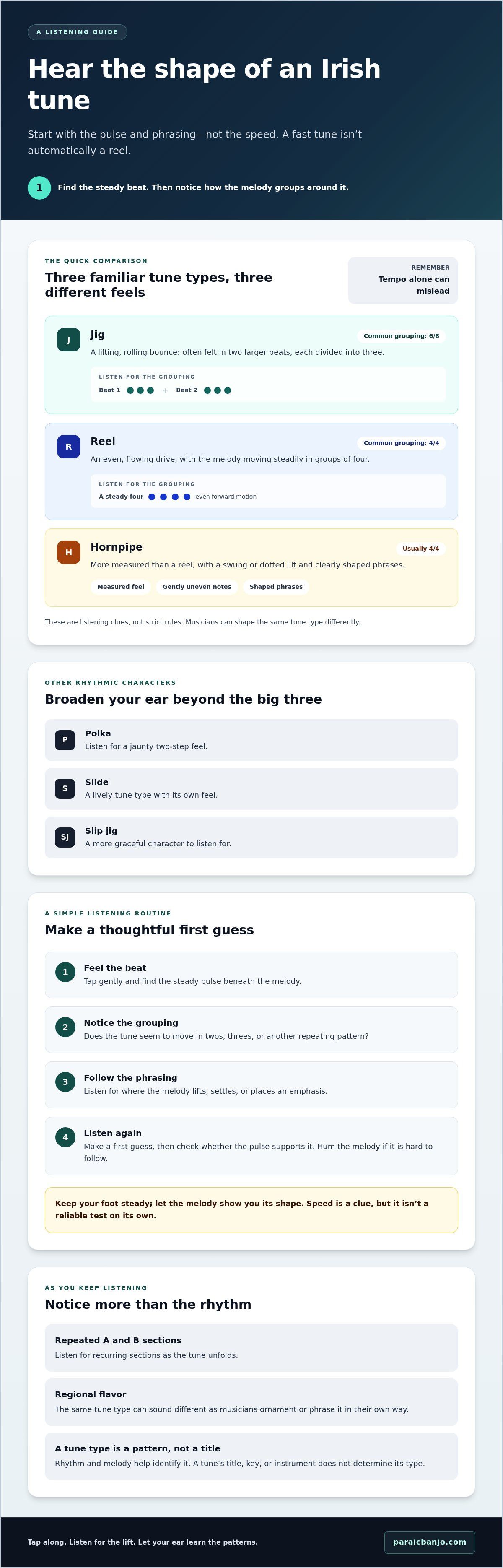
Use a simple listening routine to identify unfamiliar Irish tunes
You don’t have to name a tune on the first pass. A steady, repeatable listening routine helps you separate what you hear from what you expect to hear. Use it with a full recording or a short passage, and treat your answer as a best guess rather than a test.
Follow four steps from first listen to best guess
Listen once without labelling it. Notice the broad character: does the tune bounce, roll, swing or feel measured? Let the music make its first impression before you start counting.
Tap the pulse. Find the steady beat beneath the melody. Notice whether it seems to group in twos or threes, or has a compound lilt where each main beat divides into smaller groups. Don’t worry about getting the count perfect.
Replay a short passage. Choose a phrase you can hear clearly. Listen for a lilting or swung rhythm, where the melody places its accents, and whether a pattern returns. Tap again, keeping your attention on the pulse rather than every fast note.
Compare your clues. Check the grouping and phrasing against the tune types in this guide. Make a provisional guess, then listen once more to see whether the clues fit together.
If you’re torn between two types, that’s normal. A short excerpt may not reveal enough of the tune’s phrasing, and musicians can shape the same type differently through tempo, emphasis and ornamentation. Write down two possibilities if that helps, then listen to a longer passage or another performance. The aim is to notice more each time, not to force a certain answer.
Use regional style as context, not a shortcut
Regional traditions can influence how a tune is phrased and ornamented, but they don’t replace its rhythmic clues. East Galway and Clare styles, for example, have their own musical character. Exploring East Galway and Clare musical styles can add context to what you hear. Still, don’t assume there’s one definitive sound for a region. Compare musicians’ interpretations and listen for what stays consistent in the beat grouping, even as the phrasing changes.
Put the routine to work with another recording: listen first, tap next, and only then make your best guess. To practise attentive listening with Irish traditional music, explore the album and liner notes at listen to Páraic Mac Donnchadha’s album.
Keep learning tune types through attentive Irish music listening
You don’t need to identify every tune perfectly to become a more confident listener. The strongest clues are the grouping of the beats, the underlying pulse and the way the melody is phrased. Speed can add context, but it can’t tell you the tune type on its own. Give your ear time to notice the patterns.
Build a listening habit without needing sheet music
Choose one clue each time you listen. On one pass, focus on the pulse; on another, notice how the beats group or where the melody’s phrases rise and settle. Revisit a short passage and tap along at a comfortable pace. If you’re unsure whether a tune belongs to one type or a related one, that’s part of learning by ear, not a mistake. Keep your best guess and listen again another day.
It can also help to hear different musicians play traditional tunes. One performer may give a phrase a stronger lift, while another shapes it more gently. Notice which rhythmic features remain familiar and which details change. There isn’t always one definitive performance to use as a template, and that variation is part of the music’s life.
Explore tune context alongside the sound
Listening closely tells you how a tune moves; liner notes can add a sense of where its musical stories and traditions sit. Páraic Mac Donnchadha’s album Not Before Time - 39 Years in the Making offers an optional doorway into Irish traditional playing. It features 18 tracks recorded live with expert musicians, and the accompanying notes share historical context connected with East Galway and Clare traditions. The album isn’t a formal guide to identifying tune types, but listening with the notes in mind can give the music added context.
Choose a passage, tap along, then read the notes and listen once more. You may notice a phrase or regional character you missed at first. Keep it simple: one clue, one replay, one fresh detail. That’s a satisfying way to build your ear over time.
For more music and background on Páraic Mac Donnchadha’s work, Explore Páraic Banjo.
Take these listening clues into your next session
Learning how to identify different Irish tune types doesn’t mean naming every tune at once. Start by feeling the pulse, notice how the beats group, then listen to the phrasing. A jig’s lilting movement, a reel’s steady drive and a hornpipe’s characteristic swing can guide your first guess, but speed alone won’t settle it. Keep listening across different players, and let your ear grow familiar with the variations.
For another way to hear traditional Irish music in context, explore the work of Irish tenor banjo player Páraic Mac Donnchadha. His album Not Before Time - 39 Years in the Making features 18 tracks recorded live with expert musicians. The accompanying liner notes share historical context connected with East Galway and Clare traditions, adding stories to listen for alongside the sound.
Explore Páraic Banjo and its traditional Irish music, then try your listening routine with a track that catches your ear. No need to get every label right. Tap along, stay curious, and enjoy the music.
Frequently Asked Questions
How can you identify an Irish tune type by ear?
Listen for the beat grouping, pulse and phrasing before guessing the tune type. Tap along to find the steady beat, then notice whether the melody feels lilting, even, swung or strongly accented. A useful way to practise how to identify different Irish tune types is to replay a short passage and focus on one clue at a time. You don’t need sheet music, and your first answer can be a best guess.
How can you tell a jig from a reel?
A jig usually has a lilting compound feel, commonly grouped in 6/8, while a reel commonly moves in 4/4 with an even, forward-driving pulse. Try tapping steadily and listening to how the quick notes gather around the beat: a jig often rolls in threes, while a reel feels more evenly divided. Both can be played at different speeds, so listen for grouping and phrasing rather than relying on tempo.
What is the difference between a reel and a hornpipe?
Both are commonly in 4/4, but a reel generally has an even, flowing drive, while a hornpipe often has a more measured, swung or dotted lilt. Tap a steady beat and listen to whether the melody’s notes feel evenly spaced or gently uneven, with broad, clearly shaped phrases. Playing styles vary, so this contrast is a helpful clue, not a strict rule for every reel or hornpipe.
Is a slip jig different from a regular jig?
Yes. A slip jig is commonly grouped in 9/8, with beats arranged in three sets of three quick notes, giving it a graceful, flowing feel. A standard jig is often grouped in 6/8, with two main beats divided into threes. You can hear the difference without reading notation: tap along and notice whether the phrase seems to cycle through three groups or two.
Can tune type be identified by tempo alone?
No. Tempo can support a guess, but it can’t reliably identify a tune type by itself. A quick performance may make different tune types seem alike, and musicians can play the same type at varying speeds. Listen for the beat grouping and characteristic phrasing as well. If the clues don’t line up clearly, replay a longer passage or keep two possible types in mind.
What are the main types of Irish traditional tunes?
Common types include reels, jigs, hornpipes, polkas, slides and slip jigs. You’ll also hear single jigs, marches and waltzes. Each has characteristic rhythmic patterns and phrasing, though performances can vary. For a first listening pass, compare how the pulse moves and how the beats group, rather than trying to memorise every metre at once. The tune’s title or instrument alone won’t tell you its type.
Do regional styles change how an Irish tune type sounds?
Yes. Regional traditions and individual musicians can shape a tune’s phrasing, ornamentation and overall feel. A regional style adds context, but it doesn’t replace the rhythmic clues that help identify the tune type. Listen to different performances of the same type and notice what stays consistent in the beat grouping alongside what changes in the melody’s expression. That comparison helps you hear both the form and the player’s interpretation.