History of the Banjo in Ireland and Its Place in Irish Music

The history of the banjo in Ireland began before the tenor banjo became a familiar sound in traditional music. In 1844, the Virginia Minstrels toured Dublin, Cork and Belfast, bringing fretless five-string banjos to Irish audiences; the four-string tenor banjo found its place later, becoming increasingly used in Irish music during the 1920s. Its bright, driving sound soon suited dance tunes and céili bands.
It’s easy to hear the banjo as an instrument that simply belongs in an Irish session. Its journey to Ireland, however, connects touring entertainment, changing musical tastes and the instrument’s own evolution. Minstrel shows helped popularize the banjo, but they also appropriated Black musical traditions and relied on racist blackface performances, a history that deserves clear-eyed attention. This article traces how the banjo travelled to Ireland, how the tenor banjo took hold in dance halls and céilí bands, and how players made it their own. You’ll see how its role shifted from rhythmic backing to carrying jigs and reels, and how its lively, sharply articulated sound became part of Irish traditional music.
Table of Contents
How Did Tenor Banjos End Up in Ireland?
The banjo reached Irish audiences through touring entertainment, then changed as musicians adapted it to local tunes. The four-string tenor banjo eventually became a melodic voice in Irish traditional music.
The banjo’s arrival in Irish traditional music
The tenor banjo’s arrival was part of a longer story that began with five-string instruments. The Virginia Minstrels brought fretless five-string banjos to Dublin, Cork and Belfast in 1844. Later, four-string banjos grew more mainstream in the early 1900s, and the tenor banjo entered Irish music during the 1920s. That distinction helps explain why today’s Irish banjo sound differs from the older five-string style.
Banjo types in Irish traditional music
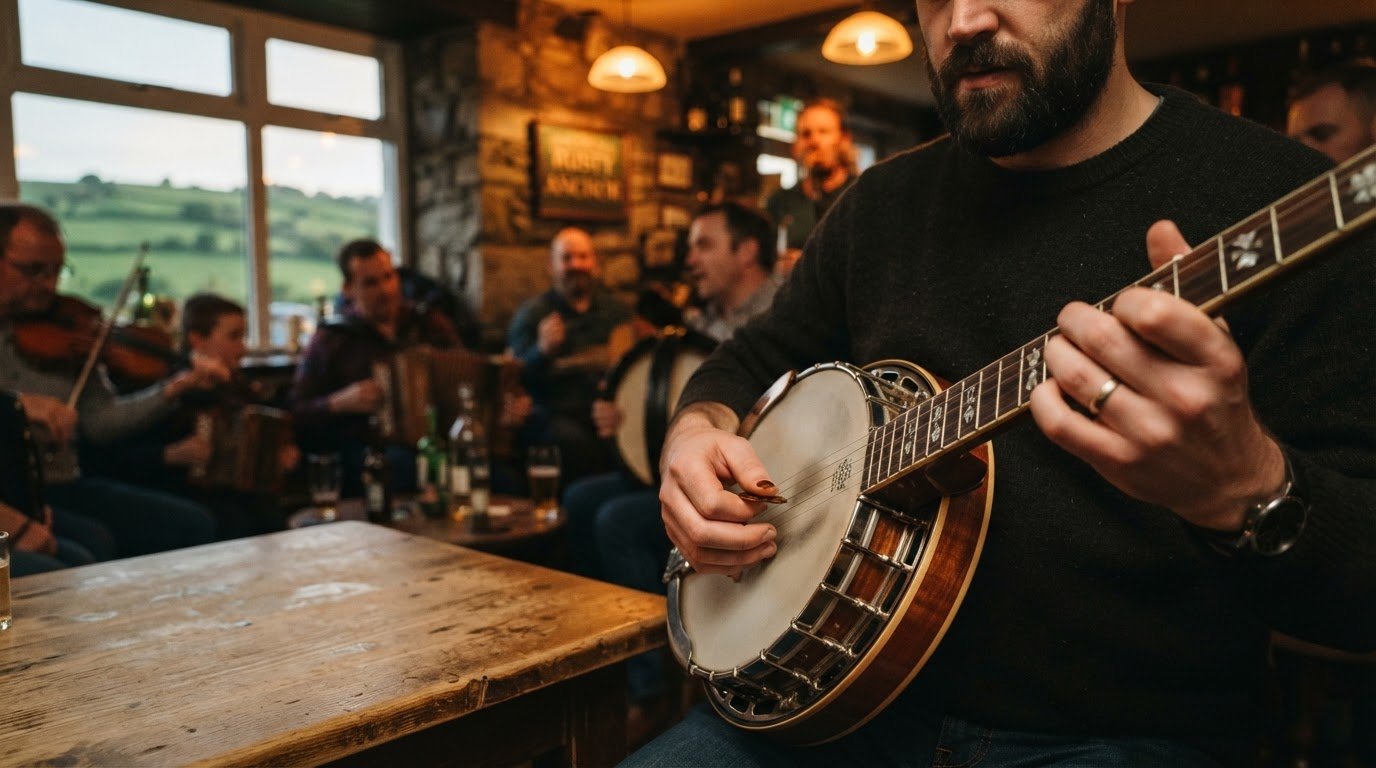
Irish traditional players are most associated with the four-string tenor banjo, played with a plectrum, or flat pick. The five-string banjo belongs to the instrument’s earlier history and remains associated with other styles. The tenor’s four strings make it suited to picking melodies alongside fiddle and accordion. So, if you’re identifying the sound in an Irish session, listen for a brisk, picked line rather than assuming every banjo has five strings.
Tuning shaped that melodic role. Standard tenor tuning is CGDA, but Irish players commonly use GDAE, one octave below the mandolin or violin. Barney McKenna of the Dubliners helped establish GDAE, and by the 1980s, octave tuning had become the de facto Irish traditional approach. Chicago tuning, DGBE, is another tenor option, though GDAE connects naturally with fiddle and mandolin fingering.
Minstrel shows and Black musical traditions
Minstrel shows brought banjo music to broad audiences through performances that appropriated Black musical traditions and used racist blackface portrayals. The banjo’s roots lie in African and African American musical culture, while minstrel entertainment presented distorted imitations for commercial audiences. Its spread cannot be separated from the people whose music and culture were exploited. Recognizing this context brings honesty to the story of the banjo’s later adoption in Ireland.
Recordings also help trace the banjo’s changing place. James Wheeler became the first Irish tenor banjo recording artist in 1916, accompanying button accordionist Eddie Herborn. A Flanagan Brothers recording of Irish tunes was most likely made in 1923. These are useful early landmarks; later, Barney McKenna and the Dubliners helped popularize the tenor banjo during a folk and Irish traditional music revival.
That revival also connects with efforts to preserve older string music. The Carolina Chocolate Drops brought renewed attention to Black old-time string-band traditions, and their album Genuine Negro Jig won the Grammy Award for best traditional folk album in 2010. Set beside Irish recordings, their work reminds listeners that banjo history carries several musical lineages, not one.
The tenor banjo's role in Irish dance halls and céili bands
In Irish dance halls, the tenor banjo brought a crisp pulse and, increasingly, a bright melodic line. Influential players include Barney McKenna of the Dubliners and Enda Scahill, a four-time All Ireland Banjo-Playing Champion. Their playing helped shape the instrument’s place in traditional music.
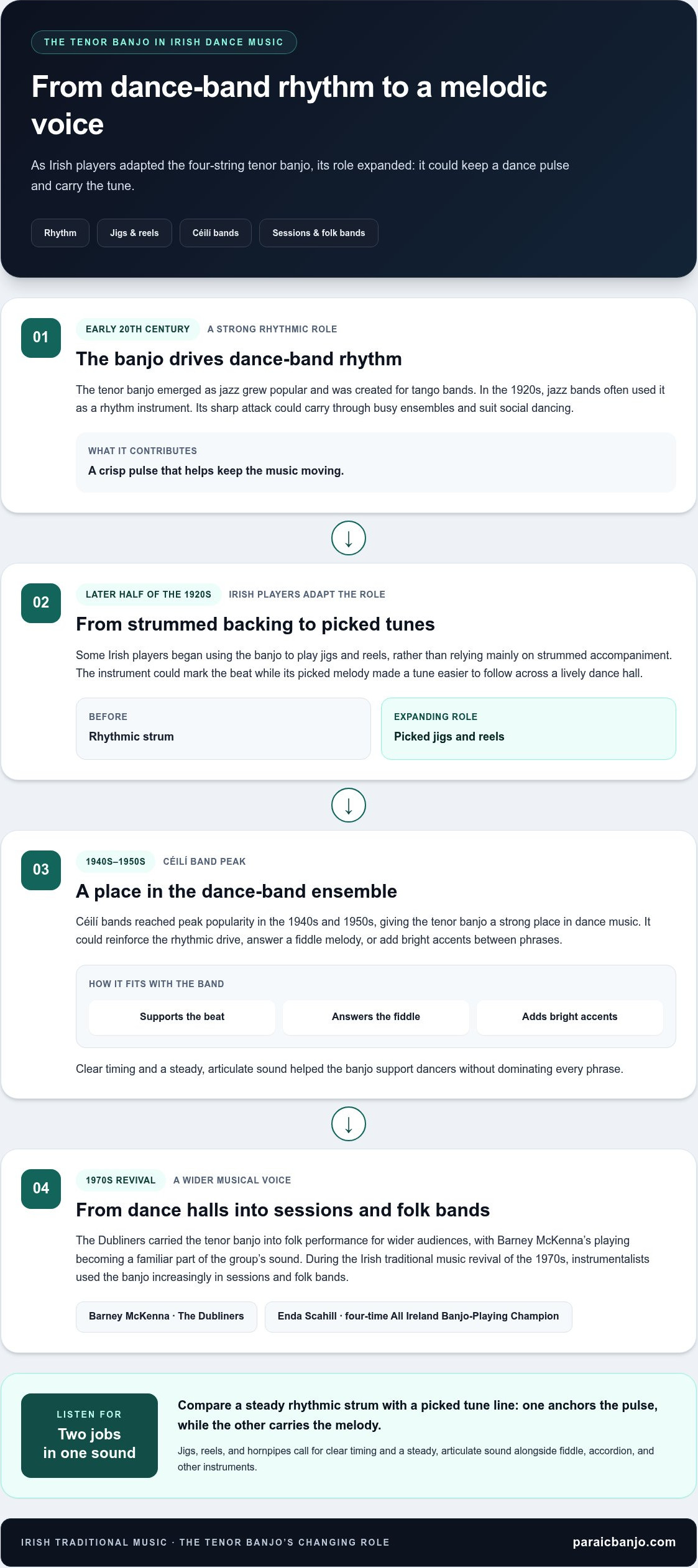
The tenor banjo’s American origins are tied to dance music: it emerged as jazz grew popular in the early 20th century and was created for use in tango bands. In the 1920s, jazz bands often used the banjo as a rhythm instrument. Its sharp attack carried through busy ensembles, a quality that also suited social dancing.
Irish players gradually moved beyond that rhythmic role. During the later half of the 1920s, some began using the banjo to play jigs and reels rather than relying mainly on strummed accompaniment. That change mattered in dance halls: a banjo could help mark the beat while its picked melody made the tune easy to follow across a lively room.
Jigs, reels and hornpipes call for clear timing and a steady, articulate sound. A plectrum lets players pick out quick notes while keeping the rhythm moving, helping the tenor banjo sit alongside fiddle, accordion and other instruments. In a céilí band, this combination can support dancers without making the banjo dominate every phrase.
Céili bands reached peak popularity in the 1940s and 1950s, giving the tenor banjo a strong place in dance music. The instrument could reinforce a band’s rhythmic drive, answer a fiddle melody or add bright accents between phrases. Its sound suited the practical demands of social dancing: tunes needed clear momentum, and each instrument had to contribute to the ensemble.
The Dubliners later carried the tenor banjo into folk performance for wider audiences, with McKenna’s playing making the instrument a familiar part of the group’s sound. During the Irish traditional music revival of the 1970s, instrumentalists used the banjo increasingly in sessions and folk bands. Its role had widened, from dance-band backing to a confident melodic voice.
To hear that change, compare a steady rhythmic strum with a picked tune line and notice how each supports the ensemble. Listen to Irish session banjo recordings for a chance to follow those rhythmic and melodic choices in traditional music.
Mid-19th-century minstrel tours in Ireland, Scotland and England
Mid-19th-century minstrel tours brought banjo sounds before Irish audiences, but touring exposure wasn’t the same as immediate adoption. The Virginia Minstrels toured Dublin, Cork and Belfast in 1844, introducing fretless five-string banjos. Their route connected Irish listeners with a performance style already popular across America and elsewhere.
A fretless banjo has no metal frets dividing the fingerboard into fixed notes. Players press the string at precise points, using small movements to shape the pitch. This technique gives the instrument a distinctive feel and sound, while its bright attack can stand out beside fiddle-led music. The five-string banjo heard on tour was not yet the four-string Irish tenor familiar from later sessions.
Christies Minstrels also toured England, Scotland and Ireland in the mid-19th century. In Edinburgh, they performed ten sell-out evenings at the Assembly Rooms. Such engagements show how minstrel entertainment could reach paying audiences across several cities. They help explain how the banjo became visible beyond America, even though local musicians later shaped its role in their own musical settings.
The banjo’s popularity came with a troubling cultural history. Minstrel shows appropriated traditional string music and banjo forms from enslaved people’s culture, then presented them through racist blackface performances. This was not a neutral exchange between musical styles: Black traditions were reshaped for commercial entertainment. Understanding that history makes it possible to describe the instrument’s spread without separating its popularity from the people whose music was exploited.
The tours belong to the earlier chapter of the instrument’s Irish story. The Irish tenor banjo’s later place in traditional music developed after four-string models became more mainstream in the early 1900s. That distinction matters when comparing a fretless touring instrument with the crisp, fretted tenor sound associated with later Irish players. Don’t assume every early reference to a banjo describes the same instrument or playing method.
Barney McKenna’s later sound offers a familiar point of contrast, not a description of what audiences heard in 1844. His tenor banjo belonged to a different stage in the instrument’s journey, after players adapted banjo playing to Irish tunes. The difference is much like comparing an early touring ensemble with a later session: the instrument travels, but musicians and musical settings change what it can do.
For a listener, the useful distinction is between arrival and adoption. Mid-19th-century tours introduced banjo performance to Irish cities; later musicians made the instrument part of Irish traditional music. Keep the five-string tour banjo, the four-string tenor and McKenna’s later playing in separate historical frames. That simple comparison makes the banjo’s transatlantic path easier to hear.
The spread of the tenor banjo to Ireland
The tenor banjo developed in America for tango bands before finding a different musical home in Ireland. Its compact four-string layout and plectrum playing suited brisk dance music, though the transition took time. Before tenor models arrived, players used five-string banjos with the short fifth string removed, or plectrum banjos.
That earlier mix continued for 15 or 20 years prior to the introduction of the tenor banjo. The distinction matters: “banjo” describes instruments with different string arrangements and playing approaches. A five-string instrument has a short string attached partway along the neck, while tenor and plectrum banjos use four strings. The body may look similar, but the neck and musical role differ.
Four-string models became more mainstream in the early 1900s. Most banjos made in the 1920s and 1930s were four-string instruments, a sign of how widely that format had spread. Irish players adapted the tenor for traditional tunes, using the plectrum to articulate quick notes and keep a strong rhythmic pulse. Its role was no longer limited to the dance-band sound that shaped its American development.
Irish emigrants helped spread banjo music by carrying tunes and playing traditions between Ireland and America. Transatlantic exchange also came through touring performers and recordings, while later Irish groups reached audiences in America. Barney McKenna and the Dubliners helped popularize the tenor banjo during a revival of folk and Irish traditional music there, connecting listeners across the ocean.
Banjo neck length offers another clue to the instrument’s development. Tenor banjos generally had 19 frets, though 17-fret necks were also available. A capo at the second fret of a standard 19-fret banjo effectively creates a 17-fret short neck. That changes the usable neck length and can make fingering feel more compact.
Playing styles continued to evolve. Some Irish banjo players use plectrum techniques to echo the rolling sound associated with Earl Scruggs. This does not make Irish playing identical to Scruggs’s bluegrass approach; it shows how musicians borrow techniques and reshape them for local tunes. Listen for how the pick balances melody and rhythm in a session.
By the 1980s, octave tuning had become the de facto approach for Irish traditional banjo playing. That development reflects a wider process: players chose an instrument, adjusted its setup and technique, then made it serve Irish melodies. To follow the spread clearly, compare the five-string banjo, the plectrum model and the tenor, then listen for how each handles a dance tune.
The banjo as a connection across cultures
The history of the banjo in Ireland is part of a wider exchange, where musicians carried instruments into new settings and shaped them around local music. As the banjo spread across the United States and Europe, regional playing styles developed. The result is not one universal banjo sound, but a family of approaches listeners can compare.
Start by listening for what each player brings to the foreground. In one performance, the banjo may carry the tune; in another, its rhythmic pattern may matter more. Notice the pace, the spaces between phrases and how the instrument responds to the ensemble. These details reveal musical choices without reducing distinct traditions to a single style.
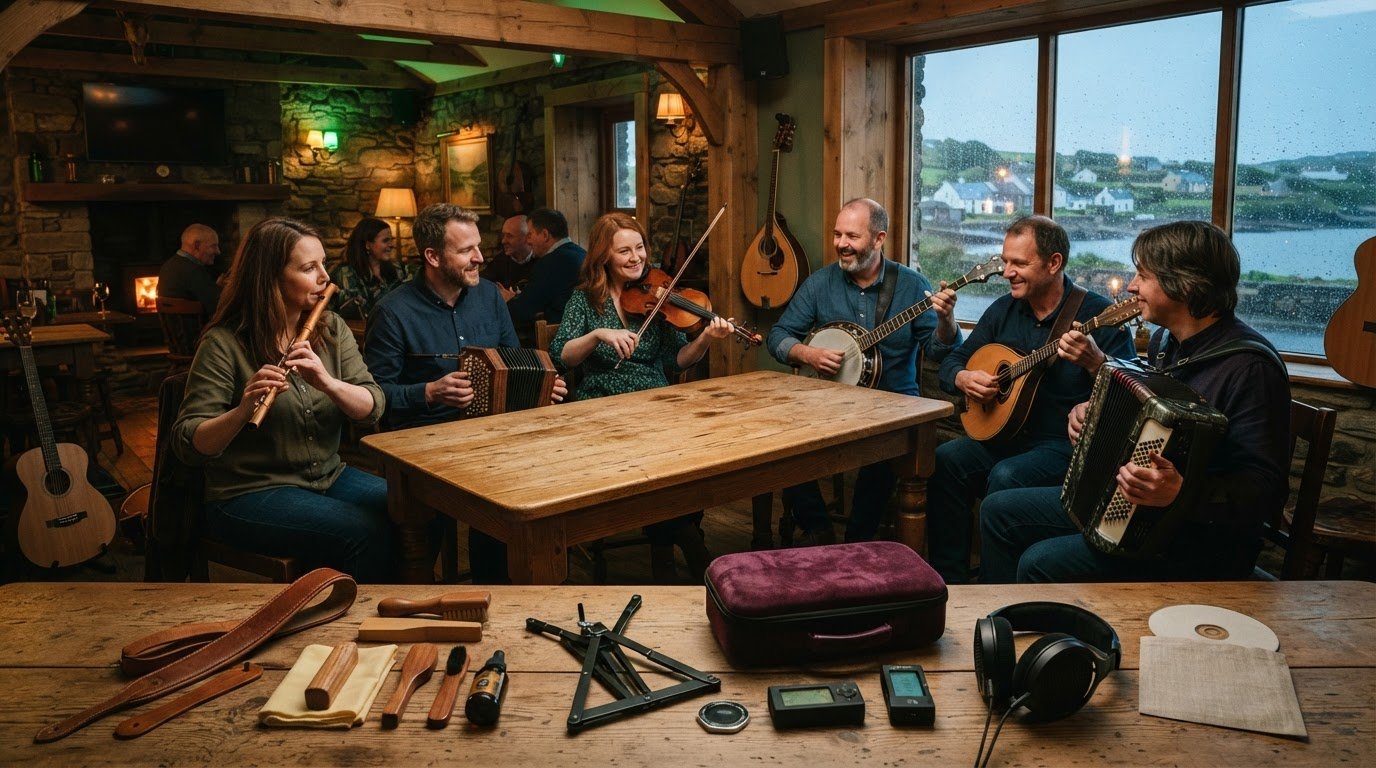
Irish traditional music offers a clear example of local adaptation. Follow how the banjo’s picked line interacts with a fiddle or another melody instrument, then notice whether it leads, answers or supports the tune. This exchange between players is part of the music’s character. Listen for the conversation, not just the loudest instrument.
Comparing recordings can sharpen your ear. Choose examples from distinct regional styles, then listen for differences in rhythmic emphasis, phrasing and how musicians shape a melody. Keep your observations specific: describe what you hear instead of assuming two traditions are identical because they share an instrument. This simple habit makes cross-cultural listening more attentive and respectful.
The history of the banjo in Ireland becomes richer when you hear adaptation as a creative process. Musicians work with the sounds and techniques available to them, making choices that suit their repertoire and ensemble. For a practical listening exercise, focus on one tune and track how the banjo’s role shifts between phrases. Each return can reveal a new detail.
That kind of close listening connects cultural context with the music itself. Let the melody, rhythm and ensemble interplay guide your attention, and compare performances without losing sight of their distinct styles. You can explore this approach through Irish tenor banjo music, listening for how the instrument contributes to a session sound.
The handmade gourd instruments that developed into the modern banjo originated in West Africa. Enslaved Africans carried the banjar and its music to North America by way of the Caribbean. Keeping those origins in view adds another layer to listening: the instrument’s story includes movement under coercion as well as later musical adaptation. Its sound cannot be fully separated from the people and routes through which it travelled.
This history gives cross-cultural comparison a broader frame. When listening to Irish banjo music, attend to its distinctive phrasing and ensemble role while remembering that the instrument’s longer story crosses regions and communities. That perspective deepens attention without treating different musical traditions as interchangeable. It also recognizes both the banjo’s African origins and the creative choices made where its music took root.
Páraic Banjo: Not Before Time - 39 Years in the Making (Physical CD)
Páraic Banjo’s Not Before Time - 39 Years in the Making (Physical CD) offers a recorded taste of Irish session music, with reels played solo and alongside other musicians. As you listen, notice how the banjo’s rhythmic drive and melodic phrases work together across the album’s 18 tracks.
Choose the physical CD, the digital album or individual digital tracks to suit how you prefer to listen. To hear the album and explore its Irish session sound, visit Páraic Banjo online.
Keep the Banjo’s Story in Motion
The history of the banjo in Ireland also reminds us that musical traditions grow through listening, playing and sharing. When you hear the instrument in a session or recording, notice what catches your ear: the lift of a picked melody, the pulse beneath a dance tune, or the way the banjo answers another instrument. Such details can make history a more personal listening experience.
Carry that curiosity into your next session or listening moment. Give the tune room to breathe, follow the banjo’s rhythmic choices, and listen for the musicians responding to one another. The stories behind the sound matter too, especially when they include cultural roots that deserve recognition and respect.
If you’d like to spend more time with Irish tenor banjo in a session setting, explore Páraic Banjo’s music. Keep listening, stay curious, and enjoy where the tune takes you.
Frequently Asked Questions
When did the banjo first arrive in Ireland?
The banjo reached Irish audiences in 1844, when the Virginia Minstrels toured Dublin, Cork and Belfast with fretless five-string instruments. That date marks a documented public introduction, not the arrival of the four-string tenor banjo used later in Irish traditional music. So, when tracing the instrument’s early Irish presence, distinguish the touring banjo from the tenor’s later adoption by local musicians.
How does Irish banjo playing differ from American banjo traditions?
Irish traditional banjo playing commonly uses a four-string tenor banjo tuned GDAE, an octave below fiddle or mandolin tuning. Players use a plectrum to articulate dance melodies such as reels and jigs. American banjo traditions include five-string playing, with its shorter fifth string and approaches distinct from Irish melody playing. Compare the string count, tuning and musical role to hear the difference.
What is the banjo’s place in Irish traditional sessions today?
In Irish traditional sessions, the tenor banjo can carry tunes alongside fiddle, accordion and other melody instruments, while its crisp attack adds rhythmic definition. Its part depends on the arrangement: a player might state a melody, add lift between phrases or support the group’s pulse. Listen for how the banjo fits around the other musicians, rather than treating it as a separate solo voice.
What are the best-known recordings featuring the banjo in Irish music?
Early landmarks include James Wheeler’s 1916 recording accompanying accordionist Eddie Herborn and a Flanagan Brothers recording of Irish tunes, most likely made in 1923. Barney McKenna’s playing with the Dubliners later helped popularize the tenor banjo.
Comments