The Lonesome Pulse: 5 Influential East Galway Musicians Who Defined a Tradition
- Paraic Mac Donnchadha

- Jul 10
- 13 min read
Updated: Jul 17
The most soul-stirring music in Ireland isn't found in the frantic, breakneck speed of a modern pub session; it's found in the quiet, unhurried space between the notes. If you've ever felt lost in a blur of fast tunes or struggled to tell one regional style from another, you aren't alone. It's tough to find your footing when you don't know which recordings carry the true weight of heritage. This guide is your invitation to discover the influential east galway musicians who defined a sound so evocative it's simply called "lonesome." Pure magic.
I've spent decades immersed in these rhythms. I'm thrilled to share the legendary figures who turned the banjo and flute into lyrical, breathing voices. We'll explore the haunting modal shifts of Paddy Fahey and the synchronized heartbeat of the Ballinakill Céilí Band. You'll learn exactly how to identify that signature East Galway flow in any recording. To start your journey, try focusing your ears on the "flat" keys like G minor or D minor in these recordings; it's the quickest way to feel that haunting quality for yourself. We are diving into five master musicians whose work serves as a definitive statement of a lifetime's passion, giving you a curated roadmap to the most authentic albums in the tradition in 2026. Let's get started.
Table of Contents
What Makes East Galway Musicians So Influential?
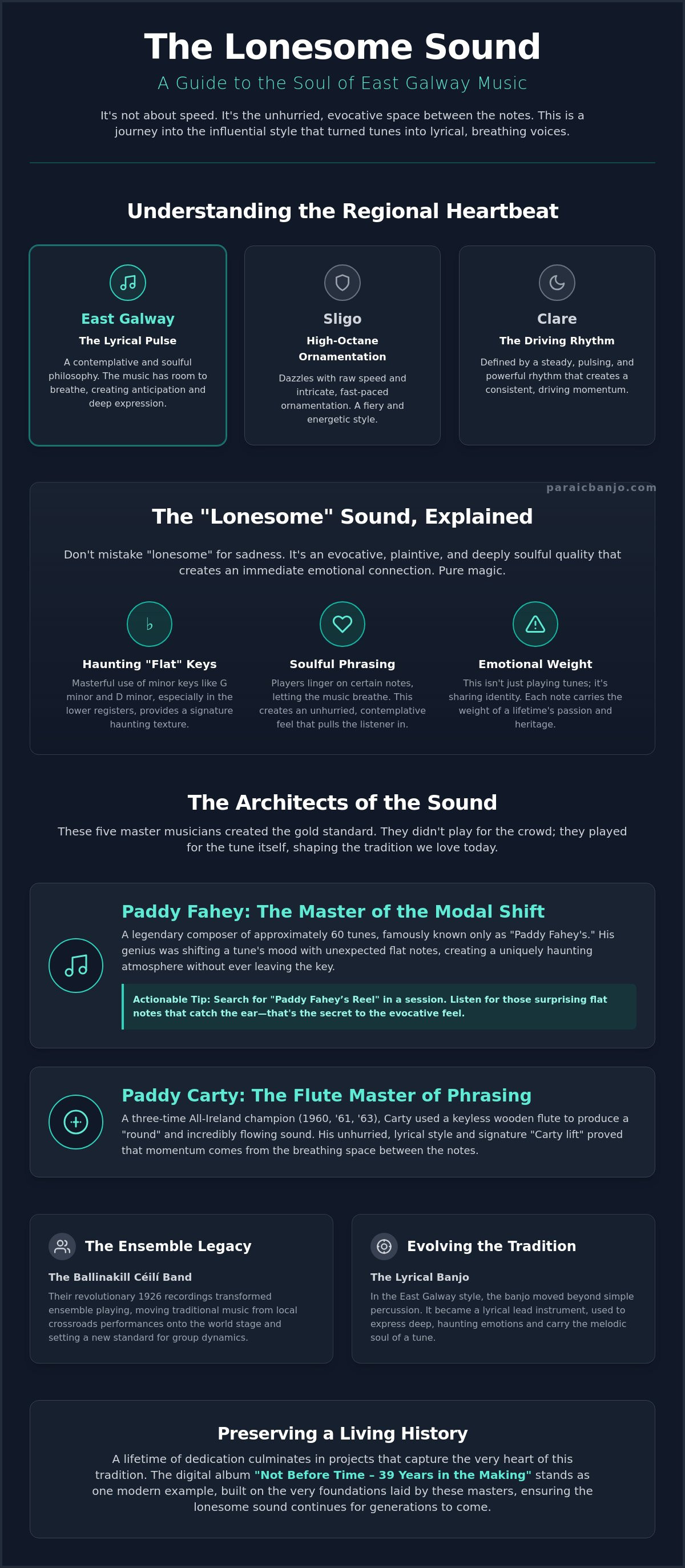
The East Galway style isn't about how many notes you can cram into a bar. It's a melodic philosophy that puts soul and expression far ahead of raw speed. While the Sligo style might dazzle you with high-octane ornamentation and Clare music pulses with a steady, driving rhythm, the influential east galway musicians of the past century chose a different path. They focused on what I call the "Lyrical Pulse." It's an unhurried, contemplative way of playing where the music has room to breathe. You feel it in the way a player lingers just a fraction longer on a specific note, creating a sense of anticipation that keeps you leaned in. These influential east galway musicians didn't just play tunes; they shared a piece of their identity with every stroke of the bow or pluck of the string.
The Regional Heartbeat: Galway, Clare, and Tipperary
Musical styles don't stop at a signpost on the road. The borders between counties are fluid, creating a beautiful blend where East Galway meets its neighbors. You can hear this overlap clearly in the East Galway vs Clare music traditions, where the lift of one region softens into the melodic flow of the other. This "crossroads" area, stretching into North Tipperary, is where some of our most distinctive tunes were born. Actionable Tip: To really grasp this, spend an evening listening to fiddle recordings from all three counties. Pay attention to the "swing" of the bow; you'll hear the pulse shift from the driving beat of Clare to the more relaxed, rolling style of Galway.
The "Lonesome" Sound Explained
If you've heard people describe this music as "lonesome," don't mistake that for sadness. In a musical context, lonesome means evocative, plaintive, and deeply soulful. It's a sound that reaches into your chest and stays there. Pure magic. Much of this feeling comes from the masterful use of minor keys, particularly G minor and D minor, often emphasized in the lower registers of the instrument. These "flat" keys provide a haunting texture that is a hallmark of the tradition. A central figure in developing this atmospheric sound was Paddy Fahey, whose compositions are legendary for their intricate, moody melodies. The lonesome sound creates an immediate emotional connection by speaking directly to the listener's heart through its haunting and unhurried beauty. If you want to experience this pulse for yourself, you can find these soulful tracks on my digital album, Not Before Time – 39 Years in the Making. It's a collection built on these very foundations.
The Architects of the Sound: 5 Must-Know Figures
To truly understand the "lonesome" pulse, you have to study the architects who built it. These influential east galway musicians created a gold standard that purists and collectors still chase in 2026. It isn't just about the notes on the page. It's about the weight of a lifetime's passion poured into the instrument. These figures represent the definitive statement of what our tradition can be, balancing technical skill with a warm, inviting spirit. They didn't play for the crowd; they played for the tune itself.
Paddy Fahey: The Master of the Modal Shift
Paddy Fahey is the absolute master of the modal shift. He composed approximately 60 tunes that are now central to the Irish canon, yet he never gave any of them a name. Instead, they are simply known as "Paddy Fahey's." His genius lay in his ability to shift the mood of a tune using unexpected flat notes. This creates a haunting atmosphere without ever leaving the key. Actionable Tip: Search for "Paddy Fahey’s Reel" in your session books. When you play it, listen for those surprising flat notes that catch the ear. They are the secret to that evocative, plaintive feel.
Paddy Carty: The Flute Master of Phrasing
Then there is Paddy Carty, a legendary figure who won three All-Ireland senior flute championships in 1960, 1961, and 1963. Carty used a wooden, keyless flute to produce a "round" and incredibly flowing sound. His phrasing was unhurried and lyrical, a style that directly influenced how I approach the rhythmic lift on the tenor banjo. The "Carty lift" remains a cornerstone of the East Galway rhythmic foundation, proving that you don't need breakneck speed to create momentum. It's about the breathing space between the notes.
To round out your listening, you must explore the work of fiddle players Lucy Farr and Paddy Kelly, along with the compositions of flute player Vincent Broderick. Their collective legacy provides the heartbeat of the region. I've spent nearly four decades absorbing these specific influences to create something that honors their spirit. You can hear this lineage in every track of my debut album, Not Before Time – 39 Years in the Making. It's more than just a recording; it's a living piece of this storied history. If you're looking for an authentic starting point for your own collection, exploring these individual digital tracks is a wonderful way to hear how these influential east galway musicians continue to shape the music today. Pure magic.
The Ballinakill Céilí Band and the Ensemble Legacy
In 1926, a group of players came together who would change the face of our music forever. The Ballinakill Céilí Band were among the first influential east galway musicians to step into a recording studio that same year, and the sound they captured wasn't just a local curiosity. It was a revolution. They took the music from the dusty crossroads of rural Ireland and placed it firmly on the global stage, proving that our traditional tunes had a power that could travel across oceans. Their style, often called the "Old Kill" style, was unhurried, rhythmic, and incredibly tight. It wasn't about showing off. It was about the collective heartbeat of the group.
This legacy of ensemble playing is something I've carried with me through every year of my career. When you listen to a high-quality traditional irish session music cd today, you are hearing the echoes of that 1926 foundation. They established the idea that a group of instruments could move as one single, breathing entity. It's a definitive statement of what happens when players value the tune over their own ego. Pure magic.
Lucy Farr and the "Old Kill" Fiddle Style
One of the most vital figures in preserving this specific heritage was Lucy Farr. She was a key member of that early movement and a master of the gentle, rhythmic fiddle style that defines the region. Lucy always emphasized "playing for the dancer," even when the tempo was slow. She understood that rhythm isn't about speed; it's about the "lift" or the internal bounce of the music. Actionable Tip: Put on a Lucy Farr recording and try tapping your foot along. You'll quickly notice that even at a relaxed pace, the pulse is incredibly strong. Practicing this will help you find the hidden power in slower tunes without feeling the need to rush.
The Ensemble Sound: Why Less is More
The Ballinakill legacy taught us the concept of the "synchronized ensemble." In this style, instruments like the fiddle, flute, and banjo blend together rather than competing for space. It's the opposite of the modern "race" session where everyone tries to play faster than the person next to them. This communal sound is about listening as much as playing. It's a conversation. I've spent 39 years honing this approach, and you can hear that collaborative spirit in the way the tracks are layered on my debut album, Not Before Time – 39 Years in the Making. If you want to really understand the tradition, seek out recordings where the instruments have room to breathe together. You can grab the digital album or individual tracks here to hear exactly how that synchronized pulse sounds when it's given the respect it deserves. It's a journey worth taking, I promise you.
The Lyrical Banjo: Evolving the East Galway Tradition
Many people think the banjo is just a percussive engine meant to drive a session with volume. That's a mistake. While it certainly has the power to cut through a noisy pub, the most influential east galway musicians saw something deeper in those four strings. They realized the banjo could be a lead voice, capable of carrying the same "lonesome" weight as a fiddle or a flute. This shift required a complete rethink of how we approach the instrument. It wasn't about how many notes you could hit in a second, but how you made each one count. By slowing down and focusing on the melody's internal rhythm, these pioneers proved the banjo could be just as evocative and plaintive as any other instrument in the tradition.
This evolution is built on what we call the lyrical pulse of East Galway. It’s a way of playing that mimics the human voice or the smooth draw of a fiddle bow. Instead of a constant, machine-gun fire of notes, the music ebbs and flows. You learn to lean into the "flat" keys and allow the natural resonance of the banjo to fill the room. I've spent nearly 40 years studying how influential east galway musicians like Paddy Carty influenced the banjo's phrasing, even though he was a flute player. It's about capturing that same "round" sound and unhurried lift. Pure magic.
Technical Tips for a Lyrical Sound
To get that soulful feel, you have to treat your ornamentation differently. Think of triplets (three quick notes played in the space of two) and rolls (a melodic turn that adds texture) as accents rather than just noise. They should highlight the melody, not bury it. Your pick control is everything here. I always advise hitting the strings with a "soft" but firm touch. You want to avoid that harsh, metallic "clack" and instead aim for a warm, woody tone that mimics a fiddle bow's grip on a string. Actionable Tip: Pick a simple jig like "The Geese in the Bog." Try playing it at exactly half your usual speed. Focus on making every note ring clearly and soulfully. You'll be amazed at the melody you find when you stop rushing.
Choosing the Right Instrument and Setup
If you want to play in this style, the tenor banjo is your best friend. We use the 4-string version, usually tuned GDAE (one octave below a fiddle), because it allows us to play traditional melodies with the correct fingering. Your setup also plays a massive role in your sound. A heavier string gauge and a thicker pick can help you achieve that signature "warmth" and sustain. It takes the "edge" off the instrument and lets the lonesome quality shine through. Ready to hear this lyrical style in action? Listen to the tracks from Not Before Time here to hear how these techniques bring the East Galway tradition to life. It's a sound that’s been 39 years in the making, and I can't wait for you to hear it. Cheers!
Preserving the Heritage: Why "Not Before Time" Matters
This album is more than just a debut; it's a living piece of history captured in sound. When you've spent nearly four decades listening to the breath between the notes of influential east galway musicians, you realize the music isn't just a set of tunes. It's a lineage. The title, Not Before Time – 39 Years in the Making, reflects a lifetime of absorbing that specific lonesome pulse until it became part of my own hands. I wanted to create something that wasn't just a digital file but a definitive statement of a passion that has defined my career. If you want to buy traditional irish music that carries this weight, you have to look for projects that honor the source. Pure magic.
These 18 tracks serve as a curated journey through the East Galway and Clare traditions, blending the unhurried lift of the "Old Kill" style with the driving heart of the West. It's about honesty. I've brought together a wide array of featured performers to ensure the sound is communal, reflecting the ensemble legacy we discussed earlier. It's a celebration of where we've been and a relief to finally share it with you. You can grab the physical CD or digital album here to start your own journey into this storied tradition.
What to Expect from the Album
You won't find any over-polished studio tricks here. I wanted the raw, live energy of a real session to shine through every track. The recordings are vibrant and sensory, capturing the tactile click of the banjo and the warm resonance of the flute. One of the most important parts of this project is the extensive supplementary material. I've included detailed liner notes that provide the "stories" behind the tunes, identifying the influential east galway musicians who passed them down. Liner notes are the backbone of regional history, keeping the names and spirits of the old masters alive for the next generation of players.
How to Build Your Own Authentic Collection
If you're serious about understanding this heritage, I always encourage buying physical CDs. The audio quality is superior, and the historical context provided in the packaging is invaluable for any collector. It gives you a roadmap for your own musical education. Actionable Tip: When you buy an album, check the credits for "source" names. If an artist tells you exactly who they learned a tune from, you've found a goldmine of authenticity. Follow those names back through the archives to see how the pulse has evolved over time.
Supporting independent Irish music releases is the only way to keep this specific regional heartbeat alive in 2026. It ensures that the "lonesome" sound continues to thrive outside of commercial playlists. By choosing to order your copy of Not Before Time – 39 Years in the Making today, you aren't just buying an album; you're becoming a collaborator in the preservation of a beautiful, ancient craft. I'm so glad to have you on this journey with me. Cheers!
Carry the Lonesome Pulse Forward
The East Galway tradition isn't a museum piece; it's a living, breathing conversation that you can participate in right now. We've explored how influential east galway musicians like Paddy Fahey and Paddy Carty turned the "lonesome" sound into a melodic philosophy that values soul over speed. You now have the tools to identify those haunting modal shifts and the synchronized heartbeat of the "Old Kill" ensemble style. Remember to keep your own playing unhurried and let the tunes breathe. It's the secret to finding the music's true emotional core. This unhurried approach is what keeps our tradition vibrant and deeply personal.
To truly immerse yourself in this heritage, get the album "Not Before Time – 39 Years in the Making" here. It features 18 tracks of pure, rhythmic Irish session music recorded live with expert collaborators. I've also included detailed historical liner notes so you can learn the stories behind every tune. This project is a definitive statement of my own 39 year journey, and I'd be honored to have you listen. It's a relief to finally share these sounds with a community that loves the craft as much as I do. Keep the music alive and enjoy every note. Pure magic.
Frequently Asked Questions
Who are some famous Galway musicians?
Paddy Fahey, Paddy Carty, and Lucy Farr are among the most celebrated names in the tradition. You will also hear the names Joe Cooley and Joe Burke spoken with great reverence in any session. These influential east galway musicians didn't just play tunes; they created a legacy of unhurried, soulful expression that still defines the region today. Their work serves as the gold standard for anyone looking to understand the true heart of Irish music.
What is the East Galway style of Irish music?
It is a melodic philosophy that prioritizes expression and "soul" over breakneck speed. The style is famous for its relaxed tempo and lyrical flow, often utilizing "flat" or minor keys to create an evocative atmosphere. If you want to get a feel for it, try listening to the internal rhythm of a tune rather than just the melody line. This unhurried approach allows the music to breathe, making it feel deeply personal and storied.
Why is Paddy Fahey so influential?
Fahey redefined the tradition through his roughly 60 known compositions, which are famous for their haunting "modal shifts." A modal shift is a way of changing the mood or "color" of a tune without actually changing the key. His refusal to name his tunes means they are simply known as "Paddy Fahey's," which adds a layer of legendary status to his work. His music is the definitive statement of the lonesome sound.
What is the difference between East Galway and Clare music?
Clare music often pulses with a steady, driving rhythm perfect for dancing, while East Galway music tends to be more contemplative and melodic. While Clare is about the "lift" or the bounce of the beat, Galway is about the "breath" between the notes. Both styles are beautiful and share fluid borders, but the Galway pulse is noticeably more unhurried and atmospheric. It’s a sound that invites you in rather than pushing you along.
Is the tenor banjo common in traditional Galway sessions?
Absolutely, the tenor banjo has become a staple lead instrument in these sessions over the last century. While it may have started as a rhythmic background instrument, influential east galway musicians adapted it to handle complex, lyrical melodies. It is now celebrated for its ability to carry that signature "lonesome" sound with a warm, woody clarity. In the right hands, it mimics the smooth draw of a fiddle bow. Pure magic.
Where can I find authentic East Galway music recordings?
You can find historical recordings from the Ballinakill Céilí Band or seek out my debut album, Not Before Time – 39 Years in the Making. My album is a living piece of history, featuring 18 tracks that capture the raw, live energy of the tradition without any studio tricks. You can buy the digital tracks or the physical CD here to start your own authentic collection today. It’s a great way to support the lineage.
What does "lonesome" mean in Irish traditional music?
"Lonesome" describes a specific emotional quality that is evocative, plaintive, and deeply soulful. It isn't about being sad; it is about a haunting beauty that reaches into your chest and stays there. This sound is often achieved through unhurried phrasing and the masterful use of minor keys like G minor and D minor. It creates an immediate emotional connection between the player and the listener, feeling like a shared secret. Because this music resonates so deeply during life's most reflective moments, it is a frequent choice for honoring a legacy during a final farewell; for those seeking compassionate guidance through such sensitive local arrangements, feel free to check out Ashley Edwards.
How can I learn to play in the East Galway style?
Start by slowing your favorite tunes down to exactly half speed. This helps you find the "soul" of the melody and forces you to focus on phrasing rather than just finger speed. Listen obsessively to the old masters and try to mimic their "round" sound and unhurried lift. It is a journey of listening as much as playing. Focus on the space between the notes, and you will eventually feel that lyrical pulse in your own hands.


Comments