Explore Irish tenor banjo albums and their musical traditions

Flashy banjo playing doesn’t always make the most memorable album. The best Irish tenor banjo albums draw you in through the tunes: a familiar reel played with fresh lift, a lively jig, or a slower air that lets each note ring. The repertoire sets the scene, while timing, ornamentation, and the musicians around the banjo shape its character.
If you love Irish session music, you’ll know that small changes in rhythm and phrasing can make a tune feel entirely different. If you’re new to the instrument, those details offer a way into its bright, rhythmic sound. Here are recordings to explore and practical listening tips for comparing tune choices, playing styles, and arrangements. You’ll also discover how banjo, melody, and accompaniment work together, helping you choose a recording that suits your ear and hear the tradition in greater depth.
Table of Contents
1. Irish tenor banjo album recommendations
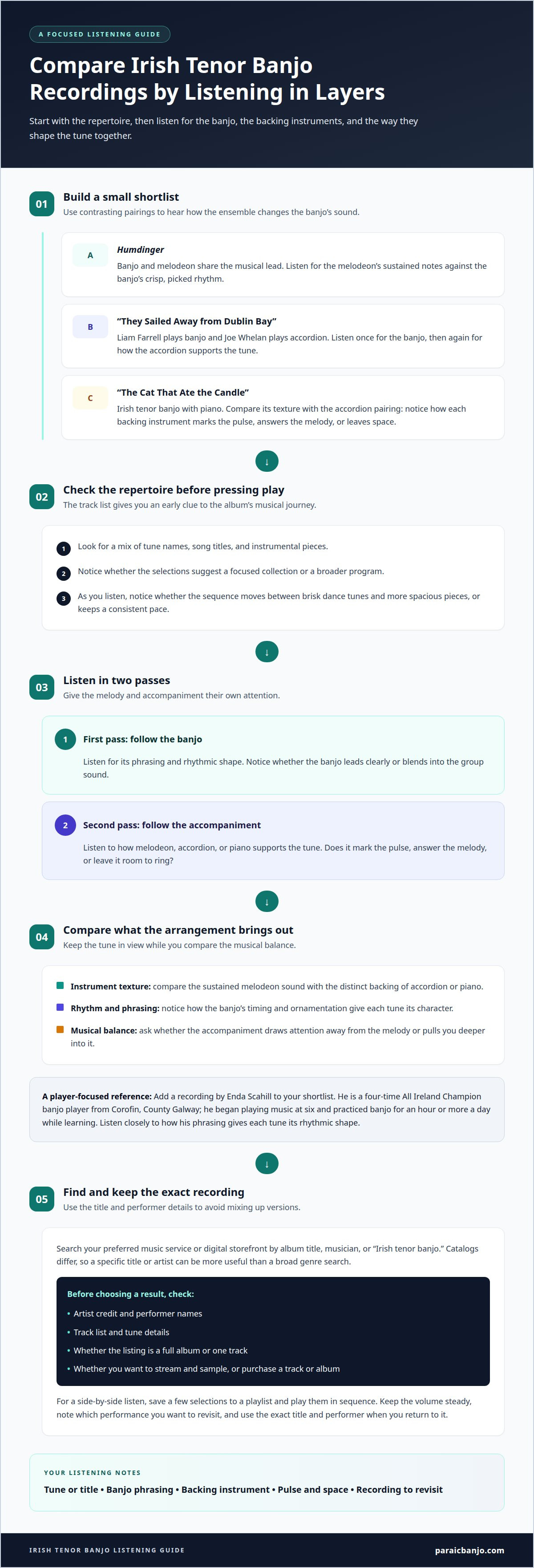
Start with Humdinger, described as the first full recording of banjo and melodeon music. Its inspiration comes from Irish melodeon and banjo recordings made in North America during the early 1900s. Choose it to hear the two instruments share the musical lead. Notice how the melodeon’s sustained notes contrast with the banjo’s crisp, picked rhythm.
For a different pairing, listen to “They Sailed Away from Dublin Bay.” Liam Farrell plays banjo, while Joe Whelan plays accordion. Listen once for the banjo, then again for the accordion’s role in supporting the tune. This comparison helps you hear how instrumental choices shape an arrangement while the music remains rooted in Irish tradition.
“The Cat That Ate the Candle” offers another arrangement to explore, pairing Irish tenor banjo with piano. Compare it with “They Sailed Away from Dublin Bay” and notice how each backing instrument shapes the performance. Piano and accordion create distinct textures around the banjo. Listen for how the accompaniment marks the pulse, answers the melody, or leaves space for it.
Recordings by Enda Scahill offer another point of reference. Scahill is a four-time All Ireland Champion banjo player from Corofin, County Galway. He began playing music at six years old and practiced banjo for an hour or more a day while learning. Listen closely to his phrasing and notice how he gives each tune its rhythmic shape.
For a varied shortlist, include Humdinger, “They Sailed Away from Dublin Bay,” and “The Cat That Ate the Candle.” Each example highlights a different instrumental combination: banjo with melodeon, accordion, or piano. As you listen, note which pairing you prefer and whether the accompaniment draws your attention away from the melody or deeper into it. Your notes can guide your next album choice.
For a player-focused listen, add a recording by Scahill to your shortlist. Compare how his banjo phrasing sits alongside the ensemble arrangements in the other examples. You might prefer a recording where the banjo leads clearly, or one where its rhythm blends into a fuller group sound. There’s no single measure of a favorite. Let the tunes, playing, and instrumental balance guide you.
Ready to explore? Add these recordings to a listening queue, then choose a tune from each to revisit. A short comparison can reveal which repertoire and arrangement style you’d happily hear again. Keep the titles that stay with you as a starting point for discovering more Irish tenor banjo music.
3. Where can I stream or buy recommended Irish tenor banjo albums in the United States?
In the United States, start with the music service or digital storefront you already use. Search its catalog by album title, musician, or the phrase “Irish tenor banjo.” Streaming services let you sample available recordings, while digital storefronts may offer albums or individual tracks for purchase. Catalogs differ, so search for a specific artist or title rather than relying only on a broad genre label.
When results appear, open the album page and review its track list and performer credits. Similar titles can refer to different recordings, and a tune may appear on several albums. Match the artist name and track details to the recording you intend to hear. If the page displays only one track, make sure you haven’t mistaken a single-song listing for a full album.
For a digital purchase, look for a clearly labelled buy or download option in the storefront. Check whether the listing is for the complete album or an individual track before proceeding. Streaming and purchasing offer different ways to listen: streaming plays music through the service, while a digital purchase is intended for your music library. Review the store description so you know which format you’re selecting.
Use this routine to keep your search focused:
Search the title or artist name in your preferred music service.
Compare the artist credit and track list with the recording you want.
Choose streaming to sample, or a purchase listing for an album or track.
Save the result to a playlist or library for easy return.
If a search returns several versions, add a tune title or musician’s name to narrow the results. Check whether the listing credits the expected performer, and compare track names before choosing. For a tune you recognize, its title can help distinguish performances. For an unfamiliar album, the artist credit and full track list offer useful clues about whether it matches your listening interests.
To compare recordings on a streaming service, save a few selections to a playlist and play them in sequence. Keep the volume steady, then note which performance you want to revisit. If you’re deciding between a full album and a single digital track, consider whether you want to explore the surrounding repertoire or focus on one particular tune.
Digital storefronts and streaming catalogs can change, so use the exact title and performer when returning to a recording. If a result doesn’t show the details you expect, refine your search instead of choosing based on a similar name alone. This habit helps you find the intended album, select the format that suits your listening, and keep your Irish traditional music library organized.
4. Comparing Irish Tenor Banjo Albums
Compare albums by asking what kind of musical journey each offers. Start with the track list, not the cover or title. Look for a mix of tune names, song titles, and instrumental pieces. Note whether the selections suggest a focused collection or a broader program. This gives you a useful sense of the repertoire before listening, without assuming every album follows the same approach.
Next, consider how the tracks are arranged across the album. The sequence might move between brisk dance tunes and more spacious pieces, or maintain a consistent pace. Notice where contrasting tracks appear and whether the order creates momentum. When you finish, ask whether the sequence felt varied, cohesive, or deliberately centered on one musical mood.
Credits can help explain why albums sound different. Check which musicians and instruments appear, and whether the same ensemble performs throughout. A stable lineup may give a collection a unified character, while changing combinations can add variety. Treat credits as context, not a verdict. What matters is whether the players’ roles and arrangements support the kind of traditional music you want to hear.
For repertoire, consider how much of the album feels familiar. Recognized tunes can make it easier to notice a player’s interpretation, while unfamiliar selections may broaden your listening. Check track titles and any accompanying notes for clues about the program’s focus. Then decide whether you want an album that deepens your connection with known melodies or introduces material you haven’t explored.
Recording quality is personal, so compare practical details rather than chasing a supposedly perfect sound. Listen at a comfortable, consistent volume. Can you follow the melody clearly? Do the instruments sound balanced, or does one dominate? Is the performance easy to hear from start to finish? These observations help you decide whether a recording suits your listening habits without making unsupported claims about how it was made.
Album notes, when available, can add context to track titles, musicians, and repertoire. Read them alongside the credits, then return to a selection that caught your attention. Ask what the notes help you notice: perhaps a tune’s background, a performer’s role, or a connection between pieces. This makes album comparisons more informative than judging a recording by sound alone.
Keep your final choice tied to your priorities. If repertoire matters most, compare track lists and album notes. If ensemble playing draws you in, pay attention to the credits and how the musicians work together. If sound quality is decisive, focus on clarity and balance during playback. A few short notes on each album’s strengths will help you choose recordings you’ll want to revisit.
4. Irish music
Irish traditional music comes alive through melody, pulse, and conversation between instruments. An album can preserve a tune’s familiar shape while revealing a player’s individual touch. Listen to the melody first, then follow the rhythmic lift beneath it. In tenor banjo recordings, notice how crisp picked notes make the tune easy to follow. The other instruments add colour, while the melody remains a useful guide for new listeners.
Humdinger offers a distinctive window into that interplay. It is described as the first full recording of banjo and melodeon music. Its inspiration came from Irish melodeon and banjo recordings made in North America during the early 1900s. That history connects the album’s sound with an earlier recording tradition. As you listen, follow how the banjo’s picked notes and the melodeon’s sustained tones meet around the tune.
Instrument pairings can change how an Irish tune feels without changing its melody. In “They Sailed Away from Dublin Bay,” Liam Farrell plays banjo and Joe Whelan plays accordion. Listen for their separate roles: one line carries the tune, while the other adds accompaniment and rhythmic support. Then replay a passage and focus on the accordion. This approach reveals the musical conversation, not just the banjo’s bright attack.
“The Cat That Ate the Candle” features Irish tenor banjo with piano accompaniment. Piano offers another arrangement to compare with banjo and melodeon or banjo and accordion. Listen to a short passage from each example. Notice how clearly the banjo melody stands out, where the accompaniment marks the pulse, and whether the instruments seem to answer one another. These details show how arrangement alone can change the feel of Irish music.
Enda Scahill offers a player-focused way to explore the tradition. He is a four-time All Ireland Champion banjo player from Corofin, County Galway. Scahill began playing music at six years old and practiced banjo for an hour or more a day while learning. Use his recordings to hear one developed approach, rather than as a measure for other musicians. Follow the tune, then listen for phrasing and rhythmic emphasis.
Try this listening sequence with Humdinger, “They Sailed Away from Dublin Bay,” and “The Cat That Ate the Candle.” First, follow the melody without shifting your attention. Next, focus on the melodeon, accordion, or piano. Finally, return to the banjo and notice how its timing fits the accompaniment. This simple approach can help you hear Irish traditional music as a shared performance, not merely a tune played over a beat.
Páraic Banjo: Not Before Time - 39 Years in the Making (Digital Album)
After exploring different Irish tenor banjo arrangements, Páraic Banjo’s Not Before Time - 39 Years in the Making offers a complete album grounded in traditional Irish session music. The digital album brings together 18 tracks recorded live with expert musicians. That makes it a useful next listen if you want to hear a full set of performances rather than sample a single tune. The album title also reflects a long-developing musical project.
The recording context shapes the listening experience. Rather than treating each track as an isolated demonstration, hear the album as musicians sharing tunes in performance. Listen for how the banjo sits within the ensemble and how the other players support the melody. The recording features live performances with expert musicians, while each listener can form their own view of the sound and interplay.
Try a simple listening routine with the 18 tracks. First, play the album from beginning to end without pausing. Notice which tunes hold your attention and how the energy changes across the track sequence. On a second pass, choose a track that stood out and focus on the banjo’s rhythm, phrasing, and relationship with the ensemble. You don’t need specialist vocabulary. A note such as “brisk,” “lyrical,” or “strongly rhythmic” is enough to record your impression.
The digital album suits listeners who want the full collection in a downloadable format. It also makes it easy to revisit particular performances while comparing repertoire and playing approaches. If one track catches your attention, Individual Digital Tracks let you choose individual songs. If you prefer a physical format for your collection, the album is also available as a physical CD. Choose the format that fits how you like to listen; neither is musically superior.
For a richer session-style listen, set aside time for the complete recording and keep the track list nearby. Afterward, return to a favorite passage and focus on one detail, such as the banjo’s pulse or how the ensemble moves together. This helps you hear more than the lead instrument alone. It also gives the album a place in your own comparisons of Irish tenor banjo repertoire, performance, and ensemble sound.
Not Before Time - 39 Years in the Making brings 18 live-recorded tracks together in one digital album, with expert musicians contributing to its traditional session setting. Choose the full album for a continuous listen, or explore Individual Digital Tracks if you want to focus on selected performances. For listeners who value a physical copy, the CD is another format option. To learn more, contact Páraic Banjo.
Frequently Asked Questions
What are the best Irish tenor banjo albums for traditional Irish music?
Humdinger and Not Before Time - 39 Years in the Making are strong starting points for traditional Irish music. Choose Humdinger to hear banjo paired with melodeon; choose Páraic Mac Donnchadha’s album for a broader session-music listen. To decide what suits you, play a track from each and note which sound you’d return to. The best Irish tenor banjo albums for you depend on the arrangements and tunes you enjoy.
Which albums feature Irish tenor banjo prominently?
Humdinger centers on banjo and melodeon, while Not Before Time - 39 Years in the Making features Páraic Mac Donnchadha’s tenor banjo in traditional Irish session music. You can also listen for the instrument in “They Sailed Away from Dublin Bay” and “The Cat That Ate the Candle.” Check each recording’s performer credits and track details to identify the banjo’s role in the arrangement.
What are the essential Irish tenor banjo recordings by classic players?
For a player reference, start with recordings by Enda Scahill, a four-time All Ireland Champion banjo player from Corofin, County Galway. The recommendations here don’t amount to a definitive list of classic-player albums, so treat Scahill as a starting point rather than a complete historical ranking. Compare his phrasing with a session recording, and listen for how each player shapes the melody and rhythm.
Who are the best Irish tenor banjo players with notable albums?
Enda Scahill and Páraic Mac Donnchadha are two named players to explore. Scahill offers a useful reference for hearing an accomplished banjo player; Mac Donnchadha’s Not Before Time - 39 Years in the Making presents his playing in a traditional session setting. Rather than treating “best” as a fixed ranking, compare their recordings by tone, rhythmic drive, and how the banjo sits among other instruments.
What Irish tenor banjo albums are best for beginners to learn from?
Beginners can use Not Before Time - 39 Years in the Making as a focused listening companion, not a substitute for instruction. Pick one tune, listen for its pulse, then replay it while following the melody. Write down where the banjo sounds strongest and how the other instruments support it. This kind of active listening helps you recognize phrasing and ensemble roles before trying to reproduce them.
Which albums showcase solo Irish tenor banjo playing?
Not Before Time - 39 Years in the Making includes a mix of solo and ensemble tunes, so it offers a chance to hear both settings. Check the track descriptions to identify solo performances, then listen for how the banjo carries the melody without the same ensemble interplay. Compare that passage with a group track to notice what accompaniment adds, such as rhythmic support or another melodic line.
What are the best modern Irish tenor banjo albums?
For a modern release rooted in traditional Irish session music, consider Páraic Mac Donnchadha’s Not Before Time - 39 Years in the Making. It brings his tenor banjo playing together with other musicians rather than presenting the instrument in isolation throughout. To see whether its sound fits your taste, compare a track with a recording built around a different accompaniment, then decide which arrangement you’d like to hear again.
What are the most influential Irish traditional music albums featuring tenor banjo?
Humdinger is a useful point of reference because it is described as the first full recording of banjo and melodeon music. That makes it a good way to explore a particular instrumental pairing, though it doesn’t establish a ranking of influence across Irish music. Listen for how the two instruments relate, then compare that sound with banjo recordings featuring accordion or piano accompaniment.
Comments