Irish Tenor Banjo Hornpipes: How to Play with Lift and Flow

What if the secret to a lively hornpipe is playing with more control, not more speed? If your tune sounds stiff from tablature or starts racing as soon as you try to add lift, you’re not alone. Irish tenor banjo hornpipes come alive through a steady, gently swung pulse and phrases that breathe, not an exaggerated bounce or a flurry of notes.
In this guide, you’ll learn how to feel that pulse, shape a tune’s phrases, and use practical picking and fretting approaches to keep the melody flowing. We’ll explain terms like “lift” and “ornament” in plain language, then finish with a practice routine you can repeat. Start with the rhythm, let each phrase settle, and give the tune room to dance. As you work, listen to Páraic Mac Donnchadha’s traditional tenor banjo playing for an example of the instrument in context.
Table of Contents
What Makes an Irish Tenor Banjo Hornpipe Sound Different?
An Irish hornpipe is a traditional dance-tune type, usually heard in 4/4 time, with a pulse that feels measured yet buoyant. On tenor banjo, its character comes from how the melody leans and flows across the beat, not from racing through the notes. Hornpipes have a long history in Irish and British traditional music. For more background, explore this overview of the history of the hornpipe.
A hornpipe isn’t simply a tune played quickly. It’s a steady dance pulse shaped into phrases, with a lift that can vary from tune to tune and player to player. Some performances give paired notes a gently uneven, swinging quality; others keep them closer to even. Neither feel is a rule for every tune. Listen for the melody’s movement against the steady beat underneath it.
How can you hear the hornpipe pulse?
Listen for the beat beneath the notes before trying to follow every turn in the melody. Tap your foot or count quietly, keeping the pulse steady as you notice which notes seem to bounce or lean. Paired notes may feel slightly uneven, but the amount of lift depends on the tune and its performance. Listen more than once, then tap along before picking up your banjo.
Resist the urge to speed up just because the tune is lively. A measured tempo can still have plenty of lift when the notes are placed clearly and the phrases have room to breathe. If your tapping becomes uneven, pause and listen again until you can pick out the pulse.
What do the tune’s written notes tell you?
Notation and tablature are useful maps, but they can’t show every detail of traditional style. Tablature, often shortened to “tab,” shows which strings and frets to play. Written music shows pitches and timing. A beat is the regular pulse you tap along to; a bar groups beats into a repeating unit; a phrase is a musical thought that often feels like a small beginning and ending.
Use the page to learn the notes, then compare it with a recording to hear how the rhythm and phrases move. The written pattern may look even, while a player gives certain pairs a light lift. For irish tenor banjo hornpipes, let both sources help: the page can guide your fingers, while listening helps you catch the tune’s feel. Read a phrase, hear it, then try playing it without losing the pulse.
How to Shape Hornpipe Rhythm and Phrasing on Tenor Banjo
Start with the pulse you’ve been listening for, then bring in the banjo without changing its steadiness. Play the melody plainly before adding ornaments or pushing the tempo. You don’t need to make every note equally strong. Keep the underlying beat dependable while the tune’s phrases rise and settle.
How should you approach picking and fretting?
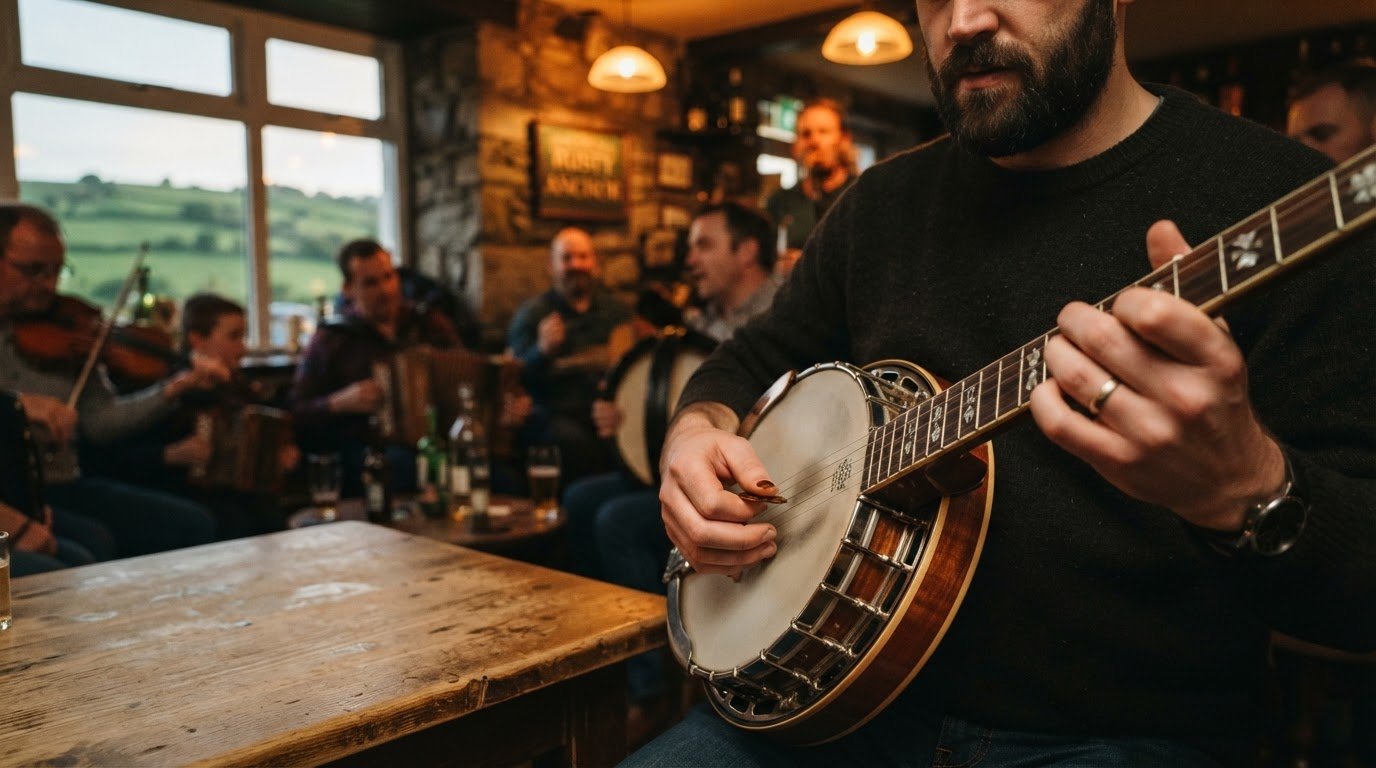
Keep the picking hand relaxed and the strokes consistent. A down-up pattern means alternating a downward pick stroke with an upward one. This can help your hand move evenly through the melody. Keep the fretting hand close to the strings, lifting and placing your fingers cleanly so notes don’t blur together. Tension makes control harder, so pause and loosen your hands if your wrist or grip tightens.
Try this with a short run from your tune: pick it slowly with an even down-up motion, then repeat it while keeping the beat steady. Listen for a clear start and end to each note. Add the next phrase only when the run feels comfortable and controlled, not merely fast.
How do ornamentation and dynamics fit in?
Ornaments are brief flourishes added around melody notes. They can bring sparkle, but they’re optional details, not a fix for shaky timing. First play the basic melody clearly. Then try one small ornament where it feels natural, checking that the pulse stays firm and the tune remains easy to recognize.
Shape the phrases, too. A phrase is a short musical thought; give it direction by noticing where it gathers energy and where it relaxes. A slight change in emphasis can help a phrase breathe without turning every note into an accent. Irish music also carries history and cultural meaning beyond technique, a connection reflected in the study of music and identity at NYU's Irish Studies Program.
Pulse gives the tune its footing, clear articulation lets each note speak, and phrasing gives the melody its shape. Together, they create lift without forcing a bounce onto every bar. Keep the time steady, connect the notes cleanly, and let the melody lead.
For a listening reference, explore Páraic Mac Donnchadha’s traditional tenor banjo playing on his debut album, Not Before Time - 39 Years in the Making. Listen for how the notes and phrases move together, without assuming every track is a hornpipe.
Hornpipe vs Reel and Jig: Hear the Difference Before You Play
These tune types can share a lively dance feel, so a label alone won’t tell you exactly how a performance moves. Listen for the pulse and how the notes group together. Hornpipes and reels are commonly counted in four, while jigs are commonly felt in groups of three. Individual musicians shape each tune in their own way, so treat these patterns as listening guides, not strict rules.
HornpipeFeel: Measured, often with a buoyant lift.Count: Four beats to a bar.Listening cue: Notice how paired notes may have a gently uneven feel.
ReelFeel: Flowing and driving, often with a more even stream of notes.Count: Four beats to a bar.Listening cue: Follow the forward momentum through each bar.
JigFeel: A lilting, three-part grouping.Count: “One-and-a, two-and-a.”Listening cue: Tap the three smaller pulses within each main beat.
What should you listen for in a hornpipe and a reel?
Both hornpipes and reels commonly have four beats to a bar, so focus on the character of the movement rather than the count alone. A hornpipe may feel more buoyant, with notes that seem to lean into one another. A reel often has a more continuous, driving flow. These are useful contrasts, not fixed formulas. Players vary their phrasing, and some performances blur the distinction.
Choose a recording of each at a comfortable tempo. First tap the main beat, then listen to how the notes sit around it. Does the melody feel gently lifted, or does it stream forward? Try this before playing either tune. It gives your picking a rhythmic reference instead of leaving you to follow the written notes alone.
How does a jig’s pulse differ?
A jig’s familiar “one-and-a, two-and-a” count groups notes in threes. Tap the main counts, then say the smaller syllables evenly beneath them. Compare that with counting “one, two, three, four” through a hornpipe. The jig’s three-part lilt should become easier to recognize, even before you pick up the banjo.
To compare tune families, listen to a jig and a reel alongside a hornpipe. In irish tenor banjo hornpipes, let the beat and phrasing tell you how the tune moves rather than assuming every tune with the same label should sound identical.

How to Practise an Irish Hornpipe on Banjo Step by Step
A tune is easier to learn when you take it in stages. Don’t start by pushing through the whole melody at speed. First get familiar with how it moves, then work in short sections until the notes and pulse sit comfortably together. This approach helps keep irish tenor banjo hornpipes lively without letting the rhythm run away from you.
How should you start learning a new hornpipe?
Choose a tune that feels manageable, and listen to it several times before you play. Notice the main pulse and where the melody seems to pause, turn, or gather energy. Then use tablature or notation to find the notes. Think of the page as a map for your fingers, not a complete guide to the tune’s rhythm or phrasing.
Learn one short phrase at a comfortable pace. Keep your picking relaxed and each note clear. Repeat the phrase until you can play it steadily without tensing up, then learn the next phrase and join the two. If the timing slips, stop and return to the recording or tap the pulse before trying again.
How can you build confidence without rushing?
Use this simple sequence:
Listen to the tune and get a feel for its pulse.
Count or tap along before playing.
Learn one short phrase from the notation or tablature.
Repeat it until the notes and pulse feel settled.
Join it to the next phrase, then work through the tune in sections.
Build tempo gradually, only when you can keep the phrase clear and steady.
Listen, count, learn a phrase, repeat it, join the phrases, then raise the tempo only when the tune stays settled. Keep practice focused on one small section at a time. A recording can help you check whether you’re keeping the pulse and shaping the phrase, rather than merely getting through the notes.
Try recording a short practice attempt and listening back. Are the notes clear? Does the beat stay steady? Can you hear the phrase move naturally, or does it sound rushed? If something feels unsettled, slow down and work on that spot before continuing. A steady, musical performance says more than speed for its own sake.
For another traditional playing reference, listen to Páraic Mac Donnchadha’s recorded tenor banjo playing on his debut album, Not Before Time - 39 Years in the Making. The album brings together 18 tracks recorded live with expert musicians. Enjoy it as a listening reference for traditional session music, not as a claim that it features a particular hornpipe.
Bring the Hornpipe to Life: Listen, Practise, and Keep the Tune Moving
Style grows through two habits working together: patient practice and attentive listening. Playing helps the notes settle under your fingers; recordings let you hear how a melody moves in the hands of experienced musicians. Return to the same tune more than once. Each listen can reveal a detail your fingers weren’t ready to notice before.
What can attentive listening teach a banjo player?
Try two focused listens. First, follow the melody from beginning to end. On the next pass, listen for how the player places notes around the pulse, shapes the end of each phrase, and makes notes speak clearly. Then widen your attention to the ensemble. Notice how the instruments fit together and support the tune’s flow. You don’t need to copy every detail; listening helps you develop an ear for musical choices.
Páraic Mac Donnchadha’s debut album, Not Before Time - 39 Years in the Making, lets you hear his traditional tenor banjo playing in context. It brings together 18 tracks recorded live with expert musicians. Let the music spark curiosity, then bring what you hear back to your own practice.
Where can you continue exploring Irish tenor banjo music?
Keep following the parts of the music that interest you. The album’s detailed liner notes offer background on the musical traditions of East Galway and Clare, giving you more context as you listen. Try reading a note about the music, then return to the recording and listen for how the ensemble supports the tune.
Give a phrase time to settle, listen again, and enjoy the small signs of progress: a steadier pulse, a cleaner run, or a more natural phrase ending. That’s how irish tenor banjo hornpipes begin to feel less like a string of notes and more like music in motion. When you’re ready for another listening session, explore Páraic’s debut album, available as a digital album or physical CD.
Keep the Pulse and Let the Tune Breathe
A convincing hornpipe doesn’t depend on speed. It comes from a steady pulse, clear notes, and phrases that move with lift and flow. Listen for how a hornpipe differs from a reel or jig, then learn a short phrase at a comfortable pace. Join the phrases and build tempo only when the tune stays settled.
Keep listening as you practise. Each time, notice something new: the shape of a phrase, the way notes are articulated, or how musicians respond to one another. Páraic Mac Donnchadha is an Irish tenor banjo player whose rhythmic and soulful style is heard on his debut album, Not Before Time - 39 Years in the Making. The album brings together 18 tracks recorded live with expert musicians, offering a rich example of traditional session music.
Ready for another listen? Explore Páraic’s traditional tenor banjo album, available as a digital download or physical CD. You can also choose individual digital tracks. Bring what you hear back to your own practice, keep the time steady, and enjoy the tune finding its feet.
Frequently Asked Questions
What is an Irish hornpipe?
An Irish hornpipe is a traditional dance-tune type, commonly written in 4/4 time. The name describes a tune family, not one fixed way of playing: the feel and phrasing can vary between tunes and musicians. Its lift often gives the melody a buoyant character. Hornpipes also have a broader history in Irish and British music, beyond their role as dance tunes.
How do you play a hornpipe on tenor banjo?
On tenor banjo, the instrument usually carries the melody rather than a chord accompaniment. Learn where the melody falls on the strings, then use clear pick strokes and neat fretting so each note speaks. A down-up picking motion means alternating strokes toward and away from the floor. In irish tenor banjo hornpipes, that motion can help your hand stay consistent while you bring out the tune’s character.
How can you tell a hornpipe from a reel?
Both are commonly in 4/4, so the time signature alone won’t distinguish them. A hornpipe often has a buoyant, measured quality, while a reel is usually heard as more flowing and driving. Listen for how the notes are grouped and accented, rather than expecting every player to follow one pattern. Tune names offer a clue, but the performance itself is the best guide.
Is a hornpipe supposed to be played with a swing?
Not always in the same way. Some performances give paired notes a gently uneven quality; others keep them closer to even. That variation is part of the music, so avoid imposing a strong swing on every hornpipe. Listen to the particular tune and let its phrasing guide your interpretation. A buoyant feel can come from the shape and emphasis of the melody, not only from uneven notes.
What tuning is commonly used for Irish tenor banjo?
GDAE is the standard tuning for Irish tenor banjo, from the lowest string to the highest. It’s one octave below fiddle tuning, which means a banjo player can use the same note fingerings as a fiddle player. This shared layout can be handy when learning a melody from a fiddle player or a source written for fiddle, even though the banjo sounds in a lower register.
Can beginners learn Irish hornpipes on tenor banjo?
Yes. Beginners can start with a tune whose melody feels manageable and use tablature to identify strings and frets. Listening alongside the written notes helps connect the finger positions to the sound and phrasing. You don’t need elaborate ornaments to make a tune recognizable. First get familiar with its melody and character; added flourishes can come later as your playing develops.
How can I practise a hornpipe without playing too fast?
Use a metronome or a recording at a comfortable pace as a speed reference. If you record yourself, listen back without playing and notice whether the tempo creeps up, especially in runs that feel easy under the fingers. Mark those spots in your notes and give them extra attention next time. Judge progress by how consistently you can keep the chosen pace, not by how quickly you can raise it.

Comments