10 Essential Irish Albums for Beginners: Your Roadmap to Traditional Music

Ever feel like the "Celtic" music you find online sounds more like a movie soundtrack than the heartbeat of a real Irish pub? Finding the right path into traditional music can be a bit of a maze, especially when you're searching for essential irish albums for beginners without getting stuck in a loop of commercial fluff. You want the grit of the fiddle, the lift of the flute, and that steady, driving rhythm that makes a session come alive.
I understand the confusion of sorting through regional styles or technical terms like reels and jigs. It's a deep well, and you deserve a guide who has spent decades in the middle of it. Start your journey by listening for the "lift," that infectious energy that makes you want to tap your foot; it's the surest sign of an authentic recording. This article provides a curated roadmap to the foundational recordings every collector needs. We'll explore the legendary groups that defined the sound and bridge the gap to modern milestones like my own debut, Not Before Time - 39 Years in the Making. You'll finish with a clear plan to build a music library that captures the true, soulful pulse of the tradition.
Table of Contents
The Beginner’s Dilemma: How to Find Authentic Irish Music
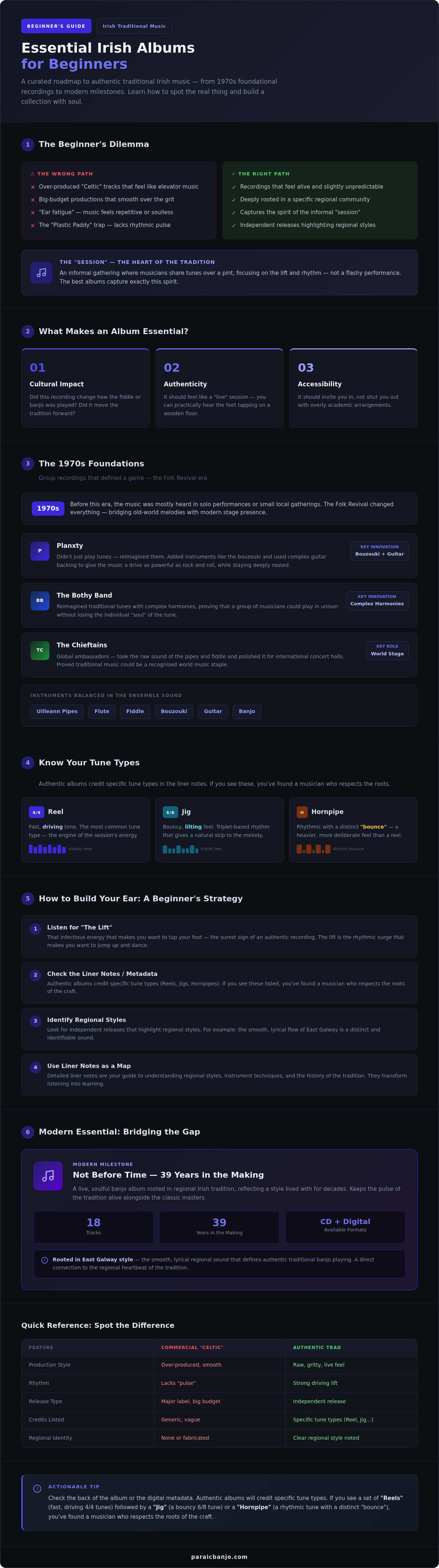
Finding the real thing is harder than it looks. You might stumble upon over-produced "Celtic" tracks that feel more like elevator music than the raw, rhythmic pulse of a Galway pub. To truly understand Irish traditional music, or "Trad" as we call it, you have to look past the commercial gloss. Starting with the wrong records often leads to "ear fatigue," where the music feels repetitive or soulless because it lacks the subtle nuances of the living tradition. The tradition is a conversation between generations, and the right albums act as your first introduction to that storied dialogue.
The true heartbeat of this music isn't found in a stadium; it's in the "session." This is an informal gathering where musicians share tunes over a pint, focusing on the lift and the rhythm rather than a flashy performance. When you're searching for essential irish albums for beginners, you want recordings that capture this spirit. They should feel alive, slightly unpredictable, and deeply rooted in a specific community.
What Makes an Album Essential?
An essential recording does more than just play notes; it captures a moment in history. When I look for essential irish albums for beginners, I prioritize three things. First is cultural impact. Did this recording change how the fiddle or banjo was played? Second is authenticity. It should feel like a "live" session, where you can practically hear the feet tapping on a wooden floor. Finally, it needs to be accessible. It should invite you in, not shut you out with overly academic arrangements. If you're ready to hear the difference, you can explore individual digital tracks from my latest collection to see how regional styles come to life.
Avoiding the "Plastic Paddy" Trap
Avoid the "Plastic Paddy" trap. This term refers to over-produced folk music that lacks the "pulse," the specific rhythmic drive that defines the tradition. Big-budget productions often smooth over the edges, but the real magic is in the grit. Look for independent releases that highlight regional styles, like the smooth, lyrical flow of East Galway. This is exactly why I spent so long on Not Before Time - 39 Years in the Making; I wanted to ensure the 18 tracks reflected that live, soulful banjo style I've lived with for decades. Whether you pick up the physical CD or the digital album, you're getting a direct connection to that regional heartbeat.
Actionable Tip: Check the back of the album or the digital metadata. Authentic albums will credit specific tune types. If you see a set of "Reels" (fast, driving 4/4 tunes) followed by a "Jig" (a bouncy 6/8 tune) or a "Hornpipe" (a rhythmic tune with a distinct "bounce"), you've found a musician who respects the roots of the craft.
The Foundations: 1970s Group Recordings that Defined a Genre
The 1970s changed everything for Irish music. Before this era, the music was mostly heard in solo performances or small, local gatherings. Then came a surge of creative energy often called the Folk Revival. This decade is where you find the most essential irish albums for beginners because it bridged the gap between old-world melodies and modern stage presence. Groups like Planxty and The Bothy Band didn't just play tunes; they reimagined them. They added instruments like the bouzouki and used complex guitar backing to give the music a drive that felt as powerful as rock and roll while staying deeply rooted in the soil.
The Chieftains also stepped onto the scene during this time, acting as global ambassadors. They took the raw sound of the pipes and fiddle and polished it for international concert halls. According to The Irish Times music coverage, these 70s groups were pivotal in transforming traditional sounds into a recognized world music staple. They proved that a group of musicians could play in unison without losing the individual "soul" of the tune.
The Ensemble Sound: Why These Groups Matter
These bands mastered the art of "the lift." In the tradition, the lift is that infectious, rhythmic surge that makes you want to tap your foot or jump up to dance. These ensembles balanced multiple instruments like the uilleann pipes, flute, and fiddle, ensuring the melody stayed front and center even with complex harmonies swirling around it. It's a delicate balance that defines the high-energy sound we love today. If you want to hear how that collaborative energy sounds in a modern setting, you can explore the guest performances on Not Before Time - 39 Years in the Making, where we captured that same live, ensemble spirit in the studio.
Actionable Tip: When you're listening to a group track, try to isolate the melody instrument first, like the fiddle or flute. Then, wait for the moment the whole band joins in. That sudden surge of volume and rhythmic energy is the "lift." If it makes your heart beat a little faster, you're hearing the real thing.
Top 3 Group Albums for Your Starter Kit
If you're building a library from scratch, these three records are your blueprints. They set the standard for every group that followed.
Planxty (The Black Album): This is a masterclass in arrangement. It introduced the bouzouki, a Greek instrument that became an Irish staple, providing a percussive, ringing backing to the pipes and mandolin.
The Bothy Band - 1975: This is pure powerhouse energy. The interplay between the fiddle and the pipes here is legendary. It’s fast, tight, and incredibly rhythmic.
The Chieftains 1: This album is the blueprint for the modern ensemble, showing how different instruments can weave in and out of a tune with grace and precision.
The Soul of the Session: Essential Solo and Small Group Albums
While the high energy of a full band is infectious, solo recordings are where you truly learn the "language" of Irish music. Listening to a single instrument allows you to hear the subtle ornaments, the breath control, and the unique phrasing that a group sound sometimes masks. In a real session, every player brings their own dialect to the tune. By studying solo masters, you start to recognize the difference between a crisp, staccato triplet on a fiddle and the fluid, sliding notes of a flute. These records are the essential irish albums for beginners because they strip away the production and leave you with the pure, unadorned melody.
There is a specific magic in the "unaccompanied" track. When a master like Matt Molloy plays the flute or Tommy Peoples takes up the fiddle, they don't need a guitar or a drum to keep time. Their internal rhythm is so strong that the music feels like it has a pulse of its own. Molloy’s solo work is mandatory listening; his ability to make a simple wooden flute sound like a soaring bird is legendary. On the other hand, Tommy Peoples represents the Donegal style, which is famous for its grit, soul, and aggressive bowing. These albums teach you that the heart of the tradition isn't about how many people are playing, but how much feeling is packed into every note.
Rhythmic Mastery: The Rise of the Tenor Banjo
The tenor banjo is a curious beast in the Irish tradition. It arrived from American vaudeville stages and was quickly adopted for its sharp, percussive attack that cuts through the din of a crowded room. In a session, the banjo acts as both the engine and the melody. It provides a driving beat that keeps the dancers moving while simultaneously playing every intricate turn of the tune. This rhythmic drive is the hallmark of the East Galway and Clare styles, where the music is soulful and steady rather than just fast. My own project, Not Before Time - 39 Years in the Making, was recorded live to capture this exact energy. Whether you choose the physical CD or the digital album, you'll hear how the banjo anchors the session with a soulful, rhythmic pulse.
Essential Solo Picks
Matt Molloy - Solo: This is the gold standard for Irish flute playing. It’s a masterclass in breath work and ornamentation.
Noel Hill - The Irish Concertina: Hill took a small instrument and showed it could have the power of a full orchestra. His phrasing is impeccable.
Not Before Time - 39 Years in the Making: This debut features 18 tracks that bridge the gap between the old masters and modern clarity, focusing on the rhythmic tenor banjo style.
Actionable Tip: To build your "Trad ear," try focusing on one instrument for an entire week. Listen only to flute players, then switch to fiddle players the next week. This helps you distinguish between different regional techniques and prevents you from feeling overwhelmed by the full ensemble sound.
If you find a particular track that resonates with you, don't be afraid to dig deeper. You can buy individual digital tracks to create your own custom study list, focusing on the instruments that speak to you most. This personalized approach makes the vast world of Irish music feel a lot more like home.
How to Build Your Ear: A Beginner’s Listening Strategy
Building a "Trad ear" is a bit like learning a regional dialect. You can't just listen to the sounds; you have to understand where they come from and how they are built. When you dive into essential irish albums for beginners, don't treat them as background noise. Instead, treat them as a textbook for a living culture. The goal is to move from hearing a "fast Irish song" to recognizing a specific set of reels played with a soulful East Galway lift. It takes time, but the rewards are a much deeper connection to the music.
Decoding the Liner Notes
Liner notes are far more than just a list of names. They are essential to traditional Irish music history because they document the lineage of every tune. Each track has a story. Maybe it was learned from an old neighbor in the 1950s, or perhaps it’s a tune that has been passed down through a family for generations. Reading these stories helps you connect with the human element of the music. You start to see the performers not as solitary stars, but as links in a long, unbroken chain. I made sure to include detailed notes in both the physical and digital versions of my own album to provide this exact context.
Actionable Tip: Keep a "tune journal." Write down the titles that catch your ear and note the instrument that stood out. Over time, you'll see patterns in the types of tunes you prefer, which makes it easier to find your next favorite album.
Identifying Regional Styles
Regionality is the secret sauce of this tradition. There is a massive difference between the East Galway vs Clare music styles. Galway music often has a "lonesome" quality. It is soulful, steady, and emphasizes a deep rhythmic pulse. Clare music, by contrast, might feel a bit more driving or "lifted." To hear this, listen for the "pulse," the underlying heartbeat that dictates the pace. It isn't just about speed; it's about the soul behind the notes. This is why I recorded 18 tracks live, to ensure that regional pulse stayed front and center.
Can you tell a Reel from a Jig? A Reel is in 4/4 time; think of it as a steady "one-two-three-four" walk. A Jig is in 6/8 time, with a bouncy "tri-ple-et, tri-ple-et" feel. Practice tapping along. If your hand moves in groups of three, it’s likely a Jig. If it’s a steady march, it’s a Reel. Once you can spot the difference, the music opens up in a whole new way.
Finally, support the artists directly. Buying a physical CD or a digital album ensures that musicians can continue to document this history for the next generation. My own debut, Not Before Time - 39 Years in the Making, is a definitive statement of a lifetime's passion and a great way to start your collection. You can explore the full album and individual tracks here to hear these regional styles for yourself.
Modern Essentials: Bridging the Gap to Today’s Tradition
Tradition isn't a museum piece kept behind glass; it's a living, breathing conversation that needs new voices to stay alive. While the legendary recordings of the 1970s gave us a sturdy foundation, modern releases ensure the pulse stays steady for the next generation. When you're hunting for essential irish albums for beginners, you shouldn't only look at the black-and-white photos of the past. You need recordings that capture the raw, unpolished energy of a current session. This is best achieved through "Live in Studio" recordings, where musicians play together in the same room, reacting to each other's "lift" in real time. It prevents the music from feeling clinical and keeps that infectious, soulful grit intact.
A debut album can often represent more than just a first step. For many of us, it’s the culmination of a lifetime spent soaking up tunes in kitchens and pubs. It represents decades of musical evolution, where every reel and jig has been polished by years of play. This deep connection to the soil is what makes a recording truly "traditional" rather than just a commercial imitation.
Not Before Time: A Modern Essential
My own debut, Not Before Time - 39 Years in the Making, was designed to be a definitive statement for the tenor banjo. It bridges the gap between the old masters and today's clarity. Across 18 tracks, I’ve focused on the rhythmic, soulful style of East Galway and Clare, recording live with expert collaborators to keep the session spirit front and center. For purists and new collectors alike, finding a high-quality traditional Irish session music cd is vital. It allows you to hear how the music has evolved while staying fiercely loyal to its roots.
Where to Buy and How to Listen
In a world of streaming, there is a massive benefit to buying traditional Irish music direct from the artist. It ensures the history and the craft are supported directly, allowing the community to thrive. You can choose between the tactile experience of a Physical CD, which comes with those detailed liner notes we discussed, or the convenience of a Digital Album and individual tracks for your mobile devices. Both options provide the high-fidelity sound necessary to hear every triplet and ornament clearly.
Actionable Tip: Start your collection with a "then and now" approach. Pick up one 70s powerhouse, like Planxty, and pair it with a modern release like Not Before Time - 39 Years in the Making. Hearing them side-by-side helps you understand how the "language" of the instruments has stayed the same while the individual "accents" continue to evolve.
Your journey into Irish music is just beginning. It’s a storied tradition filled with warmth, grit, and incredible joy. Take your time with these albums, listen for the lift, and most importantly, enjoy the ride. I'll see you at the next session!
Start Your Musical Journey Today
You now have the tools to navigate the rich world of Irish music without getting lost in the commercial noise. By focusing on the "lift" in the rhythm and digging into the stories found in liner notes, you'll soon distinguish between a simple tune and a masterclass in regional style. Building a library of essential irish albums for beginners is about more than just collecting tracks; it's about connecting with a living, breathing history that spans generations.
If you're ready to add a modern cornerstone to your collection, my debut album offers a direct link to the soulful East Galway and Clare traditions. It features 18 tracks of pure, rhythmic tenor banjo recorded live with expert collaborators. You'll also get detailed liner notes that act as your map to the music's heritage. By choosing this project, you provide direct support for an independent Irish artist dedicated to preserving this craft.
Order your copy of Not Before Time - 39 Years in the Making today. Whether you choose the physical CD or the digital version, I hope these tunes bring as much joy to your home as they have to mine over the last 39 years. Keep listening, keep tapping your feet, and enjoy every bit of the discovery!
Frequently Asked Questions
What is the difference between a Reel and a Jig?
A reel is played in 4/4 time, which feels like a steady, driving walk or a march. In contrast, a jig is in 6/8 time and has a distinct, bouncy rhythm that sounds like the word "tri-ple-et." While reels are often the backbone of high-energy sessions, jigs provide a lighter, lifting feel. Tapping your foot is the best way to tell them apart; if you're counting in fours, it's a reel.
Why do some Irish albums have so much talking or background noise?
Traditional music is social by nature, and many recordings aim to capture the raw energy of a live session. Background noise, like the hum of a room or brief comments between tracks, isn't a mistake; it's a deliberate choice to show the music is alive. It helps you feel like you're sitting in a pub rather than a sterile studio. This "live" feel is a hallmark of many essential irish albums for beginners.
Is it better to buy a physical CD or a digital download for Irish music?
It depends on how you like to engage with the history. A physical CD is often preferred by collectors because it includes detailed liner notes that act as a map to the tunes and the players. Digital downloads offer immediate access and portability for your mobile devices. For my debut, I made sure both options provide high-quality audio, so you don't lose the subtle ornaments that make the music special.
Who are the most famous Irish banjo players I should know?
You should start with Barney McKenna of The Dubliners, who pioneered the tenor banjo's place in the tradition. Other masters include Kieran Hanrahan and Gerry O'Connor, who each brought their own unique speed and phrasing to the instrument. These players helped define the rhythmic drive you hear in modern recordings. Exploring their work gives you a great perspective on how the banjo evolved from a background instrument to a session leader.
What does "East Galway style" actually mean in music?
The East Galway style is known for being soulful, steady, and highly rhythmic rather than just fast. It often carries a "lonesome" quality, which is a specific type of emotional depth found in the phrasing of the melodies. This regional style emphasizes the "lift" and the pulse of the tune, making it feel rooted and grounded. It’s a style I’ve spent decades honing and it features heavily throughout the 18 tracks of my own debut.
Can I learn to play Irish music just by listening to these albums?
Listening is the most important first step because it helps you absorb the "language" and the rhythm of the tradition. While you can't learn the physical technique of an instrument just by hearing it, you can learn the phrasing and the soul of the tunes. Most masters spent years simply listening before they ever picked up a fiddle or banjo. It’s the best way to build your "Trad ear" before starting formal practice.
How many tracks are usually on a traditional Irish album?
Most traditional albums feature between 12 and 15 tracks, often grouping two or three tunes together into a single "set." This mimics how music is played in a real session to keep the energy moving. For my release, Not Before Time - 39 Years in the Making, I included 18 tracks to provide a comprehensive look at the regional styles I love. It’s a generous amount of music that ensures you get a full, diverse experience.


Comments