A Deep Dive into Irish Music History: The Rhythms That Shaped a Nation

The heart of Ireland isn't found in a dusty history book; it's found in the lift of a fiddle bow and the steady, rhythmic drive of a tenor banjo session. You might feel overwhelmed by academic jargon or tired of sorting through commercial "Celtic" playlists that feel a bit hollow. If you've ever felt lost in the noise, it's time for a deep dive into irish music history that actually speaks your language. We're moving past the dry dates and straight into the soul of the tunes that have echoed through Irish kitchens and dance halls for centuries.
It's true that regional styles can feel like a riddle, especially when you're trying to distinguish a driving Sligo reel from the lyrical, steady flow of East Galway. This guide clears the fog. You'll discover how ancient harp melodies evolved into the rhythmic pulse of modern sessions. We'll walk through the major eras of the tradition and provide practical ways to find authentic music that captures the energy of a live performance. By the time we're done, you'll have the tools to spot the real thing and a true appreciation for this storied evolution.
Table of Contents
The Ancient Roots: From Bards to the Great Silence
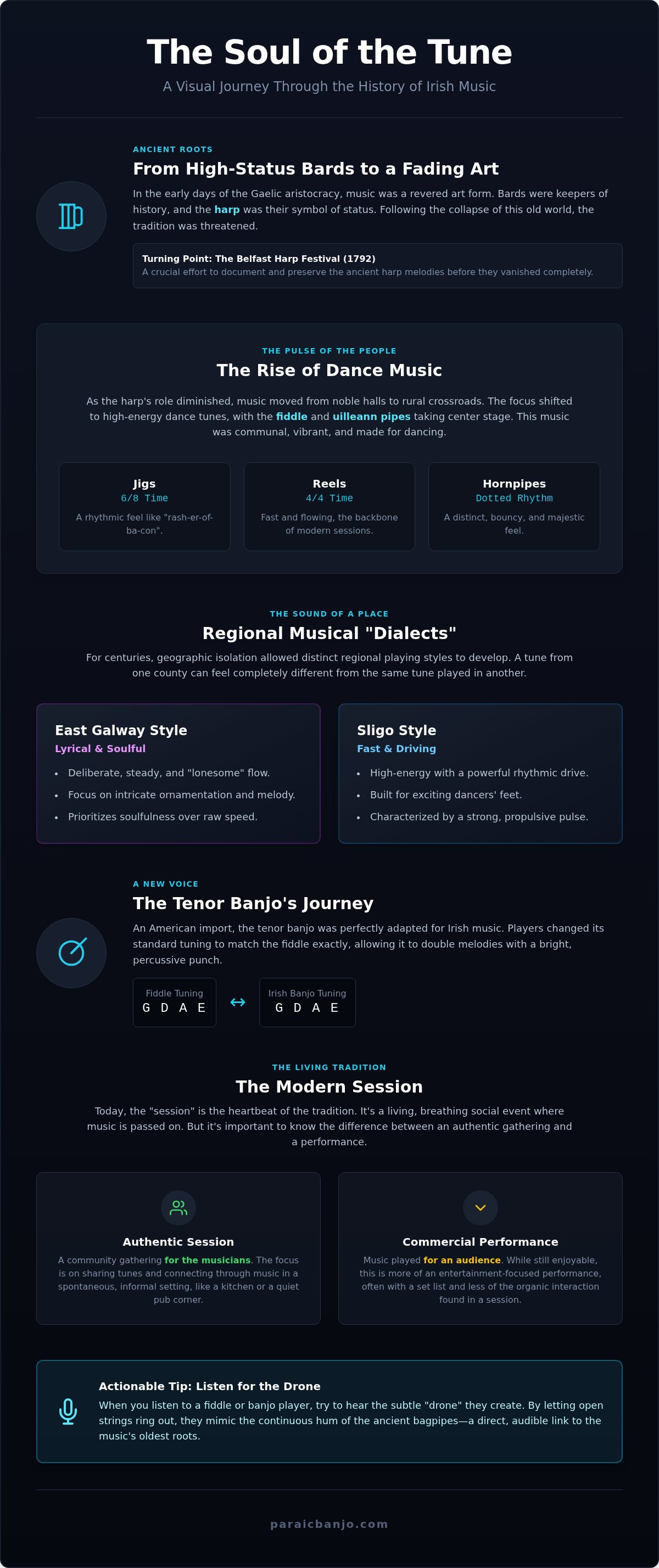
Traditional Irish music isn't a static genre frozen in time; it's a living, breathing oral tradition that changes with every player who picks up an instrument. This History of Irish Music reveals a culture where tunes weren't written down on paper but etched into memory. In the early days, the Bards held immense power. They were the keepers of history and genealogy, and the harp was their primary tool. It wasn't just entertainment; it was a status symbol of the Gaelic aristocracy. When you take a deep dive into irish music history, you see how the collapse of that old world during the 17th century forced the music to adapt or die.
The mid 19th century brought the "Great Silence," a period of profound cultural trauma following the Great Famine. Music nearly vanished in some regions as communities were decimated by hunger and emigration. Yet, the pulse remained. Even in the darkest times, the rhythmic DNA of the past survived. It's this resilience that makes the tradition so powerful today.
The Harp and the Gaelic Order
Turlough O’Carolan stands as the towering figure of this transition. He was a blind harper who blended the formal elegance of Italian Baroque music with the raw heart of Irish folk. After the Gaelic Chieftains lost their power, harpers became travelling musicians, moving from house to house to survive. By 1792, the Belfast Harp Festival attempted to preserve what was left. It was a desperate, beautiful effort to document a dying art before it slipped away forever. This festival was a turning point, ensuring that ancient melodies weren't lost to time.
The Rise of the Dance Tunes
As the 18th century progressed, the focus shifted from the contemplative melodies of the harp to the high energy of dance music. Instruments like the fiddle and the uilleann pipes took center stage. This era gave us the structures we still play in sessions today. Understanding these patterns is key when you start your deep dive into irish music history.
Jigs: Think of the phrase "rash-er-of-ba-con" to capture the 6/8 rhythm.
Reels: These are fast, 4/4 time tunes that provide the backbone of most modern sessions.
Hornpipes: These have a distinct, bouncy, dotted feel that's easy to recognize.
Crossroads dances became the heartbeat of rural life. People gathered at physical intersections to swap steps and tunes, ensuring the tradition stayed vibrant and communal. It was music for the feet as much as the ears.
Actionable Tip: Try to listen for the "drone" influence in modern tunes. Even without bagpipes present, many fiddle and banjo players use open strings to mimic that ancient, continuous hum. It's a direct, audible link to our oldest roots.
Regional Styles: The Rhythmic Pulse of the West
If you travel through the counties of the West, you'll notice the music changes just as much as the landscape. For centuries, physical isolation turned every valley and village into a unique musical laboratory. This led to distinct "dialects" of playing. While some guides on the history and origins of Irish music treat the tradition as one single sound, any session player will tell you that a reel in Sligo doesn't breathe the same way as a reel in East Galway. These regional variations are the lifeblood of the tradition, offering a rich tapestry of sound that rewards the careful listener.
Interestingly, migration played a massive role in saving these variations. When musicians moved to cities like London or New York, they clung to their home styles with a fierce pride. These urban centers became time capsules, preserving the "lonesome" or "driving" qualities that might have otherwise been smoothed over by modern influence. Taking a deep dive into irish music history means recognizing that these regional flavors are the true heart of the craft. They represent a connection to a specific place and a specific community of players.
The East Galway Style: Soulful and Steady
The East Galway style is often described as "lonesome" or "soulful." It’s a deliberate, steady approach that prioritizes melody over raw speed. You won't find players here racing to the finish line. Instead, there's a focus on intricate ornamentation and unusual keys. Legendary figures like Paddy Fahy introduced tunes that are haunting and technically demanding, requiring a deep understanding of the instrument. To really get a handle on this, you should look at What Makes the East Galway Style Unique? to see how it contrasts with neighboring traditions. This style feels like a personal conversation between the musician and the listener.
The Clare Tradition: Rhythmic and Driving
Cross the border into Clare and the energy shifts. The Clare tradition is built on "lift" and "swing." It’s music designed for the floor. The influence of the Ceili Band is huge here, where a steady, driving rhythm kept dancers moving all night long. While Galway might feel like a poem, Clare often feels like a pulse. In a modern session, these two worlds often overlap, creating a beautiful tension between the melodic depth of one and the rhythmic drive of the other. It’s a fascinating part of any deep dive into irish music history that shows how geography shapes sound.
Actionable Tip: Try the "foot-tap test." When listening to a recording, notice where the emphasis falls. In a driving Clare reel, your foot will likely hit the floor with a sharp, rhythmic bounce. In an East Galway tune, you might find yourself swaying rather than tapping, following the long, melodic lines. If you want to hear this lift in action, you can explore authentic session tracks that capture these regional nuances perfectly. It's the best way to train your ear for the subtle differences that define our musical heritage.
The Tenor Banjo Journey: From America to the Irish Hearth
The tenor banjo didn't start its life in the hills of Galway or the dance halls of Clare. It actually crossed the Atlantic in the luggage of returning emigrants and through the influence of American jazz bands in the early 20th century. While some purists once viewed it as a modern intruder, a deep dive into irish music history shows how brilliantly the instrument was reshaped to fit our old soul. The most critical technical shift was the move to GDAE tuning. By tuning the strings to G-D-A-E, players could mirror the fiddle’s range exactly, allowing them to play the same intricate reels and jigs that had been passed down for generations. It transformed the banjo from a rhythmic outsider into a melodic powerhouse.
Today, the banjo is often considered the rhythmic heartbeat of a session. It provides a crisp, percussive drive that helps keep a group of musicians "in the pocket" or perfectly in time. It’s a sound that carries the weight of history but pulses with a very modern energy.
Adapting the Banjo to the Tradition
Irish players moved away from the heavy strumming styles of American jazz and developed a sophisticated "single-note" picking technique. This means playing each note of a melody individually rather than hitting chords. You'll often hear session players debating the merits of a 17-fret versus a 19-fret tenor banjo. The 17-fret model is shorter, making those fast reaches for high notes a bit easier, while the 19-fret version offers a brighter, louder resonance that can cut through a noisy pub. Pioneers like Barney McKenna were the ones who really brought this sound into the mainstream, proving the banjo belonged alongside the pipes and the fiddle.
The Soulful Banjo: Beyond the Volume
There’s a common misconception that the banjo is simply too loud for traditional music. In reality, a master of the craft knows how to balance that natural volume with melodic sensitivity. It’s about more than just hitting the notes; it’s about the "lift" and the subtle phrasing that gives a tune its life. A soulful style uses the instrument’s percussive nature to enhance the melody, not bury it. To hear this balance in its most refined form, you can explore The Rhythmic Mastery of the Tenor Banjo. It captures that elusive session energy where the instrument feels like a definitive statement of a lifetime’s passion.
Actionable Tip: Listen for "triplets" when you're enjoying a recording or a live session. This is the signature ornament of the Irish banjo player. It’s a rapid-fire burst of three notes played in the time of two, achieved with a quick down-up-down flick of the plectrum (the pick). It adds a wonderful, crisp texture to the music that you won't hear in any other genre.
The Modern Session: A Living History
If you've followed this deep dive into irish music history from the ancient bards to the arrival of the banjo, you'll eventually find yourself at the door of a session. This is where the music truly lives. A session isn't a rehearsed concert; it's a rhythmic conversation between musicians who might have just met for the first time. It serves as a democratic, oral schoolhouse where tunes are passed from seventy year old masters to teenagers without a single sheet of music in sight. While the "pub session" is what most tourists see, the "house session" remains the tradition's private heartbeat, held in kitchens and living rooms where the focus is entirely on the tunes rather than the crowd.
The beauty of this environment is its accessibility, but it's governed by a set of cultural "unwritten rules" that keep the music flowing. It's a shared heritage that belongs to everyone, provided you respect the pulse of the room. During the Fleadh Cheoil na hÉireann 2026 in Belfast, thousands of these sessions will break out spontaneously, proving that the tradition is more vibrant now than ever before.
The Anatomy of a Great Session
In any session, there's usually a "leader" who starts the first tune. They set the tempo and decide when to transition into the next melody, creating what we call a "set." These sets are constructed to build energy, often moving through three or four reels or jigs in a row. For a player, listening is far more important than playing. You have to hear the subtle "lift" the leader is providing before you can contribute your own voice. If you're just starting your journey, What is Session Music? A Guide for Beginners offers a great roadmap for understanding these communal dynamics.
Finding Authenticity in a Digital World
It's easy to get confused by commercial "stage" music that uses traditional instruments but lacks the raw, live energy of a real gathering. Authentic session recordings are often preferred by purists because they capture the "dirt" and the drive of the moment. They aren't over-produced; they're honest. When you're looking for music that reflects a true deep dive into irish music history, look for albums that feature sets of tunes rather than isolated tracks. This reflects how the music is actually played in the wild.
Actionable Tip: If you want to sit in on a session, always listen for at least twenty minutes first. Once you've gauged the skill level and the style, wait for a break between sets and simply ask the leader, "Mind if I join you for a few?" Most musicians are incredibly welcoming to those who show respect for the etiquette of the table.
To experience this live energy for yourself, you can browse authentic session tracks that capture the definitive sound of the East Galway tradition. It’s the closest you can get to the hearth without being there in person.
Preserving the Pulse: 'Not Before Time' and the Future
Preserving a tradition requires more than just playing the notes; it takes a lifetime of listening. After decades spent at the heart of the session, Páraic Mac Donnchadha has released a definitive statement of his craft. His debut album, Not Before Time – 39 Years in the Making, isn't just a collection of songs. It's a 39-year labor of love that captures the specific, elusive energy of the East Galway and Clare styles. When you take a deep dive into irish music history, you realize that maturity is the most valuable instrument a musician can own. It takes time to understand the "lift" of a reel and the "lonesome" soul of a slow melody.
This project serves as a bridge between the legends of the past and the players of the future. It’s a vital resource for anyone looking to complete their deep dive into irish music history with authentic sounds. The extensive liner notes included with the album act as a historical record, documenting the origins of the tunes and the masters who passed them down. It’s a way to ensure the pulse of the West remains steady for the next generation.
Capturing the Live Energy of 18 Tracks
Traditional music was never meant to be sterile or isolated. That’s why Not Before Time was recorded live, featuring 18 tracks that crackle with the energy of a real session. Páraic collaborated with a circle of expert musicians to ensure the interplay between instruments felt honest and unforced. The selection includes a rich variety of reels, jigs, and hornpipes that have defined his career. If you're curious about the process of bringing these tracks to life, you can read The Story Behind the Debut Album to understand the commitment to authenticity required for such a project.
Supporting Independent Irish Music
In an age of digital streaming, the physical tradition can sometimes feel thin. Buying directly from the artist is one of the most effective ways to keep this culture thriving. The physical CD of Not Before Time is a limited-edition piece of history, offering a tactile connection to the music that a digital file can't match. It’s an investment in the craftsmanship of a seasoned master. You can Order your copy of Not Before Time and own a piece of the tradition. to help ensure these rhythms continue to shape our nation.
Actionable Tip: Use the album as a personal masterclass in the East Galway style. Pick one track and listen to it repeatedly, focusing only on the banjo’s "triplets" and phrasing. Try to hum the melody along with the recording until you can feel the specific, steady rhythm that defines the region. It’s the most practical way to deepen your own musical ear and appreciate the subtle nuances of the tradition.
Keep the Tradition Alive in Your Own Kitchen
The journey from ancient bardic harps to the driving pulse of a tenor banjo session shows that Irish music is never finished; it's always evolving. We've explored how regional dialects and the right tuning transformed a foreign instrument into a cultural heartbeat. This deep dive into irish music history is only the beginning of your own discovery. To truly understand the "lift" of a tune, you need to hear it played with the weight of experience and heart. It's about the connection between the player, the listener, and the generations that came before.
You can bring that authentic session energy home with Not Before Time – 39 Years in the Making. This project captures 39 years of musical heritage across 18 tracks recorded live to preserve that raw, honest spirit. It includes deeply researched liner notes that act as a historical guide for every set, making it a definitive statement of a lifetime's passion. Explore the Soul of the Banjo: Buy "Not Before Time" Direct from Páraic and own a piece of this storied evolution. Pick up your instrument or just turn up the volume; the next chapter of the tradition is in your hands. Happy playing!
Frequently Asked Questions
What are the three main types of Irish traditional music?
The three main pillars are instrumental dance music, Sean-nós singing, and slow airs. Dance music includes reels, jigs, and hornpipes played on various instruments. Sean-nós is a highly ornamental, unaccompanied vocal style performed in the Irish language. Slow airs often come from old songs or harp pieces, played with a focus on emotion. Understanding these categories is essential for anyone taking a deep dive into irish music history and its cultural weight.
When did the tenor banjo become popular in Irish music?
The tenor banjo became a prominent voice in Irish music during the early 20th century. It really found its feet in the 1920s and 30s when céilí bands became popular for large community dances. Returning emigrants brought instruments back from America, and players quickly realized that by tuning it to GDAE, they could match the fiddle perfectly. This allowed the banjo to become the rhythmic heartbeat of the modern session we know today.
What is the difference between a jig and a reel?
It’s all about the time signature or the pulse of the tune. A jig is usually in 6/8 time, which has a bouncy, rolling feel; think of the phrase "rash-er of ba-con." A reel is in 4/4 time and feels much faster and more driving. If you're tapping your foot, the reel is a steady "one-two-three-four," while the jig has a distinct triplet swing that keeps the dancers moving in a different way.
Why is East Galway music played slower than other styles?
East Galway music is famous for its lyrical, "lonesome" quality that favors melody over raw speed. Players in this region often use unusual keys and complex ornamentation that simply doesn't work if you're racing through the tune. It’s a deliberate, soulful style that requires a lot of patience and maturity to master. This steady pace allows the intricate beauty of the composition to shine through, making it feel like a personal conversation between musicians.
What are the unwritten rules of an Irish music session?
Respect is the foundation of any session. You should always listen to a few sets before asking to join, as this helps you gauge the skill level and style of the room. Don't start a tune unless you're invited or it's your turn in the circle. It’s also vital to keep your volume in check; you’re there to blend in, not drown out the fiddle player next to you. Sessions are communal, not solo performances.
How can I tell if an Irish music recording is authentic?
Look for live energy and tracks that are grouped into sets. Authentic recordings prioritize the natural flow of a session over polished studio perfection. A great example is an album like "Not Before Time," which features 18 tracks recorded live to capture the real pulse of the tradition. If a recording sounds too "glossy" or uses heavy synthesizers, it’s likely a commercial product rather than a true representation of the living oral tradition.
Who are some of the most influential Irish banjo players in history?
Barney McKenna is the giant who popularized the GDAE tuning, but the tradition is full of masters. Players like Kieran Hanrahan and John Carty have shaped the modern sound. Today, Páraic Mac Donnchadha continues this legacy, particularly within the East Galway tradition. His work is a definitive statement of a lifetime's passion, proving that the banjo is much more than just a loud rhythm instrument; it’s a soulful, melodic voice in the right hands.
Is traditional Irish music the same as Celtic music?
"Celtic music" is often a broad commercial label used to sell everything from New Age soundtracks to folk-rock. Traditional Irish music is a specific, living oral tradition with its own distinct structures, regional styles, and social etiquette. While there’s overlap with other nations, a deep dive into irish music history shows that the Irish tradition is uniquely defined by its specific rhythms, instruments like the uilleann pipes, and the communal nature of the pub session.


Comments