Traditional Irish Music: Beginner's Guide for 2026

Traditional Irish music isn't an artifact trapped in glass; it's an exhilarating social conversation fueled by pulse, community, and centuries of spirit. Yet, if you're getting into traditional irish music for the first time, finding your footing can feel a bit overwhelming. The tunes might all sound deceptively similar to your ears at first, and watching a circle of musicians trade lightning-fast melodies in a crowded pub can feel like an exclusive club. You might even wonder if you need to play an instrument yourself just to appreciate what's happening.
You don't. You only need curious ears and a feel for rhythm to understand the craft. This guide unpacks exactly how traditional Irish music works, how to listen actively, and where to start your journey with genuine confidence. We'll show you how to easily distinguish between jigs and reels, decode session etiquette, and explore authentic regional recordings that capture the real heartbeat of the tradition.
Table of Contents
What Is Traditional Irish Music? The Heartbeat of a Living Culture
Too many beginners assume they must immediately buy a tin whistle or fiddle just to appreciate the craft. In truth, Irish traditional music belongs as much to the engaged listener as it does to the player tapping their boot by the hearth. This isn't museum music locked behind glass or frozen in sheet notation. It's an oral, communal exchange where rhythm, swing, and lift carry far more weight than mechanical perfection. When you're getting into traditional irish music, training your ear to catch the subtle groove of a tune unlocks the entire experience.
The Living Tradition: Oral Transmission and Community
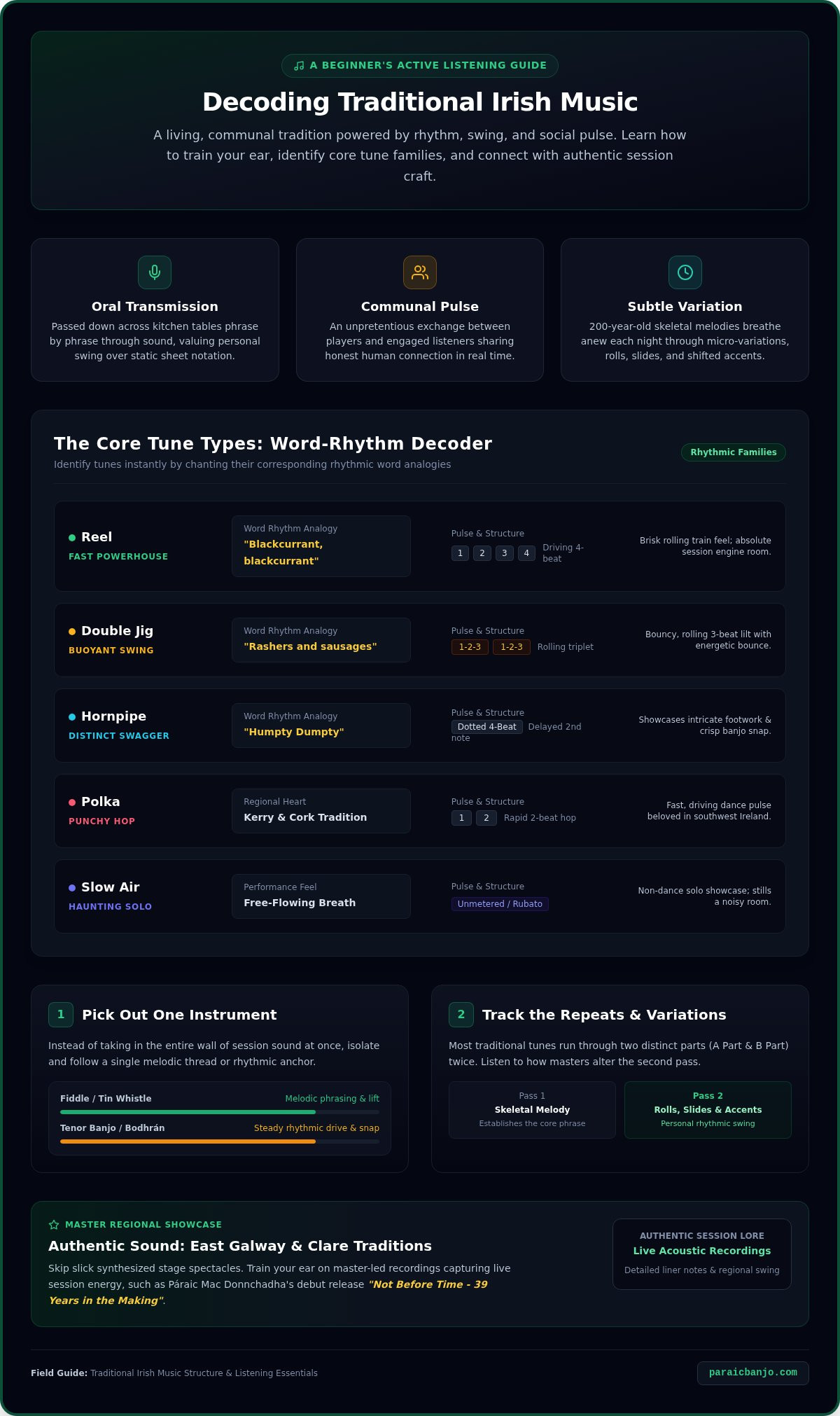
For centuries, musicians passed these melodies down across kitchen tables, learning phrase by phrase through sound rather than paper. Because players learn by ear, each musician leaves a personal stamp on every performance. A tune might keep the same skeletal melody for two hundred years, yet it breathes anew every night through tiny variations, lilts, and rhythmic accents.
To train your ear, try this simple listening habit:
Pick out one instrument: Instead of taking in the whole wall of sound, follow just the fiddle's phrasing or the steady pulse of a tenor banjo.
Track the repeats: Most tunes run through two distinct parts twice. Notice how a player subtly tweaks the second pass with a roll, a slide, or a shifted accent.
Why Irish Music Endures Across the Globe
From back rooms in Dublin to community pubs in Chicago and Tokyo, this music travels effortlessly. That global pull doesn't come from massive stage spectacles with slick synthesizers; it comes from the unpretentious warmth of real people sharing tunes in real time. Whether it's a brisk reel driven by steady string rhythm or a haunting slow air that stills a noisy room, the music speaks directly to people because it values honest human connection over polished perfection.
If you want to hear that unfiltered session magic, explore master-led recordings rather than commercial stage soundtracks. Diving into authentic releases, like the live-recorded tracks on Páraic Mac Donnchadha's debut album Not Before Time - 39 Years in the Making, gives you an immediate feel for how regional swing and communal spirit drive the best Irish music today. You can pick up individual digital tracks or the full physical CD with detailed liner notes to immerse yourself straight into genuine East Galway and Clare session lore.
Understanding the Core Tune Types: Reels, Jigs, and Hornpipes
You don't need to read sheet music to tell Irish tunes apart. When getting into traditional irish music, your ears and feet will tell you everything you need to know. As noted in A Field Guide to Irish Music, traditional tunes fall into distinct rhythmic families designed originally for dancing. Once you latch onto the word rhythms behind the beat, identifying them in the wild becomes second nature.
Reels vs. Jigs: How to Spot the Difference by Ear
Reels are the absolute engine room of Irish music. Think of a brisk, rolling train: one-two-three-four, one-two-three-four. If you can chant "blackcurrant, blackcurrant" along with the melody, you're listening to a reel. Jigs, by contrast, bounce along in threes. Tap your foot and repeat "rashers and sausages, rashers and sausages." That rolling triplet groove immediately separates a double jig from the straight sprint of a reel.
Hornpipes, Polkas, and Slow Airs
Hornpipes feature a distinct swagger. They share a four-beat structure with reels, but players deliberately delay every second note, creating a bouncy, syncopated rhythm. Polkas deliver a punchy, rapid two-beat hop, particularly beloved in Kerry and Cork. Slow airs step away from dancing altogether; a solo piper or fiddle player slows down time to deliver a poetic, unaccompanied song melody loaded with expressive ornamentation.
The Power of the Set: Why Tunes Travel in Threes
Session musicians rarely play a single melody on its own. Instead, they link two or three complementary tunes into a "set." About twice through a tune, the lead player nods or shouts a signal, and the entire table shifts instantly into a new melody. This transition often jumps into a brighter key, delivering a jolt of energy known as "the lift."
Listen closely right before the shift. You'll hear the lead player slip into the opening phrase of the new tune just a beat early to pull the rest of the room along. To hear this momentum captured live without studio gloss, explore essential traditional Irish session music, or browse the track samples at paraicbanjo.com to experience how driving banjo sets build real excitement.
The Instruments of Irish Trad: Finding the Voices of the Session
A traditional session isn't an orchestra governed by a conductor; it's a living sonic tapestry where diverse acoustic voices lock together. When getting into traditional irish music, listening becomes vastly more rewarding once you can isolate who does what in the circle. Each instrument brings its own texture, serving either as a lyrical frontline melody or as a pulsing rhythmic anchor.
Melody Makers: Fiddle, Whistle, Flute, and Pipes
The fiddle reigns as the most common lead instrument, offering sweet slides, crisp bow triplets, and distinct regional accents. Alongside it, the simple six-hole tin whistle and wooden Irish flute cut through noisy rooms with pure, woody brightness. At the tradition's soul sit the uilleann pipes (bellows-blown bagpipes). Their sustained drones, haunting chanters, and rhythmic chord keys create a deep, hypnotic atmosphere unique to the craft. You can explore instrument profiles through Comhaltas traditional music resources to see how these voices developed over centuries.
Rhythm and Drive: Tenor Banjo, Bouzouki, and Bodhrán
Behind the soaring wind and bowed melodies sits a hard-driving engine. The four-string Irish tenor banjo, tuned GDAE, delivers a percussive, sharp attack that gives tunes their punchy definition. Unlike chordal banjos in other genres, the trad banjo plays the brisk single-note melody, carving an unmistakable groove into every bar. Backing this drive is the Irish bouzouki, which weaves modal chord textures and counter-melodies, and the bodhrán, a goat-skin frame drum whose low pulse provides the session's heartbeat.
The Secret to Session Harmony: Playing in Unison
Unlike classical ensembles or pop bands that rely on vertical three-part harmonies, traditional Irish players generally play the exact same tune in unison. The real brilliance lies in the micro-variations. As a fiddle rolls through a phrase and a flute cuts a high note, the banjo punches down the beat:
Listen for unison phrasing: Notice how diverse timbres fuse together to create a single, massive sonic identity.
Catch the tiny contrasts: Spot how players decorate the same note differently without breaking stride.
To hear how this melodic drive locks together with seasoned masters, discover authentic banjo work on Not Before Time - 39 Years in the Making. Featuring 18 live-recorded tracks with physical CD and digital options available, it captures the genuine synergy of East Galway and Clare session playing at its peak.
Pub Session Etiquette: How to Experience Live Irish Music
Pub sessions aren't rehearsed gigs with spotlights and stage curtains. They are informal social gatherings where friends meet for a pint and a chat, trading melodies across a snug or corner table. For anyone getting into traditional irish music, walking into a lively room filled with seasoned players can feel a bit daunting. Don't worry. You don't need an invite to pull up a stool; you just need to know how the room operates.
What Actually Happens at a Traditional Session?
Musicians drift in gradually, unpack cases, order a drink, and catch up on news. Someone quietly starts an opening tune, and anyone who knows that particular setting joins in unison. There's no setlist, no sheet music, and no conductor. Leadership shifts organically from seat to seat, with different players kicking off sets throughout the night.
Five Golden Rules for Session Observers
Following a few ground rules ensures you enjoy the music while showing respect to the players:
Respect the circle: Leave enough physical space around the table. Fiddlers need room for their bow arms, and pipers need clearance for their bellows.
Quiet down for slow airs: While general pub chatter is normal during fast reels, silence the room when a musician plays an unmetered slow air or sings a solo song.
Hands off the instruments: Vintage fiddles, handcrafted flutes, and tenor banjos are precious, delicate tools. Never touch, move, or pick up an instrument without permission.
Tap your feet instead of clapping: Clapping along often wanders off-tempo and disrupts the players. Tap your foot quietly under your chair to lock into the groove instead.
Mind your drinks: Never balance a wet glass on an empty instrument case or set a drink within spilling distance of the musicians' table.
How to Find Genuine Sessions Near You
Skip the advertised tourist shows featuring pre-recorded backing tracks. True sessions happen organically on weeknights or Sunday afternoons in neighborhood pubs. Look for small gatherings where players sit close together, listening intently to each other rather than playing to an audience. When the musicians take a break, feel free to say hello and ask about the names of the tunes you enjoyed.
To train your ear on the relaxed, unhurried cadence of genuine sessions before you head out, order your copy of Not Before Time to hear master musicians sharing tunes just as they do around the pub table.
Building Your Traditional Music Library: Regional Styles and Master Recordings
Streaming algorithms often lump Irish tunes into generic, over-polished playlists that strip out the music's soul. When getting into traditional irish music, building a personal library centered on regional dialects and live session vitality is the most rewarding path you can take. Listening to master musicians playing in distinct local styles trains your ear to appreciate subtle ornamentation, varied phrasing, and authentic swing.
Exploring Regional Styles: East Galway and County Clare
Regional accents shape Irish melodies just like spoken dialects. In East Galway, the music moves at a relaxed, unhurried tempo. Players favor a rich, lyrical tone and a deliberate swing that lets every single note breathe. Just across county borders, County Clare brings a buoyant, lifted bounce that drives dancers straight onto the floorboards. Read our in-depth breakdown on East Galway vs Clare music to explore how these two neighboring heartlands developed their signature rhythmic pulses.
Why Liner Notes and Storytelling Matter
A tune isn't just a sequence of notes; it carries a pedigree. Digital streaming platforms regularly strip away musician credits, tune origins, and historical context. Physical albums and dedicated releases, however, preserve vital session folklore through detailed liner notes. Learning that a reel was passed down by a traveling piper in Loughrea sixty years ago changes how you hear the melody. Those stories transform abstract tunes into tangible human memories.
Try these habits when building your collection:
Hunt for live room recordings: Seek out records tracked with musicians playing together in the same room rather than sterile, multi-tracked studio creations.
Read the sleeve notes: Study the source of each tune to discover earlier masters and trace melodic lineages across counties.
Starting Your Authentic Collection with Direct Artist Support
Purchasing directly from traditional musicians ensures you receive full, uncompressed audio that captures every subtle pick stroke and foot tap. It also directly sustains the artists keeping this heritage alive. Explore our guide on how to buy traditional Irish music for practical advice on sourcing genuine session records.
To start your library with a definitive statement of West of Ireland tradition, pick up Not Before Time by Páraic Mac Donnchadha. Available as a physical CD packed with comprehensive historical liner notes, a full digital album, or individual digital tracks, it brings 18 live-recorded tracks of pure Galway and Clare session spirit straight to your speakers.
Pull Up a Chair and Start Your Trad Journey
Ultimately, getting into traditional irish music isn't about memorizing massive catalogs or deciphering sheet notation. It's about opening your ears to the groove, feeling the buoyant lift of a reel, and sharing the unpretentious warmth of the circle. Now that you know how tunes fit together and how a live room operates, you can walk into any session pub worldwide and listen with genuine confidence.
The finest way to deepen that appreciation is to surround your ears with authentic, unvarnished playing. Immerse yourself in true West of Ireland heritage with Not Before Time - 39 Years in the Making on CD and digital download. Delivering 18 vibrant tracks recorded live with master session players, detailed liner notes preserving East Galway and Clare lore, and the driving pulse of the acoustic tenor banjo, it brings the pub fireside straight to your home. Pull up a stool, listen closely, and enjoy the music!
Frequently Asked Questions
Do I need to play an instrument to get into traditional Irish music?
No, you don't need to play an instrument when getting into traditional irish music. Trad thrives as a communal social culture where listeners are just as valued as the players. Active listening, tuning your ear to regional swing, and recognizing tune structures will connect you with the tradition right away. Many lifelong session enthusiasts never pick up an instrument; they simply bring attentive ears and great company.
What is the easiest way to tell the difference between a reel and a jig?
Listen closely to the pulse and repeat simple word patterns along with the beat. A reel marches forward in an even, driving four-beat pulse, matching words like "blackcurrant, blackcurrant." A jig rolls with a bouncy, swinging three-beat lilt, matching the cadence of "rashers and sausages, rashers and sausages." If the music drives straight ahead like a train, it's a reel; if it skips, it's a jig.
Is it okay to listen to a pub session without playing an instrument?
Absolutely, pub sessions actively welcome listeners and casual spectators. Sessions aren't private band practices; they are public, informal gatherings in the heart of the community. As long as you give the musicians room for their instruments, keep conversational noise modest during quiet slow airs, and support the pub, the players will genuinely appreciate having an engaged audience in the room. Just pull up a stool and enjoy.
What makes the Irish tenor banjo different from American banjos?
Irish tenor banjos feature four strings instead of five and are tuned in fifths (GDAE), matching a fiddle an octave lower. Unlike American bluegrass banjos played with fingerpicks for chord rolls, trad players pick the four-string tenor banjo with a flat plectrum. They focus on brisk single-note melodies rather than chords, giving the instrument a punchy, percussive drive that cuts cleanly across a noisy room.
Why do Irish traditional musicians play several tunes in a row?
Musicians combine two or three tunes into a continuous "set" to build momentum and excitement. Because individual dance tunes last only about a minute, repeating a single melody gets predictable. Changing tunes mid-flight brings a sudden lift in energy, often triggered by shifting into a brighter key. Anticipating that smooth transition keeps both the players and the listeners on their toes throughout the set.
Where can I find authentic traditional Irish music recordings online?
Seek out independent artist storefronts and traditional archives rather than relying on generic streaming algorithms. Platforms like paraicbanjo.com offer live-recorded master releases like Not Before Time - 39 Years in the Making, available as a physical CD with full historical liner notes, a digital album, or individual digital tracks. Buying directly ensures you receive uncompressed audio and supports the artists keeping this heritage alive, which is an ideal move when getting into traditional irish music.
What is the East Galway style of traditional Irish music?
The East Galway style is famous for its relaxed tempo, rich acoustic tone, and deeply soulful phrasing. Instead of chasing breathless speed, East Galway players slow the tunes down to emphasize melodic swing, spacious rhythm, and subtle ornamentation. This unhurried cadence lets every note breathe, creating a mellow, contemplative groove that contrasts with the punchier, lifted bounce found in neighboring regions like County Clare.


Comments