Essential Irish Banjo Techniques: Listen, Learn, Play

What if the key to playing faster Irish tunes isn’t speed, but hearing the pulse between the notes? Fast reels can blur rhythm and phrasing, while technique names can be hard to understand without a clear example. Listening closely to traditional irish banjo recordings lets you hear how a tune lifts, turns, and breathes.
This guide covers foundational Irish tenor banjo techniques in plain language, followed by a focused practice routine to help you build control step by step. Start with a steady pulse, work on clean picking and phrasing, and practise in short sections instead of repeating the same passage until your fingers are tired.
Then bring those ideas to your listening. Follow the beat, notice where a player leaves space, and hear how one phrase carries into the next. Páraic Mac Donnchadha’s debut album, Not Before Time - 39 Years in the Making, offers 18 live-recorded tracks, with liner notes sharing musical and regional context from East Galway and Clare. Listen closely, then pick up the banjo and try a phrase for yourself.
Table of Contents
Essential Irish Banjo Techniques Start with a Steady Pulse
Before you chase speed, give the tune a dependable beat. Clean timing lets each note land clearly and keeps the music moving. Rushing can make even accurate picking sound unsettled. Irish tenor banjo technique covers the skills you use to shape a tune, from keeping time and picking notes to connecting phrases and adding ornament.
Pulse is the steady beat you can tap along to as the music moves. Practise slowly so your hands learn where each note belongs, rather than racing through a phrase and hoping it settles. As you listen, separate the melody, the tune’s main line, from the rhythmic support that gives it forward motion. The history of the banjo offers useful context on the instrument’s different forms, including the tenor banjo associated with Irish music.
How to Find the Pulse in a Traditional Tune
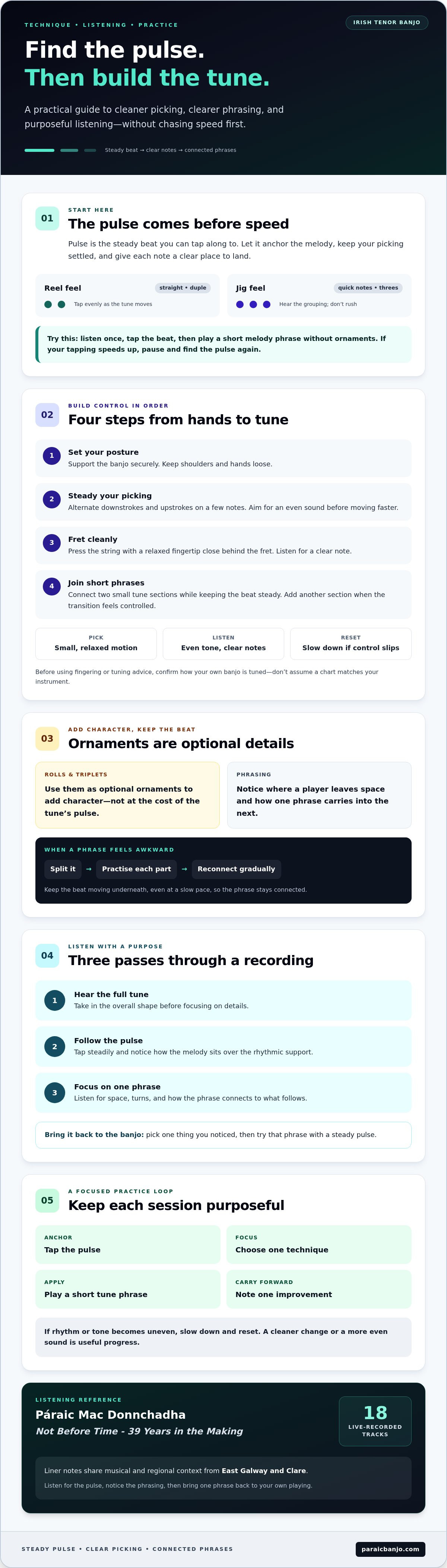
Listen to a tune once before playing. Tap your hand or foot along with the beat, keeping each tap even. Then choose a short phrase and play only its melody notes, repeating it without ornaments. Reels usually have a straight, duple feel, while jigs group their quick notes in threes. Listen for the difference while tapping steadily instead of trying to play faster.
When listening to traditional irish banjo recordings, follow the pulse first, then notice how the melody sits over it. If your tapping speeds up during a busy run, pause and listen again. A steady beat gives you a reference point to return to.
Plectrum Control Without Unnecessary Tension
A relaxed plectrum grip helps you pick evenly without tightening your hand. Hold the pick securely without squeezing, and let a small, comfortable wrist movement carry it across the strings. Try alternate picking, which means switching between downstrokes and upstrokes, on a few notes. Keep the motion small and the sound even. If your hand tenses, slow down and reset.
Keep these practice checks simple:
Tap the pulse before you pick.
Repeat a short phrase without ornaments.
Listen for even tone, not speed.
Short, focused practice can reveal more than a long run-through where the beat slips away. Take a breath, find the pulse again, and let the tune gather its lift one clear note at a time.
Build Picking, Fretting, and Tune Control One Step at a Time
Once you can keep a steady beat, give your hands a clear job. Build control in stages instead of trying to play a whole tune at speed. Before following fingering or tuning advice, confirm how your own banjo is tuned. Don’t assume a chart matches your instrument.
Step 1: Set your posture. Sit or stand comfortably, support the banjo securely, and keep your shoulders and hands loose.
Step 2: Steady your picking. Pick a few notes with alternating downstrokes and upstrokes. Keep the sound even before trying to move faster.
Step 3: Clean up your fretting. Fretting means pressing a string against a fret to change its note. Place a relaxed fingertip close behind the fret and listen for a clear sound.
Step 4: Join short phrases. Connect two small pieces of a tune while keeping the beat steady. Add another piece when the transition feels controlled.
Practise Clean Picking and Clear Notes
Choose a small group of notes and pick them slowly, one at a time. Listen for strings ringing when they shouldn’t, muffled notes, or picks that jump out louder than others. These details can show you where to ease your grip or adjust your hand. Repeat a phrase only while its rhythm and tone stay even. If either slips, slow down and reset.
Make Fretting Changes Feel More Manageable
When a phrase feels awkward, divide it where your fingers change position. Practise each small section, then the transition between them. Place your fingertips deliberately without squeezing, and reconnect the pieces gradually. Keep the beat moving underneath, even at a slow pace, so the phrase doesn’t become a string of disconnected notes.
For a focused session, alternate between a picking drill and a short tune phrase. Work on a few notes, apply that control to the phrase, then return to the notes if the sound becomes uneven. You can also use Traditional Irish Music Archive recordings to hear how a tune’s notes fit together in performance. Listen for clarity and continuity, then bring one observation back to your banjo.
Keep the goal modest: one cleaner change or a more even sound is useful progress. To hear banjo playing in a live-recorded setting, explore Páraic Mac Donnchadha’s Irish banjo album recordings, accompanied by liner notes with musical and regional context.
Add Irish Tune Character with Rolls, Triplets, and Phrasing
Ornaments are brief decorations that add shape and sparkle to a melody. In Irish tenor banjo playing, a roll is a quick cluster of notes that embellishes a melody note. A triplet is a group of three quick notes used to give a phrase a rhythmic flourish. Their execution can vary, so treat these as listening and practice terms, not rules every tune must follow. The tune comes first.
Compare the same short phrase in two versions. First, play its melody plainly: “da, da, da.” Then add one ornament to a note: “da, da-da-da, da.” These syllables are only a listening prompt, not a precise rhythm or fingering pattern. Keep tapping the beat underneath both versions. If the ornament makes the pulse disappear, simplify it until the phrase moves naturally.
Approach Rolls and Triplets Slowly
Choose one ornament you can clearly hear in a recording. Practise it on its own at a comfortable pace, focusing on clear notes and relaxed movement. Then place it once in a short tune phrase and compare that phrase with the plain version. Keep the beat audible, and don’t add another ornament until the first fits without interrupting the tune’s flow.
Shape Phrases Without Losing the Tune
Phrasing is how you give a line direction: where it seems to lean forward, settle, or leave a little space. Listen for a repeated musical idea and notice how the player handles it each time. One phrase might be answered by another, or a tiny pause might let the melody breathe. Try copying that shape before attempting every quick note.
Traditional style isn’t one fixed pattern. Regional traditions and individual players bring their own character. Explore the East Galway and Clare music traditions for more context. For a deeper background on the instrument’s path into Irish traditional music, read this academic history of the Irish banjo.
Use traditional irish banjo recordings as a study guide, not a checklist of ornaments to copy note for note. Listen to a phrase several times: first for its pulse, then for repeated shapes, and finally for where a roll or triplet appears. Pick one detail to try, compare it with the unornamented phrase, and keep the version that lets the tune sing clearly.
Use Traditional Irish Banjo Recordings as a Practical Study Tool
A recording can be more than something to enjoy. Used with focus, it can give your practice a clear next step. Try this sequence: hear the whole tune without stopping, listen again while tapping its pulse, then choose one short phrase to study. You’ll understand the shape of the music before zooming in on the details.
Listening tip: Turn one phrase into a practice prompt by hearing it, trying it, and listening again for what you’d like to improve.
Listen for One Musical Detail at a Time
On the second listen, follow the beat and notice how the player’s picking supports the melody. On the next, focus on one phrase: where does it rise, settle, or repeat? Listen for ornament placement too, but don’t try to catch everything at once. Write down one idea, such as a clear accent or phrase ending, to explore on the banjo.
Traditional irish banjo recordings can reveal how players keep a tune moving through changes in melody and decoration. Pay attention to the pulse underneath. A quick run or ornament can add energy without making the beat feel hurried.
Turn Listening into a Short Practice Routine
Choose a manageable phrase and listen until you can hum or recognize its shape. If you know it well enough, try playing it from memory. Otherwise, use an authorized recording as your reference. Start slowly, keep the phrase short, and listen again before adding it to the larger tune.
Listen: Hear the full tune, then replay the chosen phrase.
Play: Try the phrase slowly, keeping its pulse even.
Check: Listen again and notice one difference in timing, picking, or emphasis.
Reconnect: Play the phrase in context, then return to the recording if the flow slips.
This back-and-forth turns listening into a practical check, rather than an attempt to copy a whole performance note for note. Páraic Mac Donnchadha’s Not Before Time - 39 Years in the Making offers 18 tracks recorded live with expert musicians. Its liner notes add musical and regional context, including stories from East Galway and Clare. Choose a phrase that catches your ear, then take that listening into your next practice session.
Ready to explore a recording with these listening steps in mind? Explore Páraic’s Irish banjo album and listen for one phrase to bring to your instrument.
Keep Improving with a Simple Routine and Informed Listening
Good practice doesn’t need to be complicated. Give each session a small focus: settle the pulse, work on one technique, then use it in a tune phrase. This helps you check whether a skill holds up in music, not just in a drill. Keep the pace comfortable. If your hand tightens or the rhythm wobbles, slow down and rebuild the phrase cleanly.
A Focused Practice Session for Beginners
Start by tapping a steady pulse and picking a few notes evenly. Next, choose one small phrase and decide what you’re working on, such as a clean fretting change or a consistent picking pattern. Repeat the phrase slowly, then play it in the surrounding tune so it feels connected rather than isolated. Keep the routine flexible. The goal is attentive practice, not watching the clock.
Afterwards, record one observation in a notebook. Be specific: “the beat stayed steady through the phrase” or “the final note rang clearly.” This gives you a point of comparison next time. If you notice tension or uneven timing, use it as a cue to reduce the pace, relax your hands, and listen for the pulse again. A slower, controlled phrase is more useful than a rushed run-through.
Continue Learning Through Recordings and Context
Listening can keep your practice connected to the wider tradition. Compare a phrase across different performances, noticing how players shape its rhythm, accents, and endings. Treat each version as one musician’s reading of the tune, not as a definitive template. With traditional Irish session music recordings, listen first for the overall feel, then return to a short passage and choose one idea to explore on your banjo.
Make that listening practical: play your phrase, replay the passage, and check whether your timing still feels settled. Write down one detail you want to keep or adjust, then bring it into your next session. Traditional irish banjo recordings can offer a continuing source of musical ideas when you approach them with patience and curiosity.
For another listening option, explore Páraic’s recordings and, where available, read the accompanying notes for added musical and regional context. Let the music spark an idea, then take it back to the banjo. Work on one clear improvement at a time.
Carry the Pulse into Your Next Tune
Irish tenor banjo playing grows through small, attentive choices: keep a steady pulse, make each note clear, and let ornaments serve the tune rather than crowd it. Pair patient practice with focused listening. A phrase heard closely can offer a fresh idea for your own playing and remind you that the music’s lift comes from more than speed.
Make your next step simple. Choose one phrase, listen for how it moves, then play it at a pace where your timing stays comfortable. Return to traditional irish banjo recordings with curious ears, and let each listening pass reveal something new.
Páraic Mac Donnchadha’s Not Before Time - 39 Years in the Making brings together 18 tracks recorded live with expert musicians. Its detailed liner notes share musical context and stories from East Galway and Clare, offering another way into the tradition. Explore Páraic’s traditional Irish banjo recordings, choose a tune that catches your ear, and take its pulse back to your instrument.
Frequently Asked Questions
What are the essential techniques for playing traditional Irish banjo?
Start with steady timing, controlled picking, clear fretted notes, and smooth connections between tune phrases. These basics help the melody stay lively and easy to follow before you add ornaments such as rolls or triplets. First check that your banjo is tuned appropriately for your instrument and playing setup. Practise a short phrase slowly, listen for even tone, and add decoration only when the tune’s pulse remains clear.
How do beginners practise Irish tenor banjo picking?
Begin with a few notes and alternate downstrokes and upstrokes at a comfortable pace. Keep your grip relaxed and listen for notes that ring accidentally, sound muffled, or jump out louder than the rest. Once your picking feels even, apply it to a short tune phrase. If your hand tightens or the rhythm becomes uneven, slow down and reset rather than pushing through at speed.
Can I learn Irish banjo by listening to recordings?
Listening can help you recognize a tune’s pulse, phrasing, and ornament choices, but pair it with deliberate playing practice. Hear the whole tune first, then replay a phrase and try it slowly on your instrument. Páraic Mac Donnchadha’s Not Before Time - 39 Years in the Making contains 18 tracks recorded live with expert musicians. Its liner notes share East Galway and Clare musical context. Use traditional irish banjo recordings as listening companions, not a substitute for practice.
What is a roll in Irish banjo music?
A roll is a short ornament, or melodic decoration, made from a quick sequence of notes around a melody note. Players use it to add rhythmic sparkle, but its exact sound and execution can vary. To explore one, listen for a roll in a phrase, then practise the ornament slowly on its own before fitting it into the tune. Keep the underlying beat steady, and leave the ornament out if it disrupts the melody.
How can I keep time when playing Irish reels and jigs?
Tap along before you play, keeping your foot or hand even as the tune moves. Reels generally have a duple feel, while jigs group their movement in threes. Listen for that difference instead of trying to force speed. Choose a short phrase and play it slowly against your steady tap. If your tapping rushes during a run of notes, pause, listen again, and begin at a more comfortable pace.
Do I need to play ornaments to sound like traditional Irish music?
No. Ornaments can add character, but they aren’t required in every phrase, and no single decoration defines the whole tradition. A clean melody with a steady pulse is a strong place to begin. Listen to how different players use ornaments and notice where the tune still feels clear and buoyant. Try one decoration in a short phrase, compare it with the plain version, and keep the one that serves the music.
What should I listen for in traditional Irish banjo recordings?
Listen first for the overall pulse, then focus on one phrase at a time. Notice how picking supports the melody, where ornaments appear, and how the player carries momentum between phrases. Compare performances with an open mind: differences in emphasis or phrasing can reveal new ideas, not mistakes. With traditional irish banjo recordings, choose one detail to try on your banjo, then listen again to check how it fits the tune.


Comments