A Listener’s Guide to Irish Banjo Ornamentation: Hearing the Soul of the Tune
- Paraic Mac Donnchadha

- Jun 18
- 13 min read
A tune without ornamentation is like a story without punctuation. The words are all there, but the heart is completely missing. If you’ve ever listened to a blistering reel and felt like the music was moving too fast to catch, you aren’t alone. It’s easy to get lost in the speed and mistake the Irish tenor banjo for its bluegrass or guitar cousins. This article serves as a listener's guide to irish banjo ornamentation, designed to help you hear the magic hidden between the notes without getting bogged down in confusing technical jargon.
We all want to feel that deep, rhythmic connection to the tradition rather than just hearing a blur of strings. You’ll learn to identify the subtle flicks, rolls, and rhythmic pulses that give the instrument its infectious character. I’ll show you how to tell a triplet from a slide by ear and explain why the East Galway style carries such a soulful, vocal quality. By the end, you’ll be able to connect the music on your favorite albums, such as the tracks on Not Before Time, to the rich cultural history they represent. Let’s start training your ears to hear the soul of the tune.
What You'll Discover
Understand how ornamentation acts as the "spice" of Irish music, adding the essential texture and individual flair that makes a tune truly sing.
Use this a listener's guide to irish banjo ornamentation to pick out the rhythmic "engine" of the triplet and the sharp, high-pitched flick of a cut.
Train your ear to find the "pulse" in the blur of a fast reel by looking for the "swing" rather than trying to hear every individual note.
Discover how techniques like slides and drones give the banjo a haunting, vocal soul that mimics the pipes and fiddles of East Galway.
Learn why the lifetime of experience captured in the Not Before Time album is the ultimate masterclass in hearing these traditions come to life.
Table of Contents
What is Ornamentation? The Spice of Irish Traditional Music
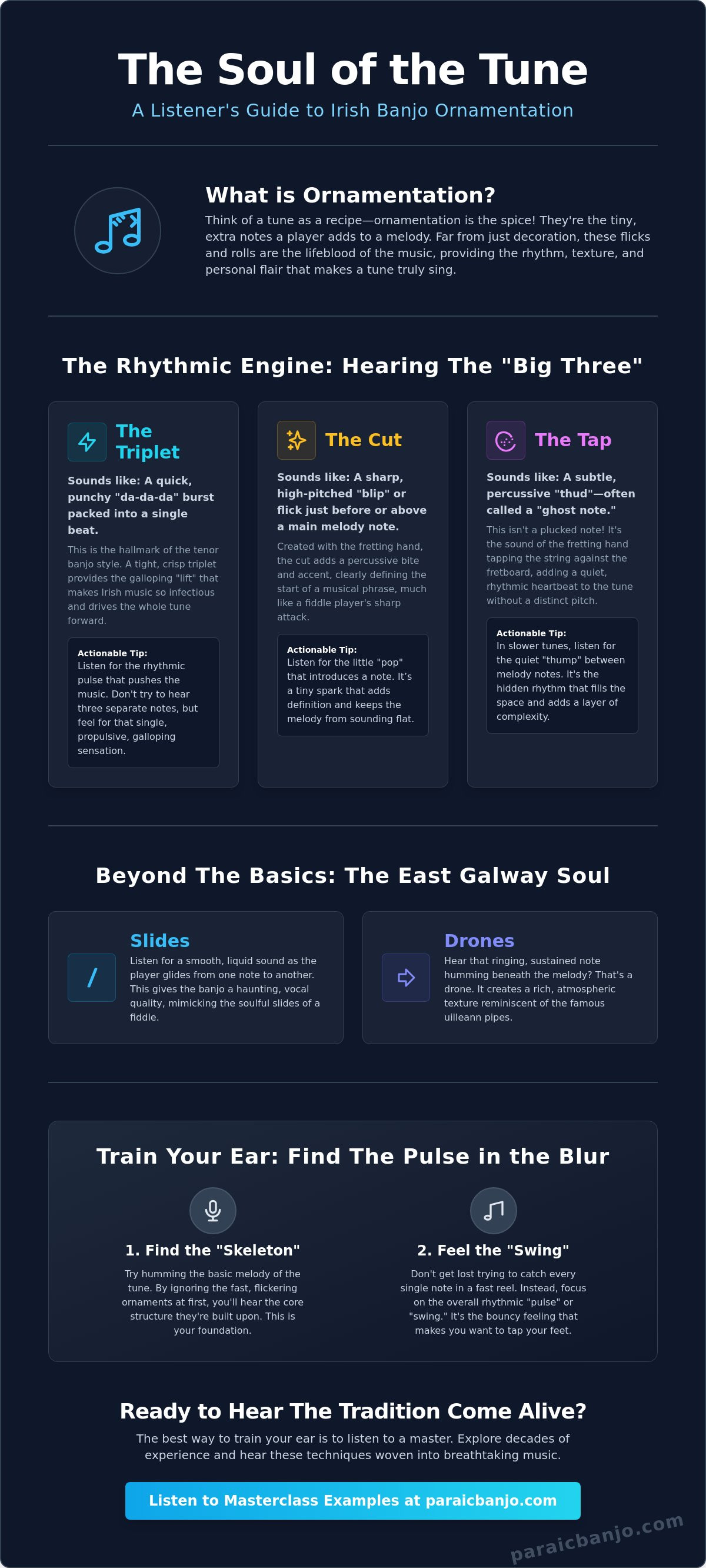
Think of a traditional tune as a basic recipe. The melody is your main ingredient, but ornamentation is the spice cabinet. It refers to those tiny, extra notes that a player tucks into the gaps of a melody. They aren't just there for show. These notes provide the rhythm, texture, and individual flair that transforms a simple sequence of sounds into something deeply personal. In this part of a listener's guide to irish banjo ornamentation, we look at why these "decorations" are actually the lifeblood of the music.
Many listeners think the music is all about speed, but that's a common trap. A fast reel played "clean" without any decoration often sounds empty and mechanical. Conversely, a slow air or a steady hornpipe filled with well-placed ornaments can be far more complex and rewarding to hear. These little flicks and rolls are how the banjo connects to the broader world of Irish traditional music. By mimicking the slides of a fiddle or the tight "pops" of the uilleann pipes, the banjo player finds a way to make a percussive instrument sound like it’s breathing. These stylistic choices often signal where a player is from, acting as a musical dialect that speaks of specific counties or even specific family traditions.
Why the Banjo is a Unique "Singer"
The banjo has a bit of a challenge compared to a violin or a flute. Once you pluck a string, the note starts to die away immediately. It doesn't have the natural sustain of a bowed instrument. To fix this, players use ornamentation to fill that "silence" between the main beats. This creates a "wall of sound" that feels continuous and energetic. It’s the difference between a bare-bones melody and a fully realized traditional performance. When you hear a banjo "singing," you're actually hearing a master player using ornaments to bridge the gaps between notes.
Listening Tip: The "Skeleton" of the Tune
Here is a practical way to train your ears. When you listen to a tune, try to hum the basic melody while ignoring the fast, flickering notes. If you can find that "skeleton," you'll start to see how the ornaments act like the structural frame of a house. They hold the rhythm together and give the tune its "lift," which is that infectious, bouncy feeling that makes you want to tap your feet.
For a perfect example of this balance, listen to a track from Not Before Time – 39 Years in the Making. You'll hear how decades of experience allow a player to keep the melody clear while weaving in enough decoration to make the instrument feel alive. It’s a masterclass in knowing exactly when to let a note stand alone and when to give it a little traditional "flick."
The "Big Three" Banjo Ornaments You Can Hear
If you want to understand the heartbeat of a reel, you have to look at the "Big Three." These aren't just technical tricks; they're the rhythmic engine that makes the music move. When you use Irish banjo ornamentation correctly, you create a galloping sensation that’s impossible to ignore. These three ornaments, the triplet, the cut, and the tap, work together to turn a simple melody into a living, breathing performance. Let’s break down exactly what your ears should be searching for.
Identifying the Triplet
The triplet is the undisputed hallmark of the rhythmic tenor banjo style. To find it, listen for a "da-da-da" sound compressed into the space of a single beat. It isn't three separate, slow notes. It’s a quick, punchy burst. A "loose" triplet can sound a bit sloppy, almost like the player is tripping over their own feet. However, a "tight" rhythmic triplet is crisp and deliberate. It provides the "lift" that makes Irish music so infectious. In this part of a listener's guide to irish banjo ornamentation, I want you to focus on that drive. It’s the sound that pushes a session forward and keeps the dancers on the floor.
The Cut and the Tap: The "Left-Hand" Magic
While the triplet is mostly about the pick hand, the cut and the tap are where the left hand shines. A cut sounds like a quick "blip" or a sharp flick just above the main note. It adds a high-pitched accent that defines the start of a phrase. It’s very similar to how a fiddle player might "cut" a note with their finger to give it a bit of bite.
The tap is more subtle. It’s often called a "ghost note" because it’s a percussive "thud" or "pop" created by hitting the string against the fretboard without actually plucking it. It adds a heartbeat to the tune. These ornaments are incredibly effective in slower tunes, like hornpipes or slow airs, where they create a beautiful cycle of tension and release. They prevent the music from feeling static. If you want to hear how these "Big Three" sound when they're woven into a lifetime of tradition, you can browse the individual digital tracks from my debut album to hear them in high definition.
When these elements combine, they create that famous "galloping" feel. The triplet provides the speed, the cut adds the sharp accent, and the tap provides the underlying pulse. It’s a complex layer of sound that makes the banjo much more than just a loud melody instrument. It becomes a rhythmic powerhouse.
Beyond the Flickers: Slides, Drones, and the East Galway Soul
While the triplets and cuts we discussed earlier provide the "engine" for the music, there is another layer of ornamentation that gives the banjo its emotional depth. These techniques move away from the purely percussive and lean into the melodic. In this part of a listener's guide to irish banjo ornamentation, we explore the sounds that make the instrument feel less like a drum and more like a human voice. These are the slides and drones that define the soulful East Galway style.
The East Galway influence is central to my own playing. It’s a style that prioritizes a deep, steady pulse and a "lonesome" quality over raw, frantic speed. It isn't about how many notes you can cram into a bar. It’s about how much feeling you can pull out of a single phrase. By using these more atmospheric ornaments, a player can create a "rhythmic and soulful" environment that invites the listener in rather than just blasting them with volume.
The Slide: Bringing the Vocal Quality to Banjo
The slide is perhaps the most emotive tool in a banjo player’s kit. To hear it, listen for a smooth transition where the player moves between two notes without a sharp break. It sounds like a singer "moaning" or "sighing" into a pitch. This technique is essential for the slow reels and jigs common in the West of Ireland. If you want a practical tip for your next listening session, focus on the slower tracks of an album. You’ll hear the slide’s texture more clearly there, as it stretches the note and adds a haunting, vocal dimension to the melody.
Drones: The Bagpipe Echo
Drones and double stops are another way we add weight to the music. By hitting an open string while playing the melody on another, a banjo player can mimic the constant "ringing" or "hum" of the uilleann pipes. This creates a rich, full sound that makes a solo banjo feel like an entire band is playing. There is a strong connection between the East Galway vs Clare music styles here. While Clare music often focuses on a driving, bouncy rhythm, the East Galway tradition uses these drones to emphasize the "soul" and the "pulse" of the tune.
When you hear these drones, notice how they anchor the melody. They provide a harmonic floor that allows the ornamentation to dance on top. It’s a technique I’ve leaned on throughout my career to ensure the banjo never sounds thin or brittle. These choices are what transform a simple tune into a definitive statement of a lifetime's passion. It’s about finding the "lift" in the drones and the "sigh" in the slides to tell a story that words just can't reach.
How to Listen: Finding the "Pulse" in the Blur
Listening to a fast reel shouldn't feel like a math test. If you try to catch every single note in a sequence, you’ll likely just get a headache. The secret to enjoying the music is to stop chasing the notes and start looking for the "swing." This part of a listener's guide to irish banjo ornamentation is all about shifting your perspective from the technical to the emotional. When you stop worrying about the speed, the soul of the tune finally starts to reveal itself.
A great way to do this is to imagine the player’s right hand as the drummer of the instrument. While the left hand is busy finding the pitches, the right hand is responsible for the pulse. It determines the "swing" and the "lift" of the tune. You should also pay close attention to the moments of silence. A master player knows exactly when not to ornament. Letting a simple melody note ring out without any decoration allows the music to breathe. It creates a contrast that makes the following ornaments even more impactful. Try to connect the sound to an emotion. A sharp, crisp cut usually signals excitement or a change in energy, while a long, slow slide often feels like a deep sigh of sadness.
The "Lift": The Secret of Irish Music
In traditional circles, we talk about "lift" constantly. It’s that infectious, bouncy feeling that makes you want to tap your foot or get up and dance. Ornamentation is what creates this lift by placing tiny accents on the off-beats. It gives the music a sense of weightlessness. Surprisingly, speed is often the enemy of lift. In many traditional sessions, if a tune is played too fast, the ornaments get squashed. There’s no room for the notes to "pop," and the music becomes a flat, mechanical blur. A slower, well-ornamented tune will almost always have more "drive" than a frantic one.
The Expert-as-Educator: Learning from the Masters
To really train your ears, you need to hear the music in its natural state. Overly polished studio albums can sometimes scrub away the grit and personality that makes the banjo human. I always recommend listening to recordings that capture a "live" feel. You can find some fantastic examples on traditional Irish session music CDs, where the raw ornamentation hasn't been buried under layers of production.
Here is a practical exercise for your next listening session. Pick a single track, close your eyes, and don't try to follow the whole melody. Instead, just try to count the triplets in a single musical phrase. You'll quickly realize how much rhythmic work is happening beneath the surface. If you want to hear this "lift" captured with total clarity, order your copy of Not Before Time – 39 Years in the Making and listen for the heartbeat in every track. It’s the best way to move from being a casual listener to someone who truly hears the tradition.
Hearing the Tradition: The "Not Before Time" Experience
A legacy isn't built overnight. It’s forged through decades of late-night sessions, quiet kitchen tunes, and a deep respect for those who played before us. When you listen to Not Before Time – 39 Years in the Making, you aren't just hearing a debut album. You’re hearing the culmination of nearly four decades spent absorbing the rhythmic soul of the West of Ireland. As we conclude this a listener's guide to irish banjo ornamentation, it’s time to see how all these technical "flicks" and "pulses" come together in a single, definitive statement of passion.
The 18 tracks on this album were recorded to capture the raw, "live" energy of a real session. We avoided the trap of over-polishing the sound because the soul of the banjo lives in its imperfections and its grit. You can hear the pick hitting the strings and the percussive "tap" of the fingers against the wood. This honesty allows you to hear the ornamentation exactly as it was intended to be felt. It’s a historical document of the East Galway style, preserved through a lifetime of dedicated playing.
A Lifetime in the Making
Why did it take 39 years? Because traditional music is a conversation that requires a lot of listening before you’re ready to lead the talk. The ornamentation you hear on the album isn't something practiced in isolation. It’s a response to the fiddlers, pipers, and singers I’ve shared stages with over the years. By using the rhythmic ornamentation techniques we’ve discussed, this recording keeps the East Galway flame alive for a new generation of listeners. Experience the pulse of the tradition and buy traditional Irish music directly from the artist to hear these stories for yourself.
Your Next Steps as a Listener
Now that you know what to listen for, it’s time to put your ears to the test. I encourage you to use the extensive liner notes included with the album. They provide the background stories and regional context for each tune, helping you connect the notes to the culture. Here is a final tip: pick one track and listen to it three times. The first time, just enjoy the melody. The second time, focus on the right-hand "lift." The third time, try to spot the "Big Three" ornaments we covered earlier.
Supporting the art directly ensures that these niche regional styles don't fade away. You can start your collection today with an Irish music digital download of Not Before Time. Whether you choose the physical CD for the full tactile experience or the digital album for convenience, you’re becoming a part of this 39-year journey. Thank you for taking the time to learn the language of our music. I hope these tunes bring as much joy to your ears as they have brought to my life. Happy listening.
Unlock the Pulse of the West
You’ve now seen how the "Big Three" ornaments provide the heartbeat of a reel and how the soulful slides of East Galway give the banjo its human voice. By shifting your focus from raw speed to the underlying "lift," you can finally hear the music as it was meant to be experienced. This a listener's guide to irish banjo ornamentation was designed to move you past the technical jargon and straight into the heart of the tradition.
Now it’s time to put those ears to work. My debut album, Not Before Time – 39 Years in the Making, features 18 tracks recorded with a raw, live session energy that puts you right in the middle of the circle. Each track is accompanied by detailed liner notes that explain the history and specific styles behind the tunes. It’s the perfect way to continue your education while supporting the preservation of these regional sounds. Experience the rhythmic soul of East Galway and Order the "Not Before Time" CD or Digital Album today. Keep listening, keep tapping your feet, and let the music speak to you.
Frequently Asked Questions
What is the most common ornament in Irish banjo music?
The triplet is the most frequent ornament you'll hear in the tradition. It provides that signature "galloping" rhythm that defines the genre. Think of it as a quick burst of three notes squeezed into the space where one note usually sits. It’s the primary tool for creating "lift," making the music feel light and bouncy rather than heavy and flat.
Can you play rolls and crans on a banjo like you can on a fiddle or pipes?
Banjo players can’t play rolls or crans in the exact way a fiddler or piper does because the instrument is percussive rather than sustained. Instead, we use a combination of triplets and cuts to mimic those complex textures. This a listener's guide to irish banjo ornamentation helps you realize that while the technique is different, the emotional goal of adding "spice" to the tune remains the same.
Why does Irish banjo music sound so different from American bluegrass?
Irish banjo is played on a four-string tenor banjo tuned GDAE, while bluegrass uses a five-string banjo with a different tuning. The focus in the Irish tradition is strictly on the melody, mirroring the fiddle or flute. Bluegrass often relies on finger-picked rolls and chords to create a background texture. In Ireland, the banjo is a front-line melody instrument that sings the tune alongside the pipes.
How do I know if a banjo player is playing in the East Galway style?
You can identify the East Galway style by its steady, relaxed tempo and a deep, soulful pulse. Unlike some modern styles that prioritize blistering speed, East Galway players focus on the "lonesome" quality of the music. Listen for long slides and the clever use of drones that make the banjo sound more like a human voice. It’s a style that invites you to feel the rhythm in your bones.
Is ornamentation the same as improvising in jazz?
Ornamentation is quite different from jazz improvisation because the core melody stays the same. In jazz, a soloist might wander far from the original tune to explore new harmonies. In Irish music, we keep the "skeleton" of the melody intact. The ornaments are simply decorations, like adding a bit of flair to your handwriting without changing the actual words you’re writing on the page.
Do I need to be a musician to appreciate these ornaments?
You don't need any musical training to appreciate these subtle flicks and pulses. The best way to start is by feeling the "lift" or the "swing" of the tune. If a piece of music makes you want to tap your feet or nod your head, the ornamentation is doing its job. Just relax and let your ears pick out the moments where the music feels particularly alive or "soulful."
What is a "triplet" in the context of a listener’s guide?
A triplet is a quick rhythmic burst of three notes played in the time of one or two beats. For a listener, it sounds like a punchy "da-da-da" that adds a sudden spark of energy to a phrase. It’s the most important rhythmic marker in the tradition. When you hear a banjo player "triplet" a note, they’re effectively acting as the drummer for the rest of the session.
Where can I hear authentic examples of these banjo ornaments?
You can hear 18 authentic tracks filled with traditional ornamentation on my debut album, Not Before Time – 39 Years in the Making. It was recorded with a live session energy to ensure every triplet and slide sounds exactly as it would in a West of Ireland kitchen. You can find the physical CD or a digital download on this site to hear how a lifetime of playing translates into soulful music.


Comments