Authentic Irish Folk Music: A Guide to the Soul of Traditional Sounds

Authenticity isn't a genre; it's a rhythmic connection to specific people, places, and decades of patience. You might feel overwhelmed by generic playlists or confused by the blurry line between commercial 'Celtic' sounds and true traditional tunes. It's frustrating when you're searching for authentic irish folk music only to find polished, over-produced tracks that lack the grit and lift of a real session. You want the music that lives in the fingers of a banjo player from East Galway or the steady pulse of a Clare fiddle, not a digital imitation.
I know the feeling of wanting a deeper connection to the music but not knowing where to start. This guide promises to help you discover the heartbeat of true Irish tradition by diving into regional styles and the stories behind the strings. We'll explore how to spot a high-quality session recording and build a collection that actually means something. From the technical nuances of the tenor banjo to the warmth of a live room, you're about to get an insider's look at the sounds that have defined a lifetime of passion. Let's get into the soul of the tradition.
Table of Contents
What Defines Authentic Irish Folk Music Today?
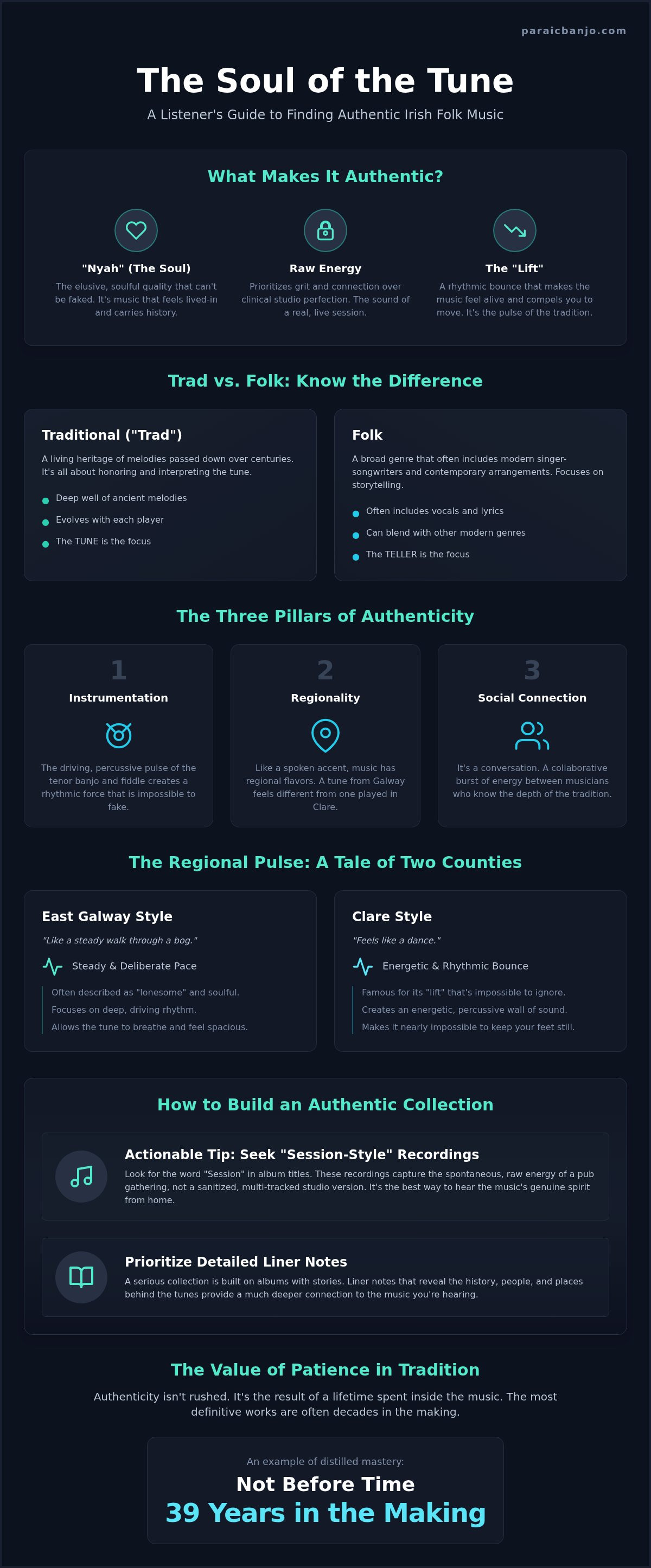
Authenticity isn't about a polished studio booth or a shiny marketing campaign. It's found in the lift of a tune and the shared breath between players in a crowded corner. When we talk about authentic irish folk music, we're describing a sound that prioritizes the "nyah", that elusive, soulful quality, over clinical perfection. It's the difference between a song performed for a passive audience and a tune played for the sake of the music itself. True authenticity feels lived-in. It carries the dust of the road and the warmth of the turf fire.
Trad vs. Folk: Understanding the Nuance
While people often use the terms interchangeably, there is a distinct line between "Folk" and "Traditional" in Ireland. Folk is a broad tent. It often includes modern singer-songwriter elements, contemporary arrangements, and acoustic ballads. Traditional music, or "Trad," is a living heritage. It's a deep well of melodies passed from hand to hand over centuries. You can trace the history of Irish music through these tunes, which evolve slightly with every player while keeping their ancient core. Trad is about the tune; Folk is often about the teller.
Actionable Tip: If you're browsing for new music, look for the word "Session" in the album title or description. This usually indicates a rawer, more energetic recording that captures the spontaneous spirit of a pub gathering rather than a sanitized, multi-tracked studio version.
The Three Pillars of Authenticity
To find the real thing, look for these three markers. First, the instrumentation. In the right hands, the tenor banjo and fiddle provide a rhythmic pulse that's impossible to fake. It's a driving, percussive force. Second, regionality matters. Just like a spoken accent, the music has regional flavors. A tune played in the East Galway style will feel lonesome and steady, while a Clare version might have a different swing. Finally, it's about social connection. Authentic irish folk music is a conversation. It's not a solo act; it's a collaborative burst of energy between musicians who know the depth of the tradition.
Capturing this isn't easy. It takes time. Decades, actually. That's why projects like Not Before Time - 39 Years in the Making are so vital to a serious collection. They don't just offer tracks; they offer a lifetime of distilled mastery. If you want to hear what 39 years of dedication sounds like, you can find the digital album or individual tracks to start your journey. It's about finding that heartbeat that has sustained the tradition for generations. Don't settle for the generic stuff when the real soul of the music is right there waiting for you.
The Regional Pulse: Exploring East Galway and Clare Styles
To really understand the soul of the tradition, you have to look West. While many listeners treat the genre as a single, uniform sound, the West of Ireland acts as a vibrant heartland where every county has its own musical "accent." If you're searching for authentic irish folk music, you'll soon realize that a tune played in a kitchen in Ballinasloe feels worlds apart from one played in a pub in Ennis. These regional nuances aren't just technical details. They're the DNA of the music itself, shaped by the landscape and the families who kept the melodies alive through the lean years.
East Galway: A Rhythmic Masterclass
The East Galway style is often described as "lonesome" or soulful. It's not about speed. Instead, it's about a deliberate, steady pace that allows the tune to breathe and the listener to feel every note. This style relies on a deep, driving rhythm rather than flashy ornamentation. Legendary figures like Paddy Fahy or the Kane sisters helped define this sound, focusing on minor keys and haunting melodies that stay with you long after the session ends. For a deeper dive into these specifics, check out this comparison of East Galway vs Clare Music: A Guide to the Rhythmic Soul of the West. It’s a great way to start training your ear to the subtle shifts in the regional pulse.
Clare's Influence on Traditional Sessions
Move a bit further south into County Clare, and the music takes on a different energy entirely. Clare music is famous for its "lift," a rhythmic bounce that makes it nearly impossible to keep your feet still. While Galway music might feel like a steady walk through a bog, Clare music feels like a dance. This energetic swing is a hallmark of Clare fiddle and banjo playing, often blending seamlessly with other styles in modern sessions to create a rich, percussive wall of sound. As noted in the Boston Public Library's guide to traditional Irish music, these instrumental styles are the bedrock of the entire tradition, providing the framework for the jigs and reels we love today.
Actionable Tip: When you're listening to a recording, pay close attention to the "swing" of the rhythm. If the notes feel slightly elongated or bouncy rather than strictly on the beat, you're likely hearing that unmistakable Clare influence.
These two distinct pulses meet in the playing of Páraic Mac Donnchadha. His tenor banjo style isn't a choice between one or the other; it's a marriage of both. You can hear the steady, soulful foundation of East Galway paired with the infectious lift of Clare. This balance is exactly what makes Not Before Time - 39 Years in the Making such a definitive statement. It's the sound of a musician who has spent four decades absorbing these regional accents until they became his own. If you want to hear this regional blend for yourself, you can explore the digital tracks from the album. It’s a perfect entry point for anyone who wants to hear the true rhythmic soul of the West.
Finding the Pulse: Live Sessions vs. Studio Recordings
Capturing the lightning of a live performance in a bottle is the ultimate challenge for any traditional musician. There is a strange paradox at play here. Studios are designed for silence and separation, yet authentic irish folk music relies entirely on connection and shared energy. When you polish a track too much, you risk scrubbing away the very soul that makes it breathe. This is why purists often steer clear of over-produced radio hits. They aren't looking for clinical perfection. They're looking for the lift, the spontaneous shout of encouragement from a fellow player, and the driving energy that only happens when musicians are reacting to each other in real time.
What is a Traditional Irish Session?
The session is the music's natural habitat. It's not a concert. It's a gathering, often in a quiet corner of a pub or a neighbor's kitchen, where tunes are shared like stories. There are unwritten rules to this social ritual. It's about listening as much as playing. The best music often happens when no one is "performing" for an audience at all. It's just a group of friends chasing a rhythm. If you're looking to bring that energy into your home, you might want to check out our guide on Exploring the Best Traditional Irish Session Music CDs for Collectors in 2026. It highlights how to find those gems that feel like you're sitting right at the table.
Identifying High-Quality Session Recordings
How do you spot the real thing in a digital store? Start by looking at the credits. High-quality recordings will often mention they were recorded "live" or "unplugged" in a single room. You want to hear the physical reality of the music. Listen for the rhythmic tap of a leather sole on a wooden floor or the sharp intake of breath from a flute player before a difficult turn. These aren't "errors" to be edited out. They are the heartbeat of the performance. They tell you that the musicians were in the same space, breathing the same air, and feeling the same pulse.
Actionable Tip: When building your library, be wary of tracks featuring heavy synthesizers or artificial reverb. These digital layers often mask the natural resonance of the instruments and flatten the dynamic "swing" that defines the West of Ireland sound. Seek out recordings where the instruments sound like wood and wire, not software.
This commitment to the live feel is exactly why Not Before Time - 39 Years in the Making was recorded the way it was. We didn't want 18 isolated tracks. We wanted 18 conversations. By recording live with a group of expert musicians, we captured that specific session pulse that only comes from decades of playing together. It’s a definitive statement of what happens when you let the music speak for itself. You can experience that raw energy for yourself by exploring the digital album or individual tracks. It’s about as close as you can get to the pub corner without leaving your house.
How to Build an Authentic Irish Music Library
Streaming algorithms are great for convenience, but they're often terrible at finding the deep stuff. Most "Top 20" playlists are cluttered with generic, atmospheric tracks that lack the rhythmic grit of the West. If you're serious about finding authentic irish folk music, you have to look where the tradition actually lives. Building a collection isn't just about filling a hard drive or a shelf. It's about stewardship. It's about curating a sound that has survived for centuries because people cared enough to listen closely.
Actionable Tip: Don't just stick to reels. A well-rounded library needs a healthy mix of jigs, hornpipes, and slow airs to truly represent the emotional range of the tradition. Start by looking for sets that transition between these rhythms to hear how the pulse shifts.
The Value of Physical CDs and Liner Notes
In the digital age, the physical CD has become a treasure map for the dedicated listener. This is especially true in traditional music, where the history of a tune is just as important as the melody itself. Liner notes provide a vital link to the past. They tell you who taught the tune to the artist, which county it hails from, and what name it carried a hundred years ago. When you look at the detailed notes for the 18 tracks on a debut album, you're seeing a musical lineage in print. It's an education you simply won't get from a scrolling screen. For more on this, check out The Collector’s Guide: How to Buy Traditional Irish Music Direct from Artists in 2026. It explains why these physical details are the key to understanding the soul of the sounds.
Supporting Independent Traditional Artists
Choosing how you buy your music makes a massive difference to the people making it. While digital downloads are convenient, buying direct from an artist's website ensures that the tradition stays financially viable. It allows musicians to keep producing the high-quality, soulful recordings that purists crave. Not Before Time - 39 Years in the Making is a perfect example of this. It represents a lifetime of distilled mastery, a 39-year milestone that deserves to be supported directly. By skipping the middleman, you're helping a living community of performers continue their craft.
Actionable Tip: Follow your favorite traditional artists on their own websites. This is often where you'll find limited edition releases, high-quality digital tracks, or physical CDs that aren't available on the major commercial platforms.
The best way to start your journey is to go straight to the source. You can purchase the physical CD or digital album of Not Before Time - 39 Years in the Making to hear the result of four decades of dedication. It’s more than just an album; it’s a definitive statement of a lifetime’s passion. Grab your copy today and start building a library that actually carries the heartbeat of the tradition.
Not Before Time: A Masterclass in Banjo Authenticity
In a world that prizes instant results, there is something legendary about a project that takes nearly four decades to reach the public. Páraic Mac Donnchadha’s debut statement isn't just a collection of songs; it’s a definitive distillation of a lifetime spent within the tradition. When we talk about authentic irish folk music, we’re talking about the kind of deep-rooted knowledge that only comes from 39 years of sitting in sessions, listening to the old masters, and finding your own voice within the rhythm. This album is a celebration of that patience. It’s a relief to finally share a work that feels like a definitive statement of passion rather than a rushed commercial product.
The style you’ll hear on this recording is a direct reflection of that long-term development. It carries the weight of the East Galway and Clare traditions, but it’s delivered with a quiet confidence that only a seasoned master can project. There’s no need for flashy, unnecessary speed when the rhythm itself is this solid. Every note is placed with purpose, creating a percussive, driving pulse that feels both ancient and fresh. It’s an invitation to step into a storied musical world where the banjo isn't just an instrument, but a storyteller.
18 Tracks of Pure Irish Tradition
The selection process for this album was meticulous. We didn't just pick 18 random tunes; we chose sets that speak to the heart of the session experience. To capture that elusive live energy, the tracks were recorded live with a group of expert musicians who understand the nuances of the West of Ireland sound. This collaboration was essential. It transformed the project from a solo effort into a vibrant, social conversation between players. For a closer look at the tracks and the story behind this release, you can read more about Not Before Time - 39 Years in the Making: The Definitive Irish Banjo Debut. It’s a great way to understand why this specific collection has earned its place in the community.
Start Your Journey with Páraic Banjo
If you're looking for a starting point for a serious collection, this is it. I encourage you to dive deep into the stories contained within the detailed liner notes. They act as a guide to the lineages and histories of the tunes, offering a level of depth you won't find on a standard digital playlist. Whether you prefer the physical weight of a CD or the convenience of high-quality digital tracks, the soul of the music remains the same. It’s about more than just listening; it’s about connecting to a living heritage that has been 39 years in the making.
Actionable Tip: When you get the album, try listening to it from start to finish without distractions. Traditional music is built on a narrative flow, and hearing how the sets build upon one another will give you a much better sense of the rhythmic journey we’ve mapped out.
Ready to hear the difference that four decades of mastery makes? You can explore the album 'Not Before Time - 39 Years in the Making' and hear the pulse for yourself. Whether you grab the full digital album or the physical CD with its historical notes, you're getting a piece of the tradition that is truly authentic irish folk music at its finest. See you in the music.
Step Into the Living Heart of the Tradition
Finding authentic irish folk music is a journey that rewards those who listen for the lift and the soul of the West. You now know that the difference between a generic track and a true traditional tune lies in the regional "accent" and the spontaneous energy of a live session. Whether it's the steady pulse of East Galway or the infectious swing of Clare, these sounds are a living conversation that has survived for centuries. It's about the connection between players and the history behind every string.
You can take these insights and start building a collection that actually carries weight. Look for recordings that capture the physical reality of the music, from the tap of a leather sole to the sharp intake of breath. I've distilled 39 years of musical dedication into one project to give you the perfect entry point. Featuring 18 authentic live-recorded tracks and expertly crafted liner notes, it's a definitive statement of a lifetime's passion. Own a piece of Irish history-Get 'Not Before Time - 39 Years in the Making' today. The tradition is waiting for you. Let's keep the music alive together.
Frequently Asked Questions
What is the difference between Irish folk and traditional music?
Traditional music, or "Trad," is a specific heritage of instrumental tunes and songs passed down through generations. Folk is a broader umbrella that often includes modern singer-songwriter styles and contemporary acoustic arrangements. While they overlap, Trad focuses on the living chain of melody and regional style. Authentic irish folk music often refers to the broader acoustic scene, while Trad remains the core heartbeat of the session.
Is authentic Irish music always fast and energetic?
No, the tradition has a massive emotional range that includes slow airs and deliberate regional styles. For example, the East Galway style is famous for its steady, soulful, and lonesome pace. While reels and jigs provide that high-energy lift for dancing, the slower pieces allow the musician to explore the deep resonance of the instrument. It's about the rhythm and soul, not just the speed of the notes.
What instruments are used in a traditional Irish session?
A typical session features a mix of melodic and percussive instruments. You'll commonly hear these core pieces:
The fiddle and uilleann pipes for melody.
The tin whistle and flute for breathy textures.
The tenor banjo and button accordion for rhythmic drive.
The bodhrán and guitar for percussive backing.
These instruments work together to create a layered, conversational wall of sound that defines the tradition.
Why is the tenor banjo so popular in Irish music?
The tenor banjo became a staple because of its percussive cut and volume, which allowed it to be heard in noisy pub environments. Its four strings are tuned like a fiddle but an octave lower, making it a perfect rhythmic partner for the melody. In projects like Not Before Time - 39 Years in the Making, the banjo acts as a driving force that anchors the entire session with its crisp, punchy sound.
Can I learn about Irish history through folk music?
Yes, the music is a living record of the people and the landscape. Many tunes are named after historical events, local characters, or specific townlands. By reading detailed liner notes, like those included with physical CDs, you can uncover the stories of where these melodies originated. It's a way to connect with the past that goes beyond textbooks, offering a sensory experience of Irish cultural heritage and community life.
Where is the best place to buy authentic Irish music online?
The best way to support the tradition is to buy directly from the artist's own website. Finding authentic irish folk music is easiest when you go straight to the source. This ensures the musician receives the most support and often gives you access to high-quality digital tracks or physical CDs with historical notes. You can purchase Not Before Time - 39 Years in the Making directly from the Páraic Banjo storefront to support independent music.
What are reels and jigs in Irish music?
These are the two most common types of dance rhythms in the tradition. A reel is played in 4/4 time and has a steady, driving feel. A jig is usually in 6/8 time and has a distinct lilt or bouncing rhythm. Understanding these structures helps you appreciate the technical skill required to maintain the pulse. Most sessions move between these forms to keep the energy and variety alive for the listeners.
Why do some people call it 'Trad' music?
Trad is simply a shorthand term for Traditional Irish Music. It's the word used by musicians and fans to describe the core instrumental heritage that has been passed down for centuries. Using the word Trad usually signals that you are looking for the raw, unpolished sound of the session rather than commercialized versions. It's a badge of authenticity within the community of players and listeners who value the roots of the sound.


Comments