What to Look for in an Irish Tenor Banjo Album: A Beginner’s Guide to the Tradition
- Paraic Mac Donnchadha

- May 16
- 13 min read
Updated: May 26
The fastest, flashiest banjo recordings are often the worst place for a beginner to start. It's a common trap. You hear a lightning-fast reel and think that's the goal, but for a student of the tradition, those notes can easily turn into a blurred mess. If you've ever struggled to distinguish the banjo from the rest of the band or felt overwhelmed by complex regional styles, you aren't alone. Understanding what to look for in an irish tenor banjo album is about finding the pulse and the articulation that makes the music breathe. You need a recording that serves as a clear blueprint for your own playing, not just a display of speed.
I've spent nearly four decades honing my craft, and I can tell you that the real soul of Irish music lives in the rhythm and the lift of the tune. This guide will help you identify the best recordings to help you understand the melody and rhythm of the tradition. We're going to look at why slow-to-mid-tempo albums are your best friend and how to spot an authentic swing. If you're ready to dive deep, my own debut project, Not Before Time: 39 Years in the Making, is available as a physical CD or digital album to help you hear every detail. Let's find the recordings that will finally make those tunes click for you.
Key Takeaways
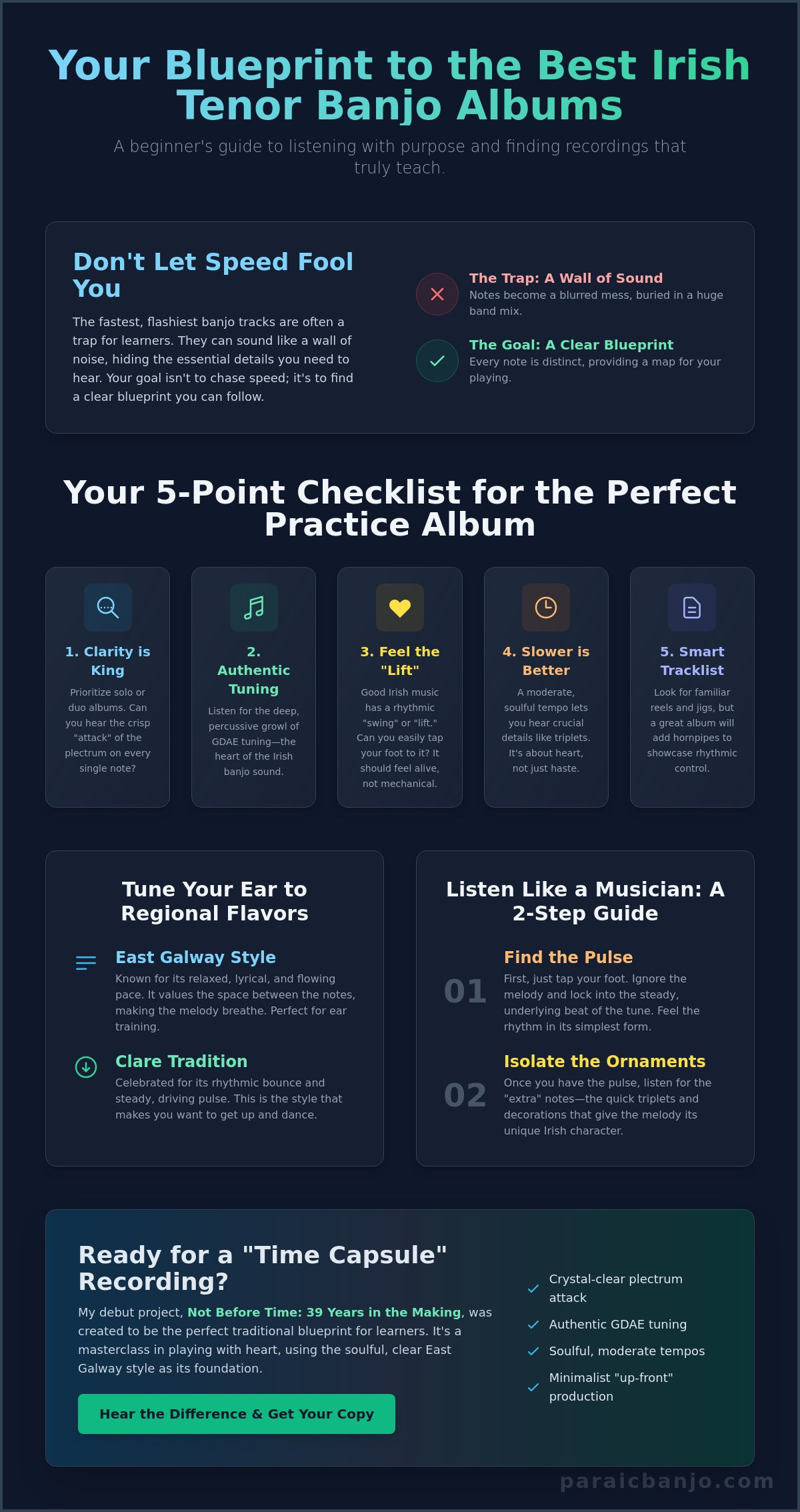
Prioritize recordings with minimalist accompaniment and clear plectrum "attack" to ensure you can hear every individual note without a wall of sound.
Discover what to look for in an irish tenor banjo album by seeking out the relaxed, lyrical paces of East Galway and the rhythmic bounce of the Clare tradition.
Ensure the recording uses authentic GDAE tuning to hear that signature deep growl that defines the instrument’s place in Irish music.
Master a simple two-step listening technique to isolate the steady pulse of a tune and identify the triplets that give the melody its character.
Look for a "time capsule" recording like Not Before Time to provide a clear, traditional blueprint for your own playing style and repertoire.
Table of Contents
What Makes an Irish Tenor Banjo Album Beginner-Friendly?
When you're starting out, the sheer volume of recordings can be overwhelming. Understanding what to look for in an irish tenor banjo album starts with one simple question: can you hear the plectrum? In the trade, we call this articulation. It's the crisp, distinct sound of the pick hitting the string. If a recording is buried under a wall of sound from a massive band, you'll lose that essential blueprint. Look for solo or duo recordings where the banjo is front and center. This clarity allows you to map out exactly how the player is navigating the tune. You can find this clear, stripped-back approach in the individual digital tracks of my own recordings, where the focus remains entirely on the melody.
A steady pulse is your best friend. You should be able to tap your foot to every track without getting lost. Beginners often find that albums featuring session standards, like common reels and jigs, are much more useful than those filled with obscure compositions. These familiar tunes provide a framework you can actually use when you sit down to practice.
The Role of the Banjo in the Tradition
The History of the Banjo in Irish Music shows us that the instrument is as much about percussion as it is melody. To get that authentic growl, most traditional players use GDAE tuning. This is one octave below a fiddle. It gives the banjo a deep, resonant quality that holds the rhythm together. When listening, pay attention to the lift or swing. This isn't something you can measure with a metronome; it's the rhythmic bounce that makes the music feel alive rather than mechanical. It's the heartbeat of the tradition.
Speed vs. Soul: Why Slower is Better
Don't be fooled by blazing virtuosity. Many new players gravitate toward the fastest tracks they can find, but speed often masks the very details you need to learn. A moderate, soulful tempo allows you to hear ornamentation like triplets clearly. A triplet is a quick succession of three notes played in the time of two, and it's a staple of the Irish sound. In the East Galway style, we value the space between the notes just as much as the notes themselves. This relaxed pace is perfect for ear training. If you're looking for a definitive example of this measured, traditional style, my debut project, Not Before Time - 39 Years in the Making, is available as a physical CD or digital album. It serves as a masterclass in playing with heart rather than just haste.
The Evaluation Checklist: 5 Things to Look for in a Recording
Picking up a new record should feel like an invitation to a kitchen session. To help you sort the wheat from the chaff, I've put together a quick mental checklist for what to look for in an irish tenor banjo album. First, check the tuning. If it doesn't have that deep, earthy growling quality that comes from the GDAE strings, it’s simply missing the heart of the Irish sound. Next, look at the tracklist. You want a healthy mix of reels and jigs; however, a truly great album will throw in a hornpipe or two to show off the player's control of rhythm and "dotted" timing.
Production matters immensely. If the banjo is buried behind a loud piano or a thumping drum, put it back on the shelf. You need the instrument "up front" in the mix where you can hear the plectrum's attack. This clarity is exactly what I aimed for with the Not Before Time - 39 Years in the Making (Physical CD), ensuring every note has its own space to breathe. Finally, check for regional flavor. Does the player lean into the steady, rhythmic bounce of Clare or the lyrical, flowing style of East Galway? Identifying these nuances is how you move from being a casual listener to a true student of the tradition.
The Importance of Authentic Liner Notes
Don't ignore the booklet. Authentic liner notes are more than just a list of names; they are a map of a musician’s life. They tell you who taught them the tunes and which specific sessions birthed the arrangements. Knowing the "source" of a tune helps you play it with more feeling. It grounds the music in a specific place and time. Publications like The Journal of Music often highlight how these historical connections define the best contemporary recordings. Use these notes to build your own musical family tree.
Solo Banjo vs. Band Arrangements
Solo albums are the gold standard for beginners. While big band arrangements are exciting, they often mask technical flaws with a "wall of sound." A solo recording forces the banjo’s unique tone into the spotlight. You get to hear the nuances of the triplets and the subtle variations in the melody. Look for that sweet spot between raw, live energy and the polished clarity of a professional studio. This balance makes it much easier when you're trying to isolate a tricky phrase for your own practice. It provides a clear, honest target for your own playing style to follow.
Regional Styles: Why East Galway and Clare Albums Matter
Regional styles are essentially the "accents" of the banjo world. Just as a Dubliner sounds different from a Kerryman, a player from East Galway approaches a reel differently than one from Sligo. For a beginner, identifying these regional flavors is a huge part of knowing what to look for in an irish tenor banjo album. While the Sligo style is famous for its blistering speed and complex ornamentation, the styles found in the West of Ireland, specifically Clare and East Galway, are often much more accessible for learners. They prioritize a steady, soulful delivery over raw velocity. This makes them a perfect starting point for ear training.
According to scholarly research on Irish music, the evolution of these regional identities is deeply tied to the local dance traditions and the instruments that dominated the area. In Galway and Clare, the music was built to keep dancers moving with a specific "lift" rather than just showing off technical prowess. Understanding this history helps you hear the "why" behind every note.
The "Mellow" Sound of Galway
East Galway music is celebrated for its relaxed, lyrical pace. Masters like John Carty have championed this "mellow" sound, which avoids the frantic energy of more modern interpretations. This style is an incredible teacher because the phrasing is clear and the tempo is human. You can actually hear the connection between the banjo and the accordion, which is a staple pairing in this region. If you listen to my Not Before Time - 39 Years in the Making (Digital Album), you'll hear this Galway influence in the way the melodies are allowed to breathe. It’s about the story the tune tells, not how fast you can finish it.
Finding the Pulse in the Clare Style
The Clare tradition is all about "The Pulse." This is the heartbeat of the music. It’s a rhythmic bounce that feels steady and grounded. When you listen to a player like Angelina Carberry, you can feel that rhythmic "lift" in every bar. It’s infectious. Here’s a practical tip: before you try to learn the notes of a Clare tune, try to hum the rhythm. If you can’t feel the pulse in your chest, you won't find it in your fingers. This steady delivery makes Clare albums a goldmine for beginners who need to lock in their timing. You can even pick up individual digital tracks from my collection to practice isolating these specific Clare rhythms at your own pace.
How to Listen to Banjo Music to Improve Your Playing
Listening isn't just a passive pastime; for a musician, it's the most important form of practice. If you really want to understand what to look for in an irish tenor banjo album, you have to move beyond just hearing the music. You need to study it. This means setting aside the background noise and focusing entirely on the interplay between the strings and the rhythm. I've spent decades listening to the masters, and I can tell you that the secrets of the tradition are hidden in plain sight if you know how to listen.
Start by isolating the rhythm. Before you even think about the notes, tap your foot to the pulse. If you can't lock into that heartbeat, the melody will always feel disjointed. Once you have the beat, start spotting the triplets. These are those quick, three-note bursts that sound like a rhythmic "da-da-da." They are the signature of the Irish banjo sound. Next, map out the structure of the tune. Most reels and jigs are built on an A-part and a B-part, usually repeated. If you can identify where one ends and the other begins, you've found the map of the song. Finally, try to hum along. If you can't hum the tune, you simply aren't ready to play it yet.
Active Listening vs. Background Music
There is a world of difference between letting a record play while you wash the dishes and truly studying a track. I recommend picking one single track and listening to it on repeat for at least 15 minutes. Focus on the "attack" of the plectrum. This is the sharp, percussive sound of the pick hitting the string. It’s the engine that drives the tune forward. By focusing on this detail, you’ll start to understand how the player uses dynamics to create that essential "lift" we discussed earlier. It's about being present with every note.
Tools for the Modern Learner
We are lucky to have technology that the old masters never dreamed of. Use digital tools to slow a track down to 75% speed. This allows you to hear the nuances of the ornamentation without changing the pitch. However, the quality of your file matters. I always suggest that buying traditional Irish music directly from the artist is the best way to get high-fidelity files that don't lose detail. To get started with a clear, traditional blueprint, you can download my Not Before Time - 39 Years in the Making (Digital Album) and use it as your primary study guide. Use high-quality headphones to catch the subtle growl of the G-string; it makes all the difference. Get the rhythm in your head before you pick up the instrument. Cheers!
Not Before Time: Why This Album is a Masterclass for Purists
After decades spent in the heart of the tradition, I felt it was finally time to put my own stamp on the music. My debut album, Not Before Time - 39 Years in the Making, isn't just a collection of tunes; it's a definitive statement of a lifetime's passion. When you are deciding what to look for in an irish tenor banjo album, you want a recording that feels like a living, breathing session. This project was nearly four decades in development, and it captures the raw, unfiltered energy of the West of Ireland musical heritage. It serves as a time capsule of the sounds that have echoed through kitchens and pubs for generations, preserved with the clarity of modern recording standards.
The album features 18 tracks that prioritize the "live" energy of a session over sterile studio perfection. I wanted to ensure that every listener feels like they’re sitting right across from the banjo. To help you on your own journey, I’ve included extensive liner notes that go beyond simple track titles. They share the stories of the masters I learned from and the specific regional contexts of the tunes. This is the kind of educational depth that turns a casual listener into a true student of the craft, providing the background knowledge necessary to play with real feeling.
Soulful and Rhythmic Mastery
My focus has always been on the pulse. In earlier sections, we talked about how speed can often mask a lack of soul; on this recording, the rhythm is steady and the articulation is sharp. It bridges the gap between those old, scratchy field recordings of the past and the high-fidelity clarity we expect today. This balance makes it an essential traditional Irish session music CD for any serious collector. You'll hear the rhythmic "lift" of the Clare style and the lyrical flow of East Galway in every bar, providing a clear target for your own ear training and practice.
Supporting the Living Tradition
There is a quiet pride in knowing you are supporting the living tradition. When you buy direct from the artist, you aren't just purchasing a file; you’re helping preserve a specific cultural lineage that has been passed down through the ages. You can use these tracks as a blueprint for your own practice sessions. Isolate the triplets, tap along to the pulse, and let the music guide your fingers. Whether you choose the Not Before Time - 39 Years in the Making (Physical CD) or the digital version, you’re getting a masterclass in the purist style. Ready to hear the pulse? Explore the tracks of Not Before Time here and start your journey into the soul of the banjo. Cheers!
Start Your Journey into the Heart of the Tradition
Mastering the banjo is as much about the ears as it is the fingers. By now, you know that what to look for in an irish tenor banjo album is a balance of clear articulation and a steady, rhythmic pulse. Focus on those solo recordings that let the instrument breathe, and don't be afraid to slow things down to catch the subtle lift of a Clare reel or the lyrical flow of a Galway jig. These regional accents are the keys to unlocking the true soul of the music.
If you're ready to put these listening skills into practice, my debut collection is the perfect place to start. Not Before Time - 39 Years in the Making brings together 39 years of musical heritage across 18 tracks of authentic, rhythmic session energy. It includes detailed liner notes that explain the history of every tune, serving as a personal guide for your own playing. Order "Not Before Time" on Physical CD or Digital Download today to hear the tradition in its purest form. Keep your plectrum moving and your ears open; the music is waiting for you. Cheers!
Frequently Asked Questions
What is the best Irish tenor banjo album for a complete beginner?
The best album for a beginner is one that features clear, melodic lines and a steady tempo. You should look for recordings like Not Before Time - 39 Years in the Making, which prioritizes the rhythmic pulse over sheer speed. This clarity helps you internalize the tune's structure. You want to hear the individual notes without them being drowned out by a full band production.
Should I listen to GDAE or CGDA tuned banjo albums?
You should prioritize GDAE tuned albums for an authentic Irish sound. This tuning is one octave below the fiddle and provides the deep, resonant growl that defines the tradition. CGDA is common in jazz, but it lacks the weight needed for Irish reels and jigs. When researching what to look for in an irish tenor banjo album, always check that the artist is using this standard traditional tuning.
How can I learn to play the tunes I hear on these albums?
Learning starts with active listening and humming the melody before you even touch your instrument. Once you can hum the tune, use digital tools to slow down the track to around 75 percent speed while keeping the pitch the same. This lets you catch the triplets and subtle variations. Buying individual digital tracks allows you to loop specific sections until they are firmly in your head.
Why is the Irish tenor banjo played with a pick (plectrum)?
The Irish tenor banjo is played with a plectrum, or pick, to provide the sharp, percussive attack needed to cut through a loud session. It allows for quick ornamentation like triplets and gives the music its characteristic lift. The pick acts as a bridge between melody and percussion. This crisp sound is essential for keeping the dancers' rhythm steady in a traditional setting.
Are there any slow Irish banjo albums for practicing?
Look for albums from the East Galway tradition if you need slower tempos for practice. Masters of this style value a relaxed, lyrical pace that is much easier for a student to follow than the faster Sligo style. My debut album features several tracks at a moderate tempo specifically to showcase the melody. These recordings provide a clear blueprint for your own practice sessions without the stress of high speed.
What is the difference between East Galway and other banjo styles?
East Galway style is defined by its relaxed, flowing nature and a focus on the melody. Other styles, like the Sligo tradition, are often much faster and more heavily ornamented. Galway playing feels more like a conversation between instruments. When deciding what to look for in an irish tenor banjo album, choosing a Galway influenced recording often provides a more accessible entry point for understanding phrasing and lift.
Where can I find the liner notes for traditional Irish albums?
You can find the best liner notes on official artist websites or within physical CD booklets. These notes are vital because they list the sources of the tunes and the history behind them. For my project, Not Before Time, the notes are extensive and act as a guide to the West of Ireland heritage. Digital downloads often include a PDF version of these notes if you buy them directly from the artist.
Is it better to buy a physical CD or a digital download for learning?
It's often better to buy the physical CD if you want the full experience of the liner notes and high quality audio. Having the booklet in your hand provides a visual map of the music. However, a digital album is incredibly useful for practice because you can easily loop tracks on your phone or computer. Both formats of Not Before Time - 39 Years in the Making offer the same authentic, rhythmic energy.


Comments