Classic Irish Folk Songs on Banjo: Mastering the Rhythmic Soul of the Tradition
- Paraic Mac Donnchadha

- Jun 25
- 13 min read
Updated: Jul 6
The fastest fingers in the room don't always make the best music. It's a hard truth I've learned over decades of session playing. You might have found yourself hitting every note of a reel at breakneck speed, yet it still feels flat or a bit too mechanical. I know that frustration well. To truly capture the rhythmic soul of this tradition, you must immerse yourself in the essential irish banjo tunes for listeners that define our heritage. These aren't just melodies. They are the heartbeat of the West of Ireland style.
I'll help you swap that robotic sound for the infectious "lift" that makes people want to dance. We'll explore a handpicked repertoire of classic reels and jigs while breaking down the specific triplets and accents that give the tenor banjo its unique voice. You'll learn how to connect with the history behind the tunes and develop a pulse that feels natural and grounded. It's about moving from technical execution to a storied musical journey. Let's start building your repertoire.
Table of Contents
The Role of the Tenor Banjo in Irish Folk Music
In the early 20th century, the banjo was mostly a rhythm instrument. However, as players began to master the flatpick, the banjo transitioned into a powerful melodic lead. Unlike the finger-picked Scruggs style or the rhythmic "frailing" of clawhammer, Irish players use a plectrum to pick out every single note of a melody. This creates a staccato, punchy sound that mirrors the intricate ornamentation of the uilleann pipes. It's a demanding style that requires precision and a deep understanding of the tune's internal rhythm. If you want to hear this evolution in action, my debut album, Not Before Time - 39 Years in the Making, showcases how the banjo can lead a set with both power and grace.
The Evolution of the Tenor Sound
The History of the Banjo shows a fascinating journey from African roots to American jazz halls before finally landing on Irish dance platforms. During the 1960s folk revival, bands like The Dubliners brought the instrument to the front of the stage. Suddenly, the banjo wasn't just in the background; it was the star. Its bright, loud tone made it a perfect sonic match for the fiddle, allowing the two instruments to lock together in a tight, unison melody that defines the modern session sound.
GDAE Tuning: The Secret to the Irish Sound
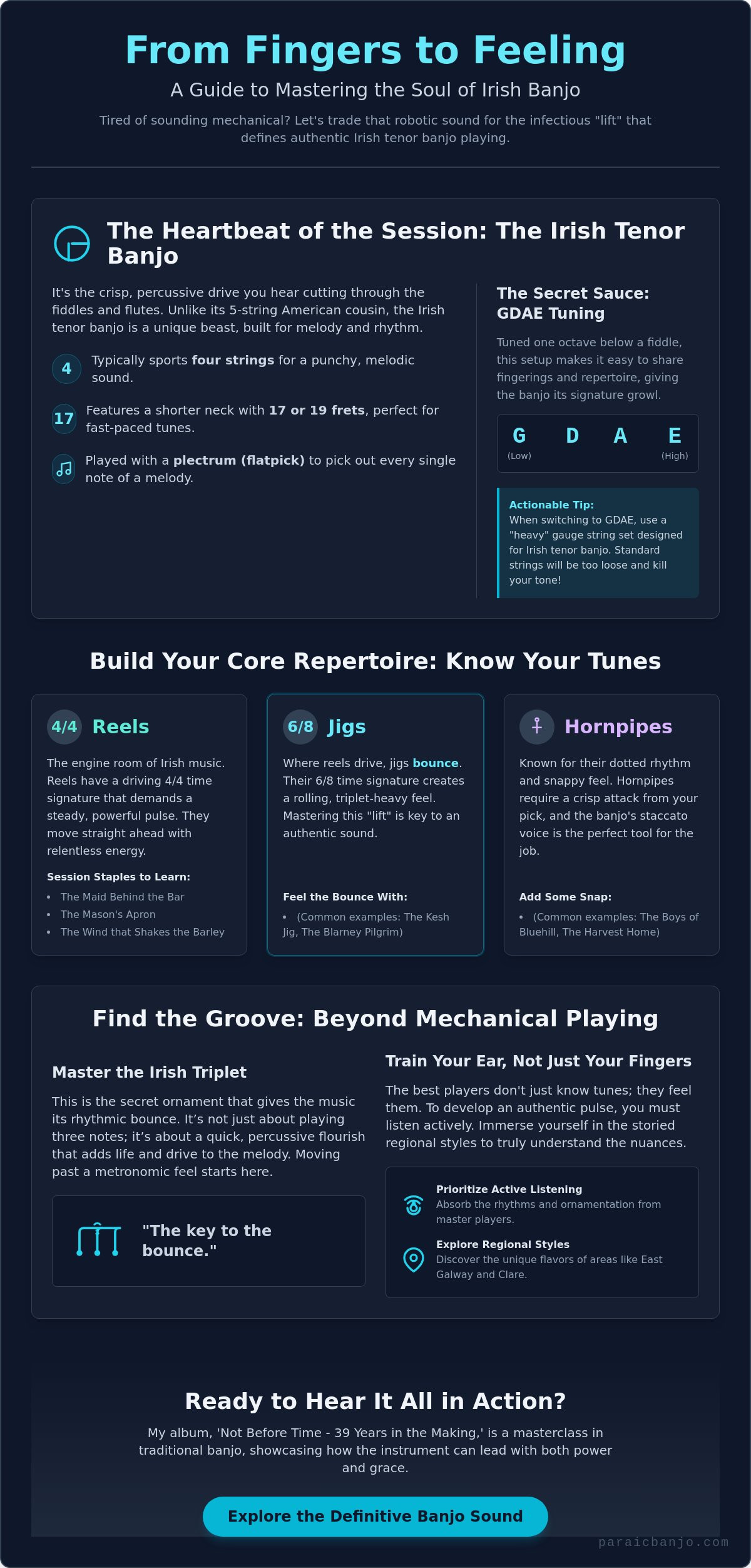
The real secret to the Irish sound lies in how we tune the strings. While jazz players use CGDA, Irish musicians tune to GDAE. This is exactly one octave below a fiddle. It allows us to play traditional reels and jigs using the same fingerings as a fiddle player, making the repertoire much more accessible. This tuning gives the instrument a growling, resonant low end that provides incredible depth to any set.
Actionable Tip:
If you are switching to GDAE tuning, don't use standard tenor strings. They'll be too loose and floppy. Instead, choose a "heavy" gauge set specifically designed for Irish tenor banjo. This maintains the right tension, prevents buzzing, and ensures your triplets sound sharp and clear.
Essential Repertoire: Classic Irish Reels and Jigs
Building a repertoire is a rite of passage for any player. You aren't just learning songs; you're joining a conversation that has spanned centuries. To start, you need to understand the different rhythmic structures that make up the tradition. Reels are the engine room. They provide a driving 4/4 force that demands a steady, unrelenting pulse. A tune like "The Maid Behind the Bar" is a perfect example of this energy. It’s a session favorite for a reason. It has a melodic flow that sits beautifully on the banjo's fretboard while allowing you to lean into that percussive drive. These are the essential irish banjo tunes for listeners and players alike who want to feel the true weight of a session.
Jigs offer a different kind of magic. While reels drive forward, jigs bounce. They use a 6/8 time signature that creates a rolling, triplet-heavy feel. Mastering this "lift" is what separates a technician from a traditionalist. Beyond the big two, you'll encounter hornpipes. These tunes use a dotted rhythm that requires a crisp, snappy attack from your pick. The banjo's natural staccato voice is perfect for this. For a deeper look at how these structures became part of our musical identity, you might enjoy this Academic Thesis on the Banjo in Irish Music. It details the instrument's long journey into the heart of the tradition. Don't forget the regional flavors either. Polkas and slides from the Kerry and Cork traditions bring a wild, infectious energy that can brighten up any set of tunes.
Top Reels for the Tenor Banjo
If you want to test your mettle, start with "The Masons Apron." It's a masterclass in fingerwork and variations. It pushes you to move beyond the basic melody and explore the banjo's full range. Another staple is "The Wind that Shakes the Barley." This tune is a fantastic lesson in clean string crossings. You have to keep the notes distinct while maintaining a blistering pace. These tunes are absolute essentials and are featured on almost any traditional irish session music cd you’ll find today. They represent the gold standard of the melodic style.
Essential Jigs for Beginners and Pros
For those just starting, "The Kesh Jig" is the quintessential entry point. It's accessible but holds a world of rhythmic potential. Once you’ve mastered that, try "Morrisons Jig." It introduces you to E-minor tonality and forces you to work on your low-string melodies. If you want to hear these classics played with the authentic lift of the East Galway style, you can find them on my album, Not Before Time - 39 Years in the Making. It’s a collection that celebrates these very roots.
Actionable Tip:
When playing fast 6/8 jigs, the biggest mistake is tensing up. Keep your pick hand relaxed. If you grip the plectrum too tightly, your wrist will lock, and you’ll lose that vital bounce. Think of the rhythm as "Rash-er-of-Ba-con" to keep your timing consistent and your hand loose.
Mastering the Rhythmic Pulse and Triplets
Technical precision is one thing, but soul is quite another. You can play every note of a tune perfectly in time with a metronome and still miss the point entirely. In Irish music, we talk about the "pulse" rather than just the beat. The pulse is that living, breathing heartbeat that makes a room full of people tap their feet in unison. It isn't rigid. It has a slight swing, a subtle delay, and an infectious lift that gives the music its character. For anyone exploring essential irish banjo tunes for listeners, you'll notice that the best players aren't just hitting notes; they're driving a percussive engine that supports the entire session.
The most iconic tool in our rhythmic arsenal is the Irish triplet. This is a quick burst of three notes played in the space where you might normally play one or two. There are two main ways to approach this: the standard Down-Up-Down (DUD) and the more specialized Down-Down-Up (DDU). Most players start with DUD because it fits the natural flow of alternate picking. However, some masters prefer the DDU approach to get a specific "snap" on the final note. Don't worry about raw speed yet. Speed is a byproduct of relaxation. If you focus on the rhythmic lift first, the speed will come naturally without making your playing sound like a machine.
The Secret of the East Galway Lift
Understanding regional styles is the key to moving from a student to a traditionalist. There is a beautiful tension in the east galway vs clare music debate. East Galway style is often characterized by a slightly more relaxed tempo with a heavy emphasis on the backbeat. This creates a rolling, danceable momentum that feels grounded. It isn't about rushing to the finish line. It's about savoring the space between the notes. When you play, try to lean into the second and fourth beats of a reel to find that elusive swing.
Actionable Tip:
To find the internal swing of a tune, practice your favorite reels at 50% of their normal speed. At this slow tempo, you can't hide behind fast picking. You'll be forced to hear where the rhythm breathes and where you can add that subtle "lift" to the melody.
Executing Clean Triplets
A clean triplet should sound like a crisp flick, not a labored struggle. The secret lies entirely in the wrist. If you feel tension creeping into your forearm, stop immediately. Your wrist should be loose, almost like you're shaking water off your fingertips. Placement is just as important as execution. Use triplets to highlight the "turn" of a musical phrase or to add energy to a repeating section. A common mistake is overusing them. If you clutter every bar with ornaments, you lose the natural beauty of the melody. Use them like salt in a stew; just enough to bring out the flavor.
How to Build an Authentic Banjo Repertoire
Building an authentic repertoire takes more than just a stack of sheet music. It requires an ear for the tradition. In the world of Irish music, we often talk about the oral tradition; the idea that music is passed down from person to person, ear to ear. If you want to find the most essential irish banjo tunes for listeners, your first step is to simply stop playing and start listening. Immerse yourself in the recordings of the masters. By studying players like Páraic Mac Donnchadha, you hear more than just notes. You hear the phrasing, the breath, and the subtle variations that give a tune its life. This deep listening builds a mental library that informs every stroke of your pick.
Don't overlook the power of a good set of liner notes. In a digital world, we often lose the "who" and the "where" behind the music. A tune isn't just a melody; it’s a connection to a specific person or a tiny village in East Galway. When you know that a reel was a favorite of a local fiddle player fifty years ago, you play it with a different level of respect. It moves from being an exercise to being a tribute. If you're ready to dive into a collection that honors these stories, you can order the physical CD or digital album of my debut work today to hear these connections for yourself.
The Value of Storytelling in Music
Knowing a tune's history fundamentally changes your relationship with the instrument. It’s the difference between reciting a poem and telling a personal story. When you look for ways to buy traditional irish music, seek out projects that include rich historical context. My own project, Not Before Time, was thirty-nine years in the making. I made sure the liner notes documented the people and places of the East Galway tradition. This preservation ensures that the music remains a living, breathing history rather than a museum piece.
Actionable Tips for Daily Practice
Once you have your tunes, you need a way to master them. I always recommend the Slow-Fast-Slow method. Start by playing a difficult phrase very slowly to lock in the fingering. Then, bring it up to session speed to test your muscle memory. Finally, bring it back down to a crawl. This final slow pass ensures that you haven't sacrificed your tone or rhythm for the sake of speed. It’s a disciplined way to ensure your essential irish banjo tunes for listeners sound polished and grounded.
Record yourself: Use your phone to record your practice. It’s the most honest teacher you’ll ever have. You’ll quickly identify exactly where your rhythm drifts from the pulse.
Create sets: Don't just learn isolated tunes. Group them into sets of two or three. Think about how the key of one tune leads into the next. A G-major reel followed by one in E-minor often creates a lovely, haunting transition.
Find a session: There is no substitute for the "wild." Find a local session and listen. Even if you don't play a single note, being in the room where the music is happening will teach you more about the rhythmic soul of the tradition than any book.
Practical Tip:
When grouping tunes into a set, try to find a common "thread." This could be a shared regional origin or a similar melodic motif. This makes the transition feel like a natural progression rather than a jarring change.
Not Before Time: A Masterclass in Traditional Banjo
This project is more than just a debut. It’s a milestone that has been thirty-nine years in the making. My album, Not Before Time - 39 Years in the Making, is a personal invitation into the heart of the East Galway and Clare traditions. It’s a definitive statement of a lifetime's passion, capturing the very essence of the rhythmic soul we've explored in this guide. For those seeking essential irish banjo tunes for listeners, these 18 tracks offer a deep dive into the repertoire that defines our heritage. Each set moves from driving, percussive reels to those bouncy, rhythmic jigs that give the West of Ireland its unique musical signature.
Actionable Tip:
Use the album for active ear training. Pick one track and listen to it repeatedly until you can hum the entire melody, including the ornaments, without the music playing. Once the tune is "in your head," you'll find that your fingers find the correct positions on the fretboard with far less effort.
The Collaborative Spirit of the Album
Traditional music is never a solitary pursuit. It’s a conversation. In these recordings, I wanted to capture the live, raw energy of a real session. The relationship between the banjo and the accompaniment is vital; they lock together to create a rhythmic engine that drives the dance. Purists often consider this album a definitive statement of the East Galway style because it prioritizes the swing and the "lift" of the tune over raw, mechanical speed. It’s about the collective pulse of the players in the room.
Get Your Copy: Support Independent Irish Music
If you want to truly immerse yourself in this tradition, I recommend the physical CD. It comes with extensive liner notes that provide the historical context and background for every tune. This information is essential for any player who wants to move beyond just hitting notes to actually telling a story with their instrument. You can buy traditional irish music direct from artist through my store, which directly supports the preservation of this craft. Whether you choose the physical CD or the digital album, you're taking the first step toward mastering the rhythmic soul of the banjo. Start your journey today and let the music speak for itself. Happy picking!
Bring the Heart of the Session to Your Own Playing
Mastering the Irish tenor banjo is a journey that goes far beyond just hitting the right notes at the right time. We've explored the importance of the GDAE tuning, the secret to those crisp triplets, and why the "lift" of the East Galway style is so vital. By focusing on the rhythmic pulse instead of just raw speed, you'll find that your playing starts to breathe with the same energy you hear in a crowded session. It's about moving from technical execution to a deeply personal expression of the tradition.
Exploring these essential irish banjo tunes for listeners is the best way to anchor yourself in our shared heritage. If you're ready to hear these techniques in action, my debut collection is the perfect companion. It features 39 years of musical heritage packed into 18 tracks of authentic session-style recordings. This project serves as a definitive East Galway style guide for any dedicated player or listener. Experience the rhythmic soul of the West - Get the "Not Before Time" album here. Keep your pick hand loose, your ears open, and enjoy every step of this storied musical journey. Happy picking!
Frequently Asked Questions
What is the best banjo for playing Irish folk music?
The 4-string tenor banjo is the undisputed king of the Irish session. For a solid start, look at the Deering Goodtime series or Gold Tone Cripple Creek models, which usually cost between $200 and $700. If you're looking for a professional sound, vintage 1920s banjos from makers like Epiphone or Paramount are highly sought after for their punchy, resonant tone that cuts through a loud room.
Do I need a 17-fret or 19-fret tenor banjo for Irish tunes?
Both are perfectly fine, but your choice depends on your hand size and tone preference. A 17-fret banjo has a shorter neck, which makes those long stretches on the low G string much easier for beginners. A 19-fret banjo has more string tension and a brighter, louder sound. Most session players eventually move to a 19-fret model for that extra volume and sustain during fast reels.
What is the difference between GDAE and CGDA tuning?
GDAE is the standard tuning for Irish music because it sits exactly one octave below the fiddle. This means you can use the same fingerings as a fiddle player, making the repertoire much easier to learn. CGDA is the traditional jazz or "Standard" tuning. While it's great for chords, it makes playing traditional Irish melodies much more difficult because the intervals don't align with the tunes' natural flow.
Can I play Irish music on a 5-string bluegrass banjo?
While it’s possible, it’s a very different animal. The 5th string on a bluegrass banjo is designed for drone notes and finger-picking rolls, which can actually get in the way of the flatpicking style used in Irish music. To get that authentic, percussive snap, you're better off sticking with a tenor banjo and a heavy plectrum. It’s all about that staccato drive and rhythmic lift.
How long does it take to learn classic Irish songs on the banjo?
You can pick up a basic melody like "The Kesh Jig" in just a few weeks if you practice daily. However, the real work lies in mastering the rhythmic "lift" and the triplets. Immersing yourself in essential irish banjo tunes for listeners will help your ear recognize these patterns faster. Expect to spend a year or two of consistent playing before you feel truly comfortable jumping into a fast-paced session.
Is the tenor banjo hard to learn for guitar players?
It’s actually a very smooth transition because you already have the pick control and finger strength. The biggest hurdle is the tuning. Since the banjo is tuned in fifths rather than fourths, your scales and chord shapes will be completely different. I recommend starting with simple scales to get your brain used to the new intervals. Once that clicks, your guitar background will give you a huge advantage.
What are the most famous Irish banjo players I should listen to?
Start with Barney McKenna of The Dubliners; he’s the man who put the tenor banjo on the map. For a more modern, technical approach, listen to Gerry O'Connor or Enda Scahill. If you want to hear the deep, rhythmic soul of the West of Ireland style, my own recordings feature the authentic East Galway pulse that has been passed down through generations of local masters.
Where can I find reliable tabs for Irish banjo songs?
Websites like The Session are fantastic for finding basic melodies, but be careful; tabs don't show you the rhythm or the "swing." To truly master essential irish banjo tunes for listeners, you need to combine those dots on the page with active listening. My album, Not Before Time - 39 Years in the Making, includes detailed notes that help bridge the gap between the notes and the actual traditional feel.


Comments