Comparing Regional Irish Banjo Styles: A Guide to the Art of the Irish Tenor Banjo
- Paraic Mac Donnchadha

- Jun 12
- 13 min read
Have you ever sat in the middle of a session and wondered why two players, both technically brilliant, sound completely different? It’s easy to get lost in the flurry of fast reels and technical terms like triplets or ornamentation. You might feel like you're missing a secret language that everyone else is speaking fluently. I know that feeling well, but I also know the joy of finally hearing the subtle differences that make each county's sound unique.
The truth is that the magic lives in the local "pulse" and the subtle lift that defines a player's home county. By comparing regional irish banjo styles, we can unlock the rhythmic codes that make this tradition so rich. This guide is here to help you move past the noise and discover the specific secrets that separate a relaxed Clare swing from the driving energy of East Galway. We’re going to look at how these traditions grew and give you the tools to finally hear the music for what it really is. Let’s start this journey together and find the style that speaks to your soul.
Key Takeaways
Learn why the 4-string tenor banjo is the backbone of the session and how its specific tuning creates that unmistakable rhythmic drive.
Master the art of comparing regional irish banjo styles by distinguishing the relaxed soul of East Galway from the bouncy, energetic flow of the Clare tradition.
Identify the "pulse" of a tune by listening for specific triplet placements, helping you move beyond technical jargon and truly feel the music.
Discover how to develop your own musical voice by blending traditional regional roots with personal ornamentation and creative flair.
Find out which recordings, like the tracks on Not Before Time – 39 Years in the Making, serve as a perfect roadmap for studying authentic rhythmic playing.
Table of Contents
The Fundamentals of the Art of the Irish Tenor Banjo
The Irish tenor banjo is a unique beast. It's got four strings and a short neck, making it perfect for the fast melodies of our tradition. While the History of the Banjo is broad, we made it our own with GDAE tuning. This is exactly the same as a fiddle, just one octave lower. This shift allowed the banjo to mirror fiddle tunes perfectly while adding a percussive "pop" that cuts through the thickest wall of sound. It's a wonderful bridge between the melodic and the rhythmic worlds. You can hear how this specific setup sounds in a real world setting by exploring the individual digital tracks from my debut album.
When you start comparing regional irish banjo styles, you'll quickly realize that the instrument's role is about much more than just hitting the right notes. It's about the "clack" of the pick and the soul of the rhythm. A player who only focuses on the melody is like a drummer who only hits the cymbals. You need that deep, resonant pulse to drive the dancers and keep the session together. It took me nearly four decades to truly capture that feeling on my album, Not Before Time, where the focus is always on the heartbeat of the tune rather than just the speed of the fingers.
Tuning and Setup for the Irish Sound
To get that authentic sound, GDAE is your only real option. It allows you to use the same fingerings as a fiddle, which is vital for the fast reels we love. I always tell fellow players to pay close attention to their plectrum. A flimsy pick will give you a thin, "tinny" sound that gets lost in a crowd. Go for something heavier, perhaps 1.0mm or thicker, to pull a soulful, woody tone out of the strings. If the strings are too floppy, your ornaments, those little decorative notes, will sound muddy and slow. It's all about precision.
The Rhythmic Core of the Banjo
Think of your banjo as a drum with strings. The melody is important, but the "lift" is what makes people tap their feet. Lift is that subtle emphasis on the off-beat that gives Irish music its bouncy, infectious feel. In my own playing, I've always prioritized this pulse over raw speed. You don't need to play a thousand miles an hour to be a great player. You just need to be solid. Focus on the downstroke on the beat and let the rhythm breathe. This is a key part of comparing regional irish banjo styles, as some areas favor a hard, driving beat while others prefer a more relaxed, swinging pulse.
The East Galway Style: Rhythmic Soul and Steady Pulse
If you're looking for the heart of the West, you'll find it in the East Galway style. It's a sound that values the space between the notes as much as the notes themselves. When comparing regional irish banjo styles, the East Galway approach stands out for its "lonesome" melodies and deep, unwavering rhythm. This isn't music meant to be played at a gallop; it's music meant to be felt in the bones. The influence of the local fiddle tradition, particularly the legendary Paddy Fahy, is undeniable. Fahy’s tunes often have a haunting, minor-key quality that requires a banjo player to be incredibly precise with their pick. You aren't just playing a reel; you're capturing a mood.
I've always believed that an uncluttered style is the most difficult to master. It's easy to hide behind a flurry of fast notes, but when you slow things down, every pick stroke counts. This philosophy is the core of my album, Not Before Time – 39 Years in the Making. It represents a lifetime of learning how to let a melody speak for itself without crowding it with unnecessary noise. It’s about finding the soul of the tune and staying there. If you want to hear this rhythmic soul in action, you can explore the individual digital tracks that showcase this steady, soulful pulse.
The Influence of the Ballinakill Tradition
The roots of this sound stretch back to the Ballinakill tradition, famous for a steady, swinging pulse. Unlike some of the more aggressive styles found in the North, this swing is gentle but incredibly persistent. It’s a rhythmic soul that keeps the dancers moving without feeling rushed. If you want to start playing with this feel, try this: listen for the emphasis on the first beat of the bar. It shouldn't be a heavy thud, but a confident, grounding pulse that sets the tone for the rest of the measure. It’s the difference between chasing the music and leading it.
Páraic Mac Donnchadha and the Galway Pulse
My own journey with the banjo has been a 39-year conversation with this Galway pulse. I prefer to use subtle variations in the melody rather than constant, flashy ornamentation. This keeps the music rooted in the tradition while still allowing for personal expression. Understanding these nuances is a key part of exploring the East Galway vs Clare music heritage. It’s a joy to finally share this definitive statement of my passion with you. Take your time with these tunes. Let the rhythm sink in before you try to speed them up. That’s where the real magic happens.
The Clare Style: Lift, Ornamentation, and Flow
While the East Galway sound invites you to lean back into the rhythm, the music of County Clare is all about leaning forward. If you've ever stood in a hall while a set dance is in full swing, you've felt that unmistakable upward surge. When comparing regional irish banjo styles, the Clare approach is defined by its incredible speed and a bouncy energy that mirrors the dancers' feet. It is a spirited, high-energy conversation where the tempo is driven by the joy of the movement, creating a sound that is both massive and incredibly light.
The influence of the legendary Clare Ceili bands, like the Tulla and the Kilfenora, is woven into the DNA of the region's banjo players. These bands created a wall of sound that somehow managed to stay nimble. As a solo player, you're trying to replicate that collective power through shimmering textures and constant movement. It’s a beautiful contrast to the stripped-back approach we find in other parts of the West. If you want to hear how this energy translates to the strings, you can explore the individual digital tracks from my own collection to see how these regional pulses differ.
Triplets and Trebles: The Clare Signature
In Clare, the use of the triplet is less about marking time and more about adding a "crackle" to the melody. Players here often use these flourishes to mimic the "crans" of a uilleann piper, which are fast, decorative notes that add a distinct texture. The secret to the Clare sound is the percussive treble. Unlike a smooth, flowing triplet, the percussive version hits with the force of a drumbeat, giving the tune its characteristic bite. It’s a technical choice that demands a very precise and confident pick hand.
The "Lift" and the Dance
To truly capture this style, you have to look for the "jump" in the music. While we've discussed the basic idea of the lift, in Clare, it’s much more pronounced. Here is a practical tip for your next listening session: try to feel the surge on the "and" between the main beats. This is where the music seems to take flight. When comparing regional irish banjo styles, you’ll notice Clare players often use a "front-side" triplet in jigs, placing the ornament right at the start of the beat to create that forward motion. It’s a subtle shift in timing, but it’s exactly what gets people out of their seats and onto the dance floor.
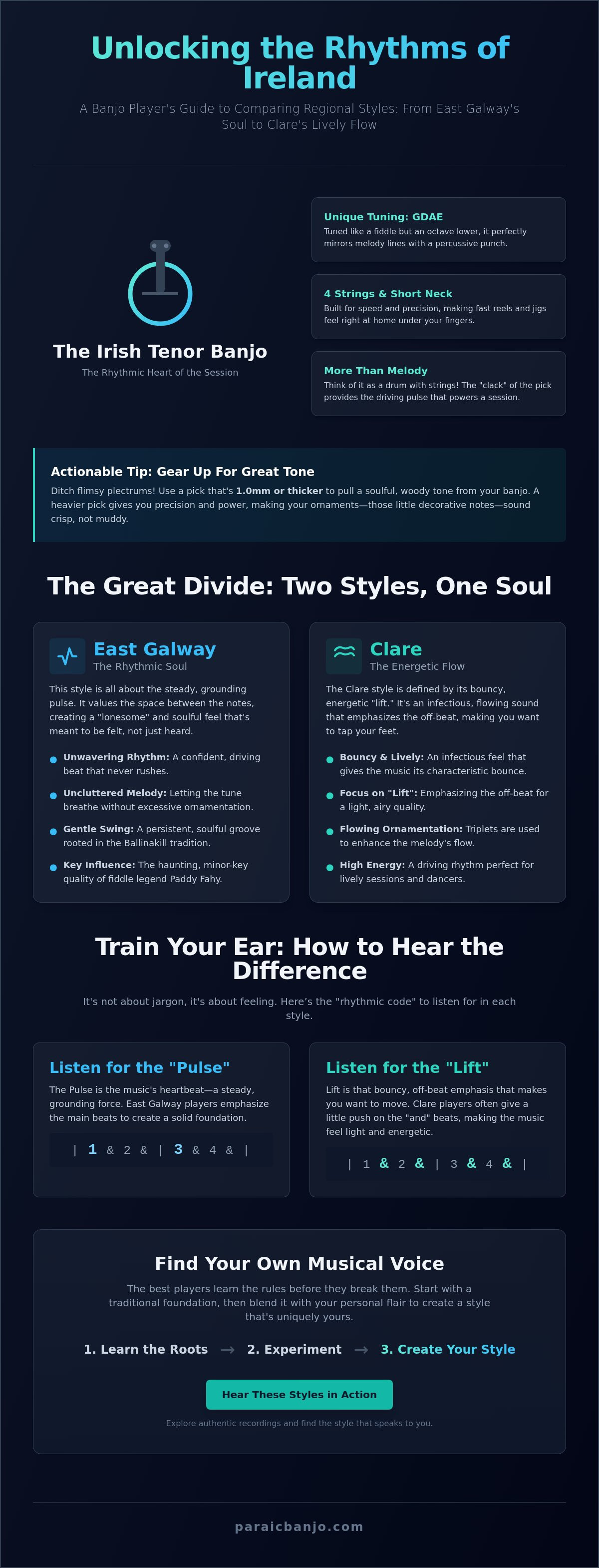
How to Spot the Differences: A Practical Comparison
Learning to tell regional styles apart is a bit like learning a local accent. At first, it all sounds like one beautiful blur of music, but soon you start to hear the specific "lilt" that gives a player away. When comparing regional irish banjo styles, you have to look past the speed and focus on how the player handles the "empty space" in a tune. Some players use that space to let the melody breathe; others fill it with percussive triplets that act like a drum roll. While every musician eventually finds their own personal voice, that voice is almost always rooted in the soil of their home county.
One of the most fascinating markers of regional identity is the "Front-side" versus "Back-side" triplet. A triplet is a quick burst of three notes played in the time of one. In some regions, players prefer the "Front-side" triplet, where the ornament hits right on the main beat to give the tune an aggressive, driving start. Others favor the "Back-side" triplet, which happens just after the beat, creating a subtle, swinging delay. It’s a tiny technical detail, but it completely changes the "feel" of a reel or a jig. It’s the difference between a style that pushes you forward and one that invites you to lean back into the groove.
Comparison Framework: East Galway vs. Clare
To help you sharpen your ear, keep these core differences in mind as you listen to your favorite players:
Tempo: East Galway is generally more relaxed and steady, prioritizing a deep pulse. Clare is often faster, focusing on a bouncy, energetic "lift."
Ornamentation: Galway players tend to be sparse and subtle, using variations in the melody itself. Clare players use frequent, percussive trebles to mimic the sound of other instruments.
Melodic Variation: In Galway, the variation is often internal and rhythmic. In Clare, the focus is on keeping the music "moving upward" for the dancers.
How to Develop Your Own Ear for Style
The best way to learn is to listen to the same tune played by different masters. Take a classic reel like "The Morning Star." Find a recording from an East Galway master and then one from a Clare powerhouse. Don't focus on the notes. Instead, ask yourself: where is the pressure? Is the player hitting the first beat of the bar hard, or are they skipping over it to create a sense of flight? Studying 15 or 20 traditional irish session music cds will reveal these patterns more clearly than any textbook ever could.
If you want to hear these regional nuances captured with clarity and soul, I invite you to explore the individual digital tracks from my debut album. It’s a project that took 39 years to perfect, specifically designed to showcase the steady, rhythmic heart of the East Galway tradition. Take a listen and see if you can feel that specific pulse we've been talking about. It’s a journey well worth taking. Happy listening!
Immersing Yourself in the Banjo Tradition
Stepping from the sidelines into the heart of the tradition is a big moment. It's when you stop just hearing the tunes and start feeling the specific choices a player makes. After decades of honing my craft, I released Not Before Time – 39 Years in the Making as a definitive statement of the East Galway sound. It’s more than just a debut; it’s a masterclass in that steady, rhythmic pulse we’ve been discussing. When you are comparing regional irish banjo styles, having a solid reference point for one specific tradition makes it much easier to spot the nuances in others. It's about building a foundation for your own musical ear.
I've always found that the best way to learn is to get close to the source. Digital files are convenient for a quick listen, but the liner notes in a physical copy are where the real education happens. These notes contain the stories behind the tunes and the names of the composers who kept this music alive. If you're ready to dive deeper, you can find the Not Before Time – 39 Years in the MakingPhysical CD or Digital Album on my site. Buying directly from the artist ensures that these regional styles are preserved and celebrated for years to come. It’s a direct connection to a lifetime of passion.
Building Your Authentic Collection
There is something special about holding a physical record in your hands. For purists, those detailed background notes are essential. They explain why a certain tune has a "lonesome" feel or how a specific rhythm was passed down through generations. To truly understand the music, you need to know how to buy traditional irish music that captures that raw, live session energy. Independent releases often carry more soul and regional flavor than polished studio productions. Supporting these projects keeps the heartbeat of the West of Ireland strong.
Next Steps for the Aspiring Banjo Fan
Ready to take your interest further? Start a "listening log." Every time you hear a new banjo track, write down what you notice about the tempo and the triplets. Do they sound sharp and percussive or smooth and flowing? This active listening is the best way to master comparing regional irish banjo styles. Also, find a local session. You don't need to bring an instrument yet. Just sit and observe the rhythmic interplay between the players. You'll see how the banjo provides that essential heartbeat. Remember, this tradition is a journey, not a race. Take your time, enjoy the pulse, and let the music settle into your soul. I’ll see you at the next session!
Embrace the Heartbeat of the West
You've now seen how the magic of the Irish tenor banjo lies in the subtle choices made by regional masters. Whether it's the steady, lonesome pulse of East Galway or the high-energy lift of a Clare reel, these styles are the lifeblood of our musical heritage. By comparing regional irish banjo styles, you move closer to understanding the soul of every tune you hear in a session. It's a journey that takes time; every bit of active listening brings you closer to the craft and the community that keeps it alive.
To truly experience the rhythmic depth we've explored, I invite you to listen to my debut album. It features 18 tracks of pure, rhythmic tenor banjo recorded live to capture that authentic, raw session energy. The detailed liner notes provide the regional history you need to deepen your understanding of the tunes and their origins. Explore the rhythmic soul of East Galway and get your copy of "Not Before Time" here. Keep listening, keep tapping your feet, and most importantly, enjoy every note of this storied tradition. Talk soon!
Frequently Asked Questions
What is the difference between a 4-string and 5-string banjo in Irish music?
The 4-string tenor banjo is the standard instrument for Irish traditional music, while the 5-string is primarily used in bluegrass or old-time styles. Irish players tune the 4-string tenor to GDAE, which is exactly the same as a fiddle but one octave lower. This allows the banjo to play the fast, melodic runs of Irish reels perfectly. The 5-string has a short drone string that doesn't fit the melodic requirements of a traditional session.
Why is the East Galway style described as "relaxed"?
East Galway style is called "relaxed" because it prioritizes a steady, deep rhythm and "lonesome" melodies over breakneck speed. It’s about letting the tune breathe and finding a soulful pulse that feels grounded rather than rushed. This approach is a major factor when comparing regional irish banjo styles, as it focuses on the internal heart of the music rather than showy, fast ornamentation. It’s music meant for the soul.
Do I need a specific type of tenor banjo to play the Irish style?
You don't need a vintage masterpiece, but a 19-fret tenor banjo is the most common choice for session playing. Some beginners prefer a 17-fret model because the shorter neck makes those wide reaches a bit easier on the fingers. The most important part is the setup; make sure it's tuned to GDAE with strings heavy enough to pull a rich, woody tone from the instrument. A good plectrum or pick is also essential for clarity.
What are triplets in Irish banjo playing, and how do they differ by region?
Triplets are quick bursts of three notes played in the time of one or two, adding a percussive "snap" to the music. In Clare, these are often sharp and frequent to mimic the sound of a piper's ornamentation. In East Galway, triplets are used more sparingly. They are often placed subtly to emphasize the rhythm of a tune rather than just acting as decoration. It's a key detail when comparing regional irish banjo styles.
Is it better to learn the banjo by ear or from sheet music?
Learning by ear is the best way to capture the "lift" and swing of the tradition. While sheet music is helpful for learning the basic notes of a tune, it can't convey the subtle rhythmic nuances that define different regions. Try listening to a track multiple times until you can hum the melody before you even pick up your banjo. This builds a much stronger connection to the music's heartbeat and the player's soul.
Who are some famous players of the Clare banjo style?
Mick Moloney and Kieran Hanrahan are legendary figures known for their mastery of the Clare sound. Their playing often features the incredible speed and flowing ornamentation that the county is famous for. Listening to their recordings is a fantastic way to hear how that bouncy, energetic "lift" works in a professional setting. They perfectly capture the spirit of the great Clare Ceili bands in their solo playing, making the music feel alive.
How can I tell if a recording is an "authentic" regional style?
To spot an authentic style, look for recordings where the player has deep roots in a specific musical community. Authentic regional playing isn't just about technical skill; it's about specific rhythmic markers like the placement of triplets and the "swing" of the reels. Authentic recordings often feel like they were captured in the middle of a living tradition. They prioritize the "pulse" of the music over polished, sterile studio production techniques.
Why is Páraic Mac Donnchadha’s album called "Not Before Time"?
My album is called "Not Before Time" because it represents a 39-year journey to finally capture my musical voice on record. It’s a milestone that reflects decades of playing in sessions and honing the East Galway rhythmic style. The title is a bit of a friendly wink to the fact that this definitive statement of my passion was a long time coming. It arrived exactly when it was ready to be shared with the world.


Comments