Download Irish Session Music: A Guide to Finding Authentic Traditional Recordings
- Paraic Mac Donnchadha

- Jun 24
- 13 min read
Updated: Jun 30
Have you ever hit play on a track only to realize it sounds more like elevator music than a session in County Clare? Most digital files today are scrubbed so clean in the studio that they've lost the very heartbeat of the tradition. It's a common struggle when you want to download irish session music; you're often met with sterile, flat recordings or low-quality MP3s that lack any sense of place or history. You want the "lift," that infectious rhythmic drive that defines our music, but it's hard to find in a sea of generic stock audio.
I've spent nearly four decades immersed in these tunes, and I've learned that the best recordings are the ones that invite you into the room. In this guide, I'll show you how to find high-fidelity files that preserve the raw energy of a real session. We'll look at the importance of choosing direct-to-fan platforms where your support actually reaches the artist, and why having detailed liner notes can transform your understanding of a tune. You're about to discover how to build a digital library that feels as storied and vibrant as the tradition itself.
Table of Contents
The Search for Authentic Irish Session Music Downloads
An Irish traditional music session is more than a gathering; it’s a rhythmic exchange that has survived centuries. When you look to download irish session music, you aren't just searching for a melody. You're looking for the pulse of a community. Real session music is characterized by its spontaneity and the "lift," which is that elusive, driving energy that makes it impossible to keep your feet still. It is a live, breathing conversation where tunes are shared, not just played.
Generic "stock" Irish music often fails the authenticity test because it’s created for background noise rather than for the tradition itself. These tracks frequently use MIDI or synthesized sounds that lack the organic grit of a wooden flute or the bright, percussive snap of a tenor banjo. For the dedicated fan, these sterile recordings feel hollow. They miss the subtle micro-rhythms and the "swing" that only come from years of playing in crowded, fire-lit pubs. To find the real thing, you need to look for recordings that respect the distinction between a "tune" and a "set." A tune is the individual melody, like a single reel or jig, while a set is the intentional sequence of two or three tunes played back-to-back. The magic happens in the transition between those tunes, and that’s what a high-quality recording must capture.
What Makes a Recording "Authentic"?
Authenticity starts with the instrumentation. Look for recordings that feature traditional pairings, like the fiddle and banjo or the accordion and flute, played with a focus on rhythm over raw speed. In styles like East Galway, the music is often played at a steadier pace to allow the soulful "lift" to breathe. The personnel on the track matters deeply too. Seek out artists who are rooted in their local musical communities, as their playing carries the history of the teachers who came before them. This connection creates a sound that is authoritative yet inviting.
Audio Formats for the Traditional Purist
Actionable Tip:
Before you buy, always check if the download includes metadata and digital liner notes. Authentic recordings often come with "stories" behind the tunes, listing where they were learned and who played them originally. This context is just as important as the audio itself. You can often find these as individual digital tracks or full albums on direct-to-fan platforms.
Why the "Session" Sound is Hard to Capture in a Studio
Capturing the raw energy of a pub session within the four walls of a studio is like trying to bottle lightning. In a crowded room in Galway, the music bounces off the stone walls, fueled by the heat of the crowd and the shared rhythm of the players. When you choose to download irish session music, you are often looking for that specific "lift," the infectious drive that makes the hair on your arms stand up. Most commercial studios are designed to be quiet and controlled, which can accidentally strip away the very soul of the performance. It takes a seasoned player to walk into that sterile environment and still play with the fire of a Saturday night session.
The secret lies in the interaction between the lead instrument and the accompaniment. Whether it is a piano or a guitar, the backing shouldn't just provide chords; it must dance with the lead banjo. This rhythmic conversation creates a "pulse" that feels alive. Achieving this level of cohesion often takes decades of playing together. It is about knowing when to push the tempo and when to let a note linger. If you want to hear this drive in action, you can explore individual digital tracks that capture this very essence, recorded with the goal of preserving that authentic session feel.
The Soul of East Galway and Clare
Regional styles are the heartbeat of the tradition. In East Galway, the music is often celebrated for its steady, soulful pace, while the Clare style might feel a bit more "lonesome" or wild. These nuances dictate how a musician phrases a melody. For a deeper dive into these differences, you can read about east galway vs clare music. For those researching the history of these sounds, the Irish Traditional Music Archive (ITMA) offers an incredible wealth of historical field recordings that highlight these regional flavors.
Mastering the Rhythmic Tenor Banjo
The tenor banjo is a percussive powerhouse in a session. A master player uses "triplets," which are three notes played quickly in the space of one, to add texture and "drive" to the set. This isn't just about speed; it is about rhythmic precision. Understanding the terminology helps you appreciate the craft. A Reel is a tune in 4/4 time with a steady, flowing feel, while a Jig is in 6/8 time, giving it a bouncy, "tri-p-let" rhythm. When a player like Páraic Mac Donnchadha records a track, he brings 39 years of session experience to ensure those rhythms feel natural, not forced.
Technical Tip:
When listening to a banjo track, pay attention to the "snap" of the triplets. If they sound muddy or rushed, the recording may have lost the rhythmic soul that defines the tradition.
Digital Downloads vs. Streaming: What is Best for You?
While streaming services make it incredibly easy to browse millions of tracks, they often sacrifice the very resonance that makes a tenor banjo or a fiddle sing. Standard streaming platforms typically compress audio to save bandwidth, which can make a complex set of reels sound "thin" or brittle. When you choose to download irish session music directly from the artist, you're opting for the full, uncompressed experience. You get to hear the actual wood of the flute and the percussive snap of the plectrum, just as it sounded in the room where it was recorded. It is the difference between seeing a photocopy of a painting and standing right in front of the canvas.
There is also the vital factor of ownership. In the world of streaming, you are essentially renting access to a library that can change at any moment. Tracks disappear, licensing deals expire, and suddenly your favorite set of jigs is gone. By downloading high-quality files to your own hard drive, you ensure that your collection is permanent. This is how real collectors build a legacy. For those looking to explore a vast, curated archive of the tradition, The Séamus Connolly Collection of Irish Music is a fantastic resource that demonstrates the value of preserved digital archives. Having your own copy means you can listen offline, anywhere from a remote cottage in Connemara to a flight across the Atlantic, without worrying about a signal.
The Collector’s Choice: Direct to Consumer
Buying direct is the gold standard for anyone serious about the music. It allows you to access digital liner notes, which are often the only way to learn the specific history of a tune or the names of the musicians involved. These stories are part of the heritage. If you're looking for a meaningful way to share this culture, high-quality digital tracks make incredible "heritage gifts" for the next generation. For more on this, see our guide on how to buy traditional irish music direct from artist.
Actionable Tip:
Use a dedicated music player app on your phone or computer that supports lossless formats like WAV or FLAC. This ensures you’re getting the maximum audio fidelity out of your downloaded library rather than letting a standard player downsample your files.
Supporting the Living Tradition
When you purchase a digital album, your support goes directly into preserving the music. For independent artists, the difference is staggering. A single £10 digital album purchase can generate approximately 200 times more revenue for an artist than the equivalent number of streams on a major platform. This financial support allows projects like 'Not Before Time' to exist, acting as a definitive milestone for the East Galway style. If you're ready to hear the difference that high-fidelity audio makes, you can download individual digital tracks today and start building a library that truly honors the tradition.
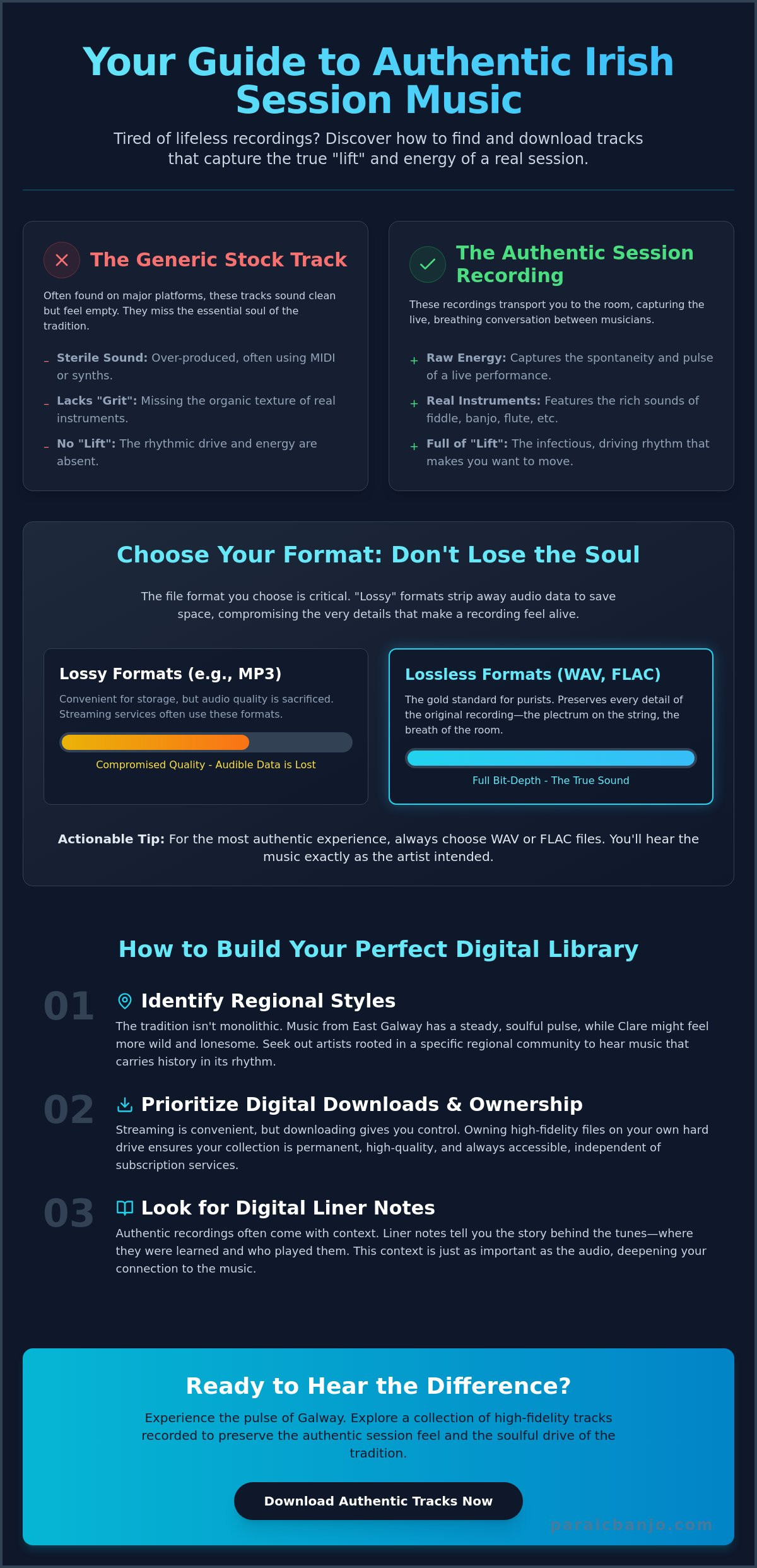
How to Build Your Digital Library of Traditional Irish Tracks
Building a library isn't just about hoarding files; it's about curating a personal archive of the tradition. When you set out to download irish session music, think of yourself as a custodian of these tunes. It’s a labor of love that spans decades, and your library should reflect that depth. You aren't just looking for background noise. You're looking for the "lift" we discussed earlier, that rhythmic heartbeat that makes the music come alive. Following a structured approach ensures your collection remains a functional, high-quality resource for years to come.
Identify Regional Styles: Start by exploring the steady, rhythmic pulse of East Galway, the wilder phrasing of Clare, or the bright, ornate fiddle style of Sligo. Knowing these flavors helps you find albums that resonate with your own musical spirit.
Seek Variety: Look for collections that offer a healthy mix of reels, jigs, and hornpipes. A hornpipe is played in 4/4 time like a reel, but it has a distinct, bouncy "dotted" rhythm that feels like a heavy step-dance.
Demand Context: Prioritize recordings that include detailed liner notes. Understanding who played a tune and where they learned it adds a layer of history that makes the listening experience much richer.
Choose Lossless Formats: Always opt for WAV or high-bitrate MP3s (320kbps). These formats preserve the percussive snap of the banjo and the resonance of the fiddle.
Organize by "Set": Tag your files by the type of set. If a track features three reels played back-to-back, label it as a "Reel Set" to make your session practice much easier.
What to Look for in a Digital Album
When browsing for new additions, check the credits for "live" recording sessions. This often indicates the musicians played together in the same room, which is essential for capturing that authentic session feel. A great digital album should also showcase a variety of instruments. Listen for the interplay between the banjo, fiddle, and piano. This variety creates the "conversation" that defines our music.
Actionable Tip:
Look for tracks specifically grouped into "sets." In a real session, tunes are rarely played in isolation. Finding recordings that transition seamlessly from one reel to another will help you learn how to manage those shifts in your own playing.
Storing and Protecting Your Music
Digital files are convenient, but they can be fragile if you don't have a plan. Always keep a backup of your library on an external drive. This protects your investment and ensures your collection survives computer upgrades or crashes. Use your digital liner notes as a study guide. They are often packed with the names of legendary players and specific tune names that you can use to further your research. If you still appreciate the feel of something tangible, check out our list of the traditional irish session music cd options for your physical collection.
Ready to add a cornerstone to your collection? You can purchase individual digital tracks to hear exactly how a well-curated, rhythmic set should sound. It’s the perfect way to start building a library that truly honors the tradition.
Experience the Pulse of Galway with 'Not Before Time'
After looking through generic archives and sterile stock tracks, it's time to hear the real pulse of the tradition. My debut album, 'Not Before Time – 39 Years in the Making', was recorded to solve the very problems we’ve discussed. It isn't just another collection of tunes; it is a definitive statement of the East Galway banjo style, captured with the raw energy of a live session. When you download irish session music of this caliber, you aren't just getting files. You're getting 18 tracks of pure, rhythmic soul that took nearly four decades to perfect. It is a celebration of the music I've lived and breathed since I first picked up the banjo.
This project features a carefully selected mix of reels, jigs, and hornpipes, all played with the steady, driving lift that defines my home region. I wanted to ensure that every note carries the weight of the masters who taught me. We recorded these tracks to preserve the "conversation" between the banjo and the accompaniment, making sure the studio didn't swallow the life of the music. You can choose from the full digital album or pick out individual digital tracks to round out your own collection. Whether you are a long-time collector or a newcomer to the tradition, these recordings offer a direct connection to the heart of Galway.
A Lifetime in the Making
This recording represents my 39-year journey through the sessions of Galway and beyond. It is a milestone that celebrates the community of musicians who keep this tradition alive. For anyone looking to buy traditional irish music that feels honest and deeply rooted, this album is an essential piece of the puzzle. The experience is highly sensory. You’ll hear the percussive snap of the strings and the warm resonance of the backing, creating a sound that is both authoritative and inviting. It’s the result of a lifetime spent honing a craft, finally shared with the world.
What’s Inside the Digital Download?
When you choose the digital version, you aren't sacrificing quality for convenience. These are high-fidelity files designed to bring the session directly into your living room. One of the most important features is the access to the digital liner notes. These aren't just a list of names; they are the stories and histories behind every set. You’ll learn where these tunes came from and why they matter to the East Galway tradition. This context transforms the music from a simple recording into a narrated journey through our musical heritage.
Ready to start?
It's time to stop searching and start listening.
and start your journey into the heart of Irish music today. I can't wait for you to hear the lift in these tracks. Enjoy the tunes!
Bring the Heart of Galway to Your Library
Finding the right recordings is about more than just filling a hard drive; it's about capturing a rhythmic soul that took generations to perfect. You now know that the "lift" of a real session comes from the percussive interplay between musicians, something often lost in sterile studio settings. By choosing to download irish session music in high-fidelity formats, you ensure that the crisp snap of the banjo and the resonance of the fiddle stay intact. Remember to prioritize direct-to-artist downloads where you get the full context of the tunes through detailed liner notes.
My debut album, 'Not Before Time', is the culmination of 39 years of musical heritage. It features 18 professionally recorded tracks that bring the authentic energy of an East Galway session into your living room. You'll receive high-quality digital audio along with the stories and history behind every set. It’s been a lifetime in the making, and I’m thrilled to finally share this definitive statement of my craft with you. Download "Not Before Time" - The Definitive Irish Banjo Album today and let the music take you home. Keep the tunes alive!
Frequently Asked Questions
Where can I find free Irish session music downloads?
Educational archives like the Irish Traditional Music Archive (ITMA) are the best places for free resources. These are perfect for learners who need to study specific tune versions or notation. While these field recordings are historically vital, they often differ from commercial studio albums which are mixed to highlight the percussive drive of the instruments for a more immersive listening experience.
What is the best audio format for downloading traditional Irish music?
Lossless formats like WAV or FLAC are the gold standard because they don't compress the sound. When you download irish session music in these formats, you preserve the subtle overtones of the banjo and the crisp breath of the flute. If you're short on storage space, a high-quality MP3 at 320kbps still offers a great balance of clarity and file size.
How do I know if an Irish music download is authentic?
Authenticity is found in the "lift" and the grouping of tracks into sets. Real session recordings avoid synthesized backing and focus on the natural interaction between lead instruments like the fiddle or banjo and traditional accompaniment. If a recording feels too rigid or "metronomic," it likely lacks the organic swing that defines the living tradition of the West of Ireland.
Can I download individual tracks or do I have to buy the whole album?
Most independent artists allow you to purchase individual digital tracks to suit your specific needs. This is a great way to pick out a particular set of reels or jigs you're currently learning. However, buying the full album usually gives you a more complete picture of the artist’s regional style and often comes with bonus digital materials like high-resolution liner notes.
What are digital liner notes and why do I need them?
Digital liner notes are the PDF booklets that accompany high-quality downloads. They are essential because they document the "genealogy" of the tunes; who played them, where they were learned, and their regional origins. Without these notes, you lose the stories that connect the music to the people and places of the tradition, leaving you with just the audio.
Is it better to download music or buy a physical CD?
It depends on whether you value immediate portability or a physical legacy. Digital downloads are perfect for listening on the go and offer the same high-fidelity sound without the physical footprint. Physical CDs, however, serve as a tangible milestone and a beautiful heritage gift that can be passed down through families, ensuring the music remains a permanent fixture in the home.
How does buying music directly from the artist help the tradition?
Buying through direct-to-fan platforms ensures that your support actually reaches the musician rather than being lost to streaming subscription fees. When you choose to download irish session music directly from creators like Páraic Banjo, you provide the resources necessary for them to continue documenting regional styles. This financial support is what allows independent projects to thrive outside the mainstream commercial industry.
What is the difference between a reel and a jig in a session recording?
The difference lies in the rhythmic structure and time signature. A reel is in 4/4 time with an even, driving pulse that is the staple of most sessions. A jig is in 6/8 time, creating a rolling, triplet-based feel often described as "double-decker" or "rash-er-of-ba-con." Recognizing these rhythms helps you understand the energy levels and pacing within a recorded set.


Comments