East Galway vs Clare Music: A Guide to the Rhythmic Soul of the West

Clare music dances with the feet, but East Galway music sings with the soul. If you've ever sat in a crowded pub in Miltown Malbay during the Willie Clancy Summer School and felt like every reel sounded identical, you aren't alone. It's easy to get lost in the flurry of fingers and bows without catching the subtle magic that separates these two powerhouses. This guide to east galway vs clare music will help you peel back the layers of rhythm and melody to hear what's actually happening under the surface.
You'll discover how to identify regional markers by ear and finally understand terms like lift, that infectious upward energy in a tune, without needing a music degree. We're diving into the history of these styles and highlighting the legendary recordings you need to study, from the lonesome tunes of Paddy Fahey to the rhythmic drive of West Clare. I've spent nearly four decades immersed in these sounds. My debut album, Not Before Time – 39 Years in the Making, is a direct result of that lifelong obsession. Whether you grab the physical CD or the digital album, you'll hear these traditions come to life. Let's start by finding that heartbeat in the music.
Key Takeaways
Learn to treat regional styles as local accents for your instrument, allowing you to better understand the history behind the tunes you play.
Recognize the relaxed, winding stream tempo and haunting minor keys that give East Galway its signature lonesome sound.
Master the art of spotting east galway vs clare music by listening for the lift, a rhythmic energy in Clare music that drives dancers to the floor.
Discover the Nyah, a soulful and expressive quality in Clare playing that adds a gritty, beautiful texture to every note.
Put these tips into practice by listening to authentic examples, like the curated tracks found on my debut release, Not Before Time.
Table of Contents
What exactly is a 'Regional Style' in Irish Traditional Music?
Imagine walking into a kitchen session in the 1940s. Back then, your music was shaped by the people living three miles down the road, not by a global playlist on a smartphone. This isolation created what we call regional styles. Think of them as local accents for your fiddle or banjo. Just as a Dubliner sounds different from a person from Cork, a player from East Galway carries a different "lilt" than someone from West Clare. Understanding the nuances of east galway vs clare music isn't just for academics; it's the key to truly feeling the "lift" in a set of reels during a session.
Three primary factors usually dictate these styles: the local landscape, a handful of legendary masters, and the instrument that dominated the parish. In Clare, the concertina and fiddle reigned supreme. In East Galway, the flute and fiddle set a different pace. These influences created a specific sonic fingerprint that remains vibrant in Irish traditional music today. Even in 2026, with all our digital connectivity, these "accents" help us connect to the specific soil where the tunes were raised. It makes you a better listener because you're no longer just hearing notes; you're hearing a story of a specific place and time.
The 'Accent' of the West
The rolling hills and rugged coastlines of the West didn't just provide scenery; they dictated the rhythm of life. These tunes were born for house dances, where the tempo was set by the feet on the floor. In Clare, that often meant a driving, pulsing beat designed to keep dancers moving. In East Galway, the music leaned toward a more relaxed, flowing "lonesome" sound. This difference is why the West of Ireland remains the beating heart of the tradition. You can experience this firsthand at the Willie Clancy Summer School in July 2026, where these rhythms are celebrated in every corner of Miltown Malbay.
Beyond the Notes: What to listen for
Playing the style is about more than hitting the right notes. It's about the "pulse," the heartbeat beneath the melody. Ornamentation, or the "decorations" like rolls and cuts, also varies. A Clare player might use a sharper, more rhythmic attack, while an East Galway player might let the notes bleed into each other with a fluid grace.
Actionable Tip: Next time you listen to a recording, try to ignore the melody for a minute. Focus entirely on the rhythm. Is it a steady, driving gallop or a winding, unhurried stream? Identifying this pulse is the fastest way to tell the difference between these two traditions. I've spent 39 years absorbing these pulses, and you can hear how they've shaped my own playing on the individual digital tracks of my debut album, Not Before Time – 39 Years in the Making. Whether you choose the physical CD or the digital version, pay close attention to how the banjo tries to capture that elusive West of Ireland swing. It’s a journey that’s still unfolding today.
The East Galway Style: The Flowing, Lonesome Sound
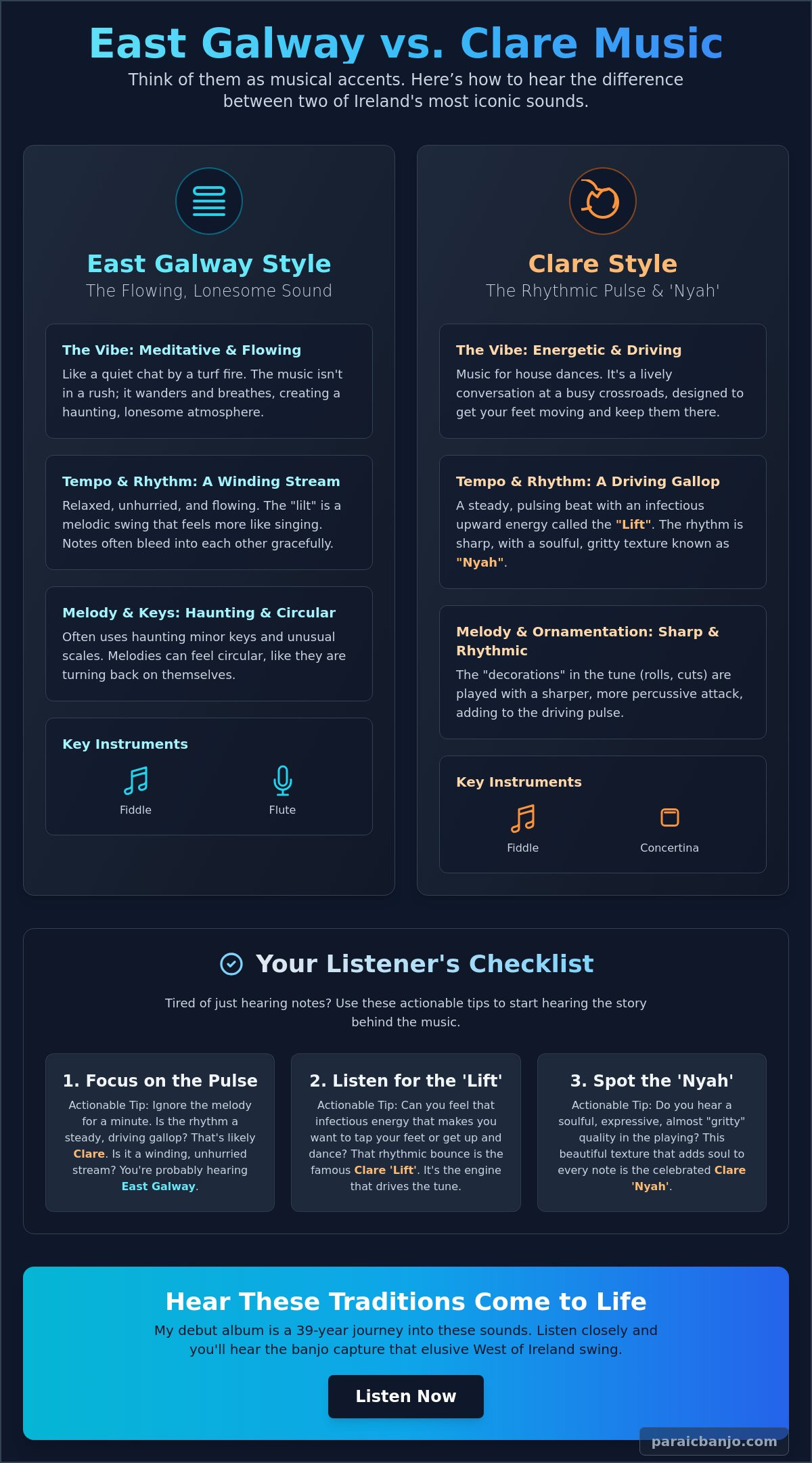
East Galway music is a meditative experience. While many listeners naturally group it with its neighbors, the reality of east galway vs clare music is that they possess entirely different souls. If Clare music is a conversation at a busy crossroads, East Galway is a quiet chat by a turf fire. It's characterized by a relaxed, flowing tempo that feels completely unhurried. The music doesn't just travel from point A to point B; it wanders through the mist of minor keys and unexpected intervals. This isn't music for a frantic gallop; it’s music that breathes.
The core of this style lies in the "lilt," a melodic swing that feels more like a vocal tradition than a purely instrumental one. You'll hear this most clearly in the hands of wooden flute players and nuanced tenor banjo pickers who prioritize tone over speed. Unlike the driving energy found in the Traditional Music of Clare, the Galway approach leans into the spaces between the notes. It’s a sophisticated, almost shadowy sound that rewards the patient listener.
The Legacy of Paddy Fahy
You cannot talk about this region without mentioning Paddy Fahy. He was a master composer who defined the "lonesome" sound of East Galway. Interestingly, Fahy never named his tunes. In a session, you’ll simply hear someone say, "That’s a Fahy reel." His compositions often utilize minor keys and unusual scales that feel ancient and modern all at once. To recognize a Fahy-style tune, listen for melodies that seem to circle back on themselves, creating a haunting, circular feel that stays with you long after the session ends.
Actionable Tip: Slowing down the pulse
To truly feel this style, you have to change how you listen. Try these steps next time you hear a Galway tune:
Tap the off-beat: Instead of hitting the heavy "one" and "three," try tapping your foot to the lighter "two" and "four." This helps you feel the subtle Galway swing.
Listen for long notes: Galway players love to hold onto certain notes, letting the vibration fill the room. This adds to that "lonesome" emotional weight.
Explore the source: Check out the sound of East Galway for a deeper dive into this rhythmic heart.
I spent decades trying to capture this specific emotional depth on the banjo. It's a difficult balance to strike, but it’s what I aimed for across the 18 tracks of my debut album. If you're looking to bring this lonesome sound into your own home, you can find the Not Before Time digital album on my website. It’s a project 39 years in the making, and it’s my way of honoring the masters who taught me how to let the music flow.
The Clare Style: Rhythmic Pulse and the 'Nyah'
If East Galway music is a quiet conversation by the fire, Clare music is the sound of a crowded hall with the dust rising from the floorboards. It's built for the feet. While we've talked about the winding, lonesome flow of the Galway tradition, the Clare style is defined by a relentless, infectious pulse. When discussing east galway vs clare music, the most immediate difference you'll feel is the rhythmic drive. Clare players often emphasize the "on-beats," creating a steady gallop that makes it nearly impossible to keep your feet still. It’s a tradition dominated by the rhythmic snap of the concertina and the driving, ornamented bow of the fiddle.
This music wasn't just played; it was lived in the context of the dance. Whether it's a house session or a massive festival like the Kilfenora Traditional Irish Music Festival in April 2026, the goal is to provide a foundation for the sets. To hear this in its purest form, you can explore the collections at the Irish Traditional Music Archive, where decades of Clare’s rhythmic history are preserved. It’s a sound that’s both ancient and incredibly alive, pulsing with a vitality that hasn't dimmed over the centuries.
What is 'Lift' in Clare Music?
You’ll often hear musicians talk about "lift." It isn't just speed; in fact, playing too fast can often kill the lift. Lift is that specific upward energy that makes a tune feel buoyant and light. Clare players use "short notes" and sharp articulations to create a bouncing rhythm. This style was perfected by the great céilí bands like the Tulla and the Kilfenora. These groups didn't just play melodies; they provided a rhythmic engine. The Tulla Céilí Band, marking its 80th anniversary in 2026, remains a masterclass in how to maintain that lift without ever rushing the tempo. It's about the space between the notes as much as the notes themselves.
The 'Nyah' Explained
Then there’s the "nyah." This is a term that's hard to define but easy to feel. It refers to a soulful, slightly buzzy, and expressive quality in the playing. It’s that bit of grit in the sound that tells you the musician is putting their whole heart into the tune. The nyah isn't a mistake or a lack of technique. It’s a deliberate, soulful choice. You can hear it in the way a fiddler digs into a string or how a banjo player strikes a chord with a bit of extra "bite." It’s a sound that feels deeply personal and rooted in the soil.
Actionable Tip: To find the nyah, listen for the "growl" in the lower registers of a tune. When a player hits those low G or D strings with a bit of extra pressure, that’s the nyah coming through. I’ve spent my life trying to bake that same soul into my own recordings. If you want to hear how that Clare pulse translates to the tenor banjo, have a listen to the individual digital tracks from my album, Not Before Time – 39 Years in the Making. It’s about more than just the notes; it’s about that rhythmic heartbeat that connects us all. You can pick up the physical CD to hear exactly how these traditions have shaped my own journey.
How to Spot the Difference: A Listener’s Checklist
Distinguishing between east galway vs clare music becomes much easier once you stop looking at the sheet music and start feeling the pulse. It's a bit like learning to tell the difference between two similar wines. At first, it’s all just "red," but eventually, you catch the oak, the fruit, and the earth. In these traditions, the notes are just the beginning; it’s the attack and the space between them that tells the story. While the tunes themselves might overlap, the way they are delivered changes everything about the atmosphere of a session.
To help you identify these styles by ear, keep this simple checklist in mind during your next listen:
Tempo: Is it a steady, driving gallop? That’s likely Clare. Does it feel like a winding stream that flows at its own unhurried pace? That’s Galway.
Key Signatures: Clare music often feels "bright," like sunlight on the Atlantic. Galway music, especially under the Fahy influence, feels "shadowy" and mysterious, often utilizing minor keys.
Ornamentation: Listen to the triplets, those quick bursts of three notes. In Clare, they are crisp and percussive, almost like a drumbeat. In Galway, they are often slurred and smooth, blending into the melody.
Emotion: Does the tune make you want to jump up and find a partner for a set? That’s the Clare lift. Does it make you want to sit back, close your eyes, and just listen? That’s the Galway soul.
The 'Foot-Tap' Test
Your own body is often the best detector for regional styles. In a session, pay close attention to how you naturally react to the rhythm. If you feel like your heel is striking the floor with weight and purpose, you’re likely feeling that famous Clare lift. However, if you find yourself swaying slightly or tapping your toe gently in a more syncopated, off-beat way, you're likely caught in the East Galway flow. Try practicing this by listening to both styles back-to-back to sharpen your instincts.
Finding Authentic Examples
The best way to train your ear is by seeking out music from the West of Ireland that hasn't been polished to a sterile shine in a modern studio. Raw field recordings and solo albums are gold mines for regional nuances. These recordings allow the individual "accent" of the player to shine through without being drowned out by a full band. Always check the liner notes too. They usually mention the masters who influenced the player, which often points you directly back to the heart of these regional traditions.
I’ve poured my own 39 years of listening and learning into every track of my debut album. You can hear these differences for yourself and start your own collection when you pick up the Not Before Time physical CD. It’s a direct link to the traditions I’ve spent my life absorbing, and it’s a great way to bring that authentic West of Ireland sound into your own home.
Bringing the Tradition Home: The Modern Banjo Perspective
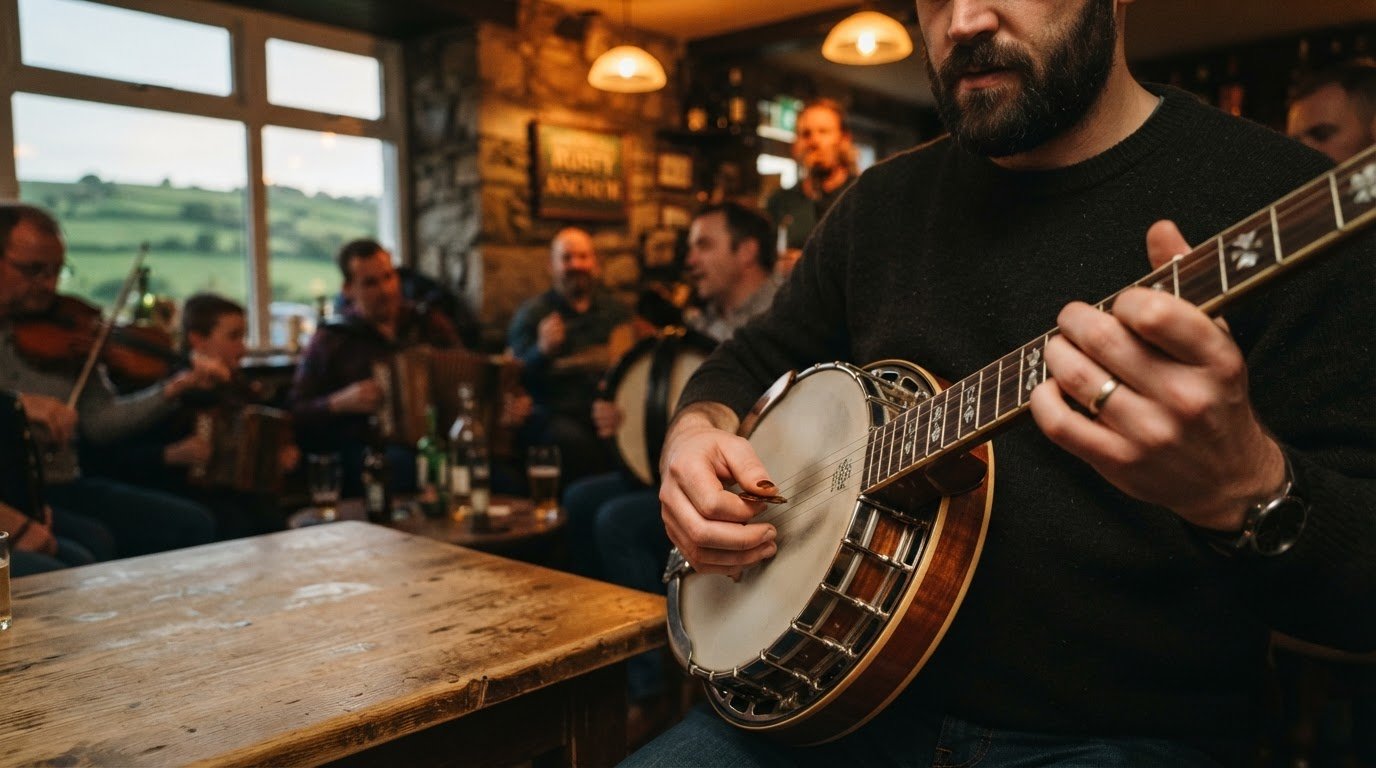
While the fiddle and flute often dominate the conversation about regional styles, the tenor banjo has a unique ability to bridge the gap between the two. It’s an instrument that can be as percussive as a drum or as fluid as a singer’s voice. Understanding east galway vs clare music from the perspective of a banjo player requires a deep appreciation for the plectrum, the small pick used to strike the strings. In the right hands, that plectrum doesn't just play notes; it dictates the entire mood of the tune, allowing a player to pivot between a driving Clare reel and a winding Galway melody with subtle shifts in technique.
My own journey with these sounds has been a long one. I've spent 39 years absorbing the nuances of the West, listening to the masters until their rhythms became my own. My debut project, Not Before Time – 39 Years in the Making, is more than just a collection of tunes; it’s a masterclass in regional sensitivity. I wanted to ensure that every track respected the soil it came from. When you listen to the Not Before Time digital album, you aren't just hearing a banjo; you're hearing nearly four decades of respect for the lift of Clare and the lilt of East Galway.
The Banjo’s Rhythmic Role
To mimic the lift of a Clare fiddle, a banjo player uses a sharp, crisp plectrum attack on the on-beats. This creates a bouncing energy that mirrors the bow's snap. On the other hand, achieving the Galway lilt requires a softer touch and very specific triplet placement. Triplets are those quick bursts of three notes played in the space of one. By "slurring" these triplets or placing them slightly off the main beat, the banjo can capture that unhurried, conversational flow. In 2026, the tenor banjo acts as a rhythmic bridge, using precise plectrum strikes to anchor the driving pulse of Clare while maintaining the fluid, conversational grace of the East Galway tradition.
Start Your Collection Today
In an era of streaming, traditional irish session music CDs remain the gold standard for anyone who wants to hear the true detail of the music. A physical disc allows you to hear the resonance of the instrument and the subtle "nyah" that often gets compressed and lost in low-quality digital files. Beyond the audio quality, buying direct is the best way to buy traditional Irish music and support the artists who spend their lives preserving these regional "accents."
Actionable Tip: When you're listening to a banjo track, try to focus entirely on the plectrum's "click" against the string. Is it sharp and rhythmic, or is it soft and almost hidden? This tiny detail is often the biggest clue to which regional style the player is honoring. If you’re ready to dive deep into these sounds, you can find my individual digital tracks or the full physical CD on my website. The music lives as long as we keep listening to its roots, and I’m honored to share my part of that story with you. Thanks for being part of the journey!
Keep the Heartbeat of the West Alive
The journey through the sounds of the West doesn't have to end here. By now, you've got the tools to hear the subtle magic in east galway vs clare music, from the driving, soulful "nyah" of a Clare fiddle to the ghostly, unhurried lilt of a Galway flute. You know that the "lift" isn't just about speed; it's about the heartbeat of the dance and the space between the notes. You've also seen how the banjo can weave these traditions together with a simple, deliberate shift in plectrum technique.
It's one thing to read about these styles, but it's another thing entirely to let them fill your own home. My debut album, Not Before Time – 39 Years in the Making, is a definitive statement of a lifetime's passion. It features 18 tracks recorded live with a host of expert collaborators, capturing the raw energy of a real session. I've also included detailed liner notes that explain the history and regional roots of every single tune, so you can continue your education as you listen. This work is the result of 39 years of mastery, finally captured in one place.
Experience the authentic sound of the West—Get 'Not Before Time' on CD or Digital today!
This music has survived for centuries because people like you choose to listen, learn, and pass it on. Keep your ears open and your feet tapping. I'll see you at the next session!
Frequently Asked Questions
What is the main difference between East Galway and Clare music?
The core difference between east galway vs clare music lies in the rhythmic pulse and overall tempo. Clare music features a driving, percussive energy meant for dancers, while East Galway music is characterized by a relaxed, flowing "lonesome" sound. One prioritizes the "lift" of the dance floor, and the other focuses on a melodic, conversational lilt that feels unhurried.
Is the tenor banjo a traditional instrument in these styles?
Yes, the tenor banjo is a mainstay in these traditions, having carved out its place over the last century. Its sharp, clear tone allows it to mimic the rhythmic snap of a Clare fiddle or the fluid triplets of a Galway flute. You can hear this versatility across the 18 tracks of my debut album, where I use the banjo to bridge these regional gaps.
What does 'lift' mean in Irish music?
Lift refers to the buoyant, rhythmic energy that makes you want to tap your feet or get up and dance. It isn't just about playing fast; it’s about the subtle emphasis on certain beats and the crispness of the notes. To practice this, try shortening your notes slightly to create more "air" in the tune, which naturally creates that bouncing Clare feel.
Who are the most famous East Galway style musicians?
Legendary fiddler Paddy Fahy is the most influential figure, known for his haunting, unnamed compositions. Other masters include flute player Paddy Carty, who used a unique wooden flute to achieve a fluid tone, and the Kane sisters. These musicians prioritized a "lonesome" emotional depth that remains the benchmark for anyone studying the East Galway tradition today.
Can I learn both styles, or should I stick to one?
You don't have to choose; learning both styles will actually make you a more versatile and sensitive player. Many musicians start with one "home" style and gradually incorporate elements of the other as they travel to different sessions. If you're just starting, try listening to the individual digital tracks of my album to see how I balance these two distinct rhythmic worlds.
Why is East Galway music often described as 'lonesome'?
The term "lonesome" describes the haunting, melancholic mood created by the minor keys and unusual scales favored in East Galway. This sound evokes a sense of quiet longing or mystery rather than sadness. It’s a sophisticated way of playing that rewards the listener who sits back and lets the melody wander through those shadowy, circular musical phrases.
Where can I find authentic recordings of these regional styles?
Authentic recordings are best found on solo albums and field recordings that capture the raw, unpolished "accent" of the player. For a definitive example of how these styles translate to the banjo, you can find the Not Before Time physical CD on my website. Buying direct ensures you get high-quality audio and detailed background notes that explain the history behind the music.
Does the style of the tune change if I play it on a different instrument?
The regional style stays the same, but the way you express it changes based on your instrument's mechanics. A fiddler uses their bow to create "lift," while a banjo player uses plectrum strikes and triplets to achieve the same rhythmic pulse. The goal is always to respect the tune's "home" style while letting the natural voice of your specific instrument shine through.

Comments