Essential Irish Tenor Banjo Music: A Guide to the Rhythmic Soul of Trad
- Paraic Mac Donnchadha

- Aug 5
- 13 min read
Updated: 1 day ago
The secret to legendary Irish banjo isn't how fast your fingers fly across the frets, but how well you capture the lift and pulse of the dance. It's a common struggle for many players; you spend hours scouring the internet for essential irish tenor banjo music only to end up buried under thousands of tunes and overly polished recordings that lack the grit of a real session. You want that raw, authentic sound, but finding a clear path through the regional nuances of East Galway or Clare can feel like chasing a ghost.
I understand that frustration because I've lived it for nearly four decades. This guide cuts through the noise to help you find the rhythmic soul of the tradition. You'll discover the core tune types like "The Leitrim Fancy" or "Wheels of the World" that form the backbone of any good repertoire. We'll also explore why learning by ear is your best tool for mastering the GDAE tuning and how to distinguish between regional styles. By the end, you'll have a curated list of tunes and a definitive reference album to help you stop practicing and start playing with heart.
Table of Contents
What Defines Essential Irish Tenor Banjo Music?
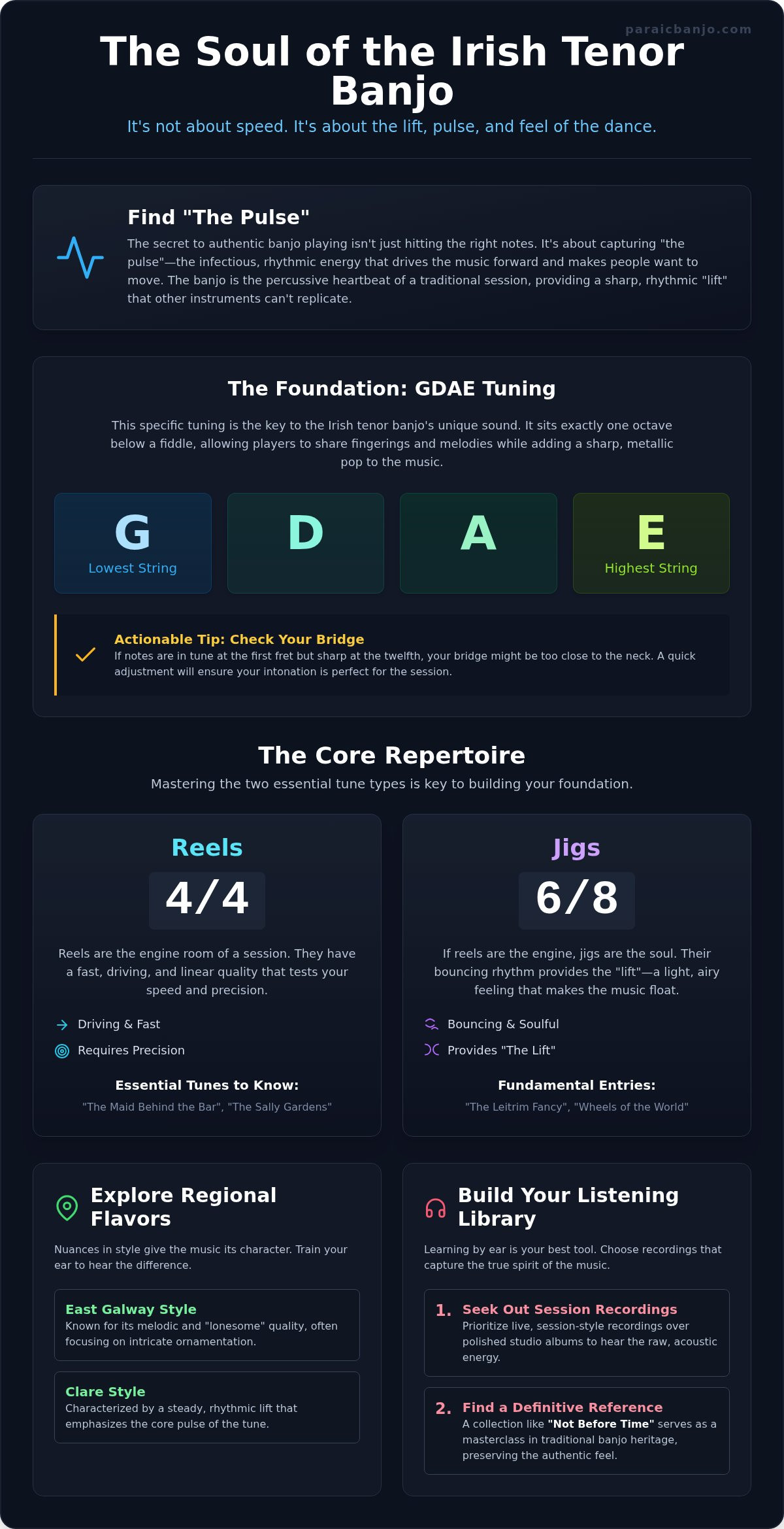
When you step into a crowded pub for a session, the banjo is often the first thing you hear cutting through the hum of conversation. It isn't just about the melody. Essential irish tenor banjo music is a driving, percussive force that gives the music its backbone. This four-string instrument is typically tuned GDAE, sitting exactly one octave below a fiddle. This specific tuning is the key to its resonance, allowing the player to mirror the intricate fingerings of a fiddler while providing a sharp, metallic "pop" that keeps the room moving. Essential banjo music is the marriage of crisp ornamentation and steady rhythm.
To truly understand this genre, you have to look beyond the notes on a page. We often talk about "the pulse," which is that infectious, rhythmic energy that makes people tap their feet without even realizing it. It is a feeling of forward momentum. If you want to hear this pulse in its purest form, my album, Not Before Time, features 18 tracks recorded live to capture that exact session energy. It’s a great way to hear how the banjo should sit within a group of players.
The Role of the Banjo in a Traditional Session
In a session, the banjo acts as the heartbeat. Because it is a plucked instrument, it provides a rhythmic "lift" that sustained instruments like the fiddle or accordion sometimes lack. A great player knows the difference between being "busy" and being effective. A busy player might throw in too many triplets (three notes played in the time of two) and clutter the tune. A respectful player uses their volume and timing to support the other musicians. If you are struggling to find that balance, listening to traditional Irish session music CDs is the best way to learn the ropes. You’ll hear how the banjo provides a percussive foundation that lets the melody soar.
GDAE Tuning: The Secret to the Sound
While the history of the banjo spans across different continents and styles, the GDAE tuning is what makes it undeniably Irish. This tuning allows for the same fingering as the fiddle and mandolin, making it easier for players to share a common repertoire. However, the tension of these heavier strings requires a bit of maintenance to sound right. Actionable tip: Check your bridge placement regularly. If your notes sound in tune at the first fret but sharp at the twelfth, your bridge might be too close to the neck. A quick adjustment ensures your intonation is session-ready and your "cuts" (quick grace notes used for rhythm) sound clear and bright. You can find more technical details and historical context in the liner notes of the Not Before Time physical CD, which I designed to be a masterclass for the dedicated listener.
The Core Repertoire: Jigs, Reels, and the Rhythmic Soul
Once you understand the pulse of the instrument, the next step is diving into the tunes themselves. Building a solid foundation in essential irish tenor banjo music means mastering three distinct rhythms: reels, jigs, and hornpipes. Each one demands a different approach from your picking hand and offers a unique way to express the character of the banjo. While some beginners might stick to just one style, a balanced repertoire is what truly defines a seasoned player. It is about more than just memorizing notes; it is about understanding the cultural weight behind every bar. This connection is explored deeply in academic research on the Irish banjo, which highlights how these tunes are woven into our very identity.
Essential Reels You Need to Know
Reels are the engine room of any session. Played in a fast 4/4 time signature, they test your speed and precision like nothing else. Classics like "The Maid Behind the Bar" or "The Sally Gardens" are considered session standards globally for a reason. They have a linear, driving quality that allows the banjo’s natural brightness to shine. Actionable tip: To keep your reels from sounding frantic, focus on a strict "down-up" picking pattern. Every beat should feel deliberate. If you find your hand tensing up, slow the tune down until the rhythm feels like a steady heartbeat rather than a race. You might even find it helpful to pick up a few individual digital tracks to hear how a steady tempo maintains the tune's integrity.
The Lift of the Jig
If reels are the engine, jigs are the soul. The bouncing 6/8 rhythm of a jig provides what we call "the lift," that light, airy feeling that makes the music feel like it’s floating. Fundamental entries like "The Lilting Banshee" or "The Kesh Jig" are perfect for practicing the "triplet" feel. In a jig, you aren't just playing three notes; you’re creating a rolling motion that mimics the steps of a dancer. It’s a rhythmic nuance that can take years to perfect, but it’s what makes the banjo so infectious in a live setting. If you want to hear these rhythms in their purest form, check out Not Before Time – 39 Years in the Making, where the jigs are played with the authentic energy of a Connemara kitchen session.
The Swung Rhythm of Hornpipes
Hornpipes are often overlooked, but they are essential for mastering ornamentation. These are played at a slower tempo than reels and feature a "swung" or dotted rhythm. This extra space between the notes gives you the perfect opportunity to insert triplets and crisp "cuts." Because the banjo has such a sharp attack, it is the ideal instrument for highlighting the intricate, percussive details of a hornpipe. Mastering this slower pace will actually improve your faster playing, as it forces you to be more intentional with your pick placement. Every note counts when the rhythm has room to breathe.
Regional Flavors: Why the East Galway Style is a Must-Hear
"Is all banjo music supposed to be this fast?" It's a question I hear a lot from folks just starting out, often after they've been overwhelmed by high-speed recordings that sound more like a race than a tune. The short answer is no. While the energy of a reel is undeniable, some of the most profound essential irish tenor banjo music happens when you slow down and let the melody breathe. This brings us to the concept of "nyah," a word we use to describe the soul, feeling, or specific character a player puts into a piece. Without it, you’re just playing notes; with it, you’re telling a story that spans generations.
Regional styles are what keep our tradition from becoming a generic "wall of sound." If every player in every county played with the exact same phrasing and ornamentation, the music would lose its local flavor. By exploring these differences, you learn to appreciate the subtle shifts in tempo and rhythm that make a Galway reel sound entirely different from one played in Clare or Sligo. It prevents the music from feeling mass-produced and keeps the individual voice of the player alive within the session.
The Rhythmic Nuances of the West
The East Galway style is particularly close to my heart. It is characterized by a slightly slower, more "lonesome" and melodic approach. It doesn't rush. Instead, it invites the listener in with a relaxed pace that allows for intricate variations. In contrast, the Clare influence often focuses on a steady, driving tempo with a specific "lift" that is tailor-made for dancers. You can see these differences in the way we use ornamentation. A Galway player might favor long, melodic slides, while someone from a more driving tradition might lean heavily into crisp, percussive triplets. If you're curious about which style fits your playing best, you can dive deeper into our East Galway vs Clare music guide for a side-by-side comparison.
Preserving the History Through Music
Understanding the region isn't just about the "how," it's about the "who." Every tune has a lineage. When I put together my debut album, Not Before Time, it was a 39-year journey to ensure these stories and regional nuances weren't lost. The physical CD includes detailed liner notes that provide the historical context for each track, explaining where a specific version of a tune came from. These notes aren't just trivia; they are a tribute to the masters who kept this music alive in kitchens and dance halls long before digital recordings existed.
Actionable tip: The next time you're at a session and hear a tune that grabs you, don't just ask for the name. Ask for the source. Knowing if a version comes from a specific player in Galway or a family in Clare helps you understand the rhythmic choices being made. It turns a simple melody into a piece of living history. If you want to hear these stories told through the strings, you can explore the individual digital tracks from the album to find the regional sound that speaks to you most.
Building Your Library: How to Spot Authentic Banjo Recordings
A common mistake for many new players is thinking that a shiny new instrument is the key to success. In reality, your most valuable tool is a well-trained ear. To truly grasp essential irish tenor banjo music, you must immerse yourself in recordings that capture the grit and life of a real performance. You aren't looking for clinical perfection; you're looking for the sound of a musician who has spent decades living inside the tunes. Here is how I recommend you build a library that actually teaches you how to play with heart.
Step 1: Look for "Live" or "Session-style" recordings. Avoid tracks that feel over-produced or sterile. You want to hear the pick hitting the string and the natural resonance of the room.
Step 2: Prioritize solo or small group albums. It is hard to learn rhythmic nuances if the banjo is buried under five other instruments. Look for recordings where the banjo is front and center.
Step 3: Seek out detailed documentation. Albums with extensive liner notes are worth their weight in gold. They tell you the "why" behind the music, not just the "what."
Step 4: Support independent artists. Buying directly from the source ensures that traditional heritage remains a living, breathing thing rather than a museum piece.
Why Purists Prefer Traditional Recordings
There is a specific kind of magic in a "raw" recording that digital perfection simply cannot replicate. Purists often look for that session-like energy because it reflects how the music is actually experienced in a kitchen or a pub. For example, if you are trying to identify the East Galway style we discussed earlier, you will notice it through a more relaxed tempo and a specific choice of reels that favor melody over sheer speed. Actionable tip: When you buy traditional Irish music, always look for an artist-direct option. This usually provides the highest quality audio and ensures your support goes straight to the person keeping the tradition alive.
Digital vs. Physical: The Collector's Dilemma
In our modern world, we often have to choose between convenience and depth. Digital downloads are fantastic for practicing on the go. You can loop a tricky track on your phone while you're waiting for the bus or sitting in the park. However, there is a tactile joy in holding a physical CD. The accompanying booklet is more than just a list of names; it is a gateway into the heritage of the music. Because I want this tradition to be accessible to everyone, I offer both formats for my debut album. Whether you want the convenience of individual digital tracks or the full experience of a physical collector's item, the goal is to get the music into your hands and your heart.
If you are ready to start your collection with a masterclass in traditional listening, I invite you to explore the 18 tracks on Not Before Time. It is a project 39 years in the making, designed specifically for those who value the rhythmic soul of the banjo. You can find the Digital Album right here to begin your journey today.
Experience the Pulse: Why Not Before Time Belongs in Your Collection
After wandering through the history and the regional nuances of this tradition, you might be wondering where to find a single source that brings all these elements together. This is exactly why I created Not Before Time – 39 Years in the Making. It isn't just a collection of songs; it's a definitive statement on what makes essential irish tenor banjo music so special. With 18 tracks recorded live to capture that raw session energy, the project avoids the sterile, over-produced feel of many modern recordings. I wanted to ensure that the "pulse" we've discussed remained the star of the show.
To achieve an authentic ensemble sound, I didn't record this in isolation. I collaborated with expert musicians who understand the ebb and flow of a real session. This makes the album a "masterclass in listening" for anyone trying to grasp how the banjo should cut through a room without overpowering the melody. Whether you're a casual listener who loves the drive of a good reel or a serious student looking for a rhythmic reference, these tracks provide a clear window into the soul of the West of Ireland tradition.
A Lifetime of Tradition in One Album
This project was truly 39 years in the making. It represents a lifetime of learning from the masters and sitting in countless sessions across Galway and Clare. My focus was never on flashy, empty speed. Instead, I prioritized soulful, rhythmic playing that respects the heritage of the tunes. Every triplet and every "cut" is placed with intention, echoing the styles of the musicians who came before me. Actionable tip: If you're a player, use the digital tracks to your advantage. Try slowing the playback speed down to 75% on your media player. This is a fantastic way to hear the subtle ornamentation and rhythmic "lift" that can sometimes get lost when tunes are played at full session tempo.
How to Get Your Copy
Preserving our musical heritage is a collective effort, and buying directly from the artist is the best way to keep these traditions alive. I offer the album in multiple formats to suit how you listen. The physical CD is a true collector's item, complete with detailed liner notes that provide the historical context and "source" for every tune. If you prefer to practice on the go, the digital album and individual tracks offer high-quality audio that you can take anywhere. By choosing this album, you aren't just buying music; you're supporting the continued story of the East Galway and Clare banjo styles.
Ready to hear the soul of the banjo? Buy traditional Irish music direct from the artist today and experience the pulse for yourself. It’s been a long journey to get these tracks recorded, and I’m thrilled to finally share them with you. Enjoy the tunes!
Bring the Rhythmic Soul into Your Home
If you're ready to immerse yourself in essential irish tenor banjo music, there's no better place to start than with a project 39 years in the making. My debut album features 18 tracks of authentic session energy and comes with expertly documented liner notes to guide your ear through every triplet and turn. Order your copy of "Not Before Time" – The Essential Banjo Album today to start building your own authentic library. Keep the tunes rolling and the rhythm steady. I'll see you at the next session!
Frequently Asked Questions
What is the best tuning for an Irish tenor banjo?
The standard and most effective tuning for the Irish tenor banjo is GDAE, which sits exactly one octave below a fiddle. This allows you to play the same melodies as a fiddler without relearning fingerings. To get the best sound, I recommend using a heavier gauge string set specifically designed for this lower tuning. This ensures the strings don't feel "floppy" and provides that crisp, percussive snap needed for sessions.
How does the tenor banjo differ from the 5-string banjo?
The tenor banjo has four strings and a shorter neck, whereas the 5-string banjo features an additional short "drone" string used primarily for bluegrass or clawhammer styles. In Irish music, we use a flat-pick to play fast, intricate melodies, while 5-string players usually use finger-picks or their nails. The tenor’s compact size and GDAE tuning make it the perfect vehicle for the driving rhythms of traditional reels and jigs.
What are some essential beginner tunes for the Irish banjo?
You should start with jigs like "The Leitrim Fancy" and "The Lilting Banshee" because their 6/8 rhythm helps you master the "lift" of the instrument. These are cornerstones of essential irish tenor banjo music and are heard in almost every session worldwide. Once you're comfortable with jigs, move on to a straightforward reel like "The Boys of the Lough." Actionable tip: Focus on learning these by ear from authentic recordings to capture the rhythmic nuances early on.
Why is the East Galway style of banjo playing so famous?
This style is celebrated because it prioritizes soul and melody over sheer, frantic speed. It’s a "lonesome" sound that allows the tunes to breathe, making it a favorite for those who value musicality. Many players consider it a masterclass in listening because it teaches you how to use phrasing and variations to tell a story. You can hear this relaxed, melodic approach across several tracks on my debut album, Not Before Time.
Can I learn the banjo if I already play the fiddle?
Yes, you can transition very quickly because the tuning and fingerings are identical to the fiddle. The main challenge will be your right-hand technique, as you're moving from a bow to a plectrum. Focus on a relaxed "down-up" picking motion to keep your rhythm steady. Since you already know the tunes, you can spend more time perfecting your triplets and "cuts" to get that authentic banjo "pop."
Where can I find authentic Irish tenor banjo recordings?
The best place to find authentic recordings is through independent artist websites where the music is preserved in its rawest form. Avoid overly produced studio albums that polish away the "grit" of the instrument. For a definitive reference, you can explore the 18 tracks on my album, which was recorded live to capture the true energy of a session. You can find these as individual digital tracks to start building your library today.
What should I look for in a traditional Irish music CD?
Look for albums that include detailed liner notes and feature the banjo clearly in the mix. Liner notes are vital because they provide the historical context and the "source" of the tunes, which is a key part of essential irish tenor banjo music heritage. A good CD should feel like a conversation with the artist. My physical CD is designed as a collector's item, offering these insights to help you understand the lineage of the music you're hearing.
Is it better to buy digital tracks or physical CDs for Irish music?
Digital tracks are excellent for convenience and practicing on the go, but physical CDs offer a deeper connection to the tradition through their booklets and artwork. If you want to study the history and the regional styles in depth, the physical format is usually the better investment. I offer both formats for Not Before Time so you can choose the one that fits your lifestyle. You can order the digital album or physical CD here to support the preservation of this music.


Comments