Exploring the Pulse: A Beginner’s Guide to Irish Reels and Jigs in 2026
- Paraic Mac Donnchadha

- Jun 7
- 14 min read
What if the difference between feeling like a confused outsider and a seasoned session regular was simply learning how to count to three or four? It's a common frustration. You're sitting in a dimly lit corner of a pub, the fiddle starts to wail, and while your heart's racing, your brain can't quite keep up with the rhythm of the irish reels and jigs filling the room. You want to join the celebration, but you feel lost in a sea of notes. It's easy to confuse different tune types or get stuck listening to "Celtic-style" elevator music that lacks the true grit and lift of the tradition.
I've spent nearly four decades living within these melodies, and I promise you that the rhythmic secrets of this music are well within your reach. In this guide, we'll explore the distinct "pulse" that separates a driving reel from a bouncy jig. You'll learn how to identify these tunes by ear, discover the cultural history that shaped them, and find out where to source authentic recordings. With audio streaming in Ireland reaching 13.2 billion plays in 2025, there is more music than ever to sift through, so finding the real stuff is vital. Let's get your ears tuned to the heart of the tradition.
Key Takeaways
Recognize how these melodies act as the rhythmic DNA of a session, moving beyond sheet music to understand their original purpose for the dance floor.
Learn to feel the "one-two-three" triple-time pulse and the essential upward "lift" that makes a jig instantly recognizable.
Identify the driving 4/4 heartbeat of irish reels and jigs so you can stay grounded even when the tempo hits high gear.
Discover how regional "accents" from places like East Galway offer a more relaxed, soulful pulse compared to more frantic modern styles.
Filter out overly polished "elevator music" by learning how to find raw, authentic recordings that capture the true spirit of the craft.
Table of Contents
The Rhythmic Heartbeat: What Exactly are Irish Reels and Jigs?
Reels and jigs are the lifeblood of our tradition. They aren't just patterns on a page or numbers in a theory book; they are the rhythmic DNA that holds a session together. At their core, these are functional melodies. They were built for the dance floor. A reel is your high-speed engine, driving and steady, while a jig has that rolling, bouncy feel that makes your toes tap before you even realize why. Understanding this distinction is what moves you beyond being a passive listener. It allows you to grasp the essence of irish music and participate in the shared energy of the room. When you can feel the shift from a 4/4 reel to a 6/8 jig, you're no longer just hearing notes. You're feeling the pulse of a culture that has survived and thrived for centuries.
The Social Soul of the Session
The music didn't start on big stages with fancy lights. It grew in small kitchens and crowded pubs across the country. These tunes were the background to life's celebrations and the glue of the community. In a session, it isn't a formal concert; it's a conversation between friends. You'll hear the clink of glasses and the low hum of voices. This environment is where irish reels and jigs truly live. If you want to dive deeper into where these rhythms began, exploring the history of the Irish jig reveals how deeply rooted these steps are in our social fabric. For a true taste of this atmosphere, you can explore individual digital tracks from my collection that capture that authentic, unpolished session feel.
Actionable Tip:
When you're at a live session, listen for the "buzz" of the room. Don't just focus on the lead instrument. The foot-tapping of the crowd and the rhythmic breathing of the players are as much a part of the music as the notes themselves.
Why the Banjo is the Perfect Guide
I've always found the tenor banjo to be the best roadmap for anyone new to the tradition. It's a percussive instrument by nature. While a fiddle might slide between notes or a flute might blur the lines, the banjo marks the "edges" of the beat with a crisp pluck. When you listen to irish reels and jigs, try to follow the banjo's lead. It highlights exactly where the beat falls, making it much easier to tell your "one-two-three" from your "one-two-three-four." I've spent 39 years honing this specific "pluck" to ensure the rhythm is front and center. You can hear this driving clarity in my album, Not Before Time – 39 Years in the Making, which is available as both a physical CD and a digital album for those who want to study the rhythm up close. Focus on the sharp attack of the strings, and you'll find the heartbeat of the tune in no time.
Decoding the Jig: The Triple-Time Lift
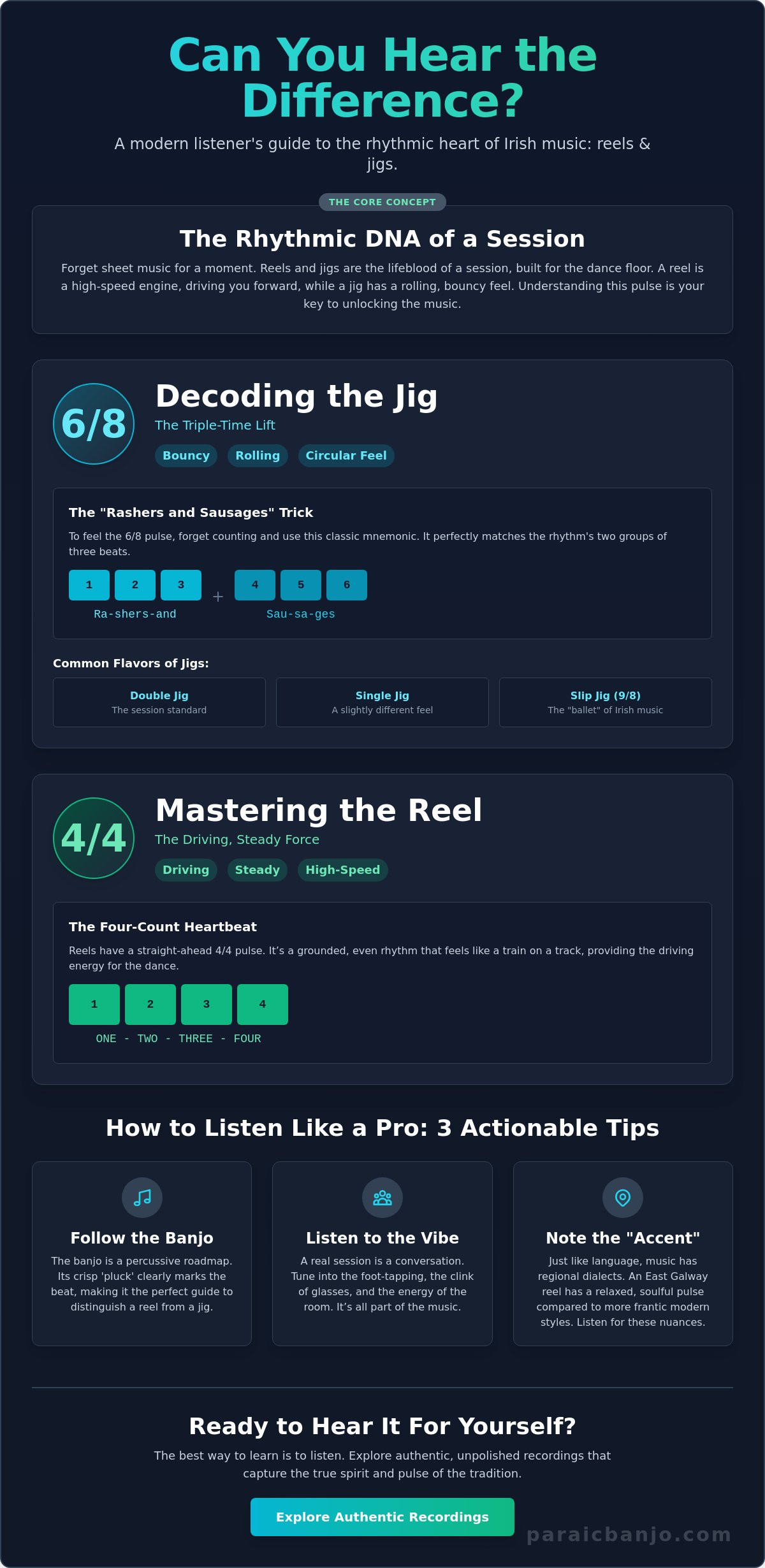
If a reel is a high-speed train, a jig is a rolling stone skipping down a mossy hill. It has a circular, tumbling quality that feels entirely different from the straight-ahead drive of other tune types. When we talk about irish reels and jigs, the jig is often the first rhythm that beginners find themselves humming. It's written in 6/8 time. This means you count it in groups of three: "one-two-three, four-five-six." But don't let the numbers bore you. The real magic lies in the "lift." This is that bouncy, upward energy that makes a dancer’s feet leave the floor. It’s a feeling of weightlessness followed by a soft landing, repeated over and over until the whole room is swaying.
Within the world of jigs, you'll encounter a few different flavors. The most common is the double jig, which is the meat and potatoes of any session. Then you have the single jig, which has a slightly different internal emphasis, and the elegant slip jig. The slip jig is unique because it’s in 9/8 time, giving it a graceful, hopping feel that’s often described as the "ballet" of Irish music. I've spent 39 years trying to capture that specific bounce in my own playing. You can experience this "lift" for yourself on the Not Before Time – 39 Years in the Making album, where I’ve carefully selected sets that highlight the rolling nature of the tradition. It's a definitive statement of my life's work, and I'd love for you to hear the pulse I'm talking about.
The "Rashers and Sausages" Trick
In the kitchens and pubs where I learned to play, we didn't always talk about time signatures. We used our ears. The easiest way to master the 6/8 pulse is with a classic Irish breakfast mnemonic: "Rashers-and-Sausages." Say it out loud. You'll notice the word "Rashers" takes up three quick syllables, and "Sausages" takes up another three. Together, they form one perfect bar of a jig.
Actionable Tip:
Say "Rashers-and-Sausages" repeatedly while tapping your foot only on the "Rash" and the "Saus." This teaches your brain to group the three quick notes into one strong beat. It’s a simple trick, but it’s the fastest way to stop feeling "lost" when the music speeds up.
Famous Jigs to Know
To really train your ear, you need to listen to the classics. Tunes like "The Kesh" or "The Lark in the Morning" are essential. These melodies are the foundation of irish reels and jigs in any corner of the world. A well-played jig should feel like it's constantly rolling forward, never stagnant. It is generally the "happiest" sounding part of a session. When the musicians switch from a serious reel into a bright jig, you can feel the tension in the room evaporate. It’s pure, infectious joy. Give those tunes a listen and try to spot that "Rashers-and-Sausages" pattern hidden in the melody. You'll be surprised how quickly your ear picks it up. Give it a go!
The Driving Force: Mastering the Irish Reel
Reels are the high gear of the tradition. If the jig is a rolling stone, the reel is a fast-moving river, steady, relentless, and deep. While many beginners get caught up in the speed, the real mastery lies in the drive. In the world of irish reels and jigs, the reel is where musicians often show their true mettle. It is written in 4/4 time, which sounds technical, but you can think of it as a steady "one-two-three-four" pulse that never wavers. Identifying a reel is all about feeling that constant, even stream of eighth notes that creates a wall of sound. It doesn't hop like a jig; it flows.
Finding the Pulse
There is a big difference between the math of the music and the heartbeat of the tune. We call the math "meter," but the heartbeat is the "pulse." In a reel, the pulse has a specific "swing." This isn't the same as jazz swing; it's a subtle, rhythmic lilt where the first note of a pair is just a hair longer than the second. It’s the slight delay that gives the music its soul and prevents it from sounding like a mechanical metronome. Without that swing, the music feels flat and lifeless. You want the tune to breathe.
Actionable Tip:
To find the soul of a reel, don't tap your foot on every beat. Try tapping only on every second beat. This creates a broader sense of the rhythm and helps you feel the "lift" within the drive. It stops you from rushing and allows you to hear the melody's internal conversation.
Reel vs. Jig: The Quick Comparison
Understanding how these two giants of the genre interact is key to enjoying any session. Reels often come at the end of a set of tunes. Musicians use them to build excitement and bring the energy in the room to a fever pitch. Because they are so driving, they naturally lead to a big finish. To hear this transition in its most authentic form, I recommend checking out some best irish session recordings. You'll hear how the "bounciness" of the early tunes gives way to the "flow" of the reels.
Use this simple breakdown to help your ears distinguish between irish reels and jigs when you're out at a session:
The Reel: 4/4 Rhythm. Driving and Flowing feeling. Use the mnemonic "Blackberry-Blackberry" to catch the even pulse.
The Jig: 6/8 Rhythm. Bouncy and Rolling feeling. Use the mnemonic "Rashers-and-Sausages" to catch the triple-time lift.
Mastering the reel takes time and a lot of listening. It’s about more than just playing fast; it’s about holding that steady, powerful line while the melody dances on top. Once you feel that river-like flow, you'll never hear a session the same way again. Give it a listen and see if you can spot the moment the "high gear" kicks in!
Regional Flavours: Why East Galway Reels Sound Different
If you've spent any time at a session, you might start to notice that not all irish reels and jigs are played with the same frantic energy. In fact, thinking of Irish music as a single, uniform sound is a mistake. Every county, and sometimes every parish, carries its own unique "accent." For those who consider themselves a traditional irish music for purist, recognizing these regional flavors is where the real fun begins. It’s like moving from understanding the words of a language to appreciating the local slang and the way the vowels stretch in the West. Understanding these nuances transforms your listening experience from surface-level enjoyment to a deep, cultural connection.
East Galway and Clare are famous for a pulse that is relaxed and soulful. In these regions, musicians often sacrifice raw speed for melodic depth and rhythmic "grit." A reel in East Galway isn't a race to the finish line; it’s a purposeful stroll through a familiar landscape. You aren't being chased by the notes; you're being invited to walk alongside them. This slower pace allows for a level of expression that gets lost when the tempo is pushed too hard. It creates a space where the instrument can truly breathe, highlighting the subtle shifts in the melody that define the player's personal style.
The East Galway "Sobs" and "Lifts"
The East Galway style is legendary for its slower tempos and heavy, intricate ornamentation. On the banjo, this translates to a soulful, almost vocal quality. We often talk about "sobs" in the music, which are those little melodic dips and sighs that give a tune its emotional weight. It's a far cry from the polished, "clean" sound you might hear on a commercial folk record. For a deeper dive into how these rhythms differ from their neighbors, you should explore the details of east galway vs clare music. You'll find that a Galway reel feels more like a conversation than a performance.
The Clare Influence
Clare music, by contrast, has a distinct "lifted" quality. It is incredibly rhythmic and bouncy, deeply influenced by the local set dance traditions. While East Galway might lean into the "sob" of a note, Clare music pushes upward, driving the dancer to stay on their toes. When I was recording the sets for my debut album, I wanted to honor both of these worlds. I’ve spent 39 years absorbing these specific pulses to ensure the music feels grounded and authentic. You can hear this blend of regional grit and rhythmic clarity by picking up a copy of my album, Not Before Time – 39 Years in the Making, which serves as a definitive statement of these influences.
Actionable Tip:
Next time you’re listening to a set of
irish reels and jigs
, close your eyes and ask yourself: "Is this music making me want to run or sway?" If the rhythm feels like it’s pushing you forward into a sprint, you’re likely hearing a more modern or Northern style. If it feels like you're swaying with a steady, heavy heartbeat, you've likely found the soulful pulse of the West.
Bringing the Session Home: How to Listen Like a Pro
To truly understand the music, you have to live with it. It isn't enough to just hear it once a week in a crowded pub. You need to bring that energy home, but you must be careful about what you choose to listen to. There is a lot of "Celtic-style" elevator music out there that polishes away the very grit we’ve been talking about. To master the distinction between irish reels and jigs, you need raw, authentic recordings that haven't been sanitized by studio trickery. You want to hear the wood of the flute, the snap of the banjo string, and the rhythmic breathing of the players. This is where the music's soul resides.
While audio streaming in Ireland reached 13.2 billion streams in 2025, the low per-stream payout for artists, which ranges between €0.003 and €0.005, means that physical media and digital albums remain the lifeblood of the community. In fact, vinyl sales in Ireland saw a 20% increase in 2025. This proves that listeners still crave a tangible connection to the craft. When you buy a physical record, you aren't just getting audio; you're getting a piece of history. You're supporting the long-term development of projects that often take decades to reach your ears. For those looking to build a serious library, you can start your collection with a physical copy of Irish music that features 18 tracks of pure banjo mastery, capturing the spirit of the West.
The Collector’s Checklist
When you are hunting for new music, look for "live-feel" recordings. These are albums where the musicians played together in the same room, capturing the spontaneous "lift" that defines the tradition. Detailed liner notes are also essential. They are your map to the tradition, telling you where the tunes came from and who passed them down. Understanding the difference between live vs recorded irish session music is vital for training your ears. A polished studio track might be pretty, but a raw session recording will teach you how the pulse actually works in the heat of the moment. It gives you the "grit" that commercial pop lacks.
Final Encouragement: Don’t Overthink It
At the end of the day, this music is meant to be felt, not just analyzed. Don't worry if you still mix up your irish reels and jigs every now and then. Even after 39 years, I’m still finding new corners in these old melodies. My debut album, Not Before Time – 39 Years in the Making, is the result of a lifetime spent chasing these rhythms. It is a definitive statement of my passion, and I invite you to join me on this journey. Whether you choose the physical CD or the digital album, remember that the music is a living thing. It is never truly finished. It just keeps rolling on. Enjoy the tunes, and I’ll see you at the next session. Until next time!
Step into the Heart of the Tradition
You now have the tools to tell a rolling jig from a driving reel and the knowledge to appreciate the soulful "sobs" of the West. Mastering irish reels and jigs isn't about memorizing math; it's about training your ears to feel the heartbeat of a community. By focusing on the "lift" and the "pulse" rather than just the notes, you've already taken the biggest step toward becoming a session regular. The next stage is simply to surround yourself with the real thing.
I’ve poured nearly four decades of my life into a project that captures this exact energy. My debut album, Not Before Time – 39 Years in the Making, features 18 tracks recorded with a raw, live session spirit that skips the studio polish. It includes detailed liner notes celebrating my East Galway heritage, acting as a definitive guide for your own listening journey. This work was 39 years in the making, and I'd love for it to be the soundtrack as you find your own rhythm. Get your limited-edition copy of "Not Before Time" – the definitive Irish banjo album and let the music speak for itself. The tradition is a long road, and I’m glad we’re walking it together. Happy listening!
Common Questions About the Tradition
How can I tell the difference between a reel and a jig by ear?
Listen for the grouping of the notes to find the pulse. A jig has a triple-time feel that rolls along like a stone skipping down a hill, while a reel has a steady, driving quadruple pulse. If you can count "one-two-three" in time with the melody, it is likely a jig. If it sounds like a constant, even stream of "one-two-three-four," you are listening to a reel. Try tapping your foot to see if the rhythm feels like a hop or a run.
What is the most famous Irish jig of all time?
"The Kesh Jig" is widely considered the most famous tune in the genre. It gained massive popularity through the legendary playing of The Bothy Band and is now a staple in almost every session worldwide. Other heavy hitters include "Morrison's Jig" and "The Lark in the Morning." These tunes are the perfect starting point for any beginner wanting to understand the rolling, joyful rhythm of the tradition before diving deeper into the music.
Why are Irish reels played so fast in sessions?
High speeds in sessions often stem from the natural energy and excitement of group playing. While irish reels and jigs were originally designed for dancing, modern sessions sometimes push the tempo to showcase technical skill and create a "buzz" in the room. However, the best players know that speed should never come at the expense of the rhythmic pulse. The goal is to maintain the "grit" and soul of the melody even when the gear is high.
What does "lift" mean in traditional Irish music?
"Lift" is the airy, bouncy quality that gives the music its upward energy. It is not about playing louder or faster; it is a rhythmic emphasis that makes the tune feel light and danceable. Think of it as the subtle spring in a dancer’s step. When a tune has lift, it feels like it is floating rather than being dragged. It is the secret ingredient that transforms a mechanical performance into a living, breathing piece of art.
Is a hornpipe the same thing as a reel?
No, a hornpipe is played with a distinct "dotted" or "swung" rhythm that makes it sound much crunchier than a reel. While both are written in 4/4 time, a hornpipe is usually played at a slower tempo with a heavy emphasis on the first and third beats. It has a "da-da, da-da" limping feel, whereas a reel flows in a smooth, even stream. Hornpipes are often associated with specific solo dances that require this heavy, rhythmic grounding.
Can I learn to play reels and jigs on the tenor banjo if I am a beginner?
Yes, the tenor banjo is a fantastic instrument for beginners because its percussive nature makes the rhythm very clear. Its four strings and shorter neck are often more manageable than a guitar for many players. While I do not offer tuition myself, I highly recommend finding a local teacher who can show you the specific "triplet" technique. This specialized picking style is what brings irish reels and jigs to life on the banjo strings with that signature crispness.
Why do Irish musicians play tunes in sets of three or four?
Playing tunes in sets allows musicians to build momentum and keep the energy flowing for both dancers and listeners. A single tune usually only lasts about 90 seconds, so joining them together creates a longer, more engaging musical journey. Usually, musicians pick tunes that share a similar key or feeling. They often save the most driving reel for the very end of the set to bring the room to a fever pitch and finish on a high note.
Where can I find authentic recordings of Irish reels and jigs?
Look for albums that prioritize a "live session" sound over polished studio production. Authentic recordings often include the natural sounds of the room and minimal editing. My own debut album, Not Before Time, was crafted specifically to capture this raw energy and is available as a physical CD or digital album. You can also find individual digital tracks on my site to hear the tradition as it was meant to be played, with all its rhythmic grit intact.


Comments