Famous Irish Banjo Recordings: The Rhythmic Pulse of Traditional Music
- Paraic Mac Donnchadha

- Jun 22
- 13 min read
The secret to a legendary Irish banjo performance isn't how fast your fingers fly, but how well you hold the silence between the notes. You've likely felt that specific frustration of searching for authentic music only to find over-produced tracks that sound more like a frantic bluegrass chase than a proper session in a Galway pub. It's a common hurdle for many listeners who want to hear the true clatter and drive of the tenor banjo without the polish of a studio losing the soul of the tune.
By exploring the most famous irish banjo recordings, you'll learn to identify the rhythmic pulse that defines the East Galway style; a sound that's grounded, steady, and deeply infectious. We're going to walk through the essential albums you need in your collection, from the foundational masters to modern releases like Chunky Business from late 2025. You'll discover how to distinguish regional nuances and find high-quality recordings, including my own debut, Not Before Time - 39 Years in the Making, which represents a lifetime's passion for this craft. Let's dive into the tracks that make the heart of Irish music beat.
Key Takeaways
Identify the "lift" in a performance, which is the rhythmic energy that separates an authentic session feel from a sterile studio track.
Explore technical benchmarks within famous irish banjo recordings to understand how the best players handle driving reels and bright keys.
Master the concept of "swing" by listening to iconic jig recordings that define the unique melodic lilt of the tenor banjo.
Uncover the "secret ingredient" of regional styles, specifically the soulful and deliberate pace characteristic of the East Galway tradition.
Turn your listening into a form of practice by using liner notes to connect with the deep history and stories behind the tunes.
Table of Contents
What Defines an Iconic Irish Banjo Recording?
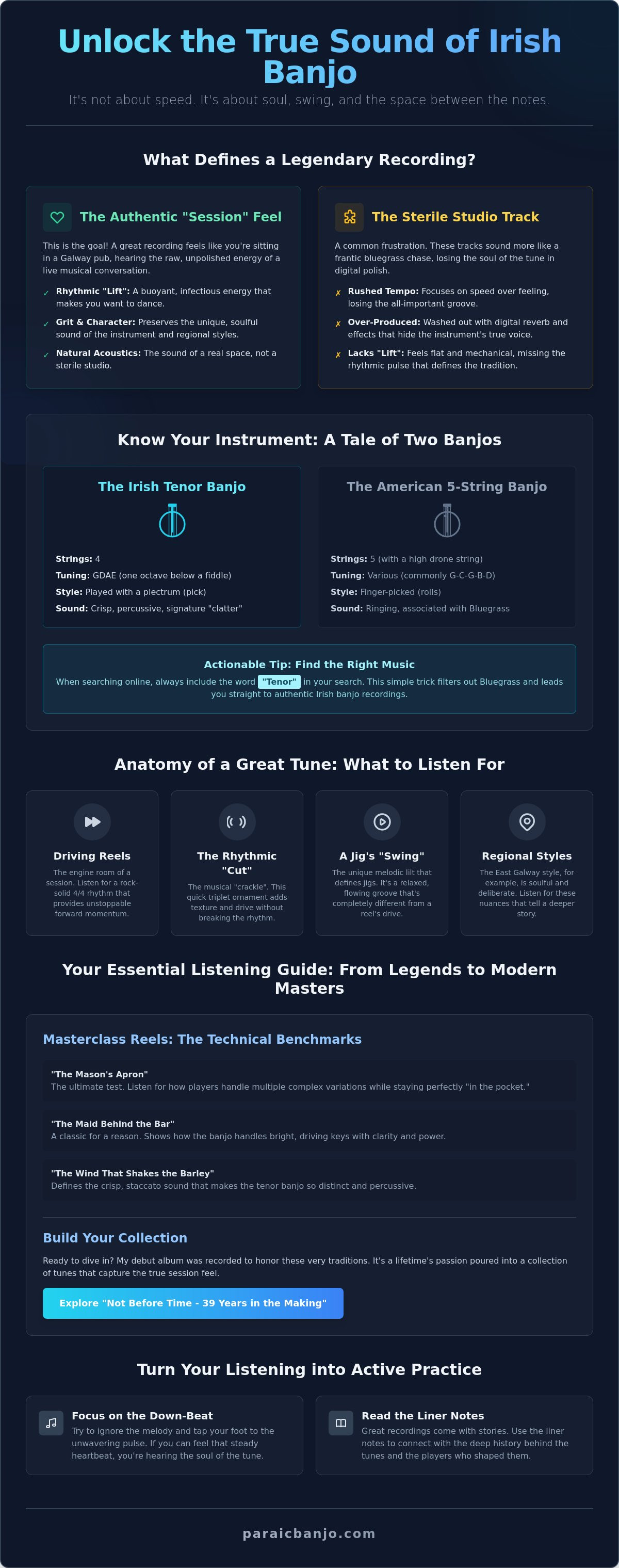
A truly legendary performance isn't measured by a stopwatch. When you're sifting through famous irish banjo recordings, you're really looking for the 'lift.' In our tradition, 'lift' refers to that buoyant, rhythmic energy that makes a tune feel alive. It's the heartbeat of the dance. An iconic recording captures this pulse by focusing on the 'cut' of the notes, providing a crisp, percussive drive that pushes the melody along without ever feeling rushed. It's about the space between the notes as much as the notes themselves, creating a rhythmic blueprint that younger players can follow for years.
Authenticity is the second pillar of a great recording. Many modern tracks are over-produced, losing the grit and character of the instrument in a wash of digital reverb. The best recordings feel like a seat at a session. They preserve the unique flavors of regional traditions, such as the soulful, steady pace of the East Galway style. This relaxed, deliberate approach allows the banjo to breathe. If you're looking for that genuine feel, you can find it in the Not Before Time - 39 Years in the Making physical CD or digital album, which I recorded to honor these very traditions after decades of playing in the community.
Tenor vs. Five-String: The Crucial Difference
It's a common mistake for newcomers to mix up their instruments. Irish traditional music relies on the 4-string tenor banjo, typically tuned GDAE. This tuning is exactly one octave below a fiddle, which allows the banjo to mirror the fiddle's intricate movements while adding a layer of percussive depth. The shorter scale length and the use of a heavy plectrum, or pick, are what create that signature clatter we love. Actionable Tip: When you are hunting for famous irish banjo recordings online, always include the word 'Tenor' in your search. This simple step ensures you find the flat-picking styles of Ireland rather than the finger-picked rolls of American bluegrass. It saves you time and ensures you're listening to the right tradition.
The Anatomy of a Great Session Recording
A great recording isn't just about the soloist; it's about how the instruments talk to each other. You want to hear the banjo 'in the pocket' with the fiddle or accordion. This means the musicians are perfectly synchronized, creating a single, powerful rhythmic unit. Listen for acoustics that feel natural, mimicking the wooden floors and stone walls of a real Irish pub. This creates a sense of place that you just can't manufacture in a high-tech studio. A masterpiece recording is one that preserves the raw, unpolished energy of a live musical conversation. You can even pick up individual digital tracks from my latest collection to hear this interplay in action and experience that authentic session heart for yourself.
The Driving Reels: Essential Banjo Masterclasses
Reels are the engine room of Irish traditional music. They provide the forward momentum that keeps a session alive, and for a banjo player, they are the ultimate test of both stamina and precision. When we look back at the most famous irish banjo recordings, the reel is almost always the centerpiece. It's where the percussive nature of the tenor banjo truly shines, cutting through the swell of other instruments with a clarity that's impossible to ignore. These tunes aren't just about speed; they're about maintaining a rock-solid rhythm while weaving intricate melodic variations into the 4/4 beat.
Take "The Mason’s Apron" as a prime example. This tune is widely considered the technical benchmark for any banjo player. Because it's often played with multiple variations, it tests your ability to stay "in the pocket" while the melody becomes increasingly complex. Similarly, "The Maid Behind the Bar" is a classic in the key of D that showcases the instrument’s ability to handle bright, driving keys with ease. If you're looking for something more soulful, "Farewell to Connaught" offers a masterclass in regional phrasing, while "The Wind That Shakes the Barley" defines the crisp, staccato sound that makes the tenor banjo so distinctive. These tracks are essential listening because they teach you how to balance power with finesse.
Mastering the Rhythmic "Cut"
One of the most important skills you'll notice in these recordings is the use of the "cut," or the triplet. This is a quick succession of three notes played in the space of one or two, adding a burst of texture without breaking the steady flow of the reel. It's what gives the music its "crackle." Actionable Tip: As you listen, try to ignore the melody for a moment and focus entirely on the down-beat. It should feel like a steady, unwavering heartbeat. If you can tap your foot consistently to that pulse, you’re hearing the true soul of the tune. You can hear this rhythmic focus throughout the tracks on my debut album, Not Before Time - 39 Years in the Making, where I aimed to capture that exact session energy.
The Evolution of Reel Recordings
The way we experience these reels has changed dramatically over the years. We've moved from the scratchy, energetic 78rpm records of the 1920s to the high-definition digital downloads available today. Despite the technological leaps, the goal remains the same: capturing the "live" energy of a set. This is why many of the best modern recordings are tracked live in the studio, allowing the musicians to react to one another in real time. When you're exploring these works, keep an ear out for the East Galway influence. This style is marked by a relaxed but powerful pace. It doesn't rush the tune; instead, it lets the rhythm settle, giving the music a grounded, authoritative feel that is deeply satisfying to hear. If you want to start your own collection, you can find individual digital tracks that highlight this specific regional lilt.
Capturing the Lilt: Famous Jig Recordings and Their Swing
If reels are the engine of a session, then jigs are the rolling waves. While reels drive forward with that steady 4/4 heartbeat we discussed earlier, the jig moves in a 6/8 time signature. This creates a completely different feel. When you dive into famous irish banjo recordings, you’ll quickly notice that the best jig performances have a certain "swing" or "lilt." It isn’t a stiff, metronomic sound like a ticking clock. Instead, it’s a rhythmic bounce that makes the music feel effortless and alive. It’s the difference between a machine and a conversation.
Take "The Kesh Jig" for instance. It’s likely the most recognized jig recording globally, and for good reason. It sets the standard for how a banjo should swing. Then you have "The Lark in the Morning," a multi-part masterpiece that really tests a player’s melodic range and ability to keep a complex structure together. If you want to hear the percussive "pop" that the tenor banjo is famous for, "Morrison’s Jig" is your powerhouse. On the other end of the spectrum, "The Cliffs of Moher" is a haunting A-minor tune. It requires a delicate, soulful touch, proving that the banjo can be just as evocative as a fiddle or a flute when handled with care.
Understanding the 6/8 "Swing"
A jig should feel like a stone rolling down a hill; it has a natural, tumbling momentum. In 6/8 time, the notes are grouped in threes. Actionable Tip: To really hear this in these recordings, use the old mnemonic "Rash-er-of-Ba-con." Say it out loud: RASH-er-of BA-con. Each syllable is a note. You’ll notice the first syllable is slightly stronger. This is how the plectrum, or pick, creates the lilt. By varying the strength of your attack, you give the music its rolling shape. It’s a technique I’ve spent nearly 40 years refining, and it’s the key to making a banjo sound truly Irish.
Ornamentation in Jig Recordings
Because the banjo is a fretted instrument, it can sometimes sound a bit "staccato" or jumpy. To fix this, we use ornamentation to create a fluid, fiddle-like sound. You’ll hear players using hammer-ons, where you strike a string and press a finger down for a second note, and pull-offs, where you pluck and release. These little flourishes add character, but the secret is restraint. The best recordings don't over-ornament; they let the core melody breathe so the listener can follow the tune. You can explore the authentic sound of traditional Irish session music to hear exactly how this balance works in a real-world setting. It’s all about serving the music, not just showing off your speed.
The Soul of the West: East Galway and Clare Style Recordings
Regional styles are the secret ingredient that distinguishes a generic folk track from the most famous irish banjo recordings. If you listen closely, you'll realize that Irish music isn't a single, uniform sound. It’s a patchwork of local traditions. When you hear a player from County Clare, you’re often hearing a "lonesome" quality. It’s highly fluid, melodic, and possesses a unique lift. Contrast that with the East Galway style. This tradition is defined by a slower, more deliberate pace. It has a deep, rhythmic soul that doesn't need to rely on sheer speed to make an impact. I’ve spent my life immersed in these sounds, and my 2026 release, Not Before Time - 39 Years in the Making, was specifically crafted to preserve that steady Galway pulse.
The East Galway Pulse
The East Galway style is a masterclass in rhythmic control. Instead of racing through a tune, players focus on the "feel" and the varied ornamentation that gives the melody its character. This approach is perfect for the tenor banjo's naturally percussive voice. By emphasizing the weight of the beat, the banjo becomes a powerful rhythmic anchor for a session. If you want to dive deeper into these nuances, you can read our guide on East Galway vs Clare music. Understanding these regional roots will change the way you hear every track in your collection.
Famous Regional Gems
To hear these styles in action, look for recordings of "The Tulla Reel." It's a Clare classic that demands a very specific "bounce" to feel authentic. On the other hand, "The Drunken Landlady" is an East Galway favorite. It perfectly highlights the banjo’s ability to drive a tune forward with a relaxed but firm rhythm. Regional style is not just about the notes played, but the breath and space between them. It’s about knowing when to let a note ring and when to cut it short to create that infectious lift.
Actionable Tip: When you're comparing recordings, try to tap along. If the music feels like it's giving a dancer plenty of time to land their steps with power, you're likely hearing the Galway influence. If the rhythm feels more buoyant and airy, you've found the Clare sound. You can hear this authentic regional drive for yourself by exploring the Not Before Time - 39 Years in the Making Digital Album, which brings these West of Ireland traditions directly to your speakers. It’s a project decades in the making, designed to bring that storied musical heritage into your home. Enjoy the journey through the West!
Building Your Collection: From Legends to Modern Masterpieces
Listening is the most vital part of practicing traditional Irish music. You can't truly play a tune until you've internalized its rhythm and soul. When you spend time with famous irish banjo recordings, you’re doing more than just enjoying a tune; you’re training your ear to catch the subtle variations in rhythm and ornamentation that define our tradition. It’s about absorbing the pulse we’ve discussed in the previous sections until it becomes second nature. This deep listening is what allows a player to move beyond the notes and find the 'lift' that makes a performance legendary.
While digital streaming is convenient, many dedicated collectors still prize the physical CD. There’s a tactile history in a limited edition release that a digital file just can't replicate. The real treasure often lies in the liner notes. These aren't just lists of names; they are the stories and history behind the tunes. They tell you who wrote the piece, where it was learned, and which regional style it represents. Supporting independent artists by purchasing these physical or digital works is the best way to ensure our musical tradition continues to thrive for the next generation.
Why "Not Before Time" is a Must-Own
My debut album, Not Before Time - 39 Years in the Making, is a project I poured my heart into after decades in the session scene. It’s a masterclass in the East Galway style, recorded live to capture that authentic, unpolished session energy we all love. Across 18 tracks of pure banjo, I’ve collaborated with expert performers to highlight our deep regional roots. I also made sure to include detailed liner notes, turning the album into a historical resource for any fan who wants to understand the 'why' behind the music. It’s a definitive statement of a lifetime's passion, and I’m thrilled to finally share it with you.
Where to Buy Authentic Music
Buying direct from the artist is the most impactful way to build your library. It ensures the person who created the music receives the support they need to keep the tradition alive, and it usually guarantees you get the highest quality audio available. Actionable Tip: Before you start your next shopping spree, check out our collector’s guide to buying traditional Irish music. It’s packed with advice on how to find the most authentic recordings and avoid over-produced commercial tracks. Ready to bring the heartbeat of the session home? You can order my debut album or individual digital tracks here and start your journey into the rhythmic soul of the west. Happy listening!
Bring the Authentic Pulse of the West Home
You've explored what makes the tenor banjo the heartbeat of a session, from the technical drive of reels to the rolling lilt of 6/8 jigs. Understanding the most famous irish banjo recordings is about more than just entertainment; it's about connecting with a living heritage that values the steady pulse of the West over mere speed. By focusing on regional styles like the soulful East Galway tradition, you're learning to hear the space and breath that give this music its true character. It’s a journey that turns a simple listener into a true guardian of the tradition.
Now it's time to bring that authentic sound into your own home. My debut album, Not Before Time - 39 Years in the Making, offers 18 tracks of pure, live-recorded session music that captures the grit and energy of the tradition. With detailed liner notes exploring the heritage of these tunes, this collection is a definitive statement of my life's work. Experience the rhythmic soul of the West-Order "Not Before Time" today. Keep the tradition alive and let the music play on!
Frequently Asked Questions
What is the best banjo recording for a complete beginner to listen to?
You should start with a clear, steady recording of "The Kesh Jig" or "The Mason's Apron." These tracks are foundational because they provide a very distinct rhythmic structure that is easy for a new ear to follow. Listening to these classics helps you internalize the basic 6/8 and 4/4 patterns that define the majority of Irish traditional music.
Is the tenor banjo on these recordings different from a bluegrass banjo?
Yes, the Irish tenor banjo is a 4-string instrument tuned GDAE, which is entirely different from the 5-string bluegrass banjo. While bluegrass players use finger picks to create fast, rolling patterns, Irish players use a single flat plectrum. This creates the crisp, percussive "clatter" that allows the banjo to cut through the sound of a crowded session.
Why do some Irish banjo recordings sound "slower" than others?
A slower tempo is often a deliberate stylistic choice associated with regional traditions like East Galway. Speed isn't the goal in these recordings; instead, the focus is on the "lift" and the rhythmic "pulse" of the tune. A relaxed pace allows for more intricate ornamentation and gives the music a grounded, soulful feel that is perfect for dancing.
What does "East Galway style" actually mean in a recording?
East Galway style refers to a relaxed, melodic approach that prioritizes rhythm and "swing" over sheer velocity. In a recording, you'll hear a steady, driving beat that feels powerful but never rushed. It's a tradition that values the space between the notes, allowing the natural character of the tenor banjo to shine through without being buried by frantic playing.
Can I learn to play by just listening to famous Irish banjo recordings?
Listening is the most important part of learning because it teaches you the "language" of the music. While you'll eventually need to pick up the instrument, spending time with famous irish banjo recordings helps you understand phrasing and rhythm. You can't play what you haven't heard, so internalizing these sounds is a vital first step for any aspiring player.
Are digital downloads as good as physical CDs for Irish music?
Digital downloads offer high-quality audio and convenience, but physical CDs are still prized by collectors for their tactile history. A CD like Not Before Time - 39 Years in the Making includes detailed liner notes that provide essential context about the tunes and regional styles. If you want the full story behind the music, the physical format is often the better choice.
What are the most famous reels I should look for on an album?
Look for staple tunes like "The Maid Behind the Bar," "The Wind That Shakes the Barley," and "The Star of Munster." These reels appear frequently in essential collections of famous irish banjo recordings because they are session favorites. They perfectly demonstrate the banjo's ability to handle bright, driving melodies while maintaining a rock-solid rhythmic foundation for other instruments to follow.
How do I know if an Irish music recording is "authentic"?
Authentic recordings usually have a "live" feel that mimics a real session rather than a sterile studio environment. Look for tracks where you can hear the natural interplay between instruments and a clear regional lilt. Avoid over-produced albums with heavy synthesizers or artificial effects, as these often strip away the raw, percussive energy that makes the traditional banjo sound so infectious.


Comments