High Quality Irish Music Download: The Purist’s Guide to Authentic Sound
- Paraic Mac Donnchadha

- May 27
- 13 min read
What if the "Celtic" playlist you're streaming is actually stripping the soul right out of the fiddle strings? You've likely felt that frustration before; you press play on a track hoping for the warmth of a real session, but you get a flat, tinny sound that feels more like corporate elevator music than a Galway pub. It's heartbreaking to hear a beautiful reel lose its punch because of poor compression. You deserve a high quality irish music download that captures every breath of the flute and every subtle ornamentation of the banjo.
I understand the search for that authentic sound because I've spent nearly four decades perfecting it. In this guide, you'll learn how to identify studio-grade audio files that preserve the raw energy of traditional playing. We will explore why lossless formats like FLAC matter, how to find specific regional styles like the lilt of East Galway, and why detailed liner notes are the secret to connecting with the artist. Whether you're looking for a full digital album or individual digital tracks from my latest project, Not Before Time, you're about to upgrade your listening experience. Let's get into the technical bits that make the music breathe.
Key Takeaways
Learn how to spot "lossless" files—formats like FLAC that don't lose any audio data—to ensure your music sounds just as clear years from now.
Discover why choosing artists with deep regional roots is the only way to avoid soulless, generic stock music and find the real "lift" of a session.
Master a simple system for securing a high quality irish music download while keeping your digital library organized by tune type and regional style.
Find out how high-fidelity recordings capture the specific "drive" of acoustic instruments like the banjo, which requires more data to sound authentic.
Get a first look at the Not Before Time digital album, featuring 18 tracks that bridge the gap between studio precision and live energy.
Table of Contents
What Defines a High Quality Irish Music Download?
Finding a high quality irish music download is about more than just clicking a button; it's about capturing a moment in time. True quality stands on two pillars: technical fidelity and cultural authenticity. If one is missing, the music feels hollow. You've likely seen the word "Celtic" plastered all over digital storefronts. Often, that's just a marketing tag used to sell generic background music that has never seen the inside of a real session. It lacks the "dirt" and the rhythmic "drive" that defines our tradition.
When you download directly from an artist, you're bypassing the heavy compression used by big streaming platforms. These services often prioritize speed over sound, stripping away the high-end frequencies that give acoustic instruments their character. By choosing a Digital Album directly from the source, you ensure that the soul of the performance stays intact. It's the difference between a blurry photo and a vivid, life-sized portrait of Irish traditional music as it was meant to be heard. Don't let your ears settle for less than the full story.
Technical Quality: Beyond the MP3
Don't settle for the thin, metallic sound of a standard MP3. To truly hear the resonance of a mahogany banjo or the sweet chirp of a tin whistle, you need lossless formats like FLAC or WAV. These files preserve every bit of data from the original studio session. Bitrate matters immensely here. A high bitrate ensures that the sharp "pop" of a plectrum hitting a string isn't softened or muddied. Studio-grade mastering is the final touch, balancing the instruments so the music feels wide and immersive. If you're building a serious library, start by looking for those lossless options. It's an investment in your listening future.
Cultural Quality: The Soul of the Session
Technical specs are great, but the music needs a heartbeat. Cultural quality is found in the regional nuances that define a player's style. You should be able to hear the relaxed, melodic flow of East Galway or the rhythmic bounce of a Clare reel. I believe the best recordings are those that capture the "live" energy of a session without being overly sanitized. You want to feel the lift in every set. The artist's pedigree acts as your ultimate quality marker. When you explore my Individual Digital Tracks, you're hearing decades of community, practice, and passion. That's a high quality irish music download you can feel in your bones.
The Collector’s Checklist for Choosing Traditional Downloads
Building a digital library is a pure joy, but only if you do it right from the start. You want files that will sound just as crisp and vibrant in twenty years as they do today. When you're browsing for a high quality irish music download, your first stop should always be the file format. Look for FLAC or WAV options. These are "lossless" formats, which is just a technical way of saying they keep every single ounce of the original studio detail. Don't settle for "standard" downloads that squash the sound into something thin and lifeless.
Next, take a moment to check the artist's history. Authenticity isn't just a vibe; it's a lineage. You can often verify a player's roots and their contribution to the scene through resources like the Irish Traditional Music Archive (ITMA), which documents the real deal. Also, ensure your purchase includes full metadata. This is the "hidden" background info that tells your media player the song title, artist, and genre. It keeps your library from becoming a cluttered mess of "Track 01" files, making it easy to find that one specific reel when the mood strikes.
Actionable Tip: Spotting Generic Stock Music
Don't be fooled by pretty cover art or a "Celtic" tag. Generic stock music is everywhere on the web. Check the composer's name; if it looks like a corporate library rather than a person, it's likely soulless background noise. Listen closely for "MIDI" instruments. These are digital recreations that lack the organic scrape of a fiddle bow or the percussive ring of a banjo string. Real music uses real wood and wire. Finally, look at the titles. A true traditional album will name specific tunes, like "The Mason's Apron," rather than generic phrases like "Happy Irish Folk."
The Value of Digital Liner Notes
A great download should feel like a complete story, not just a random collection of sounds. Digital liner notes provide the "pedigree" of each tune, telling you who the artist learned it from and why it holds a place in the tradition. While collectible irish music cds are famous for their physical booklets, a high quality irish music download should offer a digital equivalent. These stories connect you to the community in a way a raw audio file never can. If you're ready to start a collection that actually means something, my Digital Album includes 18 tracks that come with that same deep sense of history and heart. Support independent releases; it's the best way to keep this music thriving for the next generation.
Why Acoustic Instruments Demand High Fidelity
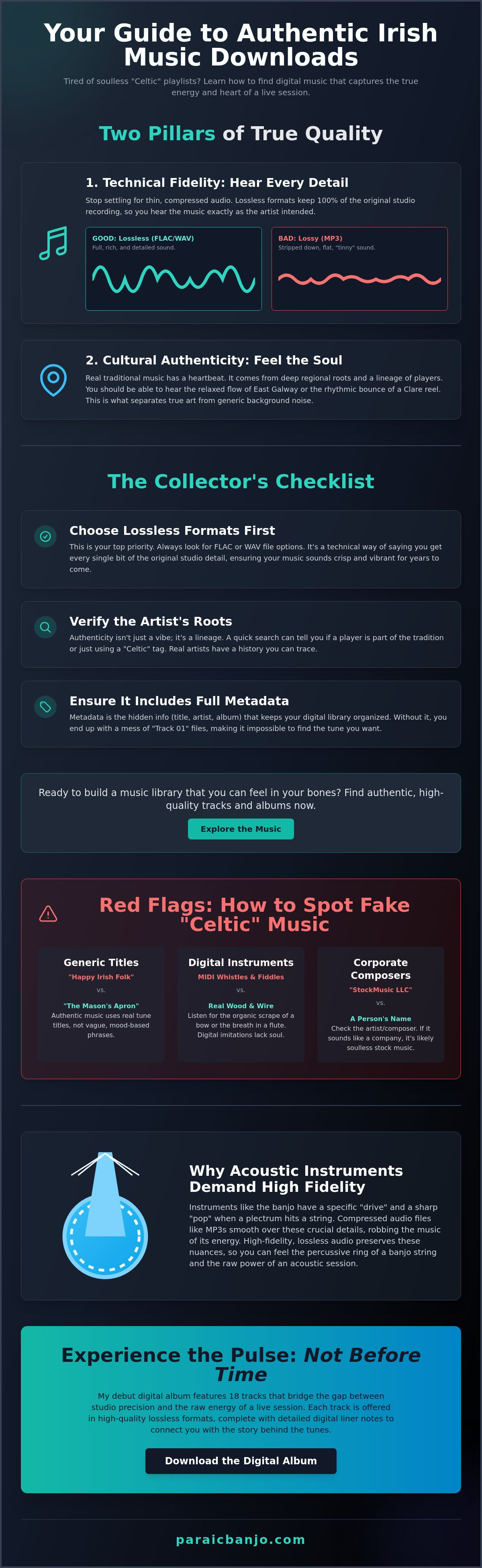
Acoustic instruments are notoriously difficult to record well. Think about the sharp, percussive "snap" of a tenor banjo or the breathy overtones of a wooden flute. These sounds are incredibly complex. When you choose a high quality irish music download, you're ensuring that these tiny sonic details aren't lost to the digital shredder. Low-quality files often smear the "attack," which is that split second where the plectrum hits the string. This leaves the music feeling sluggish. True traditional music relies on "drive" and "lift," rhythmic energies that require every bit of audio data to stay intact.
Compression is the enemy of ornamentation. In our tradition, a player's skill is often found in the "cuts," "rolls," and "triplets" they weave into a melody. If a file is too compressed, these subtle movements become a muddy blur. You can find beautiful examples of these preserved nuances at the Irish Traditional Music Archive, where the focus is on cultural preservation. To truly appreciate the craft, you need a file that allows for active listening rather than just something to play in the background while you're busy with chores. It's about feeling the pulse of the session.
Banjo Dynamics and Bitrate
The banjo is an instrument of high frequencies and sudden peaks. To capture its natural resonance, look for 24-bit audio. While a standard 16-bit CD is great, 24-bit (often called "high resolution") provides more room for the loudest and quietest sounds to exist without distortion. This prevents the instrument from sounding "thin" or "tinny." If you're comparing a compressed stream to a high quality irish music download, the difference is like moving from a flat photo to a vibrant, 3D experience. It brings the player's energy right into your room.
The Sound of the Room
Traditional music isn't made in a vacuum. It's about the interplay between the fiddle, the banjo, and the box. A high-fidelity recording captures the "air" around the instruments, giving you a sense of the physical space where the session happened. You can hear the subtle cues and the shared energy that makes an acclaimed irish banjo album stand out from the crowd. When you download my Individual Digital Tracks, you're getting that sense of space and collaboration. Tip: For the best experience, use a dedicated digital-to-analog converter (DAC) with your headphones to unlock the full depth of the recording.
How to Build and Curate Your Digital Irish Music Library
A hard drive full of files isn't a library; it's a digital attic. When you invest in a high quality irish music download, you want to be able to find that one specific East Galway reel in seconds, not minutes. The secret lies in a system that mirrors the tradition itself. Start by organizing your folders by tune type, such as Reels, Jigs, Hornpipes, and Airs. If you're a true enthusiast, go a step further and group them by regional style. Seeing a folder dedicated to "Clare Fiddle" or "Sligo Flute" makes your collection feel like a map of the musical landscape rather than just a list of names.
Don't forget about your existing physical collection. Many of us have shelves of collectible irish music cds that we've gathered over the years. You can rip these into high-fidelity FLAC files and integrate them right alongside your new digital purchases. Just be sure to back everything up. Use a simple rule: keep three copies of your library, on two different types of storage, with one copy kept in a separate location. It's the only way to ensure your investment in these studio-grade tracks stays safe for the long haul.
Mastering Your Metadata
Metadata is the digital label that tells your computer what it's playing. For a traditional musician, the standard "Artist" and "Title" tags aren't enough. Use a metadata editor to add track stories and full musician credits to your file info. Actionable Tip: Use the "Comments" tag to note down the tune's history or who you first heard playing it. This turns a simple file into a living archive. Consistent naming conventions, like "Artist - Tune Name (Tune Type)", will save you hours of searching later. When you download my Digital Album, much of this heavy lifting is already done for you, ensuring every track is as informative as it is beautiful.
Supporting the Living Tradition
The way you choose to buy traditional irish music has a direct impact on the future of the art form. Buying direct from an artist's website ensures that the funds go straight back into the heritage, allowing us to record the next generation of tunes. It's how we keep the "lift" and "drive" of the session alive in a digital world. You'll often find hidden gems on artist-run platforms, such as rare tracks or alternate takes that never make it to the big streaming services. If you're ready to add some serious weight to your library, you can pick up Individual Digital Tracks from my latest project and experience the difference that authentic, high-quality curation makes.
Experience the Pulse: Not Before Time Digital Edition
It is one thing to talk about the technical side of a high quality irish music download, but it is another thing entirely to hear the results of nearly four decades of dedication. My debut project, Not Before Time – 39 Years in the Making, is finally available for your digital library. This isn't just a collection of tunes; it is a definitive statement of a lifetime spent in the heart of the tradition. I wanted to ensure that every listener could feel the same "lift" and "drive" that we experience in a live session, even when listening through a pair of headphones in a quiet room.
The album features 18 studio-quality tracks that bridge the gap between polished production and the raw energy of a pub session. You can choose to download the full Digital Album or pick out your favorite Individual Digital Tracks to add to your curated playlists. Each track was recorded with a deep respect for the nuances of the East Galway style, ensuring that the melodic flow and rhythmic pulse remain the stars of the show. It took a long time to get these recordings exactly right, but the relief of finally sharing them with the community is immense.
The Technical Specs of the Album
To capture the authentic sound of the tenor banjo, we focused on preserving the "attack" of the plectrum and the natural decay of the strings. This recording involved a wonderful group of featured performers, creating an interplay that only happens when musicians truly know each other's style. We offer these files in high-resolution formats to ensure a pure listening experience that avoids the flat, lifeless sound of standard streaming. For banjo purists, this is a chance to hear the instrument as it truly sounds, without the digital "shimmer" that often ruins acoustic recordings. It is the real deal, captured in a studio setting.
Start Your Authentic Collection Today
If you are new to the world of high-fidelity traditional music, Actionable Tip: start by downloading a single track to hear the difference for yourself. Listen for the "air" around the instruments and the clarity of the ornamentation. When you purchase the full digital version of Not Before Time – 39 Years in the Making, you also get access to detailed digital liner notes. These notes provide the history of the tunes and the stories behind the sets, giving you a deeper connection to the music. I invite you to join me on this journey and experience the storied tradition of East Galway music in its highest form. Happy listening, and I hope the tunes bring as much joy to your home as they have brought to my life!
Bring the Pulse of the Session Home
Honoring the spirit of traditional music means refusing to settle for thin, compressed sound that strips away the "lift" of a well-played reel. You now have the tools to build a digital library that respects both the technical physics of acoustic instruments and the deep cultural roots of the players. By choosing lossless formats and prioritizing artist-direct sources, you ensure that every ornament and rhythmic drive remains crystal clear for years to come. Securing a high quality irish music download is about more than just convenience; it's an act of preservation for the tunes we love.
My debut album, Not Before Time – 39 Years in the Making, represents a lifetime of this very passion. With 18 tracks recorded in studio-grade fidelity and accompanied by detailed historical liner notes, this collection brings the storied heritage of East Galway straight to your ears. Don't wait another four decades to upgrade your listening experience. Download the high-quality digital edition of "Not Before Time" now! I'm thrilled to share these sets with you and can't wait to hear how they resonate in your own home. Keep the music alive and keep those speakers humming!
Frequently Asked Questions
What is the best file format for high quality Irish music downloads?
FLAC and WAV are the gold standards for any purist. These are lossless formats, which means they don't throw away any audio data during the saving process. While an MP3 is fine for a quick listen, it often smothers the "air" and the sharp attack of a banjo or fiddle. To keep the studio-grade fidelity of the original session intact, always opt for FLAC when building your digital library.
Why should I buy music direct from an artist instead of using a streaming service?
Buying directly ensures that your support goes straight to the person who spent decades honing their craft. Streaming platforms often use heavy compression that can make acoustic instruments sound thin and metallic. When you secure a high quality irish music download from an artist's website, you're getting the full-resolution file. You also often get digital liner notes that are rarely included on big streaming apps.
What are digital liner notes and why do they matter for traditional music?
Digital liner notes are electronic booklets that explain the history and "pedigree" of the tunes. In our tradition, knowing where a reel came from or who first played it is a vital part of the experience. These notes act as a bridge between the listener and the community. They provide the context that turns a simple audio file into a storied piece of musical heritage you can truly understand.
Can I play FLAC or WAV files on my phone or standard music player?
Yes, almost every modern smartphone and media player supports these high-fidelity formats right out of the box. If you use an iPhone, you might use ALAC, which is Apple's version of a lossless file. For Android and PC users, FLAC is the universal choice. It's a simple way to bring the resonance of a real studio session with you on the go without sacrificing any sound quality.
How can I tell if a download is an authentic traditional recording?
Look for specific tune names and regional styles instead of generic marketing buzzwords. An authentic recording will usually list the musicians and their specific instruments, like "tenor banjo" or "uilleann pipes." If the track titles are vague, such as "Irish Relaxing Moods," it's likely generic stock music. Real traditional music carries a rhythmic "drive" and "lift" that stock libraries can't replicate with digital instruments.
Is there a difference between "Celtic" music and traditional Irish music?
Yes, "Celtic" is a broad umbrella term often used for atmospheric or cinematic music. Traditional Irish music is a specific, living art form with its own unique structures and ornamentation. While some "Celtic" tracks are beautiful, they often lack the raw, percussive energy of a session. A high quality irish music download focused on tradition will always prioritize the organic sound of wood and wire over synthesized backgrounds.
How do I organize a large digital library of Irish session music?
Start by grouping your folders by tune type, such as Reels, Jigs, or Hornpipes. This makes it much easier to find the right music for your mood. You can then use metadata tags to add the regional style or the names of the musicians. This level of organization turns a cluttered hard drive into a functional archive. It allows you to appreciate the subtle differences between a Clare fiddle and a Galway banjo.
What makes Páraic Mac Donnchadha’s banjo recordings unique?
These recordings are the result of a 39-year journey into the heart of the East Galway tradition. They capture the specific rhythmic "lift" that defines the style, balancing technical precision with the warmth of a live session. Whether you choose the full Digital Album or Individual Digital Tracks, you're getting a definitive statement of a lifetime's passion. It's a chance to hear the banjo played with the quiet confidence of a seasoned master.


Comments