How to Play Irish Jigs on Tenor Banjo: A Step-by-Step Guide

What if the key to lively Irish tenor banjo jigs isn’t playing faster, but giving the rhythm more lift? When the notes start to tumble together, it’s easy to lose the pulse and feel unsure how to break a tune into practice-sized pieces.
That’s a common hurdle. A jig’s 6/8 rhythm can feel tricky at first, especially when you’re concentrating on every note. Start by tapping two steady beats to the bar, then let the notes fall into place around them. Keep the pulse clear before you add speed or decoration.
This step-by-step guide will help you find a steady jig feel, learn a tune in short, repeatable phrases, and build a practice routine that develops accuracy and flow. You’ll work through the rhythm, practise each phrase at a manageable pace, and join the pieces without rushing. Settle into the pulse first. The tune will follow.
Table of Contents
How Irish Jigs Feel on Tenor Banjo: Start with the Pulse
A jig doesn’t need to race to sound lively. For beginners, a steady pulse matters more than speed. When the rhythm is settled, the melody can skip along clearly instead of tumbling into a blur. Think of a jig as a tune commonly felt in groups of three, with a light, lilting swing.
Jig rhythm groups three smaller counts around two main beats. A straight feel gives each beat a more even, marching quality. A jig gathers its notes in threes, creating its characteristic bounce. The overview of Irish jigs offers more background on the form and its common 6/8 setting.
How to count a jig in 6/8 time
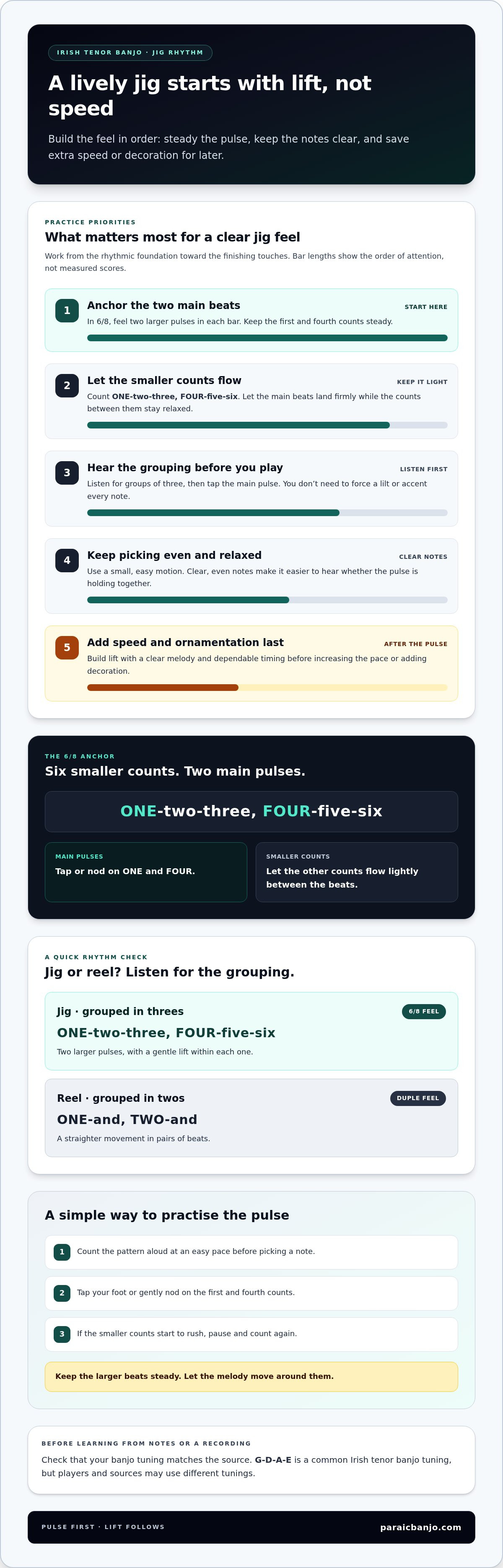
In 6/8, each bar has six smaller counts, but you’ll usually feel two larger pulses: one on the first count and one on the fourth. Say ONE-two-three, FOUR-five-six. Let “ONE” and “FOUR” land firmly while the other counts flow lightly between them.
Before picking a note, count the pattern aloud at an easy pace. Tap your foot or gently nod on ONE and FOUR to keep the main beats even. If the smaller counts start to feel rushed, pause and count again. That grounded two-beat feel is the anchor for Irish tenor banjo jigs.
How a jig differs from a reel
A reel has a duple feel, meaning its movement is grouped in twos. Try counting ONE-and, TWO-and. A jig groups its smaller counts in threes: ONE-two-three, FOUR-five-six. Keep the counts relaxed and you’ll hear the difference: the reel moves in a straighter pair of beats, while the jig has a gentle lift within each beat.
This contrast is useful when a tune’s notes blur together. First listen for whether the melody settles into groups of two or three, then tap the main pulse before you play. Don’t force a lilt or accent every note. Hold the larger beats steady and let the melody show you where it wants to go.
Set Up Your Tenor Banjo and Picking Hand for Irish Jigs
Before following a tune’s notes, make sure your banjo is tuned to match the notation or recording you’re using. Irish tenor banjo is commonly tuned G-D-A-E, from the lowest-pitched string to the highest, but players and sources may use different tunings. A note or fingering that works in one tuning won’t necessarily sound right in another.
Use an electronic tuner or a reliable reference to check each string carefully. Then confirm that the tune’s notes and fingering examples are written for that tuning. A minute spent getting this straight can save a lot of head-scratching later.
Check tuning before learning a tune
Match your instrument to the source first, whether you’re learning from written notes or by ear. If a melody sounds unexpectedly wrong, check the tuning before assuming your fingers are at fault. Keep the banjo comfortably supported, with your shoulders relaxed and your arms free to move. There’s no single rigid posture to copy. Aim for a position you can hold without strain.
Build an even picking motion
Start with a single note on one string. Pick it repeatedly at a relaxed pace, listening for an even sound and keeping your wrist loose. Use a small, economical motion rather than swinging your whole arm. If your shoulder tightens or your wrist starts to feel stiff, pause, loosen up, and begin again more gently.
Clear, even notes make the rhythm easier to hear and correct. That’s especially useful in irish tenor banjo jigs, where steady picking helps you notice whether the pulse is holding together. Once repeated notes feel comfortable, try a short run between two strings, then a simple piece of the melody. Keep your movement relaxed as you change strings. Reaching or gripping harder can make the notes uneven.
A metronome can help you check your timing, but bring it in only after you can keep a comfortable pulse on your own. Set it slowly enough that you can play without tensing up. The aim isn’t to chase the clicks. Listen for notes that land evenly, and adjust the pace if the sound starts to feel forced.
For another listening reference, explore traditional session music on Páraic Mac Donnchadha’s debut album, recorded live with expert musicians. Listen for how clear notes and relaxed phrasing sit within the ensemble, without assuming every passage is a jig.
Learn an Irish Tenor Banjo Jig One Phrase at a Time
A whole tune can look like a long run of notes on the page. Make it manageable by treating it as a chain of short musical ideas. Learn one phrase first, then connect it to the next. This gives your hands time to remember the notes while your ear stays focused on how the melody moves.
Listen, count, and map the melody
Before picking, listen to your chosen tune and notice where ideas repeat or change. Hum the melody if you can, or count along with its pulse. If you’re learning from notation, mark the beginning and end of each phrase with a pencil. If you’re learning by ear, pause after a short section and try humming it back. You don’t need to name every note yet. First, get familiar with the shape of the tune.
Then work through this sequence:
Listen: Hear the full tune once or twice and notice recurring ideas.
Count: Speak or tap along before playing, so the rhythm has a clear place to sit.
Isolate a phrase: Choose a short musical idea, such as the opening phrase, rather than tackling the entire tune.
Play slowly: Work through the notes at a pace where each one sounds clear and your picking hand stays relaxed.
Join phrases: Once the first idea feels dependable, connect it to the next one.
Keep the loop small. Repeat the phrase, listen for the spot that feels uncertain, and work on that one difficulty rather than restarting the whole tune each time. A missed note, awkward string change, or hesitation at the phrase ending can each be practised on its own.
Join phrases without losing the rhythm
When each phrase feels secure on its own, play two in a row at a comfortable pace. Pay particular attention to the join: keep the movement going through the end of one phrase and into the start of the next. If the notes become unclear or the rhythm falters, slow down and practise that transition again. Add the next phrase only when the first connection feels steady.
Raise the tempo gradually, and only while the notes remain clear and your hands stay relaxed. A recording can also help you hear how phrases flow together in traditional playing. As you explore irish tenor banjo jigs, listen for the melody’s shape and phrasing in Páraic Mac Donnchadha’s live session recordings. Then return to your chosen phrase and try to play it with the same sense of forward motion.
Make Your Jig Sound Livelier Without Rushing or Overplaying
Speed and ornamentation aren’t what make a jig come alive. First, let the melody speak clearly over a dependable pulse. Once the notes feel settled, shape the tune with a little more lift and expression. A clean, steady version will sound more convincing than a faster one where the rhythm wobbles.
Experienced traditional players are a great listening guide. Notice how they shape a phrase, where they give the melody room to breathe, and how their playing fits with the other musicians in a session. Listen for the overall feel rather than trying to copy every flourish straight away. Páraic Mac Donnchadha’s album was recorded live with expert musicians, so you can hear traditional session playing in an ensemble setting.
Common jig practice mistakes and how to fix them
If the tune keeps speeding up, stop and count the main pulses aloud before playing again. If the notes blur, shorten the phrase and simplify the picking until each note comes through clearly. When your timing falters between phrases, practise that join on its own, then return to the longer passage. These small adjustments help you find the cause instead of repeating the same stumble.
Add expression after the melody feels secure
Ornaments are optional details, not a shortcut to a traditional sound. A cut is a quick grace note that briefly separates or decorates a melody note. A roll is a more involved flourish made from a small group of quick notes around a main note. You don’t need either to make the tune work. Add one only when the melody and pulse stay clear without it.
In irish tenor banjo jigs, expression often comes from how a phrase rises, settles, or leans into the next one, not from accenting every note. Listen to a phrase several times and hum its shape. Then play it simply, aiming for the same lift without forcing the beat. Explore the East Galway and Clare musical traditions through the album’s detailed liner notes for more context on the regional music behind this style.
Ready to hear how banjo, melody, and ensemble phrasing meet in a live recording? Explore Páraic Mac Donnchadha’s traditional session album and listen for the flow between the musicians.
Follow a Practical Tenor Banjo Jig Practice Plan and Keep Listening
A regular routine gives each practice session a clear shape, so you can work on the tune without trying to fix everything at once. Keep the steps simple and repeat them from session to session:
Settle into the pulse: Before you pick up the banjo, count and tap the jig rhythm. Start playing only when the beat feels even.
Work on one phrase: Play a short section slowly, listening for clear notes and a relaxed picking hand.
Practise the transition: Repeat the end of that phrase and the start of the next. Aim to carry the rhythm smoothly across the join.
Play the tune through: Finish with a slow, complete play-through. Keep going if you make a small mistake, and notice where the flow needs attention.
Before you put the banjo down, write down one thing that went well and one specific point to revisit next time. Your success might be a cleaner phrase; your next focus could be a string change or a transition that still feels hesitant. A clear note gives your next practice session a useful starting point.
Use listening to develop traditional feel
Listening helps you hear more than the notes. Pay attention to the pulse, the shape of each phrase, and how the musicians respond to one another. In a session recording, the melody sits among other instruments. That interplay can show how a tune keeps moving without every note being pushed forward.
Try listening once without playing, choosing one detail to follow, such as how a phrase lifts into its ending. Then pick up your banjo and focus on that detail in your own playing. Return to the recording afterward and listen again. This back-and-forth between listening and playing can sharpen your ear for phrasing and ensemble feel.
For a traditional session listening example, explore Not Before Time - 39 Years in the Making, Páraic Mac Donnchadha’s debut album of 18 tracks recorded live with expert musicians. Listen for the musicians’ shared flow and phrasing, then bring one small observation back to your next practice of irish tenor banjo jigs.
Keep the Pulse Steady and Let the Tune Grow
A convincing jig doesn’t depend on speed. Start by feeling the pulse, then learn the melody in short phrases and connect them while keeping the rhythm even. If a passage feels uncertain, slow it down and work on one small challenge at a time. Clear notes and relaxed playing give the tune room to lift naturally.
Keep listening, too. Traditional session recordings can help you hear how phrasing and the interplay between musicians carry a melody forward. For a listening companion, explore Páraic Mac Donnchadha’s album, Not Before Time - 39 Years in the Making. Its 18 tracks were recorded live with expert musicians, and the detailed liner notes offer context on East Galway and Clare musical traditions. The album provides a window into traditional session music without needing to identify a particular track as a jig.
Bring one thing you’ve heard back to your next practice. With patience and a steady pulse, irish tenor banjo jigs can begin to feel less like a rush of notes and more like a tune you can shape and enjoy. Keep at it, one phrase at a time. To hear the album for yourself, explore Not Before Time - 39 Years in the Making, available as a digital album or physical CD.
Frequently Asked Questions
How do you play an Irish jig on tenor banjo?
Play an Irish jig by keeping a steady, lilting pulse and learning the melody in short phrases. First, listen and count along; then practise one phrase slowly, aiming for clear notes and relaxed picking. Join it to the next phrase once it feels dependable. Avoid rushing to full speed or adding ornaments too soon. For irish tenor banjo jigs, a grounded rhythm and clear melody are the best starting point.
What time signature is an Irish jig played in?
An Irish jig is commonly written in 6/8 time. That means each bar has six smaller counts, often felt as two larger beats: ONE-two-three, FOUR-five-six. Count aloud slowly and tap your foot on ONE and FOUR to hear the main pulse. The smaller counts should flow evenly between those beats, giving the tune its characteristic lift rather than a straight, even march.
What tuning is used for an Irish tenor banjo?
G-D-A-E is a common tuning for the Irish tenor banjo, from the lowest-pitched string to the highest. However, tunings can vary, so match your instrument to the notation or recording you’re using before learning a tune. Check each string with an electronic tuner or reliable reference. Written notes and fingering depend on the tuning, so confirming it first can prevent confusion as you practise.
How can I make a jig sound faster without rushing?
Build speed gradually while keeping the notes clear and the pulse steady. Start at a comfortable pace, then increase it only when you can play the phrase without tension or blurred notes. If you rush, slow down and count the main beats aloud. Keep your picking motion small and relaxed. A jig sounds lively through its lift and phrasing, not simply by pushing the tempo higher.
Should I learn banjo ornaments before I learn a jig?
No. Learn the melody and rhythm first, then consider ornaments as optional details. A cut is a quick grace note that decorates or separates a melody note; a roll is a short flourish made from several quick notes around a main note. Neither is needed to make a jig work. Add an ornament only when you can keep the tune clear and the pulse steady without it.
How do I practise an Irish jig on tenor banjo as a beginner?
Begin by counting and tapping the pulse before you play. Choose a short phrase, practise it slowly, then work on the transition into the next phrase. Once those parts feel steady, play the whole tune through at an easy pace. Focus on one difficulty at a time, such as a string change or unclear note. After practising, write down one success and one point to revisit.


Comments