Jigs vs. Reels: How to Hear the Difference in Irish Traditional Music

What if the quickest way to tell a jig from a reel isn’t to count faster, but to listen for how the beat groups? The difference between jigs and reels can be hard to catch when the tunes are flying, even if their names sound familiar. Time signatures can make a lively tune feel like a maths lesson, but you don’t need to read music to hear the difference.
A common jig has a lilting feel grouped in threes, while a reel moves in an even, driving pattern grouped in fours. The pulse matters more than the tempo, so a fast tune doesn’t have to leave you guessing. Start by following the larger beats, then notice how the smaller notes fit around them.
Here, you’ll find simple ways to count and tap along, plus a look at how jigs and reels fit into Irish traditional playing, where tunes are learned and shared by ear. Try the listening steps with session recordings, too. Páraic Mac Donnchadha’s debut album, Not Before Time - 39 Years in the Making, features 18 tracks recorded live with expert musicians. Listen for the grouping first, and the rhythm will start to open up.
Table of Contents
Jigs and reels in Irish music: what is the essential difference?
The clearest distinction is how each tune’s notes are organised within a bar. A common jig is written in 6/8, while a common reel is written in 4/4. These markings describe different rhythmic frameworks, not fixed speeds or rules for phrasing every note. Use the table as a quick listening guide, not as a reason to judge a performance by one clue alone.
What does a jig sound like when you count it?
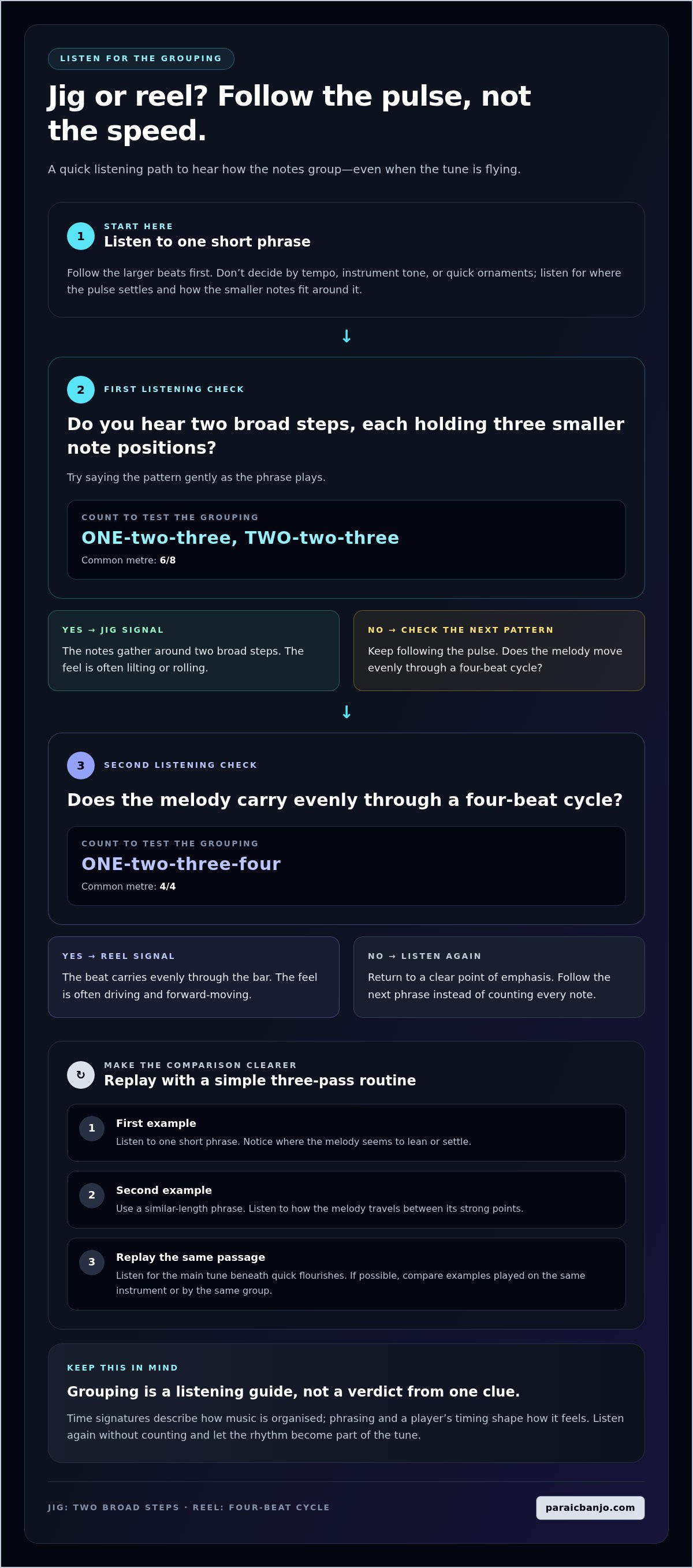
In a typical 6/8 jig, think of a bar as two broad steps, with three smaller note positions inside each step. Say “ONE-two-three, TWO-two-three” and let the capitalised beats land gently. This count helps you hear the grouping; it doesn’t mean every note should sound equally strong. A tune may feel buoyant or rolling, but players shape melodies in their own way. The Jig (dance) overview also gives context on the dance tradition and different jig forms, including light, treble and slip jigs.
Try saying the count over a short phrase, then hum the melody without counting. Notice how the tune settles into two larger steps. Connecting the count to the melodic phrase makes 6/8 feel less abstract, even if you never read a score.
What does a reel sound like when you count it?
For a common reel, try “ONE-two-three-four,” giving the first beat a little emphasis while keeping the count even. Then listen to a full phrase instead of stopping at each bar line. The melody often seems to travel forward through the four-beat cycle, so following that broader motion may feel more natural than counting each note as it passes.
A jig gathers its smaller notes around two broad steps; a reel carries its melody through a four-beat cycle. Use that as a starting point, then listen again without counting. The rhythm should feel like part of the music, not a separate exercise.
How metre, accents and phrasing shape the sound of jigs and reels
Metre is the recurring pattern of stronger and lighter beats that gives a tune its underlying shape. It sits beneath the melody, even when notes dart, repeat or gather into a phrase. To hear it, notice where the music seems to settle and how often that emphasis returns. You don’t have to name the pattern straight away. First, let your ear follow it.
Why time signatures help, but do not tell the whole story
A time signature is a written guide to how music is organised into bars. It helps a musician read a tune and see where beats and note values fit, but it doesn’t tell you exactly how a performance will feel. The melody, its phrasing and the player’s timing all shape what reaches your ear. Think of the notation as a map, not the sound of the journey.
You can recognise a tune’s broad rhythmic character without looking at a score. Listen to where a phrase begins, where it seems to lean or pause, and how it moves into the next phrase. If you read music, use the time signature to make sense of what you hear rather than expecting the written page to capture every nuance of a traditional performance. Different musicians may bring different accents and phrasing to the same type of tune.
How accents make the pulse easier to hear
An accent is a note or beat that stands out slightly from its neighbours. In a lively passage, these points of emphasis can be easier to follow than a stream of individual notes. Tap gently when you hear a recurring emphasis, then notice how the melody’s lighter movements gather around it. This can be especially helpful when ornamentation adds quick turns that make the music sound busier than its underlying rhythm.
Try listening to one phrase twice. On the first pass, follow only the prominent beats. On the second, listen to how the phrase rises, settles or leads into the next one. You can hum the melody or tap a comfortable pulse; there’s no need to count every note or keep perfect time. If the pattern slips away, return to the next clear point of emphasis and begin again.
Pulse and grouping reveal more than speed because they show how the tune is organised. Keep that in mind when a performance feels fast or heavily ornamented. Its energy may draw you in first, but recurring accents and phrase shape help your ear hear what’s happening underneath.
Jig vs. reel: a practical listening comparison beyond tempo
For a useful comparison, don’t try to decide from one striking sound. Instead, compare clearly labelled examples, then replay a short phrase from each. This helps you separate the tune’s rhythmic character from details that can distract your ear, such as a bright instrument tone, fast ornaments or a forceful performance.
Choose recordings with reliable labels. If possible, use examples played on the same instrument or by the same group so fewer details change between listens. A fiddle’s bright edge or a banjo’s crisp attack can catch your attention, but neither identifies the tune type on its own.
What to listen for when the tune is played quickly
When the notes blur, listen for the phrase’s outline rather than individual ornaments. Notice where a musical idea begins, where it turns, and how it comes to rest or leads onward. If your player allows it, replay a brief passage at a slower setting, then return to the original speed. The aim isn’t to judge the performance, but to hear the melody’s shape beneath its decoration.
A faster performance doesn’t automatically turn a jig into a reel. Tempo can change while the tune’s underlying character remains. Try humming the main phrase after listening. When the ornamented details fall away, the larger movement may be easier to recognise. Then compare that impression with a labelled example.
Can a shared instrument make the forms sound alike?
Yes. Fiddle, flute, accordion and banjo can each play both forms. The instrument supplies its own timbre, or tone colour, while the tune’s rhythm comes from how the music is organised. Ornamentation, the small turns and flourishes added around a melody, varies by player too. To explore how regional character colours a performance, compare the East Galway and Clare musical styles, then return to your labelled examples with fresh ears.
How to practise identifying jigs and reels by ear
You don’t need an instrument, sheet music or formal training to get better at hearing tune types. A little focused listening goes a long way. Give each replay one job rather than trying to catch every note and decide everything at once. This simple routine helps you hear the difference between jigs and reels with confidence, one short passage at a time.
A simple four-step listening exercise
Choose a short, clearly labelled example of each type. Listen to each passage a few times and follow these steps. It’s fine if your first impression changes as you listen again.
Listen once without counting. Notice the tune’s general movement. Does it seem to roll, bounce or stride forward?
Find a comfortable pulse. Tap a finger or gently nod along. Choose a beat you can follow without straining.
Count the smaller movements. Replay the passage and see whether the notes seem to group in threes or move in a more even pattern. Quiet counting is enough.
Check your impression. Decide whether the passage feels more like a jig or a reel, then compare your guess with its reliable label. Treat a mismatch as a clue about what to listen for next.
Now switch examples and repeat the same steps. Comparing a labelled jig with a labelled reel helps your ear notice the contrast. The difference may stand out more clearly side by side than when you try to identify an unfamiliar tune on its own.
How to keep improving without overthinking it
Keep practice manageable. Replay a brief phrase, focus on one clue, then stop counting and simply enjoy the music. If ornamentation makes the notes sound crowded, don’t force every flourish into a perfect count. Return to the larger pulse and listen for how the phrase settles around it.
As your ear gets used to the broad patterns, listen to longer passages and notice how musicians shape each phrase. Regional style adds another layer of character. The East Galway and Clare musical traditions offer a way to explore how place and playing style influence the sound. Keep the tune’s grouping as your starting point, then enjoy the details that make each performance its own.
Ready to practise with musicians playing together? Listen to traditional session music and follow the pulse before deciding what you hear.
Hear jigs and reels in the flow of Irish session music
In a session, tune type is one part of the story. Once you’ve found the pulse, widen your attention to the musicians: how a phrase is lifted, answered or carried forward, and how their timing creates shared energy. A jig or reel gives you a rhythmic framework, but a session’s sound also comes from phrasing, musicianship and the way the ensemble plays together. Listen for the pattern, then let the whole performance unfold.
That balance is part of what makes traditional recordings rewarding. Páraic Mac Donnchadha’s debut album, Not Before Time - 39 Years in the Making, celebrates traditional session music through 18 tracks recorded live with expert musicians. Its detailed liner notes offer historical context connected to East Galway and Clare. Use the listening cues you’ve learned on any passage whose tune type is clearly identified.
What a recording can teach your ear
Return to the same short passage on another listen. As the pulse becomes familiar, notice how the musicians shape a phrase together, where they lean into a beat and how one player’s line sits alongside another’s. Treat each performance as its own conversation, not a template every jig or reel must follow. The story behind the debut album adds background to the recording and the work that brought it to life.
Continue exploring Irish traditional music
Bring your listening practice to your next session or recording. First find the pulse, then enjoy the details around it: a phrase that opens out, a subtle change in emphasis, or the way the musicians move as a group. With time, recognising the difference between jigs and reels can become part of listening naturally, rather than a puzzle to solve before you enjoy the music.
For more context on the traditions behind the sound, the album’s liner notes connect the music with East Galway and Clare, while the live recording captures musicians playing together. Read the notes, then return to the music with fresh ears. Explore Páraic’s traditional session album.
Take your listening into the next tune
The next time Irish traditional music comes on, give yourself one small listening task: follow the pulse through a phrase, then let your attention wander. Notice the lift of a note, the way a melody turns, or how the musicians seem to breathe together. You don’t need to label every tune correctly for the music to open up. Curiosity is enough to keep your ear moving.
Over time, the difference between jigs and reels becomes less like a test and more like another colour in the music. The grouping gives you a place to begin; the performance invites you to stay. Put on a recording, listen again and see what catches your ear today.
Keep exploring with Páraic Mac Donnchadha’s traditional session album, available as a digital album or physical CD. Choose the format that suits you and listen for the pulse in the next tune.
Frequently Asked Questions
Is a jig always played faster than a reel?
No. Tempo varies between tunes and performances, so a lively jig can sound brisker than a more relaxed reel. Speed alone won’t settle the question. Try listening to a short phrase at a comfortable pace, or slow the playback if your audio player allows it. Notice how the notes group and where the pulse returns. That rhythmic pattern is a more dependable clue than how quickly the tune seems to move.
How do you count a jig in Irish music?
For a common double jig, try saying “ONE-two-three, TWO-two-three” and tap on the capitalised beats. This gives you a simple way to follow the larger movement while the notes continue around it. If the melody is ornamented or especially quick, don’t worry about catching every note. Keep the tap steady and count along with one brief phrase. The jig’s characteristic grouping should become easier to sense with repetition.
What time signature is a reel usually in?
A reel is usually written in 4/4, which represents four quarter-note beats in a bar. Some reels may be notated in 2/2 or 2/4, so the notation can vary. If you’re listening rather than reading a score, try a steady four-beat count and follow it across several bars. That can help you hear the tune’s even flow without needing to identify every note or accent.
Can a tune be played as both a jig and a reel?
A tune’s traditional identity usually comes from its melody and rhythmic form, so a jig doesn’t automatically become a reel just because it’s played faster. Musicians can arrange or reinterpret a melody with a different rhythmic treatment, though. In that case, listen to how the beat and subdivisions are organised in that version. If you’re unsure, compare the passage with a clearly labelled example and focus on the grouping, not just the tune’s name.
What is the difference between a slip jig and a regular jig?
A slip jig is commonly in 9/8, while a double jig is commonly in 6/8. To feel the contrast, try counting a slip jig in three larger pulses, each with three smaller subdivisions. A double jig has two larger pulses with three subdivisions each. Both share a lilting quality, but the broader grouping gives a slip jig a more flowing, three-part motion.
Do you need to read music to tell jigs and reels apart?
No. You can begin by listening for the pulse and the way smaller notes gather around it, without reading notation or knowing formal theory. Choose a short passage, tap along, and listen again while following the melody’s recurring movement. A labelled recording can help you check your impression, but it’s fine to be uncertain at first. The aim is to grow familiar with the sound through active listening.
Can the same instrument play both jigs and reels?
Yes. Fiddle, flute, accordion and banjo can all play jigs and reels. The instrument gives the melody its particular tone, while the tune’s rhythmic organisation tells you which form you’re hearing. For a useful comparison, listen to examples played on the same instrument so its sound stays constant. Then focus on how the notes group and the pulse moves. Ornamentation may differ from one player to another, too.


Comments