Influential Irish Banjo Players: The Legends and Styles That Defined a Tradition
- Paraic Mac Donnchadha

- Jun 12
- 14 min read
What if the true soul of the tenor banjo isn't found in a frantic blur of notes, but in the rhythmic "lift" that makes a whole room want to dance? If you've ever felt lost in a sea of names or struggled to hear the difference between a Galway triplet and a Dublin drive, you aren't alone. It is easy to get overwhelmed by the sheer volume of influential irish banjo players when you are just trying to find that authentic, soulful sound that stays with you long after the session ends.
I know that search for the real deal because it has been the heartbeat of my own musical journey for nearly forty years. In this guide, you will discover the masters who defined the tradition and learn how to spot the subtle regional styles that give Irish music its unique flavor. We are going to cut through the noise with a curated list of legends and practical tips on finding high quality recordings that capture the grit and grace of the instrument. Let's dive into the history and the hands that shaped this incredible sound.
Key Takeaways
Discover why the shift from five strings to four was a turning point for playing traditional Irish melodies.
Meet the influential irish banjo players who transformed the instrument from a rhythmic backup into a powerful lead voice.
Learn the secrets behind regional styles, from the driving rhythms of East Galway to the delicate touch of Clare.
Unlock the mystery of the "triplet" and learn why steady rhythm is always more important than raw speed.
Build your own must-listen playlist by identifying the soulful, high quality recordings that define the tradition today.
Table of Contents
The Evolution of the Irish Tenor Banjo
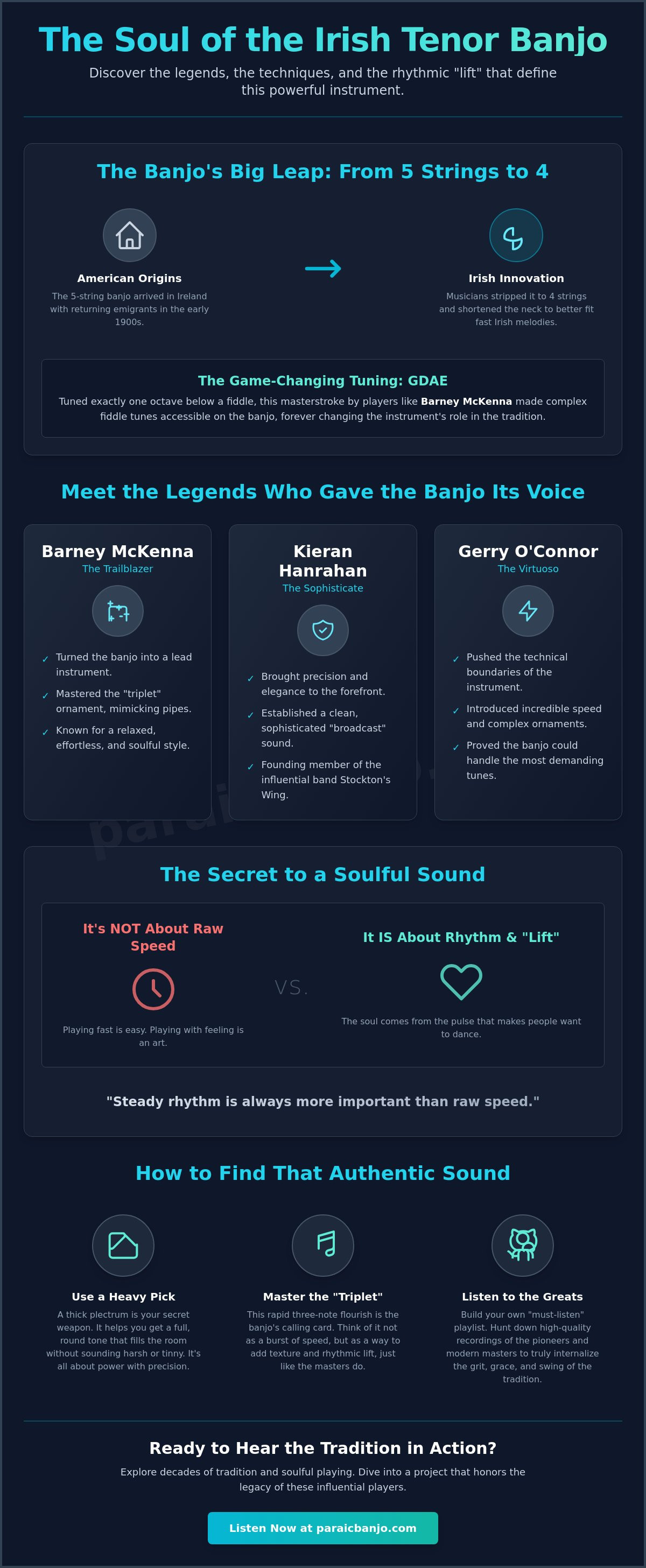
The tenor banjo didn't just appear in the Irish countryside by magic. It arrived in the early 1900s, brought back by emigrants returning from the United States. Back then, the 5-string banjo was the king of American music halls, but it didn't quite fit the tight, fast triplets of a Kerry slide or a Clare reel. Irish musicians stripped it down to four strings, shortened the neck, and created what we now call the tenor banjo. In the context of our tradition, a tenor banjo is a four-stringed instrument tuned GDAE, exactly one octave below a fiddle. This specific tuning changed the trajectory of the music forever.
It allowed players to use the same fingerings as fiddle players, making those complex melodies accessible. A legendary figure like Barney McKenna was instrumental in making this GDAE tuning the gold standard. Before his influence, many players used higher tunings that lacked that deep, resonant growl we love today. If you want to hear how this history sounds in a modern context, you can explore the Not Before Time – 39 Years in the Making (Digital Album), which captures that authentic, time-tested resonance. It's a project that honors these early shifts in the tradition.
From Music Halls to Kitchen Sessions
In the days before high-tech sound systems, volume was king. The banjo’s natural projection made it a favorite in crowded dance halls where it had to cut through the noise of shuffling feet. Eventually, it found its way into the quiet, smoky kitchens of the West. This transition from loud performance to intimate session work is where the instrument truly found its heart. To get a feel for this yourself, try practicing with a heavy plectrum, which is just a fancy word for a pick. A thicker pick helps you achieve that round tone that fills a room without sounding harsh or tinny. Many influential irish banjo players started their journey in these small house sessions, learning to balance power with precision.
The Instruments Unique Voice
Unlike a fiddle or a flute, which can hold a note for a long time, the banjo is a percussive beast. Every note has a sharp beginning and a quick end. This makes the banjo the perfect bridge between the melody and the rhythm section. It provides the pulse that keeps a session on the tracks. Achieving a soulful sound on a fretted instrument is a real challenge because you can't slide between notes easily. The soul comes from the swing; that tiny delay or emphasis on certain beats that makes the music breathe.
If you are searching for that legendary session energy, you can listen to individual digital tracks from seasoned performers to hear how they handle the rhythm. Pay close attention to how they use the triplet to add texture without losing the beat. This ornament is the calling card of all truly influential irish banjo players. It's about more than just speed; it's about the lift you give to the other musicians in the room. This rhythmic drive is exactly what we aimed to capture in the physical CD version of Not Before Time – 39 Years in the Making, ensuring the pulse of the tradition stays alive in every home.
The Pioneers: Players Who Changed the Game
While the instrument's arrival in Ireland set the stage, it was a handful of visionary musicians who truly gave it a voice. These influential irish banjo players didn't just play the notes; they reimagined what a four stringed instrument could do within a tradition dominated by the fiddle and flute. They moved the banjo from the background of the rhythm section right to the front of the stage. Through early radio broadcasts and the first waves of commercial folk recordings, their specific "touch" became the blueprint for every player who followed. It wasn't just about playing loud; it was about playing with a distinct, lyrical soul.
Kieran Hanrahan brought a level of precision and "broadcast authority" that the tradition hadn't seen before. As a founding member of Stockton's Wing and a long time voice on RTÉ’s Céilí House, he showed that the banjo could be clean, elegant, and incredibly sophisticated. Meanwhile, Gerry O'Connor began pushing the technical boundaries of the four strings to their absolute limit. He introduced a level of speed and complex ornamentation that proved the banjo could handle the most demanding tunes in the repertoire. If you are looking to experience that same blend of technical skill and deep tradition, you can find it in the tracks of Not Before Time – 39 Years in the Making, a project that celebrates this very legacy.
Barney McKenna and the Dubliners Legacy
You cannot talk about the Irish banjo without starting with Barney McKenna. He was the man who turned the banjo into a lead instrument. His genius lay in his "triplet" technique, a rapid fire three note ornament that mimicked the crisp "pop" of the uilleann pipes. Barney had a remarkably relaxed, effortless style. He never seemed to be fighting the strings. This ease made the instrument feel accessible to thousands of people who picked up a banjo after watching The Dubliners on television. Actionable Tip: To truly understand his genius, listen to Barney play slow airs. While most people focus on his fast reels, his airs reveal the banjo’s hidden expressive potential and its ability to "sing" a melody.
Technical Virtuosity vs. Traditional Soul
The rise of players like Gerry O'Connor sparked a new era of "virtuoso" playing. This modern style is often defined by incredible speed and intricate fingerwork. However, the true masters always balance this flashiness with the steady, rhythmic drive required for dancers. The best influential irish banjo players know that if the rhythm falters, the soul of the tune is lost. These pioneers created a roadmap that allows today’s players to choose their path. You can play with the driving, percussive "lift" of the old house sessions or the polished, lightning fast precision of the concert hall. Both styles are valid, but they both rely on that same rhythmic heartbeat established by the legends of the 20th century.
Regional Masters: The Soul of East Galway and Clare
To truly understand the heart of this tradition, you have to look beyond the big concert stages and into the regional styles that define the West of Ireland. While the early pioneers gave us the tools, it was the masters in places like Galway and Clare who gave the instrument its soul. These influential irish banjo players proved that the banjo could be just as expressive and nuanced as any fiddle. It is all about the "lilt," that rhythmic bounce that makes a tune feel alive without ever needing to rush the tempo. When you listen to these regional styles, you aren't just hearing notes; you are hearing the history of a specific landscape and the people who lived there.
You can hear this deep regional connection in projects like Not Before Time – 39 Years in the Making (Digital Album), where the focus is on capturing that authentic, unhurried pulse. It's a celebration of the slow-cooked mastery that only comes from decades of immersion in the session scene. If you want to hear how these styles translate into a modern collection, exploring individual digital tracks from this project is a great way to start your listening journey. It's about finding that "sweet spot" where the rhythm and melody meet.
The Rhythmic Pulse of East Galway
John Carty is perhaps the most famous modern master of the East Galway style. His playing is characterized by a "mellow" tone and a rock-solid, driving rhythm. In this region, there is a heavy emphasis on "the lift," a way of playing that feels like the music is constantly surging forward without actually getting faster. For a deeper dive into these nuances, check out this guide on East Galway vs Clare music. This style often involves playing just slightly "behind the beat," which creates a soulful, laid-back feel that is perfect for long nights in a crowded pub session. It's a style that prioritizes the groove over technical flashiness.
Clare Style: Precision and Elegance
Across the border in County Clare, the style shifts toward something more "staccato" and crisp. Angelina Carberry is the leading light here, known for her understated and incredibly precise plucking. Her style is elegant and rhythmic, using short, detached notes to create a sense of clarity that is rare on the banjo. This precision has influenced a whole new generation of session leaders who want their music to sound clean and articulate. Actionable Tip: To train your ear, try to compare a Galway reel with a Clare reel side-by-side. Focus on the space between the notes. In Galway style, the notes often feel more connected and "round," while Clare playing is defined by those crisp, separated strikes.
We also have to acknowledge the legacy of the diaspora, specifically Mike Flanagan and the Flanagan Brothers. They took the Irish banjo sound to New York in the early 20th century, blending it with the energy of the American music halls before the sound traveled back to Ireland. Their recordings are a vital part of the history for all influential irish banjo players, reminding us that this tradition has always been a global conversation. Whether it’s the physical CD or the digital version, keeping these recordings in your collection is like holding a piece of that traveling history in your hands.
How to Identify Influential Banjo Playing
Listening to influential irish banjo players is a bit like learning a new language. At first, you just hear a rapid-fire stream of notes, but as your ear matures, you start to recognize the "grammar" of the instrument. Identifying a master isn't about looking for the person with the fastest hands. It's about hearing the technical choices they make to serve the music. You are looking for a specific combination of tone, timing, and ornamentation that makes the banjo sound like it belongs in the heart of the tradition.
The most recognizable marker is "The Triplet." This is the signature ornament where three notes are squeezed into the space of one or two beats. A great player makes these sound crisp and percussive, almost like a drummer’s flam. If the triplets sound mushy or "tripped over," the soul of the tune gets lost. Beyond that, pay attention to the choice of plectrum. A heavy plectrum, usually over 1.0mm, is what gives the Irish banjo its round, fat tone. A thinner pick might be easier for speed, but it lacks the punch needed to drive a session. It's all about the contact between the pick and the string.
Listening for the "Lift"
In Irish music, "lift" is that magical rhythmic bounce that makes people tap their feet. It is the opposite of a flat, robotic rhythm. A banjo player who understands lift isn't just playing the melody; they are pushing the tune forward. They support the ensemble by emphasizing the "on" beats just enough to give the music a sense of momentum. Listen for players who know when to play "straight" and when to add a bit of swing to the rhythm. It's a delicate balance that separates the legends from the learners. If you want to hear this lift in action, you can explore these individual digital tracks to hear how the rhythm is held steady across different tune types.
Decoding the Liner Notes
When you pick up an album, the credits tell a story. In this tradition, lineage is everything. Understanding who a player learned from or which regional style they represent helps you categorize the sounds you’re hearing. You’ll often find these details hidden inside the liner notes, where historical stories and teacher-student connections are laid out. Researching these styles gives you a roadmap for your own listening journey. It transforms a simple song list into a family tree of musical influence.
Actionable Tip: Build a "listening library" by grouping tracks by region rather than just by player. Put three East Galway tracks next to three Clare tracks. Listen for the difference in the picking hand’s attack. You’ll soon realize that influential irish banjo players are masters of their specific regional dialect. This kind of active listening is the fastest way to develop your own "traditional ear." For a definitive example of this regional pride, the Not Before Time – 39 Years in the Making (Physical CD) offers a deep dive into the stories and techniques that shaped the music over decades.
The Modern Tradition: Carrying the Soul Forward
The story of the Irish banjo is far from finished. Today, we are witnessing a beautiful tension between honoring the old ways and exploring new horizons. Younger musicians are taking the foundations laid by the legends we have discussed and adding their own contemporary signatures. For instance, the 2026 recipients of the TG4 Gradam Ceoil bursary, including Jack McGoldrick and Peadar Connor, represent a new wave of talent that respects the "lift" of the past while experimenting with modern textures. Connor, in particular, is noted for fusing non-traditional harmonies with deep-rooted forms, proving that the list of influential irish banjo players is always expanding to include those who dare to innovate without losing the heartbeat of the session.
This balance isn't easy to strike. It requires a deep immersion in the culture, often spanning decades. There is a specific kind of weight and authority that only comes with time. When you hear a player who has spent thirty or forty years at the coalface of the tradition, you aren't just hearing technical skill; you are hearing a lifetime of stories. This is why projects like Not Before Time – 39 Years in the Making carry such significance. It is a definitive statement of a lifetime's passion, capturing the grit and the grace that can only be forged through years of playing in crowded pubs and quiet kitchens. It serves as a reminder that while speed is impressive, soul is what truly endures.
Capturing the Session Spirit
In our modern world, it is tempting to polish every recording until it is perfectly sterile. However, the true magic of the banjo lives in the "raw" energy of a live session. We want to hear the click of the plectrum and the rhythmic drive that made the 2025 Fleadh Cheoil na hÉireann in Wexford such a record-breaking success with its 800,000 attendees. That massive energy starts with the individual player’s touch. If you are looking to build a collection that feels authentic, I highly recommend exploring the best traditional Irish session music CDs. These recordings prioritize the "live-feel" that makes you feel like you are sitting right in the middle of the circle, surrounded by the best influential irish banjo players of the era.
Your Journey into the Tradition
Whether you are a dedicated collector or a newcomer just finding your rhythmic feet, your journey into this tradition is a personal one. You might find yourself drawn to the crisp precision of the Clare style or the driving, mellow pulse of East Galway. The beauty of this music is that there is always more to discover, more nuances to hear, and more history to uncover. I invite you to discover the soulful sounds of Páraic Banjo and order the album "Not Before Time" today. You can choose the physical CD for your shelf or the digital album for your sessions on the go. Either way, you are becoming a part of a storied musical lineage that has traveled from the music halls of the 1920s to the digital world of 2026. Keep the music alive, keep your ears open, and I'll see you at the next session. Slán go fóill!
Keep the Tradition Alive in Your Own Collection
Our journey through the history of influential irish banjo players shows that the instrument's true strength lies in its rhythmic soul and deep regional roots. We have seen how early pioneers transformed a music hall novelty into a powerful lead voice, and how today's masters continue to balance technical skill with that essential traditional "lift." It is a legacy built on decades of sessions, kitchen tunes, and a profound respect for the masters who came before. Authenticity isn't just about speed; it's about the grit and heart found in every well-placed triplet.
If you are ready to immerse yourself in this storied sound, you can order the limited edition CD "Not Before Time – 39 Years in the Making" from Páraic Banjo today. This project is a definitive statement of a lifetime's passion, featuring 18 tracks of pure banjo energy recorded live to capture that elusive session spirit. It expertly highlights the nuances of East Galway and Clare styles and includes detailed historical liner notes to help you connect with the tradition. The music is a living thing, and by listening to these soulful recordings, you are helping to carry the story forward. Grab your copy, turn up the volume, and let the rhythm take hold. Happy listening!
Frequently Asked Questions
Who is considered the most influential Irish banjo player of all time?
Barney McKenna is widely regarded as the most influential figure because he moved the banjo to the forefront of the tradition. Before him, the instrument was mostly used for backup, but his work with The Dubliners changed everything. He popularized the GDAE tuning and perfected the crisp triplet that defines the genre today. If you want to understand the roots of influential irish banjo players, his recordings are the essential starting point.
What is the difference between the East Galway and Clare banjo styles?
The primary difference lies in the rhythmic feel and the way notes are articulated. East Galway style is often described as "mellow" and focuses on a driving, surging rhythm known as "the lift." In contrast, the Clare style is more staccato and crisp, with a clear separation between notes. While Galway players might play slightly behind the beat for a soulful feel, Clare players often prioritize technical precision and elegant, detached ornamentation.
Why is the tenor banjo tuned to GDAE in Irish music?
Tuning the tenor banjo to GDAE allows it to mirror the fingerings of the fiddle, which is the backbone of the Irish tradition. This makes it much easier to play the fast, intricate melodies found in reels and jigs. Beyond the fingerings, this lower tuning provides a deep, resonant growl that fills out the sound of a session. It's a full octave below the fiddle, giving the banjo its unique, percussive authority.
What are the best Irish banjo albums for beginners to listen to?
Beginners should start with foundational recordings from masters like Barney McKenna and John Carty to hear the distinct regional flavors. For a modern take that stays true to these roots, "Not Before Time – 39 Years in the Making" is a perfect choice. It offers a live, authentic feel across 18 tracks, making it easier to hear how the instrument should sound in a real session environment. Listening to diverse styles helps build your traditional ear.
How can I tell if a banjo player is playing in a "traditional" style?
A traditional style is defined by its focus on the "lift" and the use of specific ornaments like the triplet. You can tell a player is rooted in the tradition if their music feels like it's designed for dancing, even if no one is on the floor. They will prioritize steady, driving rhythm over flashy, modern effects. Traditional players also tend to have a round, fat tone achieved by using a heavy plectrum and a relaxed picking hand.
Is speed the most important factor in Irish banjo playing?
Speed is certainly impressive, but it is never more important than the rhythm and soul of the tune. The best influential irish banjo players know that rushing a reel actually kills the "swing" that makes the music breathe. If you play too fast, the triplets become blurred and the music loses its percussive punch. It is always better to play at a steady, comfortable tempo that supports the other musicians and keeps the dancers moving.
Can I play Irish music on a 5-string banjo?
You can certainly play Irish tunes on a 5-string banjo, but it requires a very different technique than the standard tenor approach. Most 5-string players use "clawhammer" or three-finger styles, which can struggle to replicate the sharp, staccato triplets needed for Irish melodies. The 4-string tenor banjo remains the standard because its shorter neck and GDAE tuning are perfectly suited for the rapid-fire nature of traditional jigs, reels, and hornpipes.
Where can I find authentic, live-recorded Irish banjo music?
Authentic, live-recorded music is best found on albums that skip heavy studio processing to capture the "room sound" of a session. You can find this raw energy in the "Not Before Time – 39 Years in the Making" physical CD or digital album. These recordings focus on the natural interaction between the instrument and the melody, providing a high quality, soulful experience that feels much more personal than a polished commercial folk production.


Comments