Irish Banjo Standards: Tuning, Fret Counts and What “Standard” Really Means

Is there really one accepted recipe for an Irish tenor banjo? The phrase “irish banjo standards” can make it sound as if tuning, fret count and body style are all fixed. In practice, GDAE tuning and a 19-fret neck are common choices, not rules every player has to follow.
If you’ve found conflicting advice about 17- and 19-fret banjos, or resonators and open backs, you’re not missing something. These choices affect how an instrument feels and sounds, and players have different priorities. The useful first step is to understand what each feature changes, then decide which matters for the music you want to play.
This guide explains why GDAE is widely used for Irish tunes, how scale length and fret count affect playability, and why resonators are often heard in lively sessions while some players prefer an open-back sound. It also separates the four-string tenor banjo’s melodic role from the idea that every instrument must match one setup. Listen for the sound and feel you want, and use “standard” as a starting point, not a hard-and-fast rule.
Table of Contents
What Does “Irish Banjo Standard” Mean? Start with Convention, Not a Rule
Irish Tenor Banjo Tuning and Fret Counts: GDAE, CGDA, 17 or 19?
Resonator or Open-Back? How Irish Banjo Construction Shapes the Sound
How to Interpret Irish Banjo Standards When Choosing or Listening
Irish Banjo Standards in Context: Common Ground Without a Single “Correct” Setup
What Does “Irish Banjo Standard” Mean? Start with Convention, Not a Rule
The word “standard” can sound more definite than musicians intend. In Irish traditional music, it usually points to a familiar setup or playing practice, not a specification every player must follow. There’s no single authority prescribing one banjo for the tradition. Instead, players have developed shared preferences that suit the tunes, the sound of a session and the way an instrument feels in the hands.
This guide focuses on the four-string tenor banjo, commonly used to play Irish traditional melodies. It helps to separate three questions that often get bundled together: what kind of banjo it is, how its strings are tuned, and how its body is built. These are related choices, but they describe different features. A familiar answer to one doesn’t automatically settle the others.
Why “standard” can mean more than one thing
A player might use “standard” to mean a tuning, such as GDAE, or a neck with a particular number of frets. Someone else may mean a construction feature, such as a resonator. Each term describes a different part of the instrument. A common combination can be a useful starting point, while individual players choose alternatives for comfort, sound or musical preference.
A customary setup can help you recognize a familiar approach, but it isn’t a requirement for playing Irish music. When you hear a setup called “the Irish standard,” ask which feature the speaker means. The term may describe what’s widely used, not the only authentic choice. The broader History and Role of the Tenor Banjo also helps put the instrument’s development and changing musical uses in context.
The tenor banjo’s role in Irish traditional music
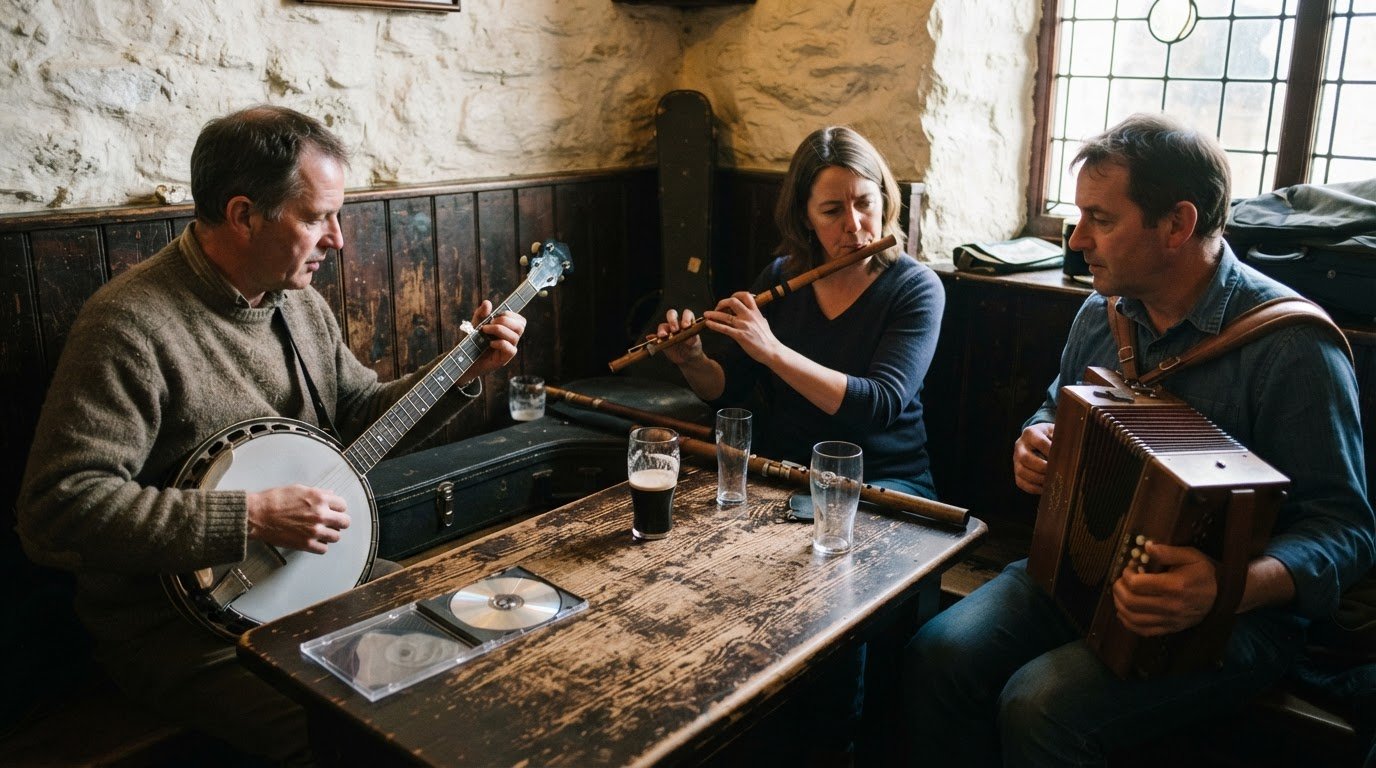
In a traditional session, the tenor banjo is often heard carrying the tune alongside instruments such as fiddle or flute. Its clear, bright notes can trace the melody so listeners can follow a phrase as it moves around the ensemble. To hear this role, listen for the banjo picking out a dance tune’s rising and falling line rather than simply marking the beat beneath it.
That melodic role is a useful way to understand the instrument, not a rule that excludes other approaches. A player can use chords or rhythmic support, too. Melody playing follows the tune’s notes, while chordal accompaniment supports the harmony. As you listen, try following one melodic phrase from start to finish. It’s a practical way to hear what the banjo contributes without needing to identify every detail of its setup.
Treat irish banjo standards as reference points. First identify the instrument format, then consider tuning and construction as separate choices. This makes conflicting advice easier to interpret: two players may describe different setups as standard because they’re talking about different features, or because common practice leaves room for personal preference.
Irish Tenor Banjo Tuning and Fret Counts: GDAE, CGDA, 17 or 19?
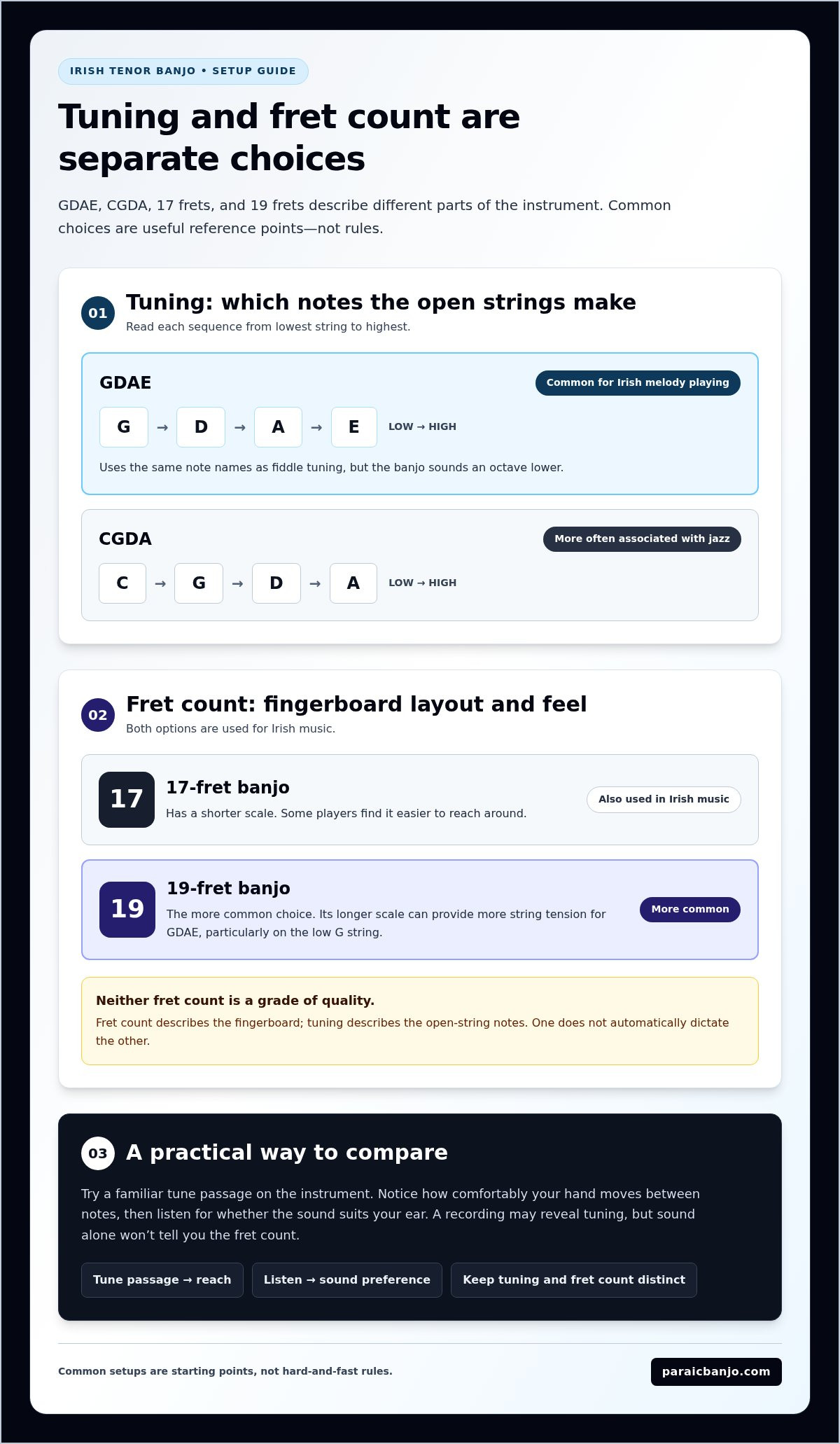
Tuning names describe the notes of the open strings, the notes they make when you play them without pressing any frets. GDAE is the common tuning for Irish tenor banjo melody playing. CGDA is another tenor-banjo tuning, more often associated with jazz. Here’s a quick comparison, with strings listed from lowest to highest:
What GDAE tuning changes for a player
GDAE uses the same note names as a fiddle’s tuning, but the banjo sounds an octave lower. That familiar note sequence makes it a natural fit for playing fiddle tunes on banjo: melodies can follow the same pitches and phrasing in a lower register. If you’re learning a tune by ear, listen for how the banjo traces its notes rather than assuming that a tuning label tells you exactly how the performance will sound.
GDAE is the common Irish tenor banjo tuning, though individual players may choose a different setup. For comparing irish banjo standards, that’s the useful distinction: a widely used tuning is a reference, not a rule that settles every player’s choices.
How 17-fret and 19-fret banjos differ
Fret count means the number of metal frets along the fingerboard. Both 17- and 19-fret tenor banjos are used for Irish music, with 19-fret models the more common choice. A 17-fret instrument has a shorter scale, which some players find easier to reach around. A longer 19-fret scale can provide more string tension for GDAE, particularly on the low G string. These are practical differences, not grades of quality.
For a sound-in-context example, spend time with Páraic’s traditional Irish banjo playing. Listen to the phrasing and how the banjo sits with the other instruments; the setup is only one part of the story.
Resonator or Open-Back? How Irish Banjo Construction Shapes the Sound
Turn a tenor banjo around and you’ll see one of the clearest construction differences: some have a resonator attached to the back, while others leave the back open. This detail can influence how the instrument sounds and feels, but it doesn’t determine whether the music is authentically Irish. Think of it as one choice among several, shaped by the player, the setting and the sound they enjoy.
What a resonator changes in a banjo
A resonator is the rear component fitted behind the banjo’s body. It helps direct the sound outward. Players and listeners often describe resonator banjos as having a crisp tone that projects well and can cut through the sound of other instruments. That’s a common observation, not a promise: the player and musical setting also affect what you hear.
Projection can be useful in a lively session, where a banjo shares space with fiddles, flutes and other instruments. A clear attack may help its melody carry through the ensemble. But “more projecting” isn’t automatically “better.” In a smaller group, or where a gentler blend is welcome, a player may prefer a different balance. When listening, notice whether the banjo stands distinctly in the mix or sits more softly alongside the other instruments.
When an open-back setup may suit a player
An open-back banjo has no resonator covering its rear. It’s a valid alternative, not a lesser version of the instrument. Open backs are often described as lighter, with a warmer, mellower sound, though those qualities aren’t guaranteed for every banjo or player. Treat them as tendencies people report, rather than a strict formula.
Compare the two types by listening to or playing the same short melody on each. Notice the tone, how comfortably the instrument sits, and whether its sound blends the way you like. With recordings, compare similar passages and pay attention to the banjo’s place in the ensemble. A recording’s overall sound can make construction difficult to identify with certainty, so treat your impression as a clue, not proof.
That’s the practical point behind irish banjo standards: resonators are a common choice for session playing, but an open back can suit a player’s preference and musical context. Neither construction type is essential to Irish music, and neither guarantees a particular tone in every situation. Let sound and feel guide you rather than treating a familiar setup as the only acceptable one. To hear traditional banjo playing in musical context, explore Páraic’s Irish banjo recordings.
How to Interpret Irish Banjo Standards When Choosing or Listening
Instrument labels make more sense when you consider them in order. First identify the kind of banjo, then work out which feature someone means by “standard,” and finally consider the musical setting. This approach helps whether you’re comparing instruments or listening for what a banjo brings to a tune.
A simple checklist for understanding a banjo setup
Identify the instrument. Check whether the discussion is about a four-string tenor banjo, commonly used for Irish traditional melody playing, or another type of banjo.
Pin down the feature. Is the speaker describing tuning, fret count or construction? These are separate choices, so a comment about one doesn’t tell you the others.
Consider the player and setting. Ask what the instrument needs to do: sit comfortably for the player, carry a melody within an ensemble, or create a tone they enjoy.
This sequence helps because “standard” can be shorthand for different things. If someone calls a banjo setup standard, identify which part they mean before comparing it with another instrument. A shared convention gives you a reference point, not a complete specification.
Sound alone won’t reliably reveal every detail. You may hear a bright, cutting tone, but that doesn’t tell you with certainty how many frets the banjo has or what tuning the player uses. Recordings can also blend several instruments together, making it harder to isolate the banjo’s qualities. Treat what you hear as evidence of musical character, not a complete instrument label.
Hear the musical tradition beyond the specifications
Try listening in three passes. First, follow the banjo’s melody: can you hear it tracing the tune alongside the fiddle or flute? Next, notice the rhythmic drive, the lift and pulse that help carry a dance tune. Then listen to the banjo’s tone in the ensemble: does it stand out, blend in, or shift between the two? These prompts reveal more about the player’s musical choices than a spec sheet alone.
Regional context adds another layer. Tunes and playing styles associated with East Galway and Clare show how Irish traditional music carries local character as well as shared session practice. Listen for phrasing and rhythmic feel, not just brightness or volume. The more tunes you hear, the easier it becomes to notice how individual players shape the music.
Use setup terms to orient yourself, then let the playing tell its own story. For a listening example, explore Páraic’s album, featuring traditional session music recorded live with expert musicians.
Irish Banjo Standards in Context: Common Ground Without a Single “Correct” Setup
The familiar reference points should now be easier to recognize: GDAE tuning, a 19-fret neck and a resonator often come up in discussions of Irish tenor banjo. They describe common choices, not a test every player or instrument has to pass. CGDA tuning and open-back construction are useful comparisons, too. They offer different approaches, not a departure from Irish music.
A setup is only one part of the musical picture. It doesn’t, by itself, tell you whether a performance is authentic, expressive or well played. Those qualities come through in the musician’s phrasing, timing, tone and connection with the tunes and other players. A banjo with less typical features can still be part of a living tradition, just as a familiar setup doesn’t guarantee a particular sound or level of musicianship.
What readers can confidently take away
Use conventions as helpful landmarks. When comparing instruments or reading about a player, first notice which feature is being discussed. GDAE or CGDA refers to tuning; 17 or 19 refers to fret count; resonator or open back describes construction. Keeping those categories separate makes advice clearer and avoids turning a common setup into a checklist for deciding who belongs.
Then bring your attention back to the music. Listen for how the banjo follows a melody, shapes a phrase and sits among the other instruments. Ask what the player seems to be aiming for, rather than judging the performance by whether it matches one expected combination. The tradition has shared reference points, but it also grows through individual musicians making choices that work for their playing and musical community.
Keep exploring Irish tenor banjo music
Instrument choices make their fullest sense through the tunes, players and sessions. Páraic Mac Donnchadha’s debut album, Not Before Time - 39 Years in the Making, offers one way to spend time with traditional Irish banjo playing. The album brings together 18 tracks recorded live with expert musicians, and its liner notes provide historical context. Listen from tune to tune to notice the interplay and phrasing that instrument labels alone can’t convey.
The clearest takeaway is simple: irish banjo standards describe common tenor-banjo choices, but no single setup defines every player or determines musical quality. Stay curious about the sound, the tune and the people making the music. Discover Not Before Time.
Take the Tune Forward
Put these ideas to work the next time you listen. Choose a tune and follow the banjo through one full phrase. Then listen again for its rhythmic lift and how it interacts with the other instruments. This gives instrument terminology a practical purpose: it helps you notice musical choices, not judge a player by a checklist.
Irish banjo standards can explain familiar approaches, but no label captures the character of a performance. Let your ear lead. Compare different interpretations of a tune and notice how each player shapes its pace, accents and melodic line. With time, you’ll hear more than the instrument’s sound; you’ll hear a musician’s own voice within a shared tradition.
For another chance to listen closely to traditional Irish tenor banjo playing, discover Páraic’s Irish tenor banjo album. Settle in with a tune, follow the melody, and enjoy where the music takes you.
Frequently Asked Questions
Is there one standard tuning for Irish tenor banjo?
GDAE is the common reference for Irish tenor banjo, but players can use other tunings, including CGDA. If you’re matching a tune resource to an instrument, check the tuning it assumes before using its fingering. Note the open strings beside a tune chart so you can quickly spot when the chart and instrument are set up differently.
Is a 19-fret banjo required for Irish music?
No. Irish music doesn’t require a specific fret count. If you’re considering a tenor banjo, try a familiar tune passage that moves between notes and positions. Notice whether your hand feels relaxed and the notes come clearly. That gives you a personal basis for comparing instruments instead of treating a common setup as a pass-or-fail standard.
Can you play Irish music on a 17-fret tenor banjo?
Yes. A 17-fret tenor banjo can be used for Irish music. Before practising from tablature, check its tuning: a fingering pattern may produce different pitches on an instrument set up differently from the one the tab assumes. Once the tuning matches, focus on playing the phrase evenly and clearly. Fret count alone doesn’t tell you how well a tune will suit your playing.
What is the difference between GDAE and CGDA banjo tuning?
They are different arrangements of the banjo’s open-string notes. The practical difference shows up when you follow written fingerings: a pattern intended for one tuning won’t necessarily give you the same notes in the other. Check the tuning named by a lesson or chart before practising. If it isn’t stated, compare the suggested notes with your instrument rather than assuming the fingering will transfer.
Does an Irish tenor banjo need a resonator?
No. A resonator isn’t a requirement for Irish music. To judge how a banjo’s sound works in context, listen to it alongside other instruments rather than relying only on a solo recording. Notice whether its tone stays clear in the mix or feels softer beside the ensemble. That can tell you more about whether the sound suits your setting than the construction label alone.
Is an Irish tenor banjo the same as a regular tenor banjo?
The terms can overlap, so the label by itself may not tell you how an instrument is set up. If you’re reading an instrument description, look for details such as string count and tuning, then compare those with the music you plan to play. This is especially useful when a resource says “tenor banjo” without specifying whether it’s written for an Irish-style setup.
Does the banjo play chords or melody in Irish traditional music?
The banjo commonly carries the tune, though its part can vary with the arrangement. Try listening at the ends of phrases: does the banjo continue the melodic line, or add a rhythmic or harmonic response while another instrument leads? Following those moments can help you hear how the player supports the group without assuming the banjo must serve only one musical role.

Comments