Irish Banjo vs Bluegrass Banjo: The Essential Guide to 4 and 5 String Differences

What if the instrument you choose determines whether you are driving a high-speed bluegrass roll or weaving through a soulful, ancient melody? It's easy to feel overwhelmed by the jargon of 17-fret necks versus 5-string resonators, especially when you just want to play the songs you love. You might even worry that your guitar skills won't translate to the irish tenor banjo playing style, leaving you stuck with an instrument that doesn't fit the music in your heart.
I understand that hesitation. After spending decades distilling my passion into my debut album, Not Before Time: 39 Years in the Making, I've seen many beginners struggle to find their footing. This guide is here to clear the fog. You'll discover the essential technical, musical, and cultural differences between Irish and Bluegrass banjos so you can choose the right tool for your journey. We'll break down strings, tunings, and those confusing terminology traps. This is about more than just gear; it's about finding your voice. By the end, you will have the confidence to pick up your first banjo and join a storied tradition with total clarity.
Table of Contents
Irish Banjo vs Bluegrass Banjo: The Essential 4 and 5 String Breakdown
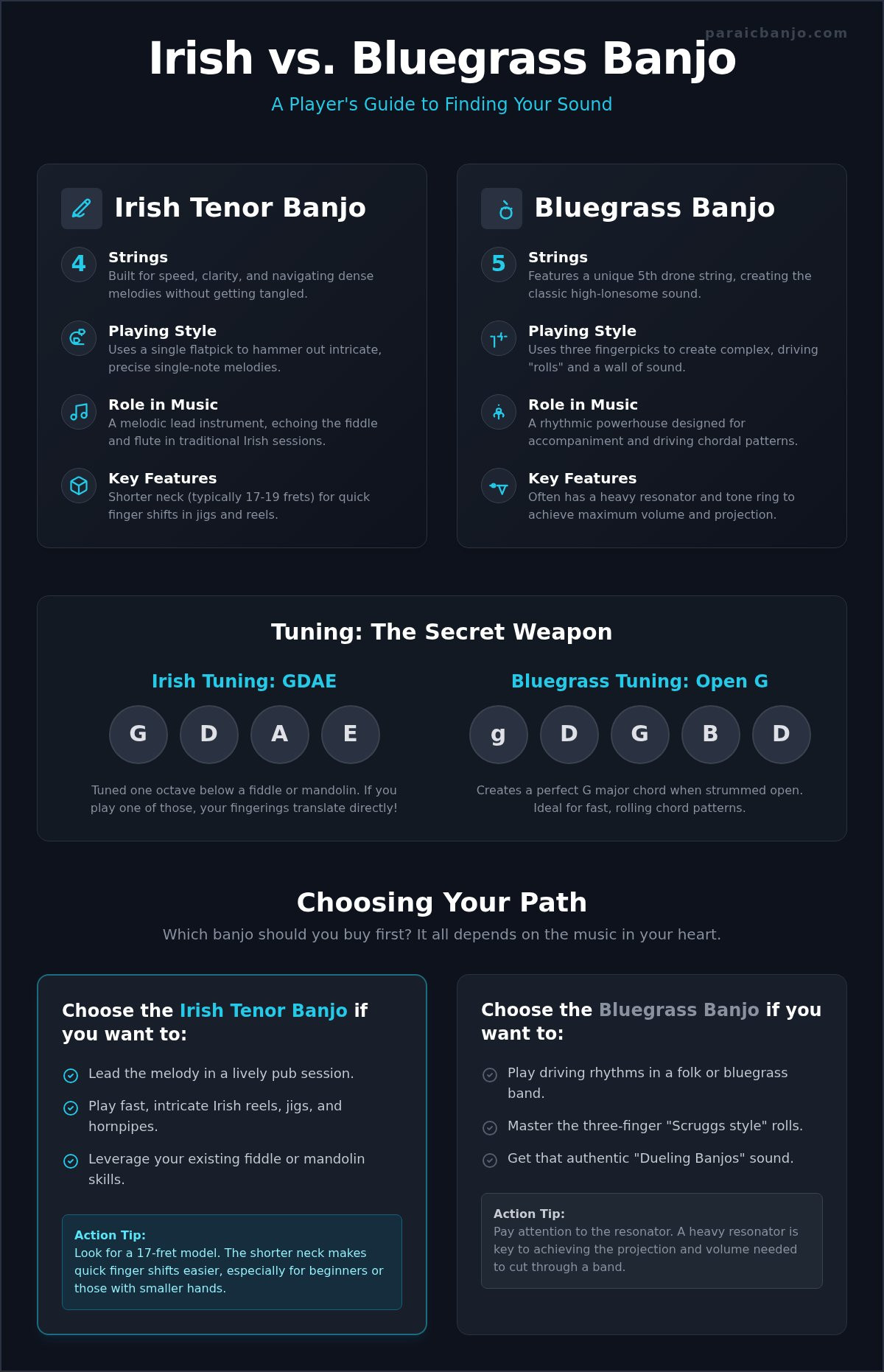
Picking up a banjo for the first time feels like standing at a crossroads. One path leads to the lively, crowded pubs of Galway where the melody is king. The other leads to the high-lonesome sound of the Appalachian mountains. The most obvious difference between these worlds is the number of strings. An Irish banjo has four, while a bluegrass banjo has five. This isn't just a minor technicality. It changes how you breathe life into the music.
In the irish tenor banjo playing style, we use a single flatpick to hammer out the intricate notes of a reel or a hornpipe. It is about precision. It is about the pulse. To hear exactly how that four-string melody cuts through a session, listen to a track from Not Before Time – 39 Years in the Making. You will hear how the instrument echoes the fiddle and the flute, note for note, with a soulful rhythm that defines our tradition. While the tenor banjo serves as a melodic lead, the bluegrass banjo is a rhythmic powerhouse designed for accompaniment and complex, driving rolls.
The 4-String Tenor: Heart of the Irish Session
The 4-string tenor is built for speed and clarity. Because it has fewer strings to navigate, you can fly through the dense ornamentation of Irish traditional music without getting tangled. The shorter neck length is a hallmark of this instrument. You will typically find models with either 17 or 19 frets. The 17-fret version is a favorite for many because the shorter reach makes those quick finger shifts much more manageable. It is the perfect tool for weaving through a jig. Action Tip: Check the fret count before you buy. 17-fret models are often easier for beginners or those with smaller hands.
The 5-String Drone: The Bluegrass Powerhouse
The bluegrass banjo is a different beast entirely. It features a unique, short 5th string that starts halfway down the neck. This string acts as a high-pitched drone, ringing out constantly as the player uses three fingerpicks to create "rolls." This is the foundation of the Scruggs style. It creates a wall of sound that is perfect for a folk band, but it makes playing tight, single-note Irish melodies much more difficult. Action Tip: If your heart is set on playing "Dueling Banjos," you absolutely need that 5th string to get the authentic sound.
Hardware and Tuning: Why the 4th and 5th Strings Change Everything
The heartbeat of any instrument lies in its tension and its tuning. When you step into the world of the four-string, you aren't just losing a string; you're gaining a whole new map of the fretboard. The most transformative difference between these two instruments is how they are tuned. While a bluegrass banjo typically lives in Open G (GDBGD), the Irish tenor banjo is almost always tuned to GDAE. This specific interval, which sits exactly one octave below a fiddle or mandolin, is what allows the irish tenor banjo playing style to mirror the complex melodies of traditional dance tunes with such ease.
Because GDAE tuning requires the bottom G string to be quite loose on a standard scale, you cannot simply use any set of strings. Irish players rely on significantly heavier string gauges to maintain enough tension for a crisp, clear note. If the strings are too light, the low G becomes "floppy," losing that rhythmic drive that is so essential in a session. This physical setup is designed for one thing: to let the melody sing out with power and authority. You can hear this perfectly balanced tension across the tracks of Not Before Time – 39 Years in the Making, where the instrument's voice is both soulful and robust.
Tuning Secrets: GDAE vs. Open G
For many, the GDAE standard is a secret weapon. If you already play the fiddle or mandolin, your left-hand fingerings will translate directly to the banjo. You don't have to relearn your favorite reels from scratch. In contrast, the Open G tuning of a bluegrass banjo is built for chords. By strumming all five strings open, you get a perfect G major chord. This makes it a dream for the fast, rolling chordal patterns of Scruggs style, but it can make navigating a tight, single-note Irish jig feel like walking through a maze. Action Tip: If you have a mandolin or fiddle background, the 4-string will feel like home from day one.
Resonators and Tone Rings: Finding Your Volume
Bluegrass players often seek out heavy resonators and massive tone rings to achieve maximum projection. They need to be heard over a full band of fiddles, guitars, and upright basses. While many Irish players also use resonators to ensure they cut through the chatter of a crowded pub, the goal is different. We look for a punchy, rhythmic snap that emphasizes the "pulse" of the tune rather than just raw volume. Action Tip: Look for a banjo with a high-quality tone ring if you want that professional, crisp snap that defines the best session recordings.
Melodic Pulse vs. Rolling Rhythm: Mastering the Picking Techniques
The way you strike the string is the soul of the instrument. In bluegrass, you're building a wall of sound with three steel fingerpicks. But in the irish tenor banjo playing style, we rely on a single plectrum to carve out the melody. It's a focused, rhythmic approach that does more than just play notes; it mimics the natural breath and phrasing of the other instruments in a session. Think of the sharp, percussive snap of a fiddle bow or the rhythmic "cut" of a wooden flute. That is the sound we're chasing.
The heart of this technique is the triplet. These quick bursts of three notes are the signature of traditional irish session music. Mastering them early will transform your playing from a stiff, mechanical sound into something that truly dances. When I recorded Not Before Time – 39 Years in the Making, the goal was to capture that specific rhythmic lift that defines the East Galway style. It isn't just about speed. It is about the pulse.
The Plectrum Approach: Speed and Ornamentation
To get the right lift, you must hold the pick with a balance of firmness and flexibility. You're looking for a grip that allows the pick to glide across the strings without getting stuck. In 6/8 time signatures, like jigs, the down-up-down stroke pattern is your foundation. This creates the natural "DA-da-da" emphasis that keeps the dancers moving. Unlike the generic up-and-down picking often shown in online videos, this specific pattern preserves the internal rhythm of the tune. Action Tip: Choose a heavy pick (1.0mm or thicker) to get a warm, traditional Irish tone that doesn't sound thin or "tinny."
The Scruggs Style: Three-Finger Rolls
Bluegrass picking is a different architecture entirely. It relies on the thumb, index, and middle fingers working in a constant, rotating cycle called a "roll." This creates a driving, syncopated rhythm that fills every gap in the music. For a beginner, synchronization is far more important than raw speed. You want every note in the roll to have the same volume and timing. If one finger is late, the whole "train" goes off the tracks. Action Tip: Start with the Forward Roll pattern (Thumb-Index-Middle) to get that classic, rolling bluegrass sound into your muscle memory immediately.
Choosing Your Path: Which Banjo Should You Buy First?
Deciding on your first instrument is really a question of where you want to spend your Friday nights. Do you see yourself tucked into the corner of a dimly lit pub, trading reels with a fiddler? Or are you dreaming of standing on a festival stage, providing the high-octane drive for a bluegrass band? Your destination dictates your tool. While you might hear of folks trying to adapt a 5-string for the irish tenor banjo playing style, it is a rare and difficult path. The extra string often gets in the way of the rapid-fire melody lines we love. It is like trying to drive a tractor on a racing circuit; it might get you around the track, but it won't feel right.
Before you commit your hard-earned cash, I always suggest visiting a local session. Sit near the banjo player. Listen to the "clack" of the plectrum and the way the notes skip along the rhythm. If that soulful, melodic pulse makes your heart beat faster, the 4-string is your calling. If you prefer the shimmering, constant wall of sound from a finger-picked roll, look toward the 5-string. Budgeting for a starter kit usually involves finding a balance between playability and price. You don't need a vintage masterpiece to start, but you do need an instrument that stays in tune and has a comfortable action. To hear the level of craft that 39 years of dedication brings to the instrument, you can explore the tracks on Not Before Time – 39 Years in the Making.
The Session Player Checklist
If you want to play the melody of a classic reel like "The Maid Behind the Bar," your requirements are specific. You need a 4-string tenor banjo with a neck that can handle the tension of GDAE tuning. This setup allows you to follow the fiddle players note for note. Focus on the "feel" of the neck; a 17-fret model is often the best entry point for those transitioning from other instruments. Action Tip: Read The Collector’s Guide to understand the value of supporting traditional artists and finding quality in the craft.
The Bluegrass Jam Checklist
For those chasing the bluegrass dream, the 5th string is non-negotiable. You need that high drone to create the syncopated rolls that define the genre. Look for a banjo with a resonator to give you the volume needed to compete with a loud mandolin or a driving guitar. Action Tip: Ensure the 5th string tuner is a geared peg, not a friction peg. Friction pegs are notoriously difficult to keep in tune, and nothing kills the joy of a jam faster than a sour drone string.
Bringing the Tradition Home: The Soul of the Irish Tenor Banjo
Beyond the strings, the tunings, and the technical gear lies the true heart of the instrument: the pulse. You can master every scale and memorize every fret, but the irish tenor banjo playing style only truly comes alive when you capture the "lift" of the music. It is a soulful, rhythmic drive that prioritizes the feel of the tune over raw, clinical speed. In the West of Ireland, the banjo isn't just a lead instrument. It is the engine of the session. It provides a percussive foundation that anchors the fiddles and pipes, creating a sound that is as much about the silence between the notes as the notes themselves.
For me, this journey has been a long one. My debut album, Not Before Time – 39 Years in the Making, is more than just a collection of tracks. It is a definitive statement of a lifetime spent immersed in these sounds. It serves as a study in authenticity for anyone looking to understand the depth of this tradition. Every track was recorded live with expert session musicians to preserve that organic, breathing energy you only find in a real Irish gathering. Action Step: Dive into the liner notes of the album. They are filled with the stories, the people, and the heritage behind each set of tunes.
The Rhythmic Heritage of the West
Understanding the difference between East Galway vs Clare music is essential for any aspiring player. The East Galway style is known for its relaxed, lyrical pace and deep rhythmic swing, while the Clare tradition often carries a more driving, staccato energy. The tenor banjo is the perfect bridge between these regional flavors. It has the power to drive a Clare reel and the sweetness to carry a Galway hornpipe. Action Tip: Focus on your lift and internal rhythm before you ever worry about playing at top speed. The soul of the music lives in the groove.
Start Your Collection with Authenticity
In a digital world, there is something sacred about a physical CD. For the purist and the collector, the tactile experience of holding the music and reading the background notes is part of the education. It connects you to the artist and the history of the tunes in a way a streaming link never can. Supporting independent artists directly ensures that these storied traditions continue to thrive for the next generation. It is about bringing a piece of the old world into your own home. Explore Páraic’s debut album and bring the session home today.
Find Your Place in the Tradition
You've seen how the extra string on a bluegrass banjo creates a rolling wall of sound, while the four-string tenor focuses on the sharp, driving melody of the session. Understanding the GDAE tuning and the plectrum-driven irish tenor banjo playing style is just the beginning of your connection to this heritage. Whether you choose the complex rolls of the Appalachian mountains or the rhythmic pulse of East Galway, the right instrument will always feel like an extension of your own voice. It is about more than just gear; it is about the stories you tell through the strings.
To truly understand the depth of this sound, you need to hear it in its most authentic form. My debut album features 18 tracks of traditional music recorded live with some of the finest session musicians in the country. It includes detailed liner notes that act as a window into the history of these tunes, making it a perfect study for any collector or player. You can Order "Not Before Time – 39 Years in the Making" on CD or Digital Download to bring that authentic pulse into your own home. Pick up your pick, find your rhythm, and enjoy every note of the journey ahead.
Frequently Asked Questions
Can I play Irish music on a 5-string bluegrass banjo?
You can technically play Irish tunes on a 5-string instrument, but you will find that the short drone string often interferes with the rapid melodic movement. Most session players stick to the 4-string tenor because it allows for the precise, single-note focus required for reels and jigs. While a few masters have adapted the 5-string, it is a difficult path for a beginner wanting to fit into a traditional pub session.
Is a 4-string or 5-string banjo easier for a beginner to learn?
The answer depends entirely on your musical goals. If you want to play fast, single-note melodies, the 4-string tenor tuned GDAE is often more intuitive, especially for those with a mandolin or fiddle background. If you prefer the driving, rhythmic rolls of folk music, the 5-string might feel more rewarding early on. Both require dedication, but the 4-string is the undisputed king of the Irish session world.
What is the difference between a tenor banjo and a plectrum banjo?
A tenor banjo typically has a shorter neck with 17 or 19 frets, making it ideal for the irish tenor banjo playing style. The plectrum banjo features a longer, 22-fret neck, similar to a 5-string but without the drone. While both are 4-string instruments played with a pick, the plectrum is traditionally used in jazz and ragtime, whereas the tenor is the heart of the Irish tradition.
Do I need to use fingerpicks for an Irish banjo?
You don't use fingerpicks in the Irish tradition. Instead, we rely on a single flatpick, or plectrum, to achieve that crisp, percussive snap. This allows for the intricate triplets and ornamentation that define our music. Fingerpicks are reserved for the bluegrass world, where they help create the constant, rolling wall of sound. For a warm, traditional tone, I always recommend a heavy pick of at least 1.0mm.
Why is Irish banjo tuning different from standard tenor tuning?
Standard tenor tuning is traditionally CGDA, which is popular in jazz circles. However, Irish players tune to GDAE, one full octave below a fiddle or mandolin. This change was popularized because it allows us to play the exact same fingerings as a fiddler. It brings a deeper, more resonant growl to the instrument, ensuring the banjo can hold its own during a lively, crowded pub session.
Can I use a guitar pick for a bluegrass banjo?
You can use a guitar pick, but you won't be able to play the signature three-finger rolls that define bluegrass. Using a flatpick on a 5-string instrument is often called plectrum style. To get that authentic Scruggs sound, you really need the thumb and fingerpicks. It is a completely different mechanical approach to the strings that relies on constant, overlapping rhythms rather than single-note melodies.
What are the best Irish banjo albums for a beginner to listen to?
Listening to authentic examples is the best way to train your ear. My debut album, Not Before Time – 39 Years in the Making, is a great place to start. It features 18 tracks of live-recorded traditional music that showcase the rhythmic pulse of the irish tenor banjo playing style. The detailed liner notes also provide historical context, helping you understand the stories and regional styles behind the tunes.


Comments