Irish Emigration Songs Instrumentals: A Guide to Their Sound and Stories
What if an emigration song could still tell its story after the words fall away? When exploring irish emigration songs instrumentals, a melody may suggest farewell or homesickness, but mood alone cannot confirm its history. A familiar Irish tune is not automatically an instrumental version of an emigration ballad.
To tell the difference, listen for how melody, rhythm and phrasing shape the music, then check the recording’s background. This guide explains what to listen for in fiddle, flute, pipes, whistle and banjo performances, and how to follow a melody back to its story. A track title is only a starting point. For another window into Irish traditional playing, Páraic Mac Donnchadha’s debut album, Not Before Time - 39 Years in the Making, brings together 18 tracks recorded live with expert musicians, with liner notes exploring musical and regional traditions.
Table of Contents
What Makes Irish Emigration Songs Distinctive?
A melody can sound mournful without having an emigration story behind it. The distinction comes from evidence: an emigration song is one whose lyrics or documented background concern leaving Ireland and migration. That context might appear in the words, a singer’s introduction, liner notes or a reliable song reference. A wistful air alone isn’t enough to establish the connection.
An Irish emigration song is a song whose words or documented history tell of leaving Ireland and the lives shaped by migration. These songs can express separation and hardship, but also hope, affection for home, memory or reflections on life abroad. Not every lament is about emigration, and not every migration story sounds sad.
The stories behind songs of leaving
Departure is only one part of the story. Distance from family, remembered places, news sent across the sea and the challenge of building a life elsewhere can all shape a song’s meaning. The voice may belong to someone leaving, someone left behind or a later generation recalling the separation. Listen for whose experience the words describe rather than assuming every song tells the same kind of farewell.
Kilkelly, Ireland (song) offers a clear example of family ties and distance at the heart of an emigration narrative. Its story unfolds through correspondence between a family in Ireland and a son abroad. The focus on communication and remembrance shows how a song can trace migration’s effects over time, not just the moment of departure.
Song, tune, and instrumental version: what is the difference?
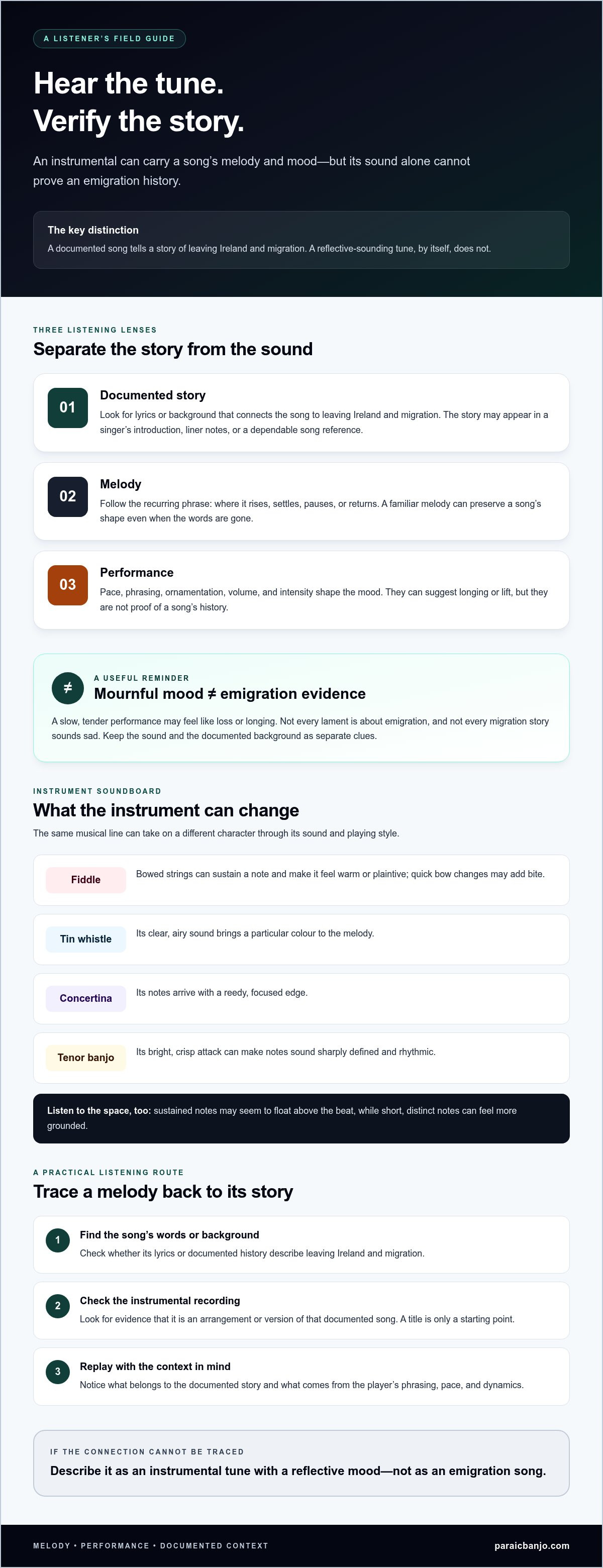
A song combines words and melody. A tune can be played without lyrics, and an instrumental version is a performance without singing. When a known song’s melody is played instrumentally, its history may connect the music to emigration. But a reflective-sounding tune isn’t automatically an emigration song.
This distinction matters when exploring irish emigration songs instrumentals. An instrumental performance can preserve a melody’s shape while leaving its original story unheard. A title may help, but it doesn’t always settle the question. Check the recording notes, accompanying lyrics or a dependable source for a documented link. If you can’t trace one, describe the music as an instrumental tune with a reflective mood, not as an emigration song.
Try this listening habit: first find the song’s words or background, then replay the instrumental with that context in mind. Notice which feelings come from the documented story and which arise from the performance itself. This helps you hear both the melody and its history more clearly.
How Instruments Carry the Melody and Mood Without Words
A familiar melody can keep its shape even after the lyrics are gone. You may still hear where a phrase rises, settles or returns, giving the instrumental a sense of movement. Without words, though, the listener’s response also depends on how the player handles the tune.
Instrumental mood alone cannot establish a song’s historical subject. A slow, tender performance might suggest loss or longing, but those feelings aren’t proof that the melody belongs to an emigration song. Treat the sound and the documented background as separate clues.
Listen for melody, phrasing, and ornamentation
Start with the main melody. Notice which phrase repeats, where the player pauses for emphasis, and whether a familiar musical idea returns unchanged or with a small twist. These details preserve a song’s shape and give a tune momentum, even without a voice carrying the words.
Then listen for ornamentation, the small decorative notes added around the central melody. A quick turn or a note that curls into the next can make a phrase feel lively, delicate or searching. Pace matters too. A measured tempo leaves more space between phrases, while a brisker one can bring out drive. Changes in volume and intensity, known as dynamics, can make a line swell, soften or press forward.
On a second listen, focus on the melody rather than judging the overall mood. Hum the recurring phrase if you can. Ask where it pauses, what changes when it returns and which note seems to carry the most weight. This close attention often reveals more than a first impression of “sad” or “cheerful.”
How different instruments shape a traditional melody
The instrument changes the colour of the same musical line. A fiddle’s bowed strings can sustain a note and make it feel warm or plaintive; quick bow changes may give a phrase extra bite. A tin whistle has a clear, airy sound, while a concertina’s notes arrive with a reedy, focused edge. Each can shape the melody’s character without changing its basic outline.
A tenor banjo has a bright, crisp attack, so its notes can sound sharply defined and rhythmic. Listen to how the melody sits against any accompaniment, too. A sustained line may seem to float above the beat, while short, distinct notes can make the tune feel more grounded. Fiddle, concertina, tin whistle and tenor banjo are useful sounds to listen for, not a guaranteed line-up on every recording.
When comparing irish emigration songs instrumentals, try two performances of a documented melody if you find them. Notice what each player emphasizes: held notes, rhythmic lift or the spaces between phrases. For traditional session playing recorded live, explore Páraic Mac Donnchadha’s traditional music and listen closely to how the instruments shape the tunes together.
A Listener’s Roundup: Instrumental Routes into Emigration Music
There isn’t one definitive instrumental playlist that gathers every melody connected with Irish migration. A more reliable approach is to follow the evidence behind each recording. Start with a song whose emigration story is documented, then look for an instrumental performance identified as an arrangement or version of that song. You can also explore traditional tunes whose migration association comes from their history, setting or later interpretation.
Instrumental adaptations of documented songs
For an adaptation, look for a named source song in the recording title, liner notes, archive description or performer’s notes. A shared melody is a useful clue, but a similar-sounding phrase alone doesn’t prove a connection. If you find both a vocal recording and an instrumental performance, compare the melody’s repeated phrases, pace and points of emphasis. The words may tell the story directly, while the instrumental brings a musical turn or pause to the fore. Call a recording an adaptation only when a reliable source connects it to the song.
Traditional tunes associated with migration stories
Some instrumental routes begin with a tune whose migration connection comes from documented history or performance context, rather than lyrics. An archive record, liner note or performer biography may explain that background. Keep that evidence separate from your own reaction: a tune can sound wistful without having a documented emigration story. The songs of emigration archive playlist from the Irish Traditional Music Archive is a useful starting point for identifying songs and performers. Use the song details to trace context, then look for a documented instrumental interpretation.
Use the table as a listening map, not a ranking of recordings. For each entry, jot down the tune or song title, performer and source of the background information. If you can’t find a source connecting an instrumental to a particular song, keep the description open: call it a traditional tune or an instrumental with a reflective mood.
This gives your exploration of irish emigration songs instrumentals a clear path without narrowing the tradition to a guessed list. Follow the trail from song to performance, and let the notes tell you what the melody alone can’t.
How to Find and Listen to Irish Emigration Song Instrumentals
A little source-checking can make a big difference. Instead of starting with a playlist labelled “sad Irish music,” begin with a song or archive entry whose emigration connection is documented. Then look for an instrumental performance that names the song or explains its relationship to it. This helps separate a song’s history from the mood a particular arrangement creates.
A practical search and listening sequence
Follow these steps to build a listening trail you can trust:
Choose a documented starting point. Find an identified emigration song in an archive or song reference, and note its title and performer.
Check recording descriptions. Look for the same title, a named source song, arrangement details or notes that connect the instrumental performance to the original.
Listen in two passes. First, take in the whole performance. Then replay it while following the melody, its phrasing and the rhythm beneath it.
Compare only what you can trace. If a vocal source and instrumental version are available, note which melodic phrases carry across. If the connection isn’t documented, don’t assume they’re versions of the same song.
Keep a few listening notes as you go: the recording title, performer, instrument you can identify, the tune’s pace and any source attribution in the description. You don’t need specialist vocabulary. “Long held notes,” “a strong rhythmic pulse” or “the main phrase returns twice” are useful observations. Mark uncertain details with a question mark so an impression doesn’t quietly turn into a claim.
Use archives and liner notes to add context
Archive catalogues can help identify a song, singer, language and recording details; liner notes may explain a tune’s background or an arrangement’s source. Read beyond the title, especially when searching for irish emigration songs instrumentals: a listing might identify a performance without explaining whether it’s an instrumental adaptation. Performer details can help you follow a musical tradition across recordings, while regional context can deepen your listening without proving a tune’s subject on its own.
For another thread to follow, explore the East Galway and Clare musical traditions reflected in Páraic Mac Donnchadha’s work. The Not Before Time album and its liner notes offer a related way to listen beyond track titles, with historical and musical context around Irish traditional music. This is a path into session playing, not a claim that the album is a collection of emigration instrumentals.
Ready to hear that broader traditional sound? Explore Páraic Banjo’s live-recorded traditional session album and listen for how the players shape each tune together.
Explore Traditional Irish Instrumental Music Through Páraic Banjo
Emigration melodies are one doorway into Irish music, but they’re not the only way to enjoy the tradition. Páraic Mac Donnchadha’s Not Before Time - 39 Years in the Making offers a companion listen. Approach it as traditional session music, not as a collection of verified emigration instrumentals.
A live session recording with regional context
Try listening with a different focus each time. On one pass, follow the tenor banjo’s rhythmic role; on another, notice how the ensemble’s pulse shifts and settles. You may hear a tune’s character emerge through the players’ timing and interplay rather than through a story attached to its title. This is a rewarding way to explore the craft while keeping historical attribution tied to evidence.
The album’s wider musical setting can also encourage you to follow the tradition beyond a single recording. Compare the playing with other Irish traditional music you enjoy, and note what feels familiar or distinct in its rhythm and ensemble sound. Let the listening lead you without assuming any individual track has an emigration theme.
Continue the listening journey
As you explore irish emigration songs instrumentals, make room for related recordings that deepen your appreciation of instrumental playing, even when they aren’t presented as emigration music. You can choose Not Before Time - 39 Years in the Making as a digital album, select individual digital tracks or enjoy the limited-edition physical CD.
Choose the format that suits your listening, settle in and give the tunes time to unfold. Explore Páraic Banjo’s album and keep following the music.
Keep Following the Music
Let your next listen be an invitation to follow one melody further. Find a song with a documented story, then trace how its tune travels through different voices, instruments and arrangements. Note what you hear and where each detail comes from. Over time, those small connections can turn a playlist into a richer musical journey, shaped by careful listening and curiosity.
That same curiosity can lead beyond emigration songs into the living sound of Irish traditional music. Páraic Mac Donnchadha’s Not Before Time - 39 Years in the Making offers another place to spend time with the craft and character of a traditional session.
Explore Páraic Banjo’s live-recorded traditional session album, available as a digital album, individual digital tracks or a limited-edition physical CD. Choose your format and enjoy the music.
Frequently Asked Questions
What makes a song an Irish emigration song?
An Irish emigration song tells a migration story through its lyrics or documented background. As you listen, notice who seems to be speaking and whether the words place that voice in Ireland or somewhere abroad. A first-person account, a remembered home or a family member’s perspective can each shape the story. These clues help you follow the narrative without assuming every song of loss is about emigration.
Can an instrumental recording still be an emigration song?
Yes, though “instrumental version of an emigration song” is usually the clearest description when a recording has no lyrics. The performance may shorten, repeat or reshape parts of the melody, so it needn’t match a vocal version note for note. When saving recordings to revisit, write down the instrumental’s title and the source song separately. That simple habit helps keep the performance and its story connected accurately.
Are Irish emigration songs always sad?
No. A song can hold mixed feelings, and a performance can bring one quality forward without erasing the others. Listen once for the overall impression, then again for contrasts: does a bright rhythmic passage sit beside a tender line, or does the energy build near the end? This can reveal a more layered response than assigning the song one emotion before you’ve heard it through.
Were Irish emigration songs written only in English?
No. Emigration-song material exists in both Irish and English. If you’re listening to a song in a language you don’t know, look for a translation or a reliable explanation of the lyrics before drawing conclusions from the sound alone. Notice whether the translation preserves the speaker’s point of view and tone. That can help you understand what an instrumental performance may leave unsaid.
How can I tell whether an instrumental tune comes from a song?
Start by noting the title and performer exactly as they appear in the recording information. If a vocal version is available, compare the order of its melodic sections with the instrumental, allowing for changes in arrangement. Similarity can guide further investigation, but it isn’t proof by itself. Label the relationship “documented” in your notes only when the source information supports it; otherwise, record it as a possibility.
Where can I explore historical Irish songs of emigration?
The Irish Traditional Music Archive’s songs-of-emigration playlist is one starting point for discovering named vocal performances. Keep a short record of each song title, singer and background details so you can find them again. Then use those titles to explore more recordings and interpretations. This makes it easier to build a personal listening list with useful context alongside each entry.