Irish Music Arranging Techniques for Rhythm and Tune Form

Updated: 3d
A tune’s rhythm can change the whole feel of an arrangement, even when the melody stays the same. Effective Irish music arranging techniques begin with hearing how meter, pulse, repeated sections, and phrasing work together.
If you’ve ever felt that a melody is clear on the page but harder to arrange in a way that feels natural, you’re not alone. Irish tunes carry their own rhythmic lift: reels are commonly written in 4/4 and felt in cut time, which groups each bar into two main beats, while jigs typically move in 6/8. Many traditional tunes also use two eight-bar parts, each repeated, creating the familiar AABB shape.
Use those patterns to make practical choices, from supporting a tune’s pulse to shaping phrases that breathe. Consider the feel of reels, jigs, hornpipes, polkas, and slides, then explore how repetition and subtle variation can keep an arrangement lively while honoring the tune.
Table of Contents
Reel, jig, hornpipe, polka, and slide rhythms
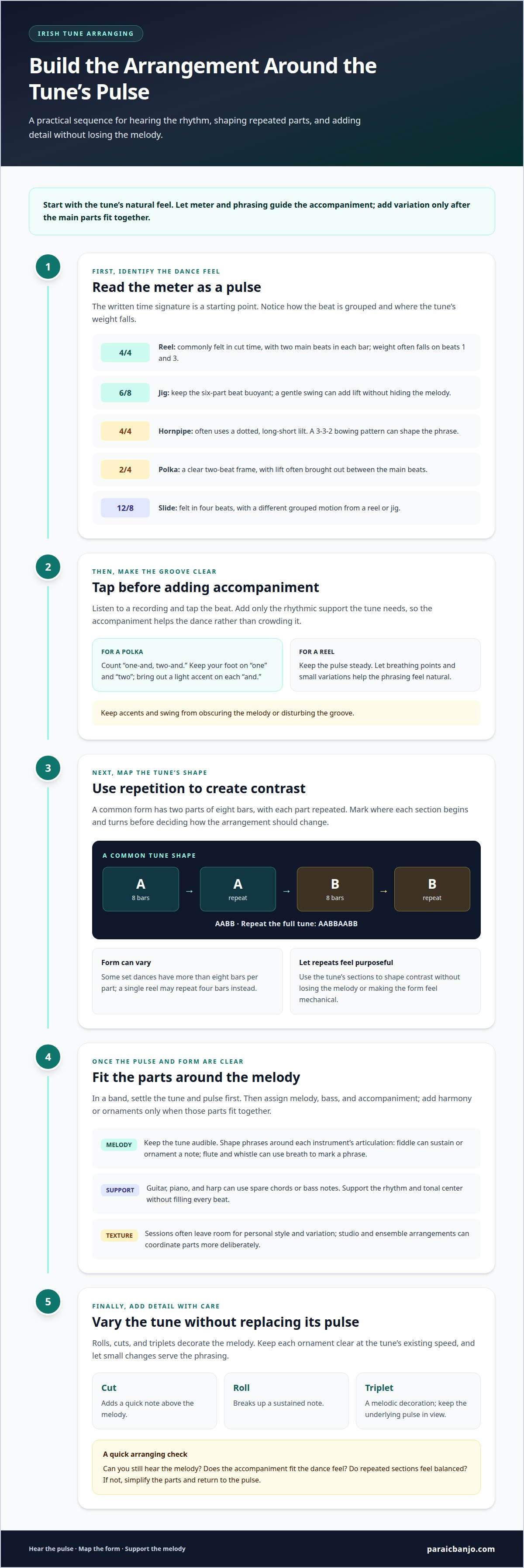
Start by identifying the tune’s meter, then make the pulse clear before adding extra parts. Reels are commonly written in 4/4 but felt in cut time, which groups each bar into two main beats, with weight on beats 1 and 3. Jigs typically use 6/8, while polkas use 2/4. Slides use 12/8 and are felt in four beats. These differences help an arranger choose an accompaniment that supports the dance rather than crowding it.
Hornpipes are written in 4/4 and often have a dotted rhythm, which gives notes a long-short lilt. A 3-3-2 bowing pattern can shape the phrase: listen for groups of three, three, and two within the pulse. In a jig, keep the six-part beat buoyant; a gentle swing can add lift, but uneven accents shouldn’t obscure the melody. For practical arranging, tap the beat while listening to a recording, then add only the rhythmic support the tune needs.
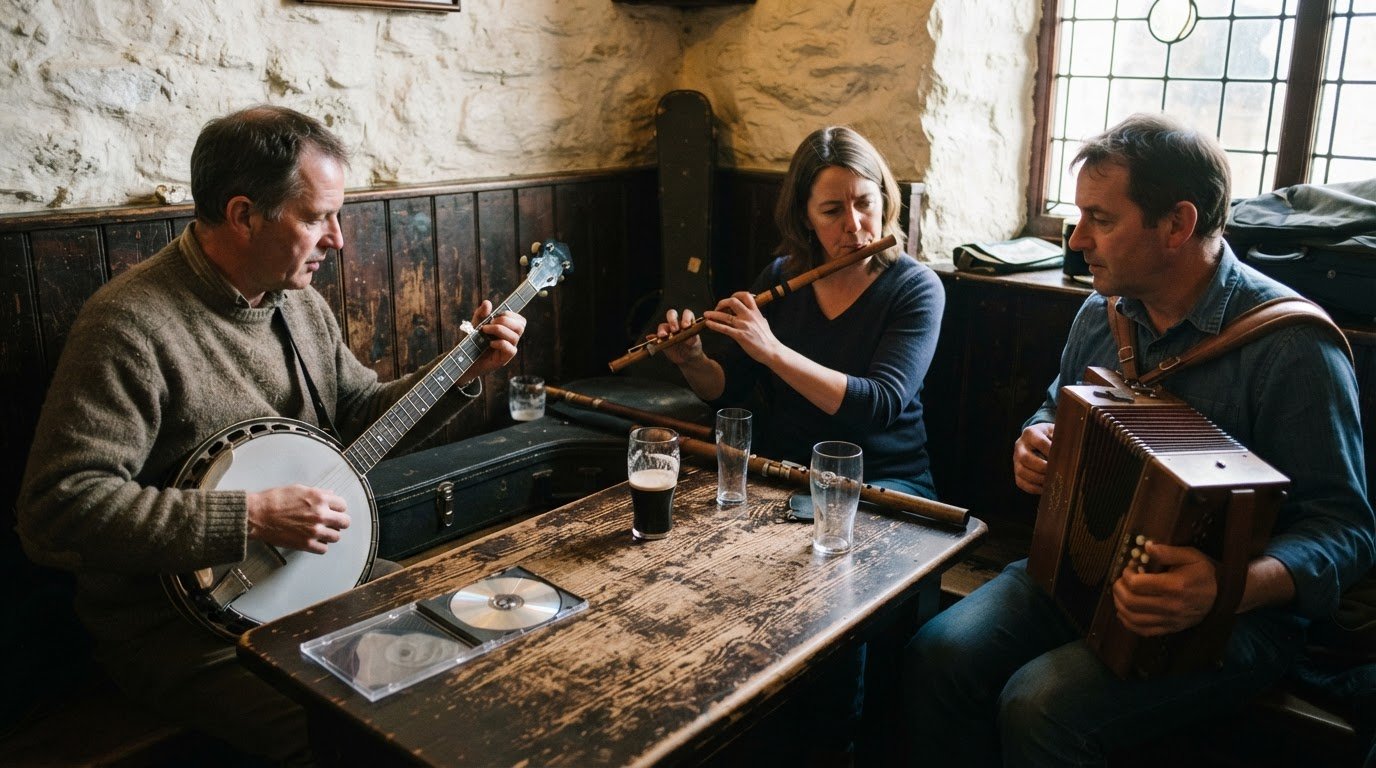
In sessions, musicians often bring personal style and variation to familiar tunes. Studio and ensemble arrangements can coordinate parts more deliberately, balancing melody, accompaniment, and changes in texture.
Rolls, cuts, and triplets decorate the melody without replacing its pulse. A cut adds a quick note above the melody; a roll breaks up a sustained note. Keep each ornament clear at the tune’s existing speed.
For fiddle, flute, tin whistle, and uilleann pipes, keep the main tune audible and shape phrases around each instrument’s articulation. A fiddle can sustain or ornament a note, while a flute or whistle can use breath to mark a phrase. Let the pipes’ distinctive sound sit naturally in the arrangement.
Effective accompaniment follows the tune’s rhythm and supports its tonal center without filling every beat. Guitar, piano, and harp can use spare chords or bass notes. For players learning harmonic backings from online video recordings, Akordify can generate instant guitar chord sheets to practice with. Start with a simple pattern, then adjust it to suit the instrument and tune.
Common approaches include steady rhythm for reels, a lilting pulse for jigs, dotted phrasing for hornpipes, and more freedom for slow airs. Slow airs can use 3/4 or 4/4, or another time signature, so let the melody guide its pacing.
For a band, first settle the tune and pulse, then assign the melody, bass, and accompaniment. Add ornaments or harmony only once those parts fit together. Avoid letting busy chords or excessive variation weaken the steady rhythm and tone. To learn a tune, listen closely to a recording while following the melody; compare what you hear with a score if one is available.
Tune structure and repeated sections
Recognizing a tune’s form helps you shape accompaniment, repetition, and contrast without losing the melody. Listen for its sections, then notice how meter and tonal center guide the arrangement.
Tune Types by Meter
Grouping tunes by meter means sorting them by how their beats are organized. It helps you choose a pulse and accompaniment that suit the tune, rather than applying one pattern to every melody. Reels and jigs have familiar dance feels, while slip jigs use 9/8 and marches can appear in 4/4, 12/8, 6/8, or 9/8. A 7/8 tune offers an example of irregular meter. These distinctions give you a useful starting point when arranging a tune for different instruments.
Forms, Keys, and Chord Progressions
A common Irish tune form has two parts of eight bars, with each part repeated. Musicians often write this as AABB; repeating the full tune gives AABBAABB. Some set dances have more than eight bars per part, and a single reel may repeat four bars instead of eight. Listen for where each phrase turns, so repeated sections feel purposeful rather than mechanical. Letting the form guide changes in texture is a practical Irish music arranging technique.
Keys and chord progressions describe the tune’s tonal home and the harmony beneath it. There are 12 major keys; for example, G major contains F sharp, and moving from C to G adds one sharp. A Dorian melody has a sharpened sixth compared with the minor mode sharing its note name. Try a simple G-to-D-to-G accompaniment, then adjust when the melody’s notes call for movement.
To learn an Irish tune, listen to a recording until you can follow the melody by ear. Then play it slowly on fiddle or another instrument, marking where each part begins and repeats. Michael’s version can help you notice phrasing, but focus on the melody before copying ornaments. Finally, play along and check that the repeated sections still feel balanced. Listen for one detail at a time, then try it in your own version.
For another listening reference, explore live recordings of traditional Irish session music and pay attention to how the melody carries through each repeated part.
A contrasting pulse can change the character even when the meter is shared. John Doyle may have written an Irish tune in 11/8, an example of how an unusual grouping can shape the tune’s motion.
Irish waltzes in 3/4 typically stress only beat 1. Irish mazurkas in 3/4 stress beat 2 rather than beat 1. That difference gives the listener a clear way to distinguish their lilt: attend to which beat receives weight, then keep accompaniment light enough that the tune remains prominent. Listening for phrase length and accent can be as useful as identifying meter alone. When trying an accompaniment, preserve the tune’s natural emphasis and leave space for its repeated phrases to register.
Polka off-beat emphasis and cross-bowing
A polka’s 2/4 meter gives its melody a clear two-beat frame, but the lift often comes from emphasizing the space between the main beats. In Sliabh Luachra fiddling, the off-beat is typically stressed. That small shift makes the tune feel springy rather than square. As you listen, tap the two main beats, then notice how a fiddle bow can give the in-between motion extra bite.
Try a simple practice pattern: count “one-and, two-and” while keeping your foot on “one” and “two.” Let the fiddle’s bow add a light accent on each “and,” without obscuring the main pulse. In traditional Irish music, this contrast lets listeners follow the dance beat while the melody gains a sharper edge. Keep the accent controlled: an off-beat should add lift, not pull the tune out of time.
Cross-bowing means changing strings as the bow moves through a phrase. In a polka, those crossings can give repeated notes or neighboring melody notes different colors. If a phrase moves between notes on adjacent strings, plan the bow direction so the change feels smooth. Then try a stronger stroke on an off-beat note. The pattern should serve the tune’s shape, not become a display of bow movement.
Build the arrangement in layers. First, play the melody with an even two-beat pulse. Next, mark where the phrase’s off-beats fall and give selected notes a little more weight. Finally, add cross-bowing where it supports the melody’s movement. Compare the first section with the next: repeating the same accent pattern creates consistency, while a small change at the phrase ending adds contrast.
For an ensemble, keep the roles clear. A guitar or piano can mark the main beats with restrained chords, while the fiddle brings out the off-beat through bowing. If both parts accent every “and,” the rhythm can feel crowded. Let one instrument hold the steady pulse while another supplies lift. Listen to the balance, then simplify whichever part masks the tune.
These examples are starting points, not rules for every Irish traditional music arrangement. A melody’s note lengths, string changes, and phrase endings all affect where an accent feels natural. Play one section slowly, keep the pulse steady, and adjust the bowing until the off-beat comes through clearly. Then return to the tune’s usual pace and check that the rhythmic lift still feels easy and grounded.
Reel pulse and phrasing
A reel’s pulse needs to stay steady while its melody moves briskly across the beat. Reels are commonly written in 4/4 and felt in cut time, which groups each bar into two main beats, with weight on beats 1 and 3. Keep that underlying movement clear in the accompaniment, even when the fiddle adds quick notes. In traditional Irish sessions, a grounded pulse lets musicians vary the tune without losing their place.
To hear the difference between pulse and melody, tap a steady beat while listening to a reel recording. Notice how the melody’s shorter notes move over that regular foundation. If you’re arranging for guitar or piano, begin with a simple bass-and-chord pattern that marks the pulse, then play the tune above it. If the accompaniment crowds the melody, simplify the chords before changing the tempo.
Phrasing gives a reel room to breathe beyond its rigid four-bar structure. A player might ease into a phrase ending, leave a brief breathing point, or give a familiar note extra weight. These choices can make the next phrase feel newly alive without changing the tune’s basic shape. Try sustaining a phrase-ending note, then leave a small gap before the next phrase. Keep the pulse going internally through that space.
In a session, musicians often add personal style and variation to familiar tunes. That doesn’t mean every player should change the melody at once. One fiddle can add a small variation while another musician keeps the main line steady; the group can then return together to the familiar phrase. This contrast keeps the rhythmic thread audible. Notice how each player’s choice fits the tune, rather than treating variation as a separate showpiece.
When shaping an arrangement, first decide which part carries the pulse. A guitar can provide steady chords, while the fiddle or flute shapes the melody’s phrasing. Keep the accompaniment simple under a busy passage, then let it open slightly where the melody rests. In a reel with repeated sections, try a small change in texture on the return, such as bringing in a second instrument. The beat stays steady while the sound gains movement.
These practical choices help traditional Irish music feel both grounded and personal. Play a reel with steady backing, mark its four-bar phrases, and listen for natural breathing points. Then add one restrained variation and compare the result. If the tune still flows clearly, the arrangement supports both its rhythmic drive and the player’s expression.
Hop jig and slip jig meter
Hop jigs and slip jigs bring a rolling triple feel to traditional music. Slip jigs are written in 9/8 and serve as the triple-meter counterpart to duple-meter jigs. Hop jigs are commonly notated in 9/8, though some appear in 3/8. These signatures affect how you group the beat, shape accompaniment, and keep the melody buoyant.
For a 9/8 tune, count three groups of three eighth notes: “ONE-two-three, TWO-two-three, THREE-two-three.” Keep the larger beats moving evenly while the notes flow inside each group. This makes the meter easier to feel than counting every eighth note with equal weight. With sheet music, mark the grouping above a phrase, then play it slowly before adding chords.
A hop jig in 3/8 uses a shorter written measure, so follow the tune’s phrasing rather than assuming its bar lines show the full dance feel. Compare a 3/8 passage with a 9/8 example by tapping the underlying pulse. Notice where the melody gathers momentum and where it settles. That listening step helps an arranger avoid forcing a heavy accent onto every written bar.
Accompaniment should clarify the motion without flattening it. On guitar, try a light bass note at the start of a larger pulse, followed by restrained chord strokes. On piano, keep the left hand simple and avoid having the right hand double every melody note. If the arrangement sounds square, reduce the chord attacks and listen again to the tune’s natural grouping.
For a player adding these tunes to a repertoire, sheet music can help identify the meter, but a recording reveals the phrasing. Listen for how a musician carries the groups through a phrase ending. Then sing or tap that shape before playing. This separates the tune’s rhythmic signature from the notes on the page and gives the arrangement a more natural lift.
When arranging a set, contrast a slip jig or hop jig with a tune in another meter through texture, not just volume. A spare accompaniment can make the rolling pulse stand out; a second melodic instrument can join later to widen the sound. Keep the pulse consistent through the change, and avoid adding accents that make the 9/8 grouping hard to hear.
Explore traditional Irish session recordings to hear how melody and accompaniment share that rolling pulse.
Páraic Banjo
Páraic Banjo offers recordings to help you explore how Irish tunes work in performance. After studying meter, repeated sections, and phrasing, listen for how those ideas come together between melody and accompaniment. Notice the pulse, the shape of each phrase, and how the musicians maintain a shared feel.
Not Before Time - 39 Years in the Making brings together 18 tracks recorded live with expert musicians. The album captures the character of traditional Irish session music, making it a useful reference when you want to hear ensemble playing rather than consider a tune only on the page. Follow one instrument at a time: notice how the melody sits within the group, then listen again for the rhythmic support around it.
Focused listening can make arranging choices easier to understand. Return to a passage and tap its pulse, then notice how the players shape the phrase ending. On another listen, attend to how the tune’s repeated sections hold together. Rather than looking for one arrangement to copy, hear how musicians keep the tune recognizable while bringing their own playing and expression to it.
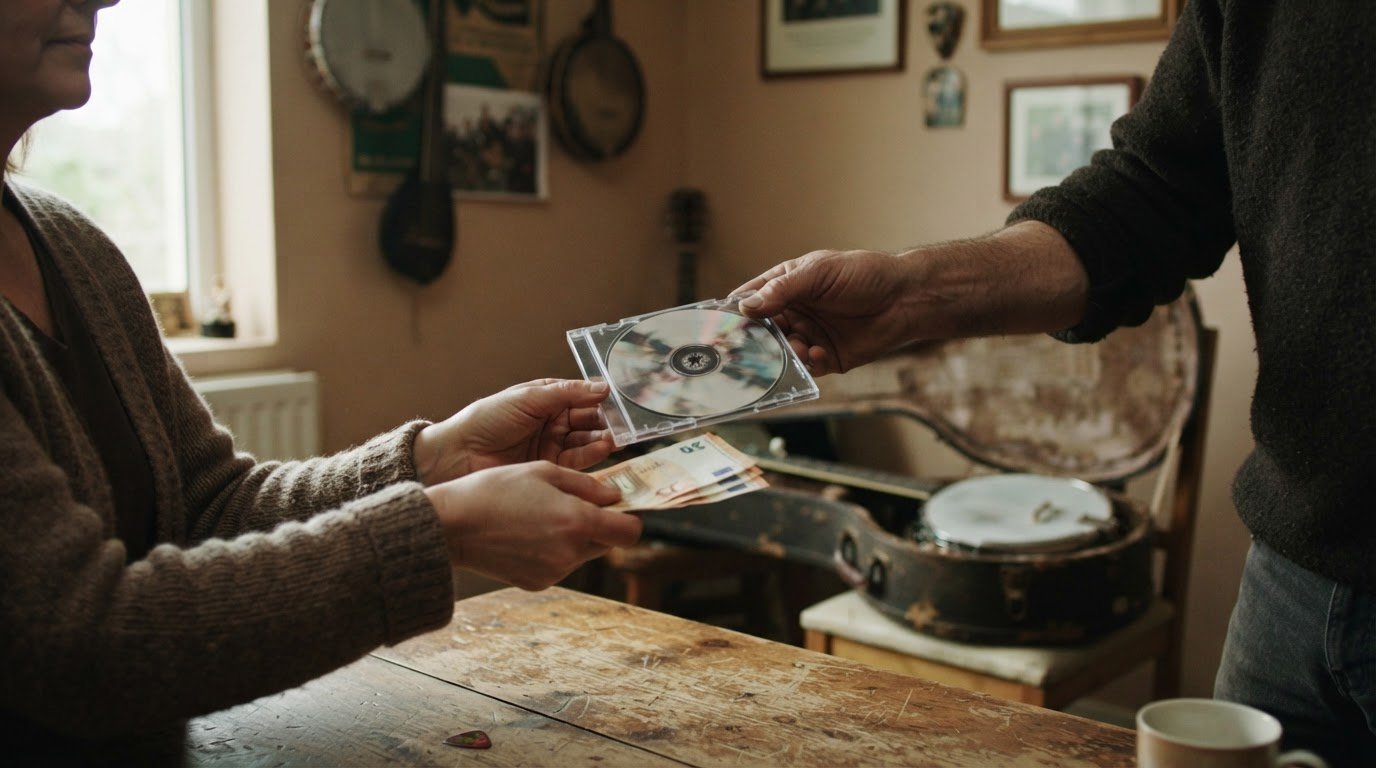
Choose the format that fits how you like to listen. The album is available as a digital album or physical CD, and individual digital tracks offer another way to listen selectively. If you’re working on a particular rhythmic feel, a track can be a handy reference for focused listening. For a broader sense of the album’s flow, listen through the full collection and notice how the ensemble’s sound develops across the recordings.
Use a simple listening routine: first follow the melody, then tap the pulse, and finally attend to the ensemble. Note a phrase ending or rhythmic detail you want to remember. When you play your own arrangement, compare its feel with what you heard, then adjust the accompaniment or phrasing while keeping the tune’s character in view.
Explore Páraic Banjo’s recordings for a direct connection to traditional session playing and ideas for listening closely. For questions about the music or recordings, contact Páraic Banjo.
Let the Tune Lead Your Next Arrangement
Choose a tune you enjoy playing and make one deliberate change to its arrangement. You might thin the accompaniment, give a phrase more space, or let another instrument answer the melody. Listen again with fresh ears. Does the tune still feel natural beneath your hands?
Focused experimentation is where Irish music arranging techniques become personal. The aim isn’t to decorate every bar, but to make choices that serve the tune and its musicians. Keep what strengthens the melody; leave out what distracts from its character. Then try the arrangement with a friend and notice how it feels when the parts meet in real time.
If you’d like to share a question or continue the conversation about arranging, contact Páraic Banjo about arranging. Bring your curiosity and a tune you love. There’s always another phrase to hear in a new way.
Frequently Asked Questions
What are the core elements of traditional Irish music arranging?
The core elements are a recognizable melody, a fitting rhythmic feel, supportive accompaniment, and room for each instrument’s character. Decide which instrument carries the tune, then give the others clear roles, such as a bass foundation or quiet countermelody. Shape the dynamics so a returning phrase feels fresh, while keeping the melody easy to follow. A spare texture can be just as effective as a fuller ensemble sound.
Comments