Irish Music Liner Notes: The Secret Map to Traditional Tunes and Heritage
- Paraic Mac Donnchadha

- Jun 6
- 14 min read
You're sitting in a corner of a crowded session, tapping your foot to a tune that feels like it’s been part of your DNA forever, yet you can’t name it. It's a common frustration. You want to know who played it first, where they found it, and why it matters, but the music moves too fast for questions. This is exactly why irish music liner notes are so much more than just a list of names on a sleeve. They are the secret map to a tradition that is usually passed from hand to hand.
I know that feeling of being on the outside looking in. It's why I've spent decades documenting the stories behind the sets, treating every recording as a definitive statement of a lifetime's passion. In this article, you'll discover how these notes preserve the very soul of the tradition and how you can use them to build a repertoire that carries real weight. We'll look at why the physical CD booklet still beats a digital stream for depth. We'll also explore how tracing a tune's lineage can turn a simple melody into a personal connection with the masters who came before us. It’s time to stop guessing and start listening with the ears of an insider.
Key Takeaways
Learn how irish music liner notes bridge the gap between the oral tradition and modern recordings by documenting the specific lineage of every tune.
Master the basics of decoding a booklet, from identifying tune types like hornpipes and polkas to solving the "Gan Ainm" mystery.
Discover practical steps for using tune names to track down alternative versions and sharpen your ear for a player's unique rhythm.
Understand the "Streaming Gap" and why physical media remains the gold standard for preserving the tactile heritage of Irish music.
See how a lifetime of session stories is woven into the 18 tracks of "Not Before Time," turning a CD into a definitive musical memoir.
Table of Contents
Why Irish Music Liner Notes Are the Heartbeat of the Tradition
Think of a tune as a living thing. It has a birth, a family, and a long journey across generations. In the world of traditional music, irish music liner notes are the written narratives that capture this life story. They aren't just a technical index of track lengths. They are the soul of the recording, detailing where a tune came from, who played it first, and how it evolved. In a digital age where music is often treated as disposable background noise, these notes demand your attention. They turn a three-minute reel into a historical document that breathes with the life of the person who played it.
The History of liner notes shows they've always been about providing context, but for the Irish tradition, they serve a much higher purpose. They act as the vital bridge between an unwritten oral history and the modern listener. Much of this music was never written down in books; it was shared across kitchen tables and in crowded pubs. Without these printed guides, the "who, when, and where" of a recording would simply disappear into the ether. Knowing the source of a tune changes how you hear it. You start to recognize the fingerprints of the masters in every note.
More Than Just a List of Names
These notes provide the "provenance" of a melody. Just like a museum tracks a painting’s history to prove its authenticity, musicians use notes to track the lineage of a set of tunes. This is where the artist becomes a curator of regional styles. Whether it's the sharp, driving rhythm of a Sligo fiddle style or the relaxed, melodic "lift" of East Galway, the notes explain the "why" behind the sound. Holding a collectible Irish music CD gives you access to the only written record of a composer’s work that might otherwise be forgotten. It’s a tangible piece of heritage you can hold in your hands.
Connecting the Past to the Present
In this community, sourcing is everything. When a musician mentions they learned a jig from a neighbor in 1974, they aren't just reminiscing. They're keeping that neighbor’s name alive for a new generation of players. It’s a way of honoring the people who kept the music going during lean times. If you want to improve your own playing or just understand the genre better, here is a practical tip: always look for the names of "source musicians" mentioned in the text. Search for those specific names in archives or on other albums. It’s the fastest way to find the most authentic, raw versions of the tunes you love.
Ultimately, understanding these notes helps you join the global Irish music conversation. You're no longer an outsider at a session; you're someone who knows the story. If you're ready to dive into these stories yourself, you can find a lifetime of them in the Not Before Time – 39 Years in the Making (Physical CD). It’s a project built on decades of respect for the tradition, and the notes are just as important as the music itself. Let's keep the history alive together.
Decoding the Booklet: What to Look for in Traditional Notes
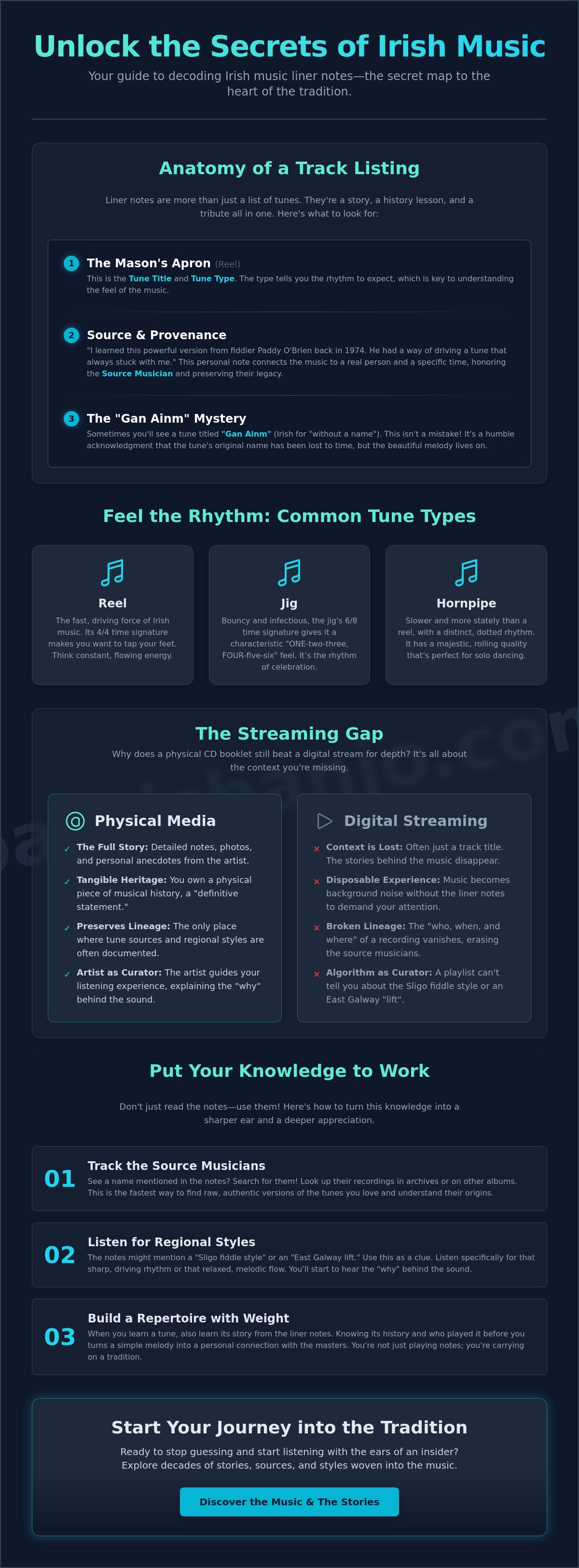
When you crack open a CD or scroll through a high-quality digital booklet, the irish music liner notes act as your decoder ring. It’s a puzzle, and the notes give you the pieces. You’ll see titles that sound like poetry or old jokes, but look closer at the labels next to them. Traditional music is organized by rhythm. You’ll see "Reel" (an upbeat 4/4 time), "Jig" (a bouncy 6/8 time), or perhaps a "Hornpipe" with its characteristic dotted rhythm. Early recordings are often cited as the Heartbeat of the Tradition, but it’s the notes that tell us why those old 78s sounded the way they did. They help you distinguish a fast-paced Clare slide from a steady, pulsing Donegal reel before the first note even hits your ears.
You might also run into the mysterious "Gan Ainm." In Irish, this simply means "without a name." It’s a beautiful, humble admission that a tune has been passed down through so many hands that the original title was lost to time. When a musician includes a "Gan Ainm" track, they’re acknowledging their role as a temporary keeper of a melody that belongs to everyone. It’s an invitation for you to listen even more closely to the regional identifiers. Is there a smooth, melodic "lift" suggesting an East Galway influence? The notes usually provide the musician’s "Why," offering personal anecdotes about why a specific track was chosen for the collection. If you want to see this storytelling in action, check out the digital album version of my latest project, where every track has a story to tell.
The Anatomy of a Great Liner Note
A typical entry should give you the "pedigree" of the melody. It lists the tune name, the rhythm type, and the person who shared it. You’ll also notice tunes are often grouped into "Sets." This is because traditional music is social; players rarely play just one tune. They string two or three together to build energy. Technical tip: Use the notes to identify the key. If the booklet says "Reel in G," you know exactly where to start on your banjo or whistle. It’s a shortcut to mastering the track yourself.
Folklore and Social History
Beyond the technical details, these booklets record the social history of the music. They tell stories of the houses, pubs, and fairs where these melodies lived long before they were ever recorded. Many notes serve as a deeply personal tribute to mentors and family members who have passed away. Reading these stories is the closest you can get to sitting in on a traditional Irish session without actually being in the pub. It’s about the connection between the player and the past, making the music feel like a conversation rather than a performance. This context is what turns a casual listener into a true enthusiast of the craft.
Digital vs. Physical: Why the CD Booklet Still Wins
Mass-market streaming is a marvel of convenience. It puts millions of tracks in your pocket with a single tap. Yet, for the traditional music lover, it often feels like a hollow victory. This is the "Streaming Gap." Large digital platforms are built for pop hits, not for the intricate lineages of a jig or reel. They often strip away the vital context that makes this music meaningful. This is exactly why irish music liner notes are still the gold standard for anyone who wants more than just background noise. They provide the map that digital algorithms simply don't understand. It’s about more than just data; it’s about the soul of the performance.
The Problem with "Track 01"
It's a common frustration. You're listening to a beautiful set of tunes, but the screen just says "Track 01" or lists a generic album title. You hear a "great reel" but have no way to trace its roots. Was it a tune from the hills of Donegal or a gift from a traveling fiddler? When you lose the name, you lose the connection to the community. Here is a practical tip for the digital age: when you can't buy a physical copy, look for high quality Irish music downloads that come with a "metadata-rich" digital booklet. These files ensure the tune names and histories stay attached to the audio. It keeps the tradition intact and your library organized.
Curation as an Act of Love
There is something irreplaceable about holding a collectible Irish music CD in your hands. It’s a tactile piece of heritage. I’ve spent months laboring over every word in my booklets because the music is only half the story. The visual elements, like photography of the landscape or the instrument’s grain, complement the East Galway style. It creates a sensory experience that a smartphone screen can't mimic. Even with digital consumption dominating the market, global physical music revenues reached $5.3 billion in 2025. People are realizing that to truly "own" the history, you need something you can touch. It’s a definitive statement of a lifetime's passion.
Curation is an act of love. When you choose to buy traditional Irish music directly, you’re not just buying a disc. You’re becoming a patron of the oral tradition. You’re ensuring that the "who, when, and where" of these melodies isn't lost to a generic playlist. It’s a relief to know that despite the digital rush, these stories are still being told with care. Let's keep the history alive, one booklet at a time. It's the best way to ensure the music stays as vibrant for the next generation as it is for us today.
How to Use Liner Notes to Master Your Instrument
If you play an instrument, irish music liner notes are your greatest practice tool. They shouldn't just sit in the case. They are meant to be studied. Start by listening to a track without reading anything. Feel the "lift" – that’s the rhythmic bounce or emphasis that gives a tune its unique life. Once you’ve felt it, open the booklet. Read the musician's description of how they approached the rhythm. It’s like getting a private lesson from the master themselves. You’ll start to see patterns in how they emphasize certain notes to create that infectious energy that moves a room.
Next, use the specific tune names to hunt down alternative versions. Check online "Tunography" databases to see how the same melody was played fifty years ago versus today. This helps you understand what is "core" to the tune and what is personal flair. Mapping out the regional style is another vital step. If a note says a tune comes from a specific parish in Clare, you can look for other musicians from that same spot. This builds a deeper understanding of the "why" behind the notes. Finally, start your own "Session Book." Use the information in the notes to create a list of tunes you want to learn, complete with their history and key. It turns your practice from a chore into a journey through heritage.
Learning the East Galway Style
In my own corner of the world, the East Galway style is known for being relaxed and soulful. The notes often describe this as a "lonesome" sound, prioritizing melody over raw speed. For banjo players, this is crucial. Look for notes that mention specific fingerings or ornamentation. These are the little extra flicks of the fingers that add texture to a phrase. Finding "rare" tunes in these booklets is a goldmine. It allows you to bring something fresh to a session that hasn't been overplayed. It shows you’ve done the work and respect the roots of the craft.
Building Your Repertoire
You can use a tenor banjo solo album as a syllabus for your own progress. Instead of rushing through, try "slow listening." Follow the written text while the music plays, focusing on one track for an entire week. This deep dive is how you truly absorb the tradition. If you’re ready to start this journey, you can find the perfect starting point with this acclaimed Irish banjo album that prioritizes storytelling. It’s a project 39 years in the making, designed to help you connect with the music on a much deeper level. Let’s get to work and keep these tunes alive together.
Inside 'Not Before Time': A Masterclass in Musical Storytelling
"Not Before Time" is more than just a title; it’s a reflection of a life spent in the sessions. When I call it "39 Years in the Making," I’m talking about the decades of listening, learning, and finally feeling the relief of getting these tunes right. The irish music liner notes included in this project act as a memoir, guiding you through 18 tracks that represent my journey from the heart of East Galway to the global stage. I didn't want this to be a solitary effort. The notes specifically credit the "pulse" and spirit of the incredible collaborators who joined me, ensuring that the listener understands this music is always a shared conversation. It’s a definitive statement of a lifetime's passion.
Every track on this album was chosen for a reason. Whether it’s a tune I learned from a neighbor decades ago or a set that came together in a moment of inspiration, the notes explain the "why." They serve to preserve the specific rhythmic heritage of my roots. In the East Galway style, the rhythm is relaxed and melodic, and the notes help you identify those subtle nuances. You’ll learn about the people who kept these melodies alive when they were just unwritten history. It’s about honoring the past while making something new and vibrant for the present.
A Legacy in Print and Sound
If you want the full experience, the Not Before Time physical CD is where the storytelling truly shines. The booklet is dense with information, capturing the raw, live energy of the recording sessions. It’s a vital resource for the purists who value the tactile nature of a limited edition release. These notes don't just list the tunes; they provide the "provenance" of the music. They explain the subtle shifts in timing that make a reel feel "soulful" rather than just fast. It’s about documenting a legacy and inviting you to be a part of it.
Your Invitation to the Tradition
Music is always better when you know the story behind the player. It’s the difference between hearing a melody and feeling a connection to the person who kept it safe for you. Don’t just let the tracks play in the background. Engage with the history. Read the notes as the music unfolds to see how a simple jig can carry the weight of a generation. Here is a final tip for your journey: pick one track, read its history, and then try to hum the "lift" of the rhythm back to yourself. You’ll find you become a better fan and a more observant player almost instantly.
This project is my invitation to you. I want you to feel like you’re sitting right there in the room with us, sharing the stories and the tunes that have defined my life. It’s a celebration of the oral tradition captured in print for the first time. To experience the full journey for yourself, you can Order the CD or Digital Album today. Let’s keep the tradition moving forward, one set at a time. It’s been a long road to get here, and I’m thrilled to finally share the map with you. See you at the next session!
Take the Map and Join the Session
You’ve seen how irish music liner notes act as more than just a simple booklet; they’re a living, breathing connection to the masters who came before us. By decoding the types of tunes and tracing their regional roots, you move from being a casual listener to a true keeper of the tradition. Whether you’re hunting for a rare "Gan Ainm" melody or trying to capture that specific East Galway lift on your own instrument, the story behind the music is what makes the experience whole. It turns every track into a personal encounter with history rather than just another digital file.
Now it’s time to put that map to use and deepen your connection to the music. You can Get the full story and the 18-track album "Not Before Time" here. This collection is a definitive statement of my own path, featuring 18 tracks of pure, rhythmic banjo alongside the detailed historical liner notes we’ve explored together. It’s 39 years of musical heritage gathered into one place, just for you. Don’t just listen to the tunes; own the history and let it fuel your own passion for the craft. I’m thrilled to share these stories with you. See you at the next session!
Frequently Asked Questions
What information is usually included in Irish music liner notes?
Irish music liner notes usually feature the names of the tunes, their rhythm types, and the "pedigree" of where the musician learned them. They often include personal stories about the sessions or mentors who passed the music down across generations. This documentation is vital because it turns a simple recording into a historical record. It's the best way to ensure the oral tradition stays accurate and respected as it moves into the digital age.
Why do some Irish tunes have the name "Gan Ainm"?
"Gan Ainm" translates to "without a name" in Irish. It's used when a tune has been passed through so many hands in the oral tradition that the original title was lost to time. Seeing this in a booklet is a beautiful, humble reminder of the music's age and its journey through countless kitchen sessions. It invites the listener to focus on the melody's soul rather than just its label.
Can I get liner notes if I only download digital music?
You can definitely get irish music liner notes with digital music if you look for high-quality downloads that include a "digital booklet." These are often PDF files that contain all the photography and stories found in the physical version. When you choose a digital album today, you aren't just getting the audio files. You're getting the full narrative of the project's journey, ensuring the context is never lost to a generic playlist.
How do liner notes help me learn to play the banjo or fiddle?
These notes help you learn by identifying the key, the rhythm, and the specific "lift" or emphasis used by the player. Use the notes as a syllabus for your own practice by tracking down the "source musicians" mentioned in the text. By listening to the original versions, you'll better understand the ornaments and fingerings that make a tune sound authentic. It's like having a masterclass in your pocket every time you practice.
Are liner notes important for identifying the "East Galway" style of music?
Absolutely, they are essential for identifying the East Galway style, which is known for its relaxed, melodic, and soulful rhythm. The notes often describe the "lonesome" quality of the tunes and credit the specific local players who defined the sound. Without this written context, it can be hard for a newcomer to distinguish these regional nuances from the faster, driving styles found in other parts of Ireland.
Why should I buy a physical CD instead of streaming if I want the full history?
Buying a physical CD is the only way to avoid the "Streaming Gap" where vital context is often stripped away by large platforms. A physical booklet offers a tactile heritage that you can hold and study while you listen. It provides a deeper connection to the artist's journey and ensures you own a definitive piece of the tradition. It's a relief to have a permanent record that doesn't depend on a digital algorithm.
How do I find the source of a traditional Irish tune if the notes are missing?
If the notes are missing, you can use online "Tunography" databases to find the source of a traditional Irish tune. Search by the melody or any part of the title you know to find other albums where the tune appears. You can also join community forums where seasoned players are usually happy to help identify a tune's lineage. It's a great way to engage with the wider musical community and sharpen your own ear.
Who writes the liner notes for traditional Irish albums?
The irish music liner notes are typically written by the musician who recorded the album, acting as a curator of their own life in music. Sometimes they collaborate with a fellow player or a historian to add extra depth to the regional stories. In my latest project, the notes serve as a memoir, reflecting on decades of sessions and the incredible collaborators who helped bring the 18 tracks to life with their unique, shared pulse.


Comments