Irish Tenor Banjo Recordings: Picking Exercises You Can Practise at Home

What if clearer picking came from listening more closely, not playing faster? Irish tenor banjo recordings can be more than tunes to enjoy: they let you hear how melody and rhythm fit together. If your notes blur at speed or your timing wavers, start with a short phrase instead of trying to fix the whole tune at once.
This article shows you how to turn attentive listening into a repeatable practice routine. You’ll learn to focus on the pulse, choose a manageable passage, and build it back up at a comfortable pace. Páraic Mac Donnchadha’s Not Before Time - 39 Years in the Making offers a listening reference through 18 live-recorded tracks and liner notes on East Galway and Clare traditions. Listen for the shape of a phrase, then bring that feel to your own banjo.
Table of Contents
How Irish tenor banjo recordings can make picking practice more purposeful
Build steady Irish tenor banjo picking with simple foundation drills
Use reels and jigs to test timing, clarity, and picking control
Follow a practical routine to turn listening into confident picking
Keep learning from Irish tenor banjo recordings as your playing grows
How Irish tenor banjo recordings can make picking practice more purposeful
Repeating a difficult bar can feel productive, but repetition alone doesn’t tell you what to change. A recording gives you something specific to listen for: the steady pulse underneath the tune, the shape of a melodic phrase, and whether each note sounds clear. Instead of simply playing the passage again, ask: what do I hear, and what can I adjust?
A listening map is a short passage from a recording that gives your practice one clear musical target. It could be a small melodic turn or a few notes that move between strings.
Start with just a few notes. You don’t need to learn a whole tune or understand every musical term to benefit from listening. The tenor banjo has a place in several musical traditions; The Tenor Banjo on Wikipedia offers background on the instrument, including its use in Irish traditional music. For practice, keep your attention on the sound of the passage you’ve chosen.
Listen for one detail at a time
First, listen for the pulse: the steady sense of movement that carries the music forward. Don’t try to catch every note. Tap your foot gently or count along if that helps you notice whether the beat stays settled. On your next listen, follow one phrase. Notice where it begins, where it seems to settle, and whether the melody rises, falls, or turns back.
Then choose a short passage as your reference. Listen to the notes individually: do they sound distinct, or do they blur together? You’re not trying to copy the player’s speed straight away. Avoid guessing the recording’s tempo or tuning. Focus on what you can hear clearly, and use the same passage to guide your own attempt.
Set up a practice session you can repeat
Before picking up the banjo, choose one goal. “Play evenly” or “make the change between these two strings cleaner” gives you a clearer focus than trying to fix everything at once. Sit or stand comfortably, keep the instrument steady, and let your picking hand stay loose. If your hand tenses, slow down and reset before continuing.
Write down the passage and your focus, then use this simple cycle:
Listen to the passage and name the detail you’re tracking.
Play only that small section at a comfortable pace.
Pause and compare what you played with what you heard.
Keep your notes brief, such as “phrase near the start, even notes.” That gives you a clear place to begin next time and makes changes easier to notice. Irish tenor banjo recordings become more useful when you return with a fresh listening goal, rather than expecting a perfect copy on the first try. Start small, listen closely, and let the tune guide your practice.
Build steady Irish tenor banjo picking with simple foundation drills
Good picking starts with control, not a race to match a fast recording. Build the skill in stages: relax your hand, make repeated notes even, practise changing strings, then bring those movements into a short musical phrase. Working on one movement at a time helps you hear what needs attention. If a step feels awkward, slow down or return to the previous one. That’s not going backwards; it’s building a steadier foundation.
Clean, even notes matter more than speed at first because they give you a sound you can shape and trust.
Keep the sequence simple:
Let your picking hand move comfortably without squeezing the pick.
Play a repeated note and listen for an even sound from one stroke to the next.
Move between two strings while keeping the pulse steady.
Try a brief phrase from a tune, paying attention to the note changes.
Here, a “stroke” means one movement of the pick across or away from a string. A metronome is a tool that marks a regular beat. Keep the exercise straightforward: focus on the movement and the sound, rather than getting caught up in terminology.
Practise an even picking motion
Choose one string and play the same note repeatedly at a comfortable pace. Listen for notes that jump out louder or fade away. Aim for a consistent volume rather than more force. Keep the pick movement small and your hand loose. If your wrist or fingers begin to tense, pause and reset. A metronome can help you hold a steady pulse, but you can also count gently or listen to the spacing between your own notes.
Make string changes deliberate
Choose two strings and move between them in a small, repeated pattern, without adding a tune yet. Keep the beat steady and listen for a clean arrival on each new string. If the pick catches or a note disappears, ease the pace until the change feels reliable. Then find a brief passage in a recording that uses a similar movement and try it in context. Keep the passage short enough to repeat without rushing.
Once the movement feels comfortable, join the drills together: repeated notes, a controlled string change, then a short phrase. Don’t increase the pace just because the notes are landing. First check that the sound stays clear and your hand remains relaxed. When both feel steady, raise the tempo slightly and listen again. If clarity slips, return to the more comfortable pace.
For a listening companion as you work through these ideas, explore Páraic Mac Donnchadha’s Not Before Time - 39 Years in the Making. Choose a phrase to return to, then bring that small piece back to the banjo, one clean movement at a time.
Use reels and jigs to test timing, clarity, and picking control
Reels and jigs give your picking two different rhythmic feels to explore. A reel tends to move with an even, flowing pulse, while a jig has a lilting bounce. You don’t need to master either style before practising. Instead, notice how the rhythm changes the way you group notes, where your pick moves, and whether the melody stays clear.
Don’t use speed as your scorecard. A fast but uneven phrase can lose its shape, while a slower attempt lets you hear which notes land cleanly and where the pulse wavers. Start with the melody and beat. Ornamentation, the small decorative touches added around a melody, can wait until the tune feels steady in your hands.
Start with a short reel phrase
Choose a brief reel passage you can hold in your ear. Listen for its recurring rhythmic shape: which notes seem to move evenly, and where does the melody turn? Pick it slowly enough to make each note distinct. Repeat the phrase several times, checking that its shape stays recognisable and your picking remains relaxed. If a note blurs, pause and work on that small spot before playing through again.
As you repeat the phrase, notice whether the pulse drifts or a note disappears when you focus on changing strings. Keep the passage short enough to let you pay attention instead of pushing through. Once it sounds clear at a comfortable pace, increase the speed gradually, only as far as you can keep its shape intact.
Approach a jig phrase without rushing
Before playing, listen to the jig’s lilting feel and let the rhythm settle in your ear. Choose a short phrase and pick it at a pace where the pulse stays even, without forcing the notes into a hurried run. Record a take if you can, then listen back for clarity and steadiness. Can you hear the phrase’s bounce? Do the notes remain distinct? Compare the sound, not the speed.
To make the contrast useful, practise a short reel phrase and a short jig phrase in separate turns. Ask yourself what changes: does one phrase invite a different picking motion, or does a particular note transition need more care? These are observations, not rules about which tune type is easier. Your hands may find one passage more comfortable today and the other more challenging.
Irish tenor banjo recordings can help you hear these rhythmic differences, but use them as a reference, not a speed test. Listen to a phrase, pick it slowly, then return to the recording with one question in mind: is my pulse steady, and can I hear every note? Leave ornamentation until the melody and beat feel secure. A clean phrase has lift of its own.
Follow a practical routine to turn listening into confident picking
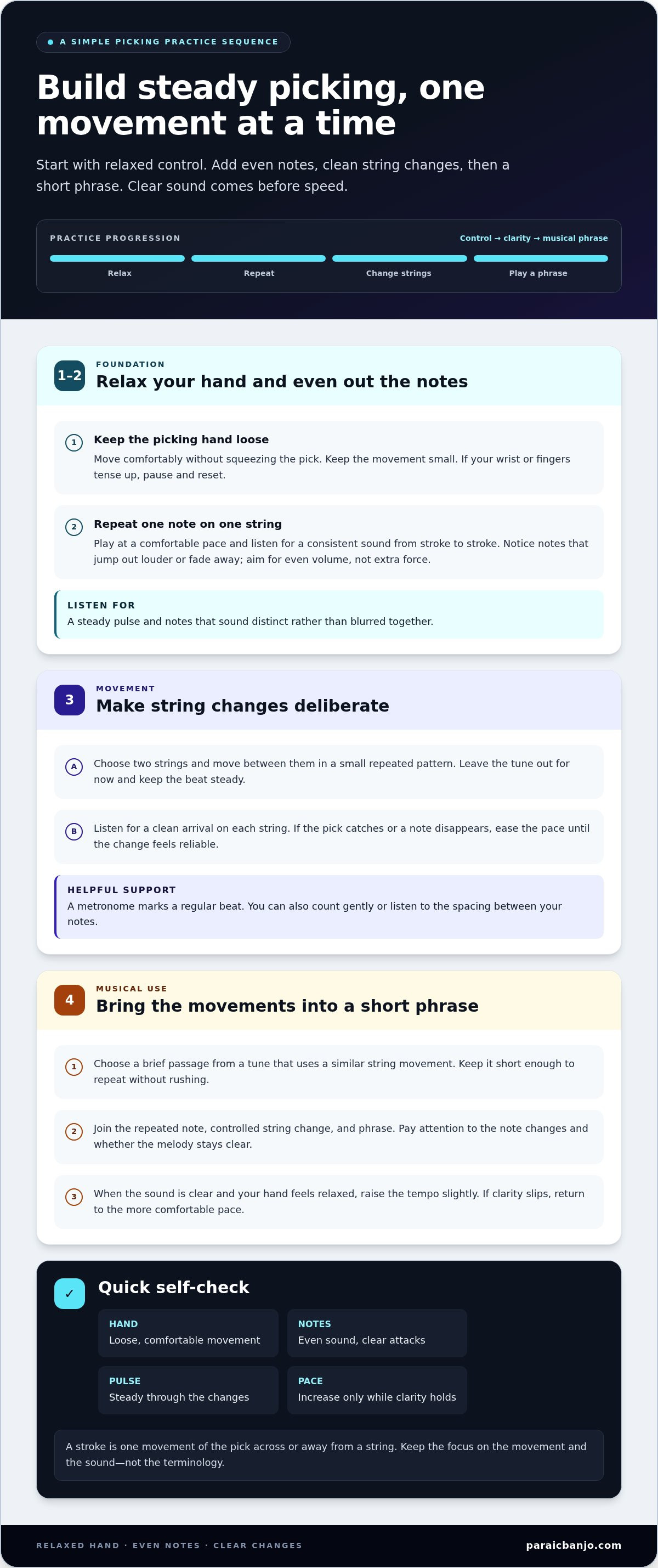
A useful practice session doesn’t need to cover a whole tune. Choose one short phrase you can hear, attempt, and review without losing track of your goal. This keeps listening active and makes it easier to notice small changes in your picking over time.
Try this sequence:
Listen. Hear the passage without playing and choose one detail to focus on, such as the pulse or a clear note change.
Isolate. Find a manageable phrase by ear. Notice where it begins and ends.
Practise slowly. Play the phrase at a comfortable pace, aiming for a steady feel rather than matching the recording’s speed.
Record yourself. Make a brief recording so you can listen without also concentrating on your hands.
Review. Listen for your chosen detail, then write down one improvement and one next step.
Break a recording into a phrase-sized exercise
Choose a small passage with a melody you can hold in your ear. Listen several times before picking up the banjo. Each pass can reveal more about how the phrase moves. Practise it on its own, then return to the full recording and hear how it fits. If you’re interested in the musical background, the regional context of East Galway and Clare can deepen your listening while you keep the notes in focus.
Keep the passage small enough to repeat without fatigue or guesswork. Work on a single melodic turn or a short run of notes instead of trying to follow an entire tune from the start. If you lose the phrase, listen again and narrow the section. The aim is to give your hands a clear piece of music to work with, not to make a perfect transcription.
Review your playing without getting stuck
Listen back for one chosen detail, such as whether the pulse stays even or each note remains distinct. Avoid judging the whole performance at once. That can turn a useful check into a list of everything you think went wrong. If your chosen detail is improving, note it. Then choose one practical next step, such as slowing down or focusing on a particular change.
Revisit the same drill in a later session and compare what you hear. Keep your notes brief: “pulse stayed steady” and “clean up the last change” is enough to guide your next attempt. Progress can be subtle, but a short recording makes it easier to notice what memory alone might miss. That’s one way irish tenor banjo recordings can lead to more focused practice.
For another tune to listen to as you put this routine into action, explore Páraic Mac Donnchadha’s album and choose a brief phrase that catches your ear.
Keep learning from Irish tenor banjo recordings as your playing grows
Your ear develops alongside your hands. A first listen might bring the tune’s broad shape into focus. A later one may reveal how the banjo sits among the other instruments, where the melody seems to breathe, or how the group holds a shared pulse. Those details can be hard to notice when you’re busy following every note. Return to a familiar passage with a fresh question to guide your listening.
Listen for ensemble playing, not only the banjo
Listen to the whole group before narrowing your attention to the banjo. Notice how its bright, percussive sound fits with the other instruments and whether you can hear the melody clearly within that blend. Treat what you notice as a prompt for practice, not a definitive technical analysis. If the tune feels buoyant, ask whether your own playing has a similar sense of lift, then explore that feeling on the banjo.
Páraic Mac Donnchadha’s debut album, Not Before Time - 39 Years in the Making, makes a listening companion, with liner notes that offer regional and historical context. For more about the album’s background, explore the article on the Not Before Time debut as part of your listening journey.
Choose a next step that fits your playing
Pick a drill you already know and make it a little more challenging when it feels controlled. You might extend a passage, add a string change, or raise the pace slightly while keeping your hand comfortable. If the movement tightens or the rhythm slips, ease back. A useful next step should stretch your attention without making the exercise feel out of reach.
Keep listening, too. Revisit a passage and notice what stands out after you’ve spent time practising. You may hear the ensemble balance differently or catch a melodic turn that didn’t register before. Take that observation to your banjo as a question to explore, rather than assuming there’s only one correct way to play it.
Not every listen needs to become a lesson. Let the music be music, and choose a small detail when you want a practice idea. If the sound or regional context draws you in, discover Not Before Time - 39 Years in the Making, settle in for a listen, and see what your ear finds next.
Carry the music into your next practice session
Let your next step be small enough to enjoy. Choose a recording that draws you in, and give yourself time to listen before reaching for the banjo. As your playing grows, the same tune can become a familiar companion, not just a test of technique. You may find your attention shifting from the notes themselves to the character and lift of the music.
That’s the lasting value of irish tenor banjo recordings: they can keep your curiosity alive while your hands find their own way through a tune. There’s no need to rush or measure every session by how much you’ve mastered. Stay with the sound, take the next phrase when you’re ready, and enjoy the process.
For a fresh listening companion, explore Páraic Mac Donnchadha’s Irish banjo recordings. Choose a phrase that catches your ear, then bring it to your next practice session.
Frequently Asked Questions
How do you practise Irish tenor banjo picking as a beginner?
Start by checking your instrument’s tuning before learning a melody. Irish tenor banjo is commonly tuned GDAE, from the lowest-pitched string to the highest. Once the strings are in tune, learn where a few melody notes sit on the fretboard instead of trying to memorise every possible note. A familiar tune can help you connect those note positions with sounds you already know.
Can listening to Irish tenor banjo recordings help improve picking?
Yes. Irish tenor banjo recordings can help you remember a tune’s melodic shape and hear how versions may differ. Listen for a note or turn that stands out, then see if you can hum it back without the recording. Treat recordings as examples to learn from, not proof that every player must use identical notes or phrasing. Traditional tunes can have their own character in different performances.
How can I practise picking without playing too fast?
Set a pace that lets you stay comfortable instead of trying to keep up with a full-speed performance. Pay attention to your body as well as the sound: if your hand stiffens or you grip the pick harder, pause and reset. You can also spend part of a session singing the tune, which keeps you connected to the melody without asking your hand to race.
What is the best way to practise a short phrase from a recording?
Use the phrase to explore how its melody notes relate to one another. Sing it, then notice which note feels like a point of arrival and whether the line rises or falls before reaching it. Try playing those musical landmarks, then connect them with the notes between. This helps you understand the phrase’s direction, not just reproduce a sequence of finger movements.
Should I use a metronome when practising Irish banjo?
A metronome is useful if you want to check whether your sense of tempo holds without a recording. Try playing along with its beat, then turn it off and continue for a little while. Notice whether the pace stays settled or drifts. You don’t need a metronome for every tune or practice session. Use it as an occasional reference, then let your own listening guide you.
How do I make my banjo picking sound more even?
Pay attention to how the pick meets the string. If it catches deeply, the note may sound harsh or take more effort than the next one. Try a lighter, more consistent touch and listen for notes with a similar character. Keep your grip comfortable, too. The goal isn’t to make every note identical, but to avoid accidental accents that interrupt the melody.
Can I learn Irish tenor banjo tunes by ear from recordings?
Yes. Listening by ear is a useful way to become familiar with a tune. Try pausing after a musical idea and humming what you expect to hear next, then resume the recording and see how your memory matches it. Pay attention to repeated melodic ideas as well as new ones. This helps you recognise patterns and anticipate where the tune is going, even before you can play it fluently.
Comments