Soulful Irish Banjo Music: A Guide to the Pulse and Passion of the Tenor Banjo

Why does a tune played at half the speed of a competition winner often carry twice the emotional weight? In a world of high-speed recordings that can feel a bit mechanical, it's easy to miss the rhythmic lift that makes soulful irish banjo music so captivating. You might feel overwhelmed by players who prioritize technical flash over the actual swing of the tune. It is a common struggle for those seeking the authentic regional sounds of places like Clare or East Galway.
I understand that search for something deeper. It is the same passion that led to the release of "Not Before Time," a project thirty-nine years in the making that celebrates the steady, driving pulse of the tradition. This guide helps you discover the rhythmic heart and regional soul of traditional Irish banjo music through its masters and stories. You will learn to identify the key elements of soulful playing, from the "nyah" of the pick to the specific nuances of the East Galway style. We will explore the best players to listen to and uncover why feeling will always triumph over pure speed.
Key Takeaways
Identify the "pulse" in traditional tunes and learn why rhythmic swing is more important than technical speed.
Explore the legacy of masters like Barney McKenna and Kieran Hanrahan to understand how regional styles shape the banjo's character.
Compare the relaxed, melodic lilt of East Galway with the driving, rhythmic intensity found in the Clare tradition.
Discover how to create soulful irish banjo music by treating your right-hand pick arm as the engine of your sound.
Learn how Páraic Mac Donnchadha’s debut album, Not Before Time, serves as a definitive statement of the East Galway musical tradition.
Table of Contents
What Defines Soulful Irish Banjo Music?
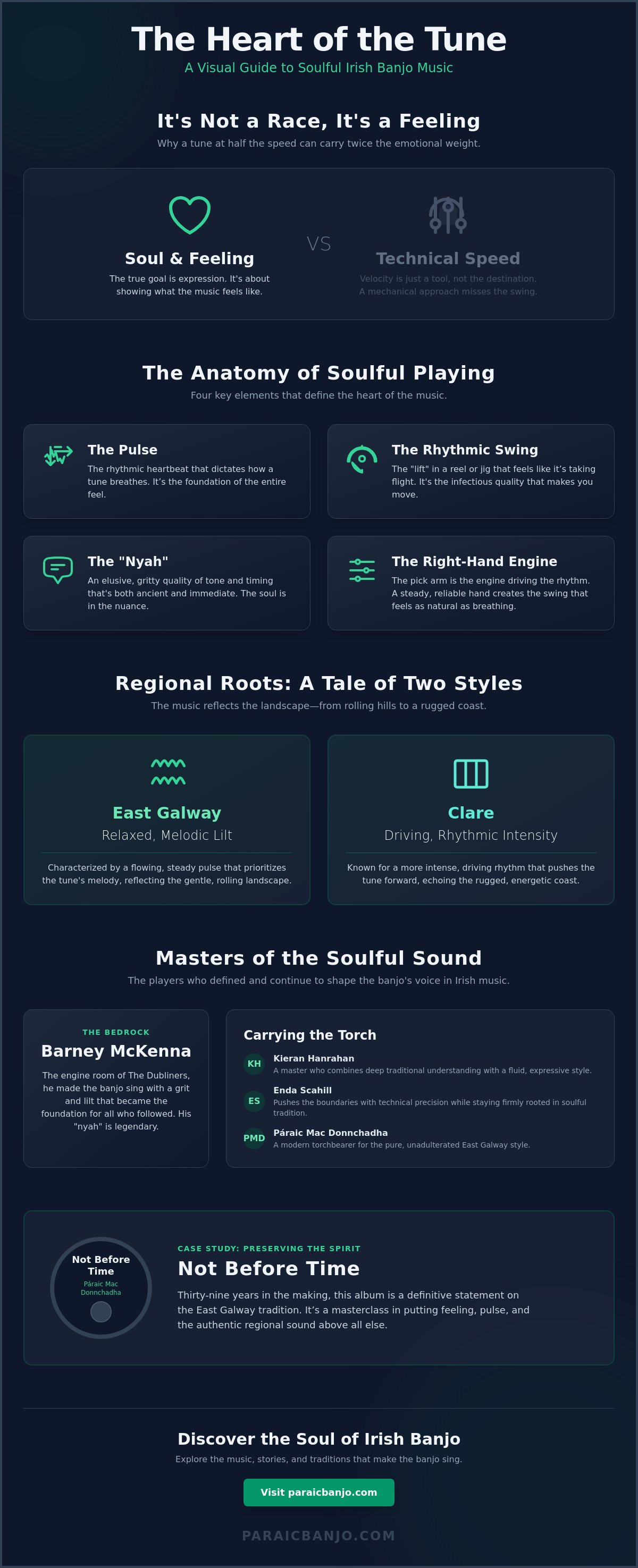
What makes a tune stick in your bones? It isn't just the notes or the sheer speed. It's the pulse. In the world of Irish traditional music, the pulse is the rhythmic heartbeat that dictates how a tune breathes. When we talk about soulful irish banjo music, we aren't talking about how many notes you can cram into a single bar. We are talking about the lilt and the swing. It's that infectious feeling that makes you want to tap your foot or reach for a pint. Listen close. You can hear it in the way a player leans into a phrase.
The tenor banjo didn't start as a lead instrument. Early on, it was often seen as a rhythmic novelty, a loud addition to the back of a session meant to cut through the noise. But over decades of development, it moved to the front. It became a soulful lead voice capable of carrying deep emotion and complex melody. The difference between a technical player and a soulful one is simple. The technical player shows you what the banjo can do. The soulful player shows you what the music feels like. Velocity is just a tool; expression is the true goal. It takes years to find that balance. It's a journey of decades.
The Rhythmic Swing of the Tenor Banjo
Think about "the lift" in a great reel or jig. It's that moment where the rhythm feels like it's taking flight. This isn't just about perfect timing; it's about the internal clock of the player. Soulful playing uses ornamentation like triplets and trebles to add texture and "colour" to the melody. These aren't just clutter. They are rhythmic accents that emphasize the beat and give the music its signature drive. A great player uses their right arm as an engine. They drive the swing with a steady, reliable hand that feels as natural as breathing. Precision meets playfulness.
Emotional Resonance in Traditional Melodies
While reels are exciting, the banjo truly shows its soul in slower tempos. Hornpipes and slow airs allow the instrument’s unique tone to ring out and fill the room. You can hear the landscape of rural Ireland in those notes. The music reflects the rolling hills of East Galway or the rugged, rhythmic coast of Clare. It carries the weight of history and the joy of the present moment. This connection to place and community is what gives the music its depth. Soulful banjo is the marriage of precision and passion. It's a definitive statement of a life spent in the music.
The Quest for the Best Irish Banjo Player: Masters of the Soulful Sound
Who is the best? Ask ten different players in a pub session, and you'll likely get ten different answers. But if you're searching for soulful irish banjo music, one name always rises to the top like the head on a fresh stout: Barney McKenna. Barney didn't just play the banjo; he made it sing with a grit and a lilt that hadn't been heard before. He was the engine room of The Dubliners, and his influence remains the bedrock of everything we do today. He proved that the banjo belonged in the heart of the tradition.
Understanding this sound requires looking back at the banjo's journey to Ireland and how it was adapted to fit the local temperament. It wasn't just about importing a four-string instrument from America. It was about bending it to the will of the reel and the jig. Barney's style was defined by the "nyah," that elusive quality of tone and timing that feels ancient and immediate all at once. It's a sound that values the space between the notes as much as the notes themselves.
Pioneers of the Four-String Style
The Dubliners took the banjo from the fringes and put it center stage. Early recordings from the 1960s and 70s set a high bar for what we consider soulful tenor banjo tone. It was raw. It was honest. These recordings captured a spirit of rebellion and celebration that defined a generation. You can learn more about these icons in our guide to the most famous Irish banjo players. These pioneers proved that the banjo could be as expressive and nuanced as any fiddle or flute.
Modern Masters and Innovators
Today, players like Enda Scahill carry the torch forward with incredible skill. They bring a level of technical precision that would have been unthinkable fifty years ago, yet they keep one foot firmly in the soil of tradition. A modern master isn't just a soloist who plays fast. They are someone who can sit into a session and drive the entire room with their rhythm. They understand that soulful irish banjo music is a conversation between the past and the present. It requires a balance of technical flash and deep, melodic respect.
Whether it's the precision of the Clare style championed by Kieran Hanrahan or the relaxed swing of East Galway, the "best" player is the one who makes the music feel alive. If you want to hear that life captured on record, you can explore individual digital tracks that celebrate this very legacy. It's about the passion, not just the practice. It's about the soul in every strike of the pick. Go on, have a listen.
Regional Roots: How East Galway and Clare Shaped the Banjo’s Soul
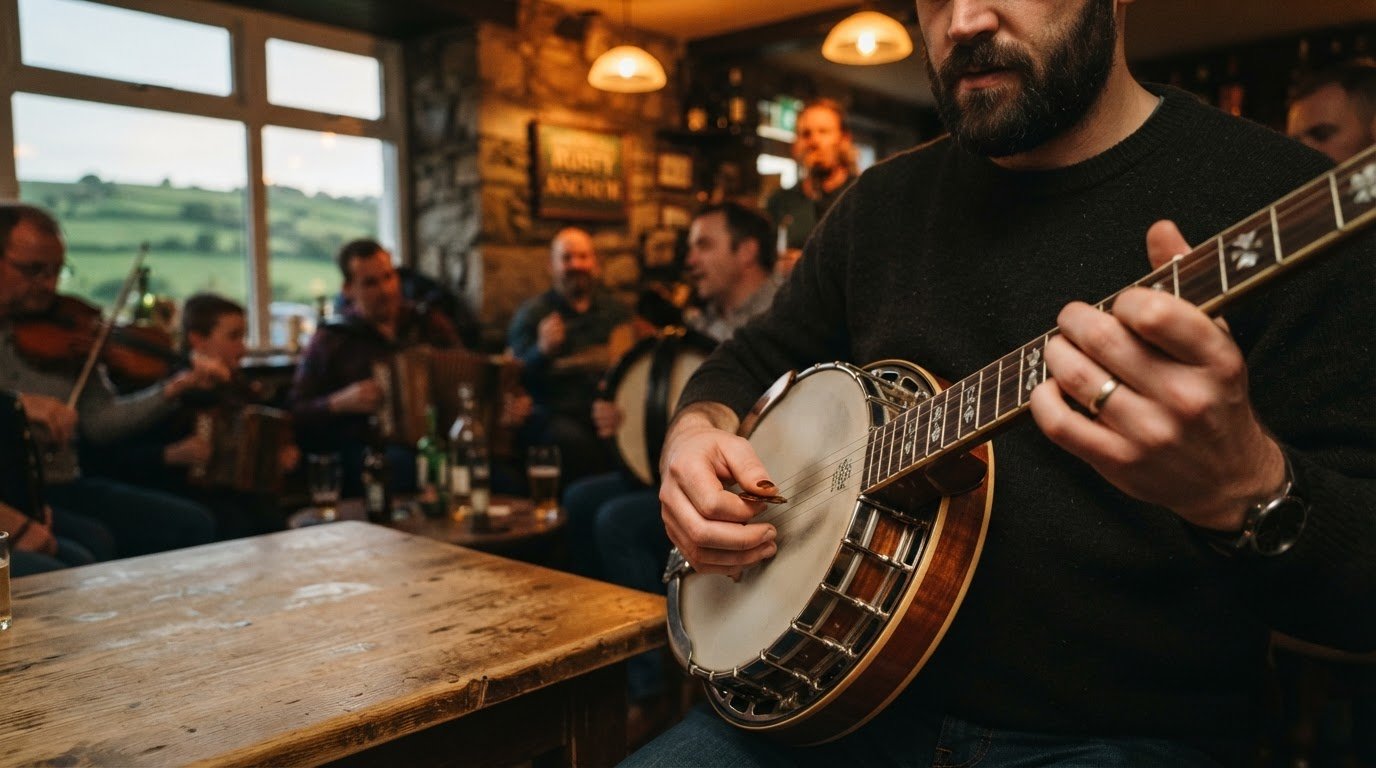
Music in Ireland is never just one thing. It is a collection of local dialects, each with its own rhythm, vocabulary, and spirit. When you listen to soulful irish banjo music, you are often hearing the echoes of a specific landscape. The way a player strikes the string or chooses their tempo is rarely an accident. It's a reflection of the community they came from and the musicians who sat beside them in smoke-filled pubs decades ago. Regionality gives the music a sense of place that transcends the digital world. It anchors the tunes in the soil.
The local "session" culture is the laboratory where these styles are preserved. In these informal gatherings, younger players soak up the nuances of their elders. They learn that a reel played in Ballinasloe shouldn't necessarily sound like a reel played in Ennis. This oral tradition ensures that the banjo isn't just a generic lead instrument but a vessel for regional identity. It's about belonging to a storied musical tradition rather than just playing notes on a page.
The East Galway Influence: Rhythmic and Relaxed
East Galway is widely considered the spiritual home of a more melodic, laid-back approach to the banjo. This style doesn't rush. It breathes. Heavily influenced by the lyrical phrasing of legendary fiddlers and accordion players from the region, the East Galway banjo sound is all about the "swing." It prioritizes the beauty of the melody over aggressive speed. Páraic Mac Donnchadha embodies this heritage perfectly. His playing reflects a deep commitment to this "gentle, steady music," proving that soul is found in the space between the beats. It's a definitive statement of a lifetime's passion for a specific, storied sound.
The Clare Pulse: Driving the Dance
Move toward County Clare, and the pulse shifts. Here, the music is inextricably linked to the tradition of set dancing. The Clare style is rhythmic and driving, designed to keep dancers' feet moving on a wooden floor. It often feels more "staccato" than the Galway lilt, with a percussive quality that acts as a rhythmic engine. If you attend the 39th Feakle Festival, scheduled for August 5th to August 10th, 2026, you will hear this driving Clare pulse in its natural habitat. While Galway offers a melodic lilt, Clare provides the drive. Both are essential, but they offer very different versions of what makes a tune feel alive. It's a beautiful contrast that keeps the tradition vibrant and diverse. Go on, find your favorite and let the rhythm take you.
Technique vs. Feeling: Crafting Soul on the Four-String Tenor Banjo
Speed is a seductive trap. Many players spend years chasing the fastest tempo possible, only to realize they've left the music behind. Soulful irish banjo music isn't a race; it's an invitation. While your left hand handles the map of the notes, your right hand is the engine of the soul. This is where the lilt lives. If your pick arm is stiff, the music will be too. You have to let the wrist go loose to find that elusive "nyah" that characterizes the best traditional playing. It's a physical conversation between the player and the instrument.
Dynamics play a massive role in creating emotional resonance. A tune shouldn't be a flat line of sound. You need to use the natural volume of the tenor banjo to create peaks and valleys. Varying your strike can emphasize a particular turn in a reel or add a gentle touch to a hornpipe. In a live session, the unspoken rules of playing with feeling often involve knowing when to pull back. It's about respect for the collective sound. You aren't just playing for yourself; you're contributing to a storied musical tradition that has survived for generations.
The Secret of the Triplets
Triplets are the seasoning of Irish music, but it's easy to over-salt the dish. To execute a soulful triplet, it must sit perfectly within the rhythm without breaking the flow. There is a distinct difference between a melodic triplet, which follows the tune’s curve, and a rhythmic "treble," which acts as a percussive accent. A triplet should feel like a heartbeat, not a hammer. When used correctly, these ornaments add a splash of color and texture that makes the banjo feel alive. Use them to highlight the swing, not to show off your speed.
Listening as a Technical Skill
Listening is the most underrated skill in a musician's toolkit. The best players I know spend more time listening to archival recordings than they do practicing scales. They study how the old masters from East Galway or Clare reacted to a fiddle or an accordion in a crowded room. This helps you develop a personal style that is rooted in history but feels immediate. By hearing how others build a collective soul in a session, you learn how to react to the instruments around you. It's about sensitivity. It's about heart.
If you want to hear this balance of technical skill and deep emotional feeling, you can explore the Not Before Time digital album. It's the result of thirty-nine years of listening, learning, and finally, recording. Every track is a definitive statement of what it means to play with passion. Go on, have a listen and feel the pulse for yourself.
Preserving the Spirit: The Story of Not Before Time
How do you capture a lifetime of rhythm in a single recording? It isn't easy. The music we've discussed, that elusive soulful irish banjo music, often disappears the moment the session ends. To preserve it, you need more than just high-end microphones. You need a deep, personal connection to the lineage of the players who came before. This is the heart of the "Not Before Time" project. It represents a definitive statement of the East Galway style, recorded not for commercial flash, but to honor a storied musical tradition that has survived for centuries.
The album serves as a bridge. It connects the "nyah" and lilt of the old masters with a new generation of listeners. This isn't just about the notes; it's about the documentation. Extensive liner notes accompany the project, providing the background and stories behind the tunes. This educational aspect is vital. It ensures that when you listen, you aren't just hearing a banjo, you're understanding a heritage. It's a celebration of a community that values the contribution of every performer in the room.
39 Years in the Making
This project didn't happen overnight. It is the result of a 39-year journey dedicated to the rhythmic mastery of the four-string tenor banjo. Páraic Mac Donnchadha spent decades soaking up the atmosphere of rural sessions before ever stepping into a studio. This patience is what makes the album a purist's dream for collectors. It isn't a rushed debut; it's a lifetime’s passion finally realized. You can discover the tracks and the history behind this journey in the Not Before Time debut feature. Every track carries the weight of those years.
The Soul of the Session Captured
To ensure the music felt authentic, the choice was made to record live with fellow masters. You can't manufacture "pulse" in a isolation booth. By playing together in the same room, the musicians captured the driving energy and spontaneous lilt that defines a great night of music. This approach preserves the soulful irish banjo music that can so easily be lost in modern, sterile productions. If you are looking to expand your library, explore more traditional Irish session recordings for your collection. These albums are essential for anyone who wants to hear the music as it was meant to be played.
The work is finished. The relief and pride of completing such a long-term project are palpable in every note. We invite you to join this journey. You can find the Not Before Time physical CD or digital album right here. It's a piece of history, a bit of the West of Ireland, and a whole lot of soul. Go on, take a piece of the tradition home with you.
Keep the Pulse Alive in Your Own Collection
Finding soulful irish banjo music is about more than just hitting the right notes; it is about capturing a feeling that has been honed over decades. We have looked at how the rhythmic lilt of East Galway and the driving heart of Clare give the tenor banjo its unique voice. This music is a living thing. It thrives in the sessions and the stories passed down through generations. It is a marriage of precision and passion that requires a lifetime to truly master.
That lifetime of work is captured in "Not Before Time," a project thirty-nine years in the making. These eighteen tracks were recorded live with expert musicians to preserve that raw, authentic session energy that defines our tradition. Every tune is accompanied by extensive liner notes documenting its history and lineage, making it a true collector's item. Experience the soulful pulse of East Galway; order the "Not Before Time" CD today. It is a definitive statement of a storied tradition, and it is ready for you to enjoy. Happy listening.
Frequently Asked Questions
What is the difference between an Irish tenor banjo and a regular banjo?
The Irish tenor banjo has four strings and is typically tuned GDAE, which is an octave below a fiddle or mandolin. This differs from the five-string bluegrass banjo that uses a short drone string and open tunings. The four-string setup and specific tuning allow Irish players to mirror the intricate, fast-moving melodies of traditional reels and jigs with greater ease and clarity.
Who is widely considered the best Irish banjo player of all time?
Barney McKenna is the most influential figure in the history of the instrument. As a founding member of The Dubliners, he pioneered the GDAE tuning and established the "nyah" or soulful tone that defines the genre. While modern virtuosos have pushed the technical boundaries, Barney's ability to drive a tune with raw, rhythmic power remains the gold standard for every traditional player.
How do I make my banjo playing sound more soulful?
Focus on your right-hand pick arm to develop a consistent pulse rather than just chasing speed. Soulful irish banjo music relies on the lilt and the swing of the rhythm, which comes from subtle variations in volume and timing. Listen to old recordings to understand how to place your triplets so they feel like a heartbeat within the melody. It's about feeling the music, not just executing notes.
What are the best albums for soulful Irish banjo music?
Essential listening includes "Not Before Time" by Páraic Mac Donnchadha for its definitive East Galway sound. You should also seek out Barney McKenna’s work with The Dubliners and "The Irish Tenor Banjo" by Kieran Hanrahan. These recordings showcase the range of the instrument, from driving dance rhythms to gentle, melodic airs that capture the true spirit of the tradition. They provide a perfect introduction to soulful irish banjo music.
Is the East Galway style different from the Clare style of banjo?
The East Galway style is generally more relaxed and melodic, emphasizing a deep lilt, while the Clare tradition is famously rhythmic and driving. Clare music is built for the dance floor, often featuring a staccato, percussive quality. Galway players tend to favor a steadier, "gentle" pace that lets the complexity of the melody shine through without rushing the beat. Both styles offer a unique sense of place.
Can I learn to play soulful Irish music as a beginner?
Yes, beginners can start their journey into the tradition by prioritizing rhythm over velocity from their very first lesson. It's better to play a simple jig slowly with a good lilt than to play a reel at breakneck speed without any swing. Starting with basic scales and learning tunes by ear will help you develop the necessary "internal clock" required for authentic, soulful playing. Patience is your best friend here.
What is a "session" in the context of Irish banjo music?
A session is an informal gathering of musicians, usually in a pub or home, where tunes are played together in a social setting. There is no set list or formal stage; instead, one player starts a tune and others join in if they know it. It is the primary way the music is shared and preserved, allowing players to soak up regional styles and rhythmic nuances through collective performance.
Why is rhythm more important than speed in traditional Irish music?
Rhythm is the foundation of the music because traditional tunes are fundamentally rooted in dance. If you lose the pulse, the music loses its meaning, no matter how fast your fingers are moving. A steady, driving rhythm allows the listener to feel the "lift" of the tune, which is the hallmark of a truly skilled traditional performer. Speed should always be a byproduct of good technique, never the primary goal.

Comments