Soulful Irish Instrumental Music: A Guide to the Heart of the Tradition

Most listeners think they know Irish music from the upbeat jigs on generic playlists, but have you ever felt the rhythmic "nyah" that turns soulful tenor banjo music into a lifetime’s conversation? It's the difference between background noise and a living heartbeat. If you've ever felt frustrated by studio-slick recordings that lack the grit and character of a real session, you're not alone. It's easy to get lost in a sea of characterless Celtic compilations that miss the point of the tradition entirely.
We're going to help you rediscover the depth of this heritage by exploring the history and spirit of the music. This isn't about speed or empty showmanship; it's about the "nyah," that elusive, soulful quality that defines the East Galway and Clare styles. You'll learn how to distinguish authentic regional flavors and meet masters like Páraic Mac Donnchadha, whose work represents nearly four decades of dedication to the craft. We'll show you how to listen for the stories hidden between the notes so you can experience the music as it was meant to be heard: alive, breathing, and deeply personal.
Table of Contents
What Makes Irish Instrumental Music Truly "Soulful"?
Soul in Irish music isn't a destination; it's a way of traveling through a tune. Many people mistakenly believe that "soulful" is just a synonym for "slow" or "sad." That couldn't be further from the truth. While a lonesome air certainly carries weight, some of the most profound emotional moments happen in the middle of a driving reel or a bouncing jig. True soul comes from the connection between the player's life experience and the rhythmic pulse of the instrument. It's about the "lift," that infectious energy that makes you want to tap your foot even when the melody feels hauntingly beautiful.
The "Nyah": The Secret Ingredient of Soul
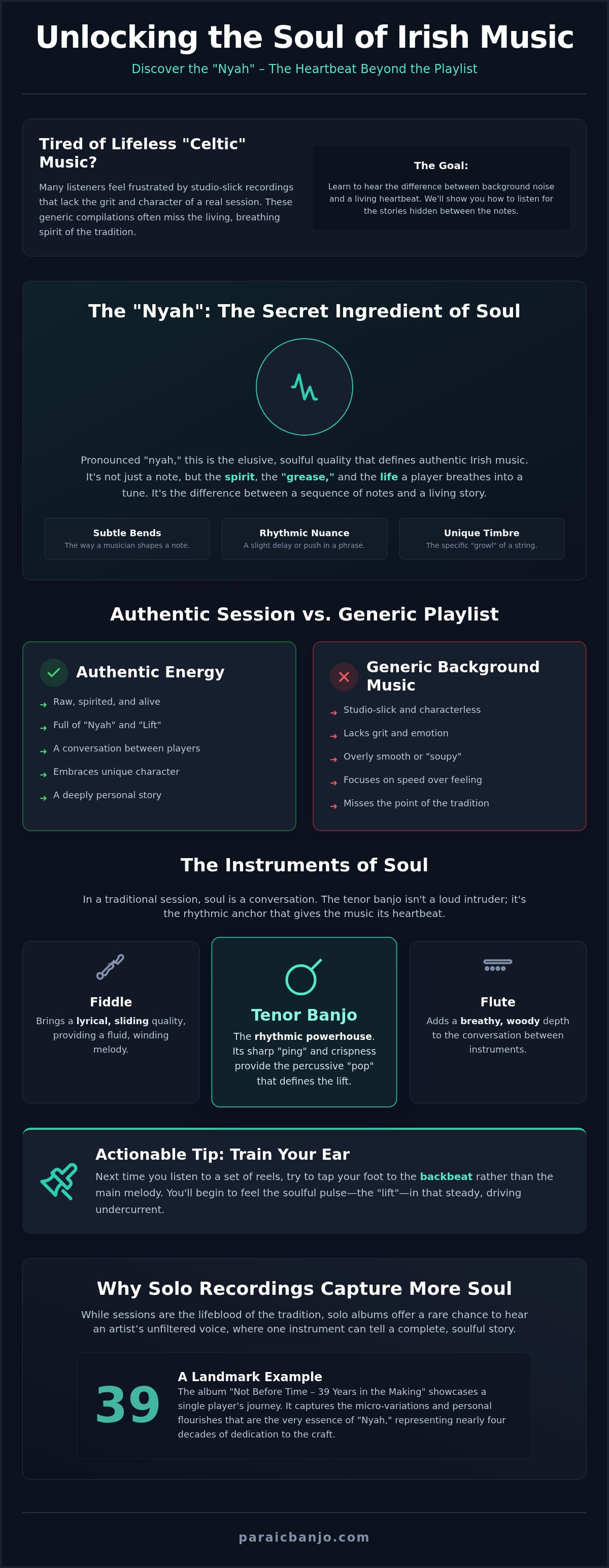
If you ask a traditional musician what makes a performance stand out, they'll likely mention the "nyah." It's a term that's hard to pin down but impossible to miss once you hear it. Think of the nyah as the spirit or the "grease" in a player's style. It's the subtle way a musician bends a note, the slight delay in a triplet, or the specific growl of a string. This quality transforms soulful tenor banjo music from a sequence of notes into a living, breathing story. It's the sound of decades spent in crowded sessions and quiet practice rooms. To develop your own ear, try this: listen for the subtle variations in a repeated melody line. A master never plays the same phrase exactly the same way twice; they let the nyah guide the evolution of the tune.
Rhythm as an Emotional Language
The rhythm of a tune is its heartbeat. In the East Galway style, this pulse is often mellow and relaxed, prioritizing the melody's internal "lift" over sheer speed. This approach allows the instrument to sing. Understanding the history of the banjo helps us see how it evolved from a rhythmic driver into a sophisticated melodic voice in Irish circles. When the rhythm is right, it creates a conversation between the players and the listeners. This is why a live, unpolished sound often feels more soulful than a perfect studio edit. The small imperfections and the raw energy of a room full of people connect with us on a primal level. For a deeper look at how these pulses vary by county, check out our guide on east galway vs clare music to see how regional styles shape the soul of the west.
The Instruments That Carry the Soulful Sound
In a traditional session, the soul isn't found in a single note but in the conversation between players. While the fiddle and flute provide a fluid, winding melody, the tenor banjo acts as the rhythmic anchor. It’s a common misconception that the banjo is merely a loud, percussive intruder. In reality, it is one of the most expressive uniquely Irish instruments when played with sensitivity. The interplay between these instruments is a delicate dance of textures. The fiddle brings a lyrical, sliding quality, while the flute adds a breathy, woody depth. The banjo provides the percussive "pop" that defines the rhythmic lift. Without the banjo's crispness, the music can sometimes feel overly smooth or "soupy." A master player understands this history and uses their instrument to create a bridge between the melody and the rhythm.
The Tenor Banjo: A Rhythmic Powerhouse
The Irish tenor banjo is a rhythmic powerhouse because of its sharp attack and quick decay. This creates a "ping" that cuts through the hum of a crowded pub. In the East Galway style, the focus is squarely on clarity. Every ornament, every triplet, and every slide must serve the melody. It isn't about how many notes you can cram into a bar, but how much life you can breathe into the ones that are there. This clarity allows soulful tenor banjo music to convey deep emotion without relying on excessive speed. When you hear the rhythmic pulse of a well-played banjo, you're hearing the heartbeat of the West of Ireland.
Actionable Tip: Next time you listen to a set of reels, try to tap your foot to the backbeat rather than the main melody. You’ll feel the soul of the music pulsing in that steady, driving undercurrent.
Why Solo Albums Offer More Soul
While sessions are the lifeblood of the tradition, solo albums offer a rare chance to hear an artist’s unfiltered voice. In a group setting, players often compromise to stay in unison. In a solo recording, however, one instrument can tell a complete, soulful story. This is why Not Before Time – 39 Years in the Making is such a significant milestone. It captures the nuance of a single player’s journey, allowing the listener to hear the micro-variations and personal flourishes that define a lifetime of practice. When you strip away the layers of a full band, you’re left with the raw emotion of the performer. You hear the history of the tunes and the regional character of the West of Ireland in every pluck. It’s an intimate experience that background music simply can't replicate. If you want to hear this depth for yourself, you can listen to the stories within the debut album to feel that authentic session energy.
Authentic Session Energy vs. "Background" Music
Real Irish music isn't meant to be polite background noise. It's a spirited, often loud, and always communal conversation. If you’ve ever felt that certain "Celtic" playlists feel a bit thin or clinical, it’s likely because they’ve been scrubbed of their personality to fit a generic "relaxing" mold. Soulful tenor banjo music thrives on the friction of a live room. It needs the audible breath of a flute player, the tap of a shoe on a floorboard, and the spontaneous reaction between musicians to truly come alive. These aren't mistakes; they're the evidence of life. When music is treated as a social event rather than a product, the listener is invited into the circle rather than just being a consumer.
The Myth of the "Perfect" Studio Recording
In the modern age, it’s tempting to fix every slightly sharp note or rhythmic wobble in a computer. However, over-produced music often loses the nyah. When you polish away the grit, you polish away the soul. Authentic recordings are often captured live to preserve the "lift" that happens when players are actually looking at each other across a table. This is why the 18 tracks on "Not Before Time – 39 Years in the Making" were recorded live; it captures the raw, unpolished energy of a real session. The interaction between the banjo and the other instruments creates a momentum that you simply can't replicate by recording parts in isolation.
Actionable Tip: When building your collection, look for albums that list specific "sets" of tunes. In a real session, tunes are joined together to build energy and momentum. A recording that mimics this structure is far more likely to carry that authentic, soulful energy.
Why History and Storytelling Matter
Every reel, jig, and hornpipe has a name, a composer, or a story of how it traveled from one county to another. Knowing that a tune was learned from a neighbor fifty years ago adds a layer of emotional weight you can't get from a generic track title. This is where physical media and detailed liner notes become invaluable. They provide the historical context that turns a melody into a legacy. If you want to move beyond the surface level, you should buy traditional irish music that prioritizes these stories. Understanding that a specific reel was a favorite of an East Galway master changes how you hear the rhythm. It connects you to a lineage of players who have kept this soulful tradition alive for generations. Knowing the "why" behind a tune makes the "how" of the performance much more meaningful.
How to Curate Your Soulful Irish Music Collection
Building a collection isn't just about accumulating tracks. It's about curating a library of stories. To find the real stuff, you have to look past the algorithm-driven suggestions that prioritize generic "Celtic" background noise. Authentic traditional music is a living heritage; your collection should reflect that depth. Start by identifying the specific voices that resonate with you, prioritizing independent artists who carry the torch of their ancestors rather than generic labels. This approach ensures you're getting music with character and history, not just something designed for an elevator or a gift shop.
Identifying Regional Flavors
Irish music is a collection of distinct regional voices. It's a patchwork of local dialects. If you're looking for soulful tenor banjo music, you'll find its heartbeat in the East Galway style. This tradition is celebrated for its relaxed, melodic pace and emphasis on clarity over speed. Contrast this with the rhythmic, swinging lift of County Clare or the fast, driving fiddle music of Donegal. Searching for specific regional keywords will lead you to the true masters of the craft.
The Collector’s Advantage: Physical vs. Digital
A traditional irish session music cd offers more than just superior audio depth. It provides a tactile connection through detailed liner notes. These notes are where the education happens. You'll learn how tunes are paired into "sets," an art form that tells a story of momentum and mood. Digital downloads are convenient, but they often strip away this vital context, leaving you with only half the story.
Whenever possible, you should prioritize buying traditional irish music direct from artist. This ensures your support goes straight to the source, helping to keep these regional styles alive for the next generation. It's a way of participating in the tradition yourself. If you're ready to add a definitive statement of a lifetime's passion to your library, you can buy the debut album Not Before Time – 39 Years in the Making and experience the authentic "nyah" for yourself. Every track is a window into a storied tradition, captured live to keep the energy of the session intact.
Experience the Soul: "Not Before Time – 39 Years in the Making"
We've explored the theory of the "nyah" and the importance of regional pulse, but the true test of any tradition is the sound itself. Páraic Mac Donnchadha’s debut album, "Not Before Time – 39 Years in the Making," is the culmination of nearly four decades spent at the center of the session circle. It’s a landmark release that finally puts a lifetime of skill and soulful tenor banjo music into the hands of collectors and newcomers alike. This isn't just another folk record; it's a definitive statement of a lifetime's passion, captured live to ensure the spirit of the music remains completely untamed.
Recorded with a "live-in-the-room" feel, this collection brings the atmosphere of a West of Ireland pub directly to your speakers. You can hear the interaction, the lift, and the raw energy that studio-slick productions often scrub away. It’s an invitation to sit in the corner of a storied Galway session, where the music is played for the love of the tune rather than the demands of a commercial label. For anyone who has struggled to find authentic Irish music that carries real weight, this album is the answer you've been waiting for.
A Lifetime’s Passion in 18 Tracks
The album features 18 tracks that serve as a masterclass in the East Galway and Clare styles. Páraic has carefully selected a variety of jigs, reels, and hornpipes that represent his 39-year journey through the tradition. This isn't just a product; it’s a preservation of a specific way of playing that values melody and soul over sheer speed. Every triplet and every slide is placed with the quiet confidence of a seasoned master who knows exactly when to let the tune breathe.
Actionable Tip: To truly appreciate the narrative flow, listen to the album in one sitting from start to finish. The way the sets are paired creates a momentum that mirrors a real night of music, building from steady, melodic explorations into driving, high-energy reels.
Join the Musical Journey
It’s time to move beyond shallow playlists and dive into deep listening. The soul of Irish music is found in the details, and those details are best experienced through a dedicated collection. The physical CD version of the album is a particular treasure for collectors, featuring extensive liner notes that provide historical context for every single track. These notes act as an educational guide, explaining the origins of the tunes and the masters who passed them down. It’s a way to connect with the lineage of the music while enjoying the performance.
The tradition is a living thing, and it only survives when we support the artists who dedicate their lives to it. By choosing an authentic recording over a generic compilation, you become a part of the story. Don't settle for background noise when you can have a heartbeat. Explore the album "Not Before Time" on Páraic’s store today! Experience the soulful tenor banjo music that took 39 years to perfect and bring the true spirit of the West of Ireland into your home.
Bring the Spirit of the Session Home
Authentic Irish music is a conversation that spans generations. We've explored how the elusive "nyah" and the rhythmic lift of regional styles turn a simple tune into a soulful experience. It’s clear that moving beyond generic playlists is the only way to truly connect with the heart of this tradition. This journey into soulful tenor banjo music isn't just about melody; it's about the stories and the people who keep the flame alive. You don't have to be in a pub in Galway to feel that energy; you just need to listen to the right recordings.
If you're ready to add a definitive statement of a lifetime's passion to your collection, now is the time. With 18 tracks recorded live to capture the raw energy of a real session, my debut album is a preservation of the East Galway and Clare styles I've spent 39 years honing. The physical CD even includes detailed liner notes to guide you through the history of every tune. Order "Not Before Time – 39 Years in the Making" on CD or Digital Download and start your own musical journey today. The tunes are waiting for you!
Frequently Asked Questions
What does "soulful" mean in the context of Irish instrumental music?
Soulful refers to the "nyah" or the emotional spirit a player infuses into a tune through subtle variations in rhythm and ornamentation. It is the connection between the musician's life experience and the instrument's voice. This quality makes the music feel alive and personal rather than mechanical. It’s about the feeling behind the notes, ensuring the melody carries weight and resonates with the listener's own emotions. It’s the difference between hearing a tune and feeling a story.
Is soulful Irish music always slow and sad?
No, soulfulness is not limited to slow airs or mournful laments. In traditional music, a high-energy reel or a bouncy jig can be deeply soulful if it possesses the right "lift" and rhythmic pulse. Soul comes from the sincerity of the performance and the player's ability to communicate through the instrument. A driving tune can move a listener just as much as a quiet one when it’s played with authentic feeling and rhythmic drive.
Why is the tenor banjo considered a soulful instrument?
The tenor banjo is soulful because its percussive attack and crisp melodic clarity provide the rhythmic heartbeat of a session. While some see it as just a loud instrument, a master player uses it to create nuanced, soulful tenor banjo music that emphasizes the beauty of the tune. Its unique GDAE tuning allows for a deep, resonant sound that complements other instruments while driving the emotional momentum of the set in a storied tradition.
How can I tell if an Irish music recording is authentic?
Authentic recordings usually prioritize live energy and regional character over studio perfection. Look for albums recorded in a live setting where you can hear the interaction between musicians. These recordings often feature "sets" of tunes played together, mirroring a real session. Avoid generic "Celtic" labels that scrub away the grit and personality of the performance. True authenticity is found in the raw, unpolished spirit of independent releases that capture the breathing life of the room.
What is the "East Galway style" of Irish music?
The East Galway style is a regional tradition known for its relaxed, melodic pace and heavy emphasis on the "lift" of the tune. It avoids excessive speed, allowing the intricate ornaments and the soul of the melody to shine through. This style is often described as mellow and lyrical. It's a tradition that prioritizes the internal rhythm and emotional weight of the music over technical showmanship or aggressive tempos, making for a deeply resonant experience.
Why should I buy music directly from the artist?
Buying directly ensures that the artist receives the full support needed to continue preserving these musical traditions. It bypasses large corporations and streaming platforms that offer minimal payouts. When you purchase from an independent musician, you're directly funding the creation of future projects and the maintenance of niche regional styles. It creates a personal connection between the listener and the creator, helping to keep the living heritage of the music thriving for decades to come.
What are liner notes, and why do they matter for instrumental music?
Liner notes are the written stories and historical context included with an album, particularly on a physical CD. They explain the origins of the tunes, the people who passed them down, and the significance of the sets. For instrumental music, these notes are essential because they provide the narrative that the melody alone might not convey. They turn a simple listening experience into a deep dive into Irish cultural history, adding layers of meaning to every track.
Can I listen to soulful Irish music for relaxation?
Yes, many listeners find the rhythmic pulse and melodic flow of soulful tenor banjo music to be incredibly grounding. While it isn't "relaxation music" in the generic sense, the steady, driving nature of traditional tunes can provide a sense of calm and focus. The mellow tones of the East Galway style are particularly well-suited for deep listening, offering a sophisticated alternative to clinical, characterless background tracks often found on generic streaming playlists.
Comments