Stories Behind Traditional Irish Tunes: The Lore and Legends of the Session
- Paraic Mac Donnchadha

- Jun 8
- 13 min read
Have you ever sat in the corner of a crowded pub, swept up in the energy of a session, yet felt like you were missing the punchline to a century-old joke? It's a common frustration for many of us. You hear the driving rhythm of a reel or the playful bounce of a jig, but the names and origins remain a mystery. Without knowing the stories behind traditional Irish tunes, these melodies can feel like a blur of notes rather than the vibrant history they truly are.
After spending thirty-nine years honing my craft and gathering these tales, I've realized that the lore is just as important as the notes themselves. I promise that discovering the fascinating histories hidden within your favorite reels will transform your next session experience. We're going to explore the local legends and rural struggles that birthed these classic sets. This guide will help you distinguish similar-sounding tunes while connecting you to the characters who kept this music alive through the generations. It's time to move beyond the dry, academic texts and get to the heart of the music. Let's peel back the layers of the tradition together.
Key Takeaways
Learn how tune lore serves as a rhythmic map for musicians, making it easier to remember complex fingerings and the heart of a melody.
Dive into the stories behind traditional irish tunes to discover how rebellion and the supernatural shaped the reels and jigs we love today.
Get practical tips on using physical liner notes and digital archives to trace the history of your favorite tunes back to their source.
Understand the evocative "lonesome" sound of East Galway music and why its slower tempo creates such a deep emotional connection.
Discover why high-quality, independent recordings are essential for keeping the authentic spirit of the session alive for future generations.
Table of Contents
What Are the Stories Behind Traditional Irish Tunes?
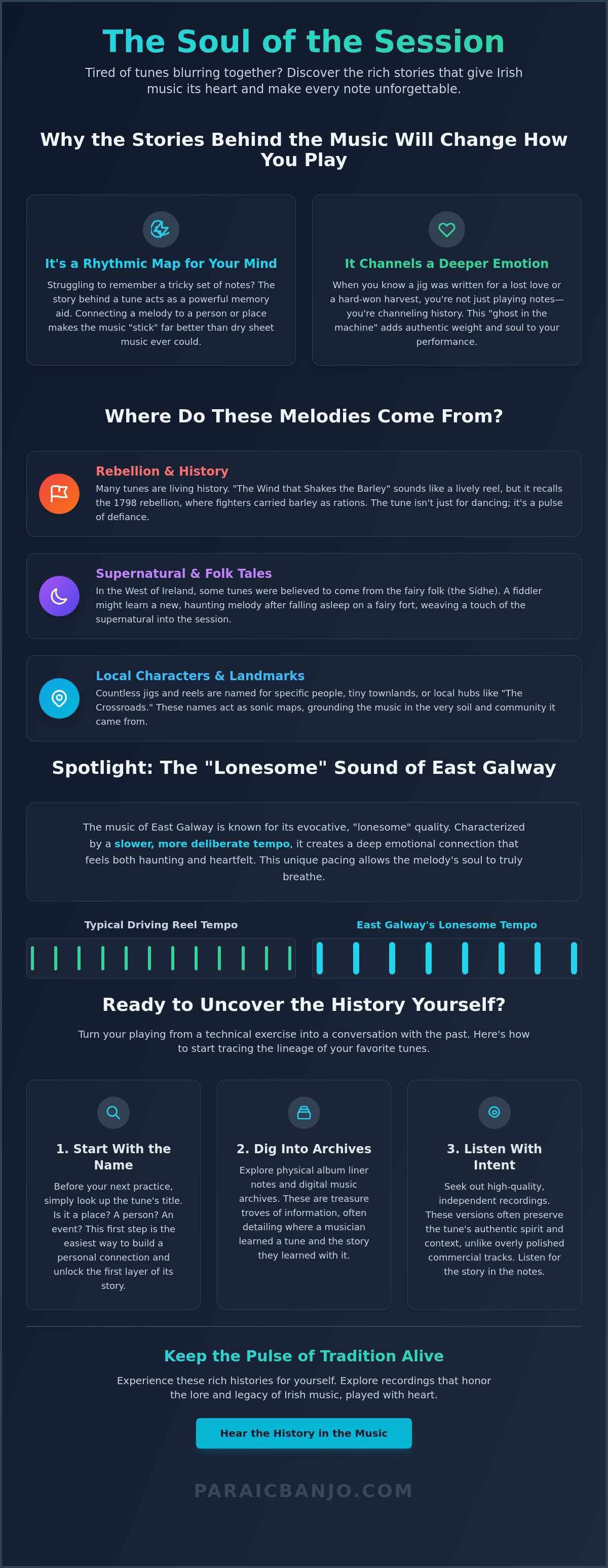
When you sit down to play a set of reels, you're doing more than just moving your fingers across a fretboard or a set of keys. You're tapping into a legacy. The stories behind traditional irish tunes are the secret ingredients that give a session its flavor. We call this "tune lore." It's a rich collection of local anecdotes, specific townland names, and sketches of the colorful characters who first hummed these melodies into existence. These aren't just titles on a page; they're the DNA of the music itself.
Why do these stories matter so much? For a musician, a story is a powerful mnemonic device. It's much easier to remember a complex string of notes when you associate them with a specific neighbor's eccentricities or a historical event. If you're struggling to keep your sets straight, try this: look up the name of the tune before your next practice. Connecting a melody to a person or a place makes the music "stick" in a way that dry sheet music never can. It turns a technical exercise into a personal conversation.
There's also what I like to call the "ghost in the machine." When you know that a particular jig was written to commemorate a hard-won harvest or a lost love, it fundamentally changes how you strike the strings. You aren't just playing notes; you're channeling an emotion. The deep historical roots of Irish traditional music ensure that every performance carries a weight of authenticity. In the oral tradition, you'll often find that one tune has four different names depending on which county you're in. That's not confusion; it's a map of how the music traveled.
The Connection Between Names and Places
In places like East Galway and Clare, the landscape is practically woven into the music. You'll find countless reels named after tiny townlands that you won't even find on most modern maps. These names act as sonic landmarks. Then there's the legendary "Crossroads." In folklore, the crossroads was where musicians would meet to trade tunes and, occasionally, where a few supernatural deals were rumored to happen. Jigs are often even more personal, frequently named after the specific local characters or traveling fiddlers who carried them from house to house. You can hear these local influences clearly in the individual digital tracks from my latest collection.
From Oral Tradition to the Modern Session
For centuries, these melodies lived in rural kitchens and smoky pubs, passed from ear to ear. Today, they've traveled from those quiet corners into the digital world. As a musician, you act as a "custodian." Your job is to keep the soul of the tune alive while adding your own touch. Tune lore is the heartbeat of the Irish social fabric, pulsing through every measure and every beat. If you want to hold a piece of this history, Not Before Time – 39 Years in the Making is available as a physical CD, complete with the context these tunes deserve.
The Origins of Classic Reels and Jigs
Many people think of Irish music as a static museum piece. It's actually a living record of human survival. When you look at the stories behind traditional irish tunes, you aren't just looking at dusty archives. You're looking at the 19th-century struggle for identity. Take a classic like "The Wind that Shakes the Barley." On the surface, it’s a high-energy reel. Dig deeper, and you find a reference to the 1798 rebellion, where United Irishmen carried barley in their pockets as rations. After they fell, the barley grew from their graves. That rhythm isn't just for dancing; it's a pulse of defiance.
This human element is what I’ve spent nearly four decades trying to capture. My project, Not Before Time – 39 Years in the Making, isn't just a collection of tracks. It’s an attempt to preserve these layers of history so they don't fade away. You can hear this depth in every note of the Not Before Time digital album, where the arrangements honor the original spirit of the composers while bringing a fresh energy to the strings.
Fairies, Fiddlers, and Folk Tales
In the West of Ireland, the line between our world and the next was always thin. There’s a persistent legend of the fiddler who falls asleep on a fairy fort, only to wake up with a melody he’s never heard before. These tunes often carry a "lonesome" quality, a haunting melodic shift that feels slightly out of time and tied to Irish mythology. Some old-timers even considered certain tunes dangerous. They believed playing them late at night would attract the Sídhe, or the fairy folk, who might decide to take the musician along with the music. It sounds like superstition, but that eerie atmosphere is baked into the very structure of the scales we use.
Commemorating Life Events through Music
Irish music serves as a diary for the community. We have laments for the dead and reels for the living. The "Flight of the Earls" isn't just a title; it’s a sonic monument to the departure of the Gaelic aristocracy in 1607. Later, during the 19th-century waves of immigration, tunes became bridge-builders between Ireland and America. You can feel the grief and joy struggling against each other in the structure of these melodies.
Actionable Tip: Want to find a story quickly? Look for tunes starting with "The Trip to..." in the title. These almost always document a specific journey or a musician's visit to a new place, like "The Trip to Durrow" or "The Trip to Sligo." It’s a great way to start mapping out the geography of your repertoire. Keep your ears open at the next session; you'll be surprised what you hear when you know what to listen for.
How to Uncover the History of Your Favorite Tunes
Finding the stories behind traditional irish tunes is a bit like being a musical detective. You don't need a PhD to do it, but you do need to know where the clues are hidden. While streaming services are wonderful for a quick listen, they often strip away the soul of the music by removing the context. When you hold a physical CD in your hands, you get the liner notes. These are often personal letters from the artist, explaining exactly which neighbor taught them a setting or why a particular reel reminds them of a rainy Tuesday in 1974. It's that personal connection that turns a list of tracks into a legacy.
If you're looking for deeper roots, digital archives like the Irish Traditional Music Archive (ITMA) are gold mines. Try using specific search terms like "field recordings" or the names of legendary players from the 1920s. You'll often find that the melody you play today has shifted and morphed over the decades. If you really want to understand the rhythmic heart of this tradition, I’ve put together a guide called The Sound of East Galway that breaks down how geography dictates the beat. It’s a great way to start training your ear to hear the history behind the notes.
Don't be afraid to talk to the musicians at a live session, either. There's a certain etiquette to it. Wait for the set to finish and for the player to take a sip of their drink. Instead of asking "What was that called?", try asking "Who did you get that tune from?". This usually opens up a much better conversation about the tune's lineage and the people who kept it alive. It's how the stories behind traditional irish tunes have always been shared, from one person to the next, over a shared love for the craft.
Where to Look: Reliable Archives and Collections
Captain Francis O'Neill's Music of Ireland is the "Bible" for many of us. Published in 1903, it’s a massive historical reference, though you have to remember it was compiled by a police chief in Chicago, not a farmer in Kerry. Websites like The Session are fantastic databases for finding ABC notation, but they require a critical eye. Since anyone can upload a version, you'll find hundreds of variations. I always recommend cross-referencing tune titles with historical Irish maps. Seeing that a reel is named after a specific bog or bridge helps you visualize the world the music came from.
Practical Tips for the Active Listener
Actionable Tip: Start a "Tune Journal" today. Every time a melody catches your ear, write down the date, the pub, and the person playing it. Note any small details they mentioned about the tune's origin. Over time, this becomes your own personal archive of lore. If you want to hear how this research translates into a finished project, the detailed historical notes included with Not Before Time – 39 Years in the Making are designed to bridge that gap. Learning to identify the relaxed, melodic pulse of the East Galway style will change the way you listen to every recording in your collection. It’s all about the details.
What is East Galway Style Music and Why Does it Matter?
While many musicians today chase the frantic speed of a high-octane session, there's a different kind of magic found in the West of Ireland. To truly understand the stories behind traditional irish tunes, you have to recognize the regional accents that define them. East Galway is the home of the "lonesome" sound. It's not just a fancy word for being sad; it's a specific emotional weight and a haunting, melodic quality that feels like a conversation across a century. This style doesn't rush. It breathes.
The rhythmic mastery of this region is characterized by a tempo that's often slower and more deliberate than the punchy styles of County Clare. This isn't because the players lack technical skill. In fact, it's quite the opposite. It takes immense control to hold a relaxed pace while maintaining a driving, rhythmic "lift." The legendary Ballinakill Ceili Band brought this sound to the global stage in the early 20th century, proving that a melody played with heart and steady rhythm could move a room just as easily as a fast one. I've spent 39 years immersed in this specific pulse, learning that the lore is often found in the spaces between the notes.
If you want to experience this authentic rhythmic drive for yourself, you can explore the Not Before Time individual digital tracks, which were recorded specifically to showcase this regional soul. Every track is a tribute to the masters who came before me.
The Rhythmic Heart of the West
The relaxed tempo of the East Galway style allows the story of the tune to really come forward. It gives the musician room for subtle ornamentation and variations that get lost at higher speeds. On the tenor banjo, this translates to a steady, rolling drive that anchors the entire session. It's about finding the "swing" rather than just hitting the beats. You can read more about Galway style banjo playing to see how this technical approach creates such a unique auditory experience.
Key Figures and Their Legacy
Giants like P.J. Hayes and Paddy Carty were the architects of this sound. Their playing was a direct reflection of the rolling, green landscape of East Galway, full of gentle curves and deep history. The East Galway style prioritizes melody over raw speed. When you listen to their old recordings, you aren't just hearing jigs and reels; you're hearing the endurance of a community that valued the beauty of the tune above all else.
Actionable Tip: Next time you're practicing a new set, try slowing your metronome down by 10 or 15 beats per minute. Focus entirely on the clarity of the melody and the "lift" of the rhythm. You'll find that the stories behind traditional irish tunes become much clearer when you aren't racing to the finish line. It's in that slower space that the real soul of the music starts to shine through.
Preserving the Pulse: The Role of Modern Recordings
High-quality recordings are about more than just clear sound. They're about capturing the breath of the player and the "lift" of the rhythm that you only find in a real session. In a world of digital noise, generic streaming playlists often flatten the music, stripping away the regional soul we've explored. Independent releases act as the antidote. They allow the music to exist as it was intended, full of character, grit, and the specific nuances of the player's touch. A good recording doesn't just play a tune; it preserves an atmosphere.
By documenting the stories behind traditional irish tunes in the liner notes, we ensure that the names of the old players aren't lost to time. These notes serve as a vital historical archive. They provide a paper trail for melodies that have traveled through countless hands before reaching mine. Digital tracks are convenient, but they often lack the "who" and the "where" that make this music so deeply human. My debut project, Not Before Time – 39 Years in the Making, is my definitive statement on this craft. It's the result of decades of listening and learning, a celebration of the community that raised me musically.
Why Purists Prefer Physical CDs
There's a reason many of us still reach for the physical CD. It’s the tactile connection to the art. When you open that booklet, you're holding a piece of history. You're reading about the specific kitchen where a tune was learned or the character who gave it its name. Beyond the lore, buying physical media or digital albums directly from the artist is the most effective way to ensure the tradition continues. It’s a direct way to support music from the west of ireland so it can thrive for the next generation of players.
Join the Musical Journey
You don't have to be a professional musician to protect this heritage. By learning these histories, you become a custodian of the tradition yourself. Actionable Tip: The next time you're at a session or listening to a track with a friend, share one detail about that tune's history. Maybe it's a story about a "fairy" melody or a local townland. When you share the lore, the story travels further and stays alive in the social fabric. Explore the stories and sounds of 'Not Before Time' here. Let's keep the pulse of the tradition going together. I'll see you at the next session!
Carry the Tradition Forward
Understanding the stories behind traditional irish tunes is what transforms a simple reel into a shared piece of history. We've explored how tune lore acts as a vital bridge between generations and why the "lonesome" East Galway style prioritizes melody over raw speed. These tunes are living maps of our past, stretching from rebel barley fields to the quiet kitchens of the West. It's about more than just hitting the right notes; it's about honoring the people who kept them safe through the centuries.
My debut album captures 39 years of musical mastery across 18 tracks. I recorded these live to preserve that raw, authentic session energy that defines our community. Every physical CD includes detailed liner notes to help you connect with the heritage of each melody. Order 'Not Before Time – 39 Years in the Making' and dive into the stories behind the music. Grab your instrument, head to your local pub, and keep these tales traveling. I'll see you at the next session!
Frequently Asked Questions
What is the story behind the tune 'The Wind that Shakes the Barley'?
The story behind "The Wind that Shakes the Barley" centers on the 1798 rebellion where barley was carried as rations. When fallen rebels were buried in unmarked graves, the barley would sprout, marking their resting places with green shoots. This reel isn't just a dance; it’s a sonic monument to those who fought. It shows how the music acted as a living archive for the community’s struggles and resilience.
How did traditional Irish tunes get their names?
Names for traditional Irish tunes were usually descriptive, honoring the people or places that shaped the music. You might find a jig named after a specific neighbor’s house or a reel that commemorates a local landmark. These titles acted as social maps, helping musicians navigate a massive repertoire without written scores. They were functional, personal, and deeply rooted in the specific townlands where the music was most active.
What is East Galway style music exactly?
East Galway style is defined by its relaxed tempo and a haunting, melodic quality often described as lonesome. This approach values the "swing" or lift of the rhythm over raw technical speed. By playing a bit slower, musicians can explore deeper ornamentation and allow the melody to breathe. It’s a style that invites the listener in rather than overwhelming them, reflecting the steady, rolling energy of the West of Ireland.
Why do many Irish tunes have multiple different names?
Multiple names for the same tune are a natural result of the oral tradition traveling across county lines. A melody might be known by one name in Galway and another in Kerry, depending on which local musician was the primary source. These variations reflect the music’s vibrant journey. When you look for the stories behind traditional irish tunes, you’ll see how these different titles help track the music's historical movement through various communities.
Are the stories behind Irish tunes historically accurate?
Stories attached to tunes are often a mix of historical fact and evocative folk legend. While some titles commemorate real political events or figures, others are purely anecdotal, capturing a moment of humor or supernatural wonder. The goal of tune lore isn't academic perfection but rather preserving the spirit of the session. These tales give the music a human face, making it easier for new generations to connect with the tradition.
How can I find the history of a specific Irish tune?
To find a tune's history, start by cross-referencing the title in digital archives like the ITMA or physical collections like O'Neill’s. Physical liner notes are also invaluable, as they often contain first-hand accounts from the artists that you won't find online. Another useful tip is to listen for regional variations in the rhythm. A slight shift in the pulse can often point you toward the specific county or player where the tune originated.
Why is the tenor banjo so prominent in East Galway music?
The tenor banjo provides a crisp, rhythmic anchor that is essential for the steady pulse of East Galway music. Its percussive nature helps define the "lift" in the rhythm, especially when playing at a more relaxed tempo. This allows the banjo to act as the heartbeat of the session, supporting instruments like the flute or fiddle. In the West, the banjo is a vital tool for driving the rhythmic soul and character of the set.
What is the significance of 'The Crossroads' in Irish music lore?
The Crossroads was a literal meeting place for rural communities to dance and trade tunes before social halls were built. It represents the democratic, outdoor spirit of the tradition, where anyone could join the circle. In folklore, these spots were also seen as thin places where the fairy folk might join the music. Today, the crossroads remains a symbol of the social connection and shared history that the stories behind traditional irish tunes help preserve.


Comments