The Art of Irish Tenor Banjo Recording: Capturing the Rhythmic Pulse
- Paraic Mac Donnchadha

- May 14
- 13 min read
If your recording sounds more like a clattering typewriter than a lively session in a County Clare pub, you've likely missed the heartbeat of the instrument. Achieving a professional irish tenor banjo recording isn't about chasing clinical perfection; it's about preserving that elusive rhythmic lift that makes people tap their feet. Many musicians find their studio sound turns out thin or overly metallic, losing the warmth and drive that defines our 4-string tradition. It’s a common frustration, especially when the unique character of the tenor banjo gets buried under settings more suited for a 5-string bluegrass style.
You deserve a recording that feels as vibrant as a lifelong musical journey. We'll show you exactly how to capture the authentic, soulful pulse of your playing by balancing technical precision with stylistic flair. This article dives into the secrets of microphone selection, the importance of room acoustics, and how to maintain that infectious East Galway swing through your digital audio workstation. We're moving from the historical context of the tradition to the practical steps of modern production, ensuring your music rings out with the pride and passion it deserves. Let's get that rhythmic pulse captured just right.
Key Takeaways
Learn why GDAE tuning is the secret to that deep, resonant sound in every professional irish tenor banjo recording.
Discover why small-diaphragm condenser microphones are the gold standard for capturing the delicate balance between the percussive bridge and melodic fretboard.
Understand how regional influences from East Galway and Clare dictate the specific rhythmic 'lift' and soulful phrasing of your tracks.
Use our purist’s checklist to ensure the warm 'skin' sound of the banjo head is present, making the audio feel like an intimate musical conversation.
Explore how a masterclass project like 'Not Before Time' serves as a definitive roadmap for preserving decades of traditional passion.
Table of Contents
What Defines an Authentic Irish Tenor Banjo Recording?
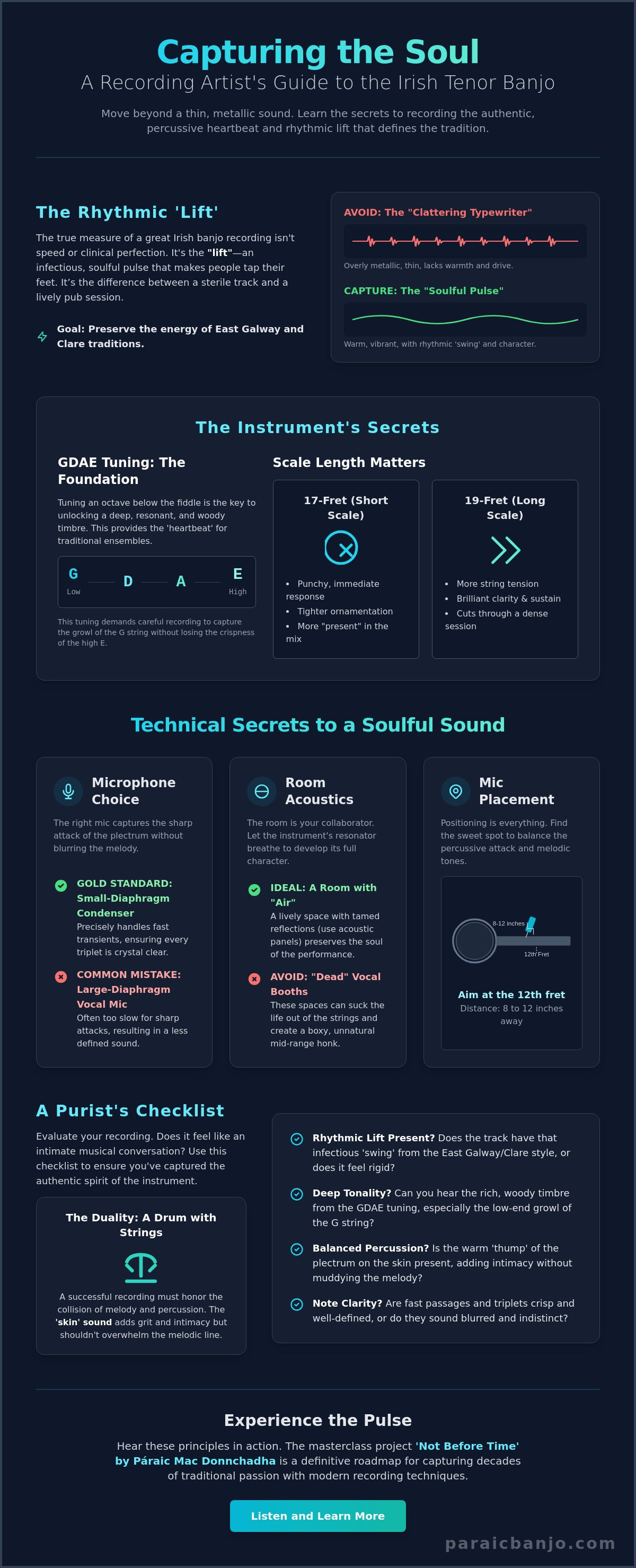
An authentic irish tenor banjo recording captures a specific, percussive magic that you simply won't find in other genres. It isn't just about the notes on the page; it's about the air moving around the resonator and the distinct "pop" of the plectrum hitting the string. While bluegrass players rely on 5-string rolls and jazz musicians focus on complex chordal syncopation, the Irish tradition is built on a foundation of melody driven by a relentless, soulful pulse. This pulse, often called the "lift," is the true measure of a great track. If the recording feels clinical or overly polished, you lose that infectious energy that defines a Saturday night session in County Clare. Speed is often a distraction. A master knows that a slower reel played with the right "swing" carries more weight than a frantic blur of notes.
The secret to this deep, resonant sound lies in the GDAE tuning. By tuning the tenor banjo an octave below the fiddle, we unlock a rich, woody timbre that provides the heartbeat for traditional ensembles. This tuning demands more from the instrument and the recording engineer alike. You need to capture the low-end growl of the G string without losing the crisp definition of the high E. It's a delicate balance that separates a muddy basement tape from a definitive musical statement.
The 4-String Banjo in Irish Music
The journey of the 4-string banjo into the heart of Irish music is a story of adaptation and grit. Originally a staple of American minstrelsy and jazz, it migrated into the Irish tradition and found a permanent home. When you're setting up for an irish tenor banjo recording, the scale length of the instrument makes a massive difference. Many players prefer the 17-fret short-scale banjo for its punchy, immediate response. These shorter necks allow for tighter ornamentation and reach, which translates to a more "present" sound in the mix. Conversely, 19-fret models offer more tension and sustain, providing a brilliant clarity that cuts through a crowded session. Understanding these nuances helps you choose the right gear to capture the specific regional flavor you're after.
Melody vs. Percussion: The Dual Nature of the Sound
In a traditional session, the banjo is often described as a "drum with strings." It occupies a unique space where melody and percussion collide. A successful recording must honor this duality. You want to hear the "thump" of the pick hitting the skin of the banjo head, but it shouldn't overwhelm the melodic line. This requires careful attention to the balance between the bright, metallic treble and the warm, organic low end. When you listen to a well-captured track, it should feel like a conversation between the player and the instrument. The skin sound adds a layer of intimacy and grit, reminding the listener that this music is a living, breathing tradition born in crowded rooms and celebrated with every strike of the plectrum.
Technical Secrets for Capturing the Soulful Tenor Banjo
Getting a stellar irish tenor banjo recording requires more than just hitting record; it's about understanding the physics of the instrument. Many beginners make the mistake of using a large-diaphragm vocal mic, but seasoned engineers often reach for small-diaphragm condensers. These microphones are the industry standard for traditional music because they handle fast transients with incredible precision. They capture the sharp attack of the plectrum without blurring the melody, ensuring every triplet rings out with clarity. It’s about finding that balance between the metal of the strings and the wood of the rim.
The room is your secret collaborator. Avoid "dead" vocal booths that suck the life out of the strings. You want a space with a bit of "air" to let the resonator breathe and develop its full character. If you're in a small room, watch out for that boxy, honking mid-range that can ruin a take. Positioning your setup away from corners and using a few acoustic panels can tame the reflections while keeping the soul of the performance intact. You aren't just recording a banjo; you're recording the space it lives in. If you want to hear these technical choices in action, listen to the authentic banjo tones captured on the "Not Before Time" project. It’s a masterclass in how gear and technique meet tradition.
Mic Placement for the 4-String Banjo
Positioning is everything. Aim your primary mic at the 12th fret, about 8 to 12 inches away. This catches the clarity of the fretwork and the brightness of the strings. For a deeper, more authoritative sound, place a second mic near the lower edge of the resonator to capture the "growl." Be careful here. Ensure the microphones are at equal distances from the source or use the 3-to-1 rule to avoid phase issues. Phase cancellation can make your banjo sound thin and hollow, which is the opposite of the resonant, soulful sound we're chasing.
The Role of the Plectrum in Audio Clarity
The pick you choose is basically your hardware EQ. A 0.60mm pick offers a bright, snappy "click," while a 1.0mm plectrum provides a thicker, more rounded tone. In a professional irish tenor banjo recording, that rhythmic click isn't a mistake; it's the heartbeat of the tune. It provides the "lift" that drives a reel forward. To reduce unwanted scratchiness during high-gain recording, try angling the pick slightly or using a bit of high-frequency limiting in your DAW. These small adjustments ensure the rhythm is felt as much as it is heard.
Capturing the Rhythmic Mastery of East Galway and Clare
To truly master an irish tenor banjo recording, you have to look beyond the sheet music and listen to the land. Regional styles aren't just subtle differences in notes; they dictate the very "swing" or "lift" that makes a track feel alive. If you're recording a tune from the East Galway tradition, you're chasing a specific kind of ghost. This style is famous for its slightly slower tempos and a deep, soulful emphasis on triplets. It isn't about speed. It’s about the space between the notes. When you capture this on a digital track, you need to ensure the microphone picks up the deliberate, lyrical phrasing that makes this region’s music so hauntingly beautiful.
Contrast that with the driving, rhythmic pulse of Clare. Here, the banjo needs to feel like a runaway train that’s perfectly on the tracks. The recording energy has to be higher, capturing the percussive "pop" of the plectrum with absolute clarity. Páraic Mac Donnchadha has spent a lifetime immersed in these nuances, and his work serves as a vital bridge between these old-world roots and modern digital formats. He doesn't just play the tunes; he records the history of the families and sessions that birthed them. It’s a definitive statement of passion that refuses to let the regional "lilt" be flattened by modern studio compression.
Recording the 'Lift' in Irish Reels and Jigs
What is 'lift'? It’s that elusive, buoyant feeling that makes a listener want to tap their foot or jump into a dance. In an irish tenor banjo recording, capturing lift is often the hardest task. Many engineers make the mistake of forcing a player to follow a strict, clinical metronome. While a click track helps with timing, it can often kill the natural "heartbeat" of a traditional tune. Authentic recordings allow for the subtle, human ebbs and flows of the tempo. This is especially true when the banjo interacts with accompaniment like a guitar or piano. The "lift" happens in the micro-seconds of anticipation between the instruments, creating a shared rhythmic energy that feels spontaneous and celebratory.
Soulful Phrasing: Beyond the Notes
A great recording captures the breath and the pauses that make music feel human. In the Irish tradition, variation is everything. You rarely play a part the same way twice. A professional recording must highlight these small changes in ornamentation and emphasis. Páraic uses 39 years of experience to inform his phrasing, ensuring every note carries the weight of tradition. By focusing on the "soul" of the phrase rather than just technical accuracy, you create a recording that feels like a conversation. It’s about inviting the listener into a storied tradition where the silence is just as important as the sound.
A Purist's Checklist for Evaluating Banjo Recordings
How do you know if an irish tenor banjo recording has truly captured the spirit of the tradition? It’s a question of soul over circuitry. When you listen to a track, ask yourself: does it sound like an intimate conversation or a formal lecture? A lecture is rigid. A conversation has ebb, flow, and personality. You should be able to hear the warmth of the banjo head; that organic "skin" sound grounds the instrument in reality. If the triplets are blurred by excessive reverb or the accompaniment is so loud it drowns out the melodic nuances, the recording has failed the tradition. You’re looking for a sense of place. Even in a quiet room, the audio should carry the atmosphere of a session. The rhythm must be the absolute master.
The balance of the mix is equally vital. In the best recordings, the guitar or piano accompaniment supports the banjo without overshadowing it. You want to hear the interplay between the instruments, a shared rhythmic drive that feels effortless. If the banjo feels like it’s fighting to be heard, the "lift" is lost. Every note should ring out with clarity, especially during those complex ornaments that define our regional styles. It’s about finding that sweet spot where the technical production serves the music, not the other way around.
The 'Live' Recording Myth
Many believe a great irish tenor banjo recording must be captured in a crowded pub to be authentic. That’s a myth. While Páraic’s debut was famously recorded in a Clare pub to catch that specific energy, you can achieve "live" vitality in a controlled studio. The secret isn’t the background noise. It’s the raw, rhythmic truth. This means using minimal editing. If you "quantize" a track to a perfect grid, you kill the lift. You want the natural human timing. You want the slight push and pull that happens when a musician is truly "in the pocket." It’s about capturing a definitive moment.
Evaluating Liner Notes and Context
The music is only half the story. A purist looks for the lineage. Where did the tunes come from? Was it a reel learned from a neighbor in East Galway? Historical context informs how we hear the notes. When a recording includes detailed background notes, it transforms from a simple digital file into a piece of living history. It educates the newcomer while honoring the masters. This connection to the source is what gives a project its status. If you're ready to hear what 39 years of dedication sounds like, explore the tracks on Not Before Time and experience the pulse for yourself. It’s more than just an album. It’s a lifetime of stories told through four strings.
Experience the Pulse: 'Not Before Time' by Páraic Mac Donnchadha
After decades of playing in the heart of the tradition, the moment finally arrived to put it all on tape. "Not Before Time" is more than just a collection of tunes; it’s a definitive masterclass in irish tenor banjo recording. When you’ve spent 39 years honing your craft in the kitchens and pubs of East Galway and Clare, you don't just want a clean sound. You want the truth. This 18-track journey is the result of a lifetime spent listening to the masters who came before, distilled into a project that feels as though you’ve just pulled up a chair at a session. It was a long road to get here, but the wait was essential to ensure every triplet and every pause carried the weight of history.
The album succeeds because it doesn't try to hide the grit. By recording live in a Clare pub, we captured that elusive atmosphere we discussed earlier. It isn't a sterile studio recreation. It’s a living, breathing document of the music as it’s meant to be heard. Collaborating with a host of incredible musicians was key to this. Their accompaniment provides the perfect bedrock, allowing the 4-string banjo to lead the conversation without ever feeling isolated. This is the rhythmic pulse in its purest form, captured with the quiet confidence of a seasoned hand.
Behind the Scenes of the Debut Album
Selecting 18 tracks from a 39-year repertoire was no small feat. Each set was chosen to represent a specific branch of the tradition, from the driving reels of Clare to the soulful, slower tempos of East Galway. Every track is a story, meticulously arranged to showcase the dual nature of the banjo as both a melodic and percussive force. You can read more about Not Before Time - 39 Years in the Making: The Definitive Irish Banjo Debut to understand the deep roots and the meticulous process behind this milestone.
How to Support Independent Irish Music
Supporting independent music is about more than just a transaction. When you buy directly from the artist, you ensure the tradition continues to thrive and that the high-quality audio you hear is exactly as intended. While the limited-edition physical CD is a beautiful keepsake for your collection, it is currently in high demand. The digital download offers immediate access to the full 18-track experience, preserving every nuance of the irish tenor banjo recording. Whether you’re a long-time player or a newcomer to the 4-string sound, this album is an invitation to join the journey. Bring the pulse of the session home—order 'Not Before Time' today. It’s been a long time coming, and I'm delighted to finally share it with you.
Keep the Rhythmic Lift Alive
Capturing a true irish tenor banjo recording is a journey that starts with the heart and ends with the right microphone placement. You've learned that the secret isn't found in a clinical metronome; it lives in the subtle swing of East Galway and the driving energy of Clare. It's about finding that sweet spot where the percussive attack of the plectrum meets the woody resonance of the GDAE strings. By focusing on the pulse rather than just the speed, you preserve the soul of the instrument for every listener.
Now it's time to hear those techniques in action. Every choice made during the creation of "Not Before Time" was designed to honor the soulful phrasing of the 4-string tradition. With 18 tracks of expert-led session music and detailed liner notes that dive into the historical context of each tune, this project is a definitive statement of a lifetime's passion. Each track has been mastered for high-quality digital and physical playback to ensure you feel every beat. Explore the soulful sounds of Páraic's debut album, 'Not Before Time' and let the authentic pulse of the banjo fill your home. Let's keep the tradition ringing out for generations to come.
Frequently Asked Questions
What is the difference between a 4-string and 5-string banjo in Irish music?
The 4-string tenor banjo is the standard for Irish music because its shorter neck and GDAE tuning allow it to play fast fiddle melodies with ease. In contrast, the 5-string banjo features a high drone string and is primarily used for the rolling finger-style patterns found in bluegrass. The tenor banjo’s percussive, punchy nature provides the essential drive needed for traditional reels and jigs.
How do I get a good Irish tenor banjo sound in my home studio?
Achieving a professional irish tenor banjo recording at home starts with choosing a room that has a bit of natural "air" rather than a completely dead space. Use a small-diaphragm condenser microphone aimed at the 12th fret to capture the crisp attack of your plectrum without the mud. Avoid placing your setup in corners, which can create a boxy, honking sound that ruins the natural resonance of the instrument.
What is the best tuning for recording Irish tenor banjo?
GDAE is the definitive tuning for recording because it sits exactly one octave below the fiddle, providing a deep and woody resonance. This "Irish tuning" allows the banjo to mirror the melodic range of the session while adding a thick, percussive layer to the ensemble. It’s this specific setup that helps capture the soulful, low-end growl that defines the traditional 4-string sound.
Can I record a tenor banjo with a single microphone?
You can certainly record with a single microphone if you find the "sweet spot" where the bridge and fretboard sounds converge. Place the mic about 10 to 12 inches away from the 12th fret to get a balanced mix of string clarity and resonator depth. While a two-mic setup offers more control, a well-placed single condenser often provides a more coherent and natural feel that mimics a live performance.
Why is the East Galway style significant in banjo recordings?
The East Galway style is significant because it prioritizes lyrical phrasing and emphasized triplets over raw, frantic speed. In a recording, this style creates a relaxed and haunting "lift" that lets the listener appreciate the space between the notes. It’s a tradition that values the "soul" of the tune, making the audio feel more like an intimate conversation than a technical exercise.
What makes Páraic Mac Donnchadha's album 'Not Before Time' unique?
This album is a rare milestone because it distills 39 years of session experience into a single, definitive debut. Recorded live in a County Clare pub, it captures the raw, infectious energy of a real session across 18 tracks of expert-led music. It’s a storied project that balances professional audio quality with the deep, regional roots of East Galway and Clare traditions.
How can I tell if an Irish music recording is authentic?
An authentic recording will feature a rhythmic "lift" that feels human and spontaneous rather than rigid or mechanical. You should be able to hear the warm "skin" sound of the banjo head and the distinct "click" of the plectrum hitting the strings. If the timing is too perfect or the sound is overly processed with reverb, it likely lacks the traditional heartbeat of a true session.
Is it better to download or buy a physical CD for traditional Irish music?
Choosing between a physical CD and a digital download depends on whether you value historical context or immediate convenience. The physical CD of "Not Before Time" includes extensive liner notes that explain the source and history of every tune. Both formats provide the same high-quality irish tenor banjo recording, ensuring that the vibrant pulse of the music comes through clearly on any playback system.


Comments