The Best Irish Session Recordings: A Purist’s Guide to Authentic Traditional Music
- Paraic Mac Donnchadha

- Jun 1
- 14 min read
Technical perfection is often the quickest way to kill the spirit of a great tune. If you've ever pressed play on a folk album only to find it sounds like it was recorded in a vacuum, you know exactly what I mean. It's frustrating to hunt for the best irish session recordings only to be met with over-produced arrangements that strip away the "lift" and "pulse" that define our tradition. You want the grit, the rhythmic drive, and the feeling of being right there in the corner of a crowded pub.
I've spent nearly four decades immersed in this music, and I promise to show you how to find recordings that preserve that authentic atmosphere. We'll explore the soul of regional styles like East Galway and identify the tracks that belong in every purist's collection. With vinyl sales in Ireland jumping by 20% in 2025, it's clear that more listeners are looking for a tangible, honest sound. If you're ready to stop settling for sterile audio, you can explore the "Not Before Time – 39 Years in the Making" digital album to hear how we've captured that elusive session energy. Let's dive into the sounds that truly matter.
Key Takeaways
Learn to distinguish between sterile studio polish and the raw, conversational energy that defines an authentic traditional session.
Build a foundational collection using our "Gold Standard" list of the best irish session recordings, featuring legendary pub tracks from London to Westport.
Master the "lilt," that specific melodic bounce and rhythmic lift that separates a soulful performance from a merely technical one.
Uncover the regional phrasing secrets of East Galway and Clare styles to add historical depth and variety to your listening habits.
See how a lifetime of passion was captured in 18 tracks of pure banjo mastery on the "Not Before Time – 39 Years in the Making" physical CD.
Table of Contents
What Defines the Best Irish Session Recordings?
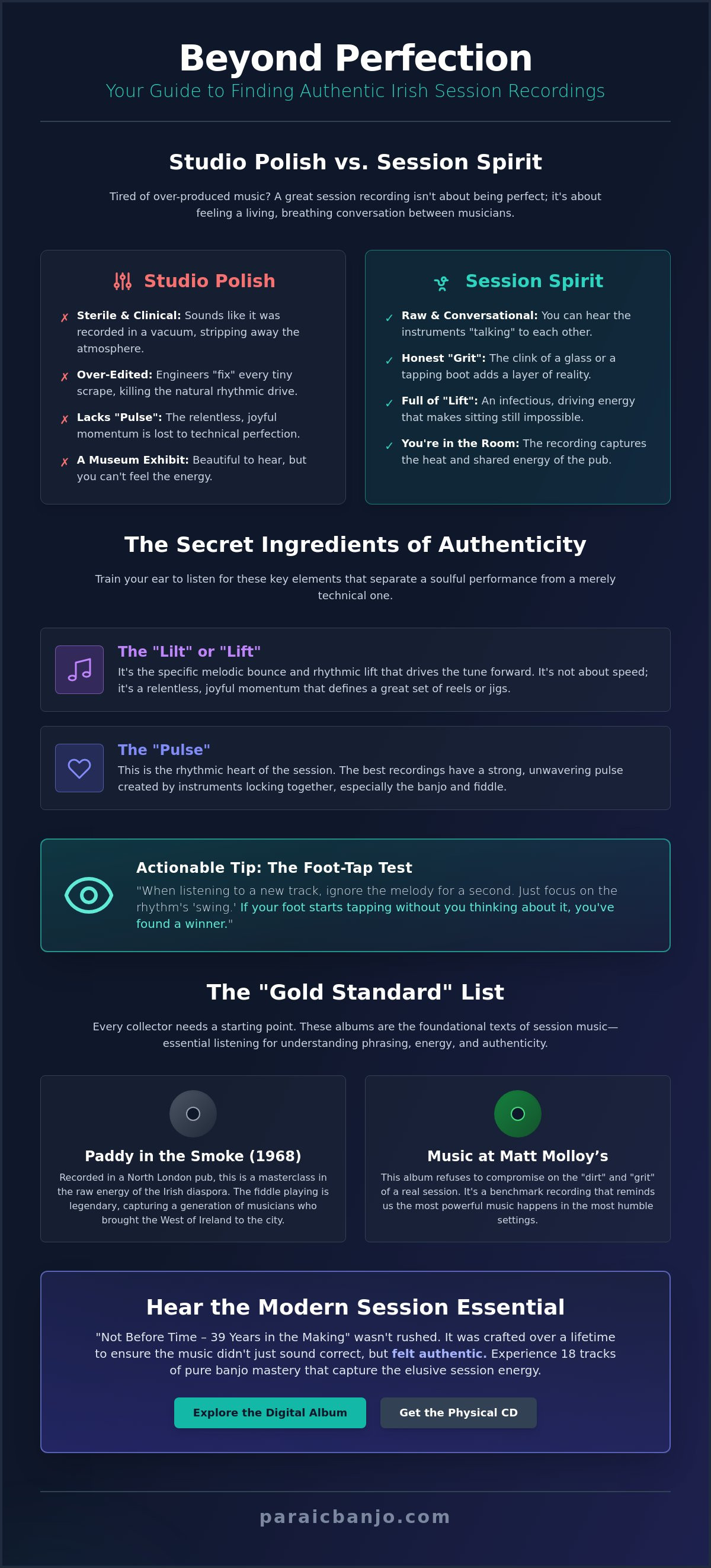
A session isn't just a group of musicians playing tunes in a circle. It's a living, breathing conversation. When you're searching for the best irish session recordings, you aren't looking for clinical perfection or a sterile environment. You're looking for that specific spark where the instruments stop being separate entities and start talking to each other. It's a communal experience. The best recordings capture the heat of the room, the shared glances between players, and the collective decision to push a set just a little bit further.
There is a massive difference between "Studio Polish" and "Session Spirit." A studio recording often feels like a museum exhibit; it's beautiful, but you can't touch it. Session spirit is different. It's tactile. It's why I waited nearly four decades to release Not Before Time. I wanted to ensure that the music didn't just sound correct, but felt authentic. Authenticity takes time to settle. It requires a lifetime of listening to the way a tune breathes before you can truly capture it on a physical CD or a digital album.
The most important element to listen for is "The Lift." This is the intangible energy that drives a great set of reels or jigs. It's that moment when the rhythm becomes so infectious that the room seems to vibrate. It isn't about speed. It's about a relentless, joyful momentum that makes sitting still feel impossible.
The Raw vs. The Refined
In a true session recording, background noise is your friend. The clink of a glass or the rhythmic thud of a musician's boot on a wooden floor adds a layer of reality that a soundproof booth can't replicate. Over-editing is the enemy of the "pulse." When engineers try to "fix" every minor slip or scrape, they often kill the rhythmic drive that makes the music move. If you want to hear this raw energy in action, you can explore my individual digital tracks which prioritize the "live" feel over artificial perfection.
Actionable Tip: When you're evaluating a new track, try to ignore the melody for a moment. Focus entirely on the "swing" of the rhythm. If your foot starts tapping without you thinking about it, you've found a winner.
The Role of Rhythmic Mastery
Authenticity often comes down to how different instruments interact. In the best sessions, the banjo and fiddle lock together to create a "wall of sound" that feels much larger than two people. Soulful playing isn't about cramming in as many notes as possible. It's about the spaces you leave and the way you emphasize certain beats to create a groove. To dig deeper into these stylistic choices, you can read more about the essence of irish music and why certain rhythms resonate so deeply within the tradition. It's about the heart, not just the hands. Ready to hear it for yourself? Grab the "Not Before Time" digital album and feel that rhythmic connection today.
The "Gold Standard" List: Every Collector’s Starting Point
Every musical tradition has its foundational texts. In the world of Irish music, these aren't books, they're recordings. When we talk about the best irish session recordings, we're referring to the albums that every player has listened to until the tape wore out or the digital file started to feel like part of their own DNA. These records are more than just entertainment. They are textbooks that teach us about phrasing, ornamentation, and the shared language of the pub corner. They capture moments where the music was purely about the connection between the players and the tunes.
Albums like Paddy in the Smoke and Music at Matt Molloy’s are essential because they refuse to compromise on the "dirt" and "grit" of a real session. They don't hide behind reverb or fancy production. Instead, they let the natural drive of the instruments take center stage. If you're building a collection, these are the tracks that define the benchmark for everything that followed. They remind us that the most powerful music often happens in the most humble settings. If you want to hear how I've taken these lessons into the modern era, you can find that same dedication to raw sound on the Not Before Time physical CD.
Why "Paddy in the Smoke" Still Matters
Recorded in a North London pub in 1968, this album is a masterclass in the energy of the Irish diaspora. It captures a generation of musicians who brought the West of Ireland to the city. The fiddle playing here is legendary for its speed and surgical precision. It’s a snapshot of a time when the music was a vital link to home. Listen closely to the way the players anticipate each other’s moves; it's telepathic.
Actionable Tip: Use this album as a "pulse" builder. Try to tap along to the beat for an entire set without losing the rhythm. It’s harder than it sounds because the tempo is so alive and fluid.
Capturing the Pub Atmosphere: Matt Molloy’s
Westport is home to one of the most famous sessions in the world, and the Music at Matt Molloy’s collection perfectly captures that Westport magic. Even with high-quality recording equipment, the producers managed to keep the "live" feel intact. The interplay between the flute and the banjo is particularly striking here. It shows how two very different instruments can merge into a single, driving force. To understand more about how these environments are captured, check out our guide on live vs recorded irish session music. It’s all about finding the balance between clarity and that unmistakable pub soul. Don't be afraid of a little background noise; it's the heartbeat of the tradition.
How to Evaluate Authentic Session Energy
Searching for the best irish session recordings requires a different set of ears than listening to pop or classical music. You aren't just listening for a melody. You're listening for a specific kind of heat. Many people think a recording has to be made in a noisy pub to be "real," but that isn't always the case. Authenticity is found in the performance, not just the location. It's about whether the musicians are playing for the tune or for themselves.
One way to capture this is through a "Live-in-Studio" approach. When I recorded the 18 tracks for my debut, I wanted to avoid the sterile, layer-by-layer process that kills the "pulse." Instead, we focused on raw energy and first takes. This method preserves the spontaneous decisions that happen when musicians are locked in a groove. With 13.2 billion audio streams in Ireland in 2025, there is plenty of music out there, but very little of it carries the weight of a real session. You have to look for that "first take" magic where the music feels like it's happening right now.
Another marker of quality is the "Lilt." This is the melodic bounce that distinguishes Irish music from other folk traditions. It’s a rhythmic lift that makes a reel feel like it’s floating rather than just marching along. If a recording sounds too heavy or "square," it’s likely missing this essential ingredient. Check the liner notes too. A purist’s recording will often include the history of the tunes and the names of the "sets" as they were played. This context shows a deep respect for the lineage of the music.
Actionable Tip: Look for albums that list tracks as "sets" (e.g., The Mason's Apron / The Star of Munster) rather than individual tunes. This shows the recording follows the natural flow of a session where one tune bleeds into the next to build momentum.
The Rhythmic Conversation
A great recording should make you feel like you're sitting right in the middle of the circle. The goal of a session is "unison" sound, where every instrument is playing exactly together to create a single, powerful voice. Watch out for "The Fog." This happens in over-produced albums where the instruments blend so much that you can't hear the individual character of the banjo or the fiddle. You want clarity within the collective drive.
Evaluating the "Pulse"
The banjo often acts as the heartbeat in modern sessions, providing the percussive drive that keeps everyone on track. If you want to test a recording, try tapping your foot. It’s a simple test. If you find yourself losing the beat or if the rhythm feels "stiff," the pulse is missing. You can discover a masterclass in this kind of rhythmic drive with the Not Before Time digital album. It’s all about keeping that heartbeat steady from the first note to the last.
The Regional Secret: East Galway and Clare Style
If you travel just a few miles down the road in the West of Ireland, the music changes. It's subtle, but for a purist, it's everything. When you listen to the best irish session recordings, you're often hearing the sonic signature of a specific county. Clare music is famous for its steady, relaxed drive; it's a rhythmic engine that never feels rushed. Galway music, specifically from the East, is a different beast entirely. It's more soulful. It's more about the phrasing and the "nyah," that elusive quality of feeling and soul that makes a tune stick in your ribs.
My own playing is a definitive statement of this East Galway tradition. It’s a milestone I’ve reached after 39 years of honing this specific regional voice. It isn't something you learn overnight; it's a style that takes decades to settle into the bones. I was heavily influenced by legends like Paddy Fahy and Mike Cooney, players who understood that the notes on the page are just the beginning. They taught me that the "lift" we discussed earlier isn't just about volume. It's about the swing.
The East Galway Banjo Style
On the banjo, it's easy to fall into a "machine gun" sound where every note is hit with the same intensity. That's not the Galway way. We look for the melody within the rhythm. We use "nyah" to give the tune a bit of a cry. If you want to hear this phrasing in action, I recommend listening to track 5 of "Not Before Time." It captures that specific Galway swing where the rhythm feels like it's leaning back just enough to let the melody breathe. It's about making the instrument talk rather than just rattle off notes.
Preserving the West of Ireland Sound
One of the most fascinating parts of the tradition is how a version of a reel can change as it crosses a border. A Galway version of a tune might have different ornamentations or a slightly shifted emphasis compared to a Clare version. Preserving these boundaries is vital for the health of the tradition. If you're looking to build a collection that honors these differences, you should learn how to buy traditional irish music with a focus on regionality.
Supporting the artists who keep these styles alive is the only way to ensure the music doesn't become a homogenized, generic sound. You can make a real difference by choosing to buy traditional irish music direct from artist. It ensures your support goes straight back into the community that nurtures these sounds. Ready to add some authentic Galway soul to your library? Pick up the "Not Before Time" physical CD and hear the difference for yourself. Cheers for keeping the tradition alive.
Why 'Not Before Time' is the Modern Session Essential
It took 39 years to get this right. This project wasn't something I wanted to rush; the music deserves more than a hasty studio session. When you're searching for the best irish session recordings, you're looking for something that feels permanent. You're looking for a definitive statement. This album is exactly that. It's the result of a lifetime spent listening, playing, and breathing the tradition. It’s a milestone that carries the weight of decades, yet it feels as fresh as a tune played at a crossroads on a summer evening. I’m incredibly proud to finally share these 18 tracks of pure, unadulterated Irish tenor banjo mastery with you.
The music here isn't just a collection of notes. It's a story. That’s why the liner notes are a "must-read" for any serious collector. They provide the history of the tunes and the context of the sets, serving as an educational resource for anyone who wants to go deeper into the tradition. Whether you choose the digital album or the physical CD, you're getting more than just audio; you're getting a roadmap of a musical journey. I wanted to ensure that every listener feels like a collaborator in this tradition. It’s about passing the torch.
Actionable Tip: If you're just starting your collection, begin with the individual digital tracks to find your favorite sets. Once you’ve caught the bug, get the full physical CD for the complete experience, including the detailed notes and high-resolution sound.
A Collaboration of Masters
A session is never a solo effort. To capture the true "pulse," I brought in expert musicians who understand the rhythmic conversation of the West of Ireland. We focused on a recording process that kept the energy "live." We avoided the over-processed "fog" that ruins so many modern folk albums. The result is a high-quality audio experience that still feels like you're sitting in the middle of a heated set. You can feel the vibration of the strings and the drive of the rhythm. If you’re ready to hear what four decades of passion sounds like, get your copy of Not Before Time today.
The Ultimate Gift for Music Lovers
In an age of streaming, physical media is making a serious comeback. CD sales actually saw an increase of 4.5% in 2025, proving that listeners still value holding a piece of music in their hands. A physical CD with detailed notes remains the gold standard for purists. We offer worldwide shipping to bring the authentic sound of East Galway right to your doorstep, no matter where you are. It’s the perfect addition to any traditional music library.
Actionable Tip: Pair the physical CD with a good pair of headphones. The intricate banjo picking and the subtle interplay between the instruments are much easier to appreciate when you can hear every percussive strike of the plectrum. Dive in and enjoy the tunes. It’s been a long time coming!
Start Your Authentic Musical Journey Today
Finding the right sound is about more than just picking a track. It's about connecting with a tradition that has survived for generations. You now know how to identify the "lilt" that makes Irish music move and why regional phrasing like the East Galway "nyah" is so vital for a purist's collection. By prioritizing the rhythmic conversation over sterile studio editing, you can ensure your library reflects the true heart of the pub corner. It is this dedication to the "pulse" that separates the best irish session recordings from the rest.
I've poured 39 years of passion into a project that captures exactly that energy. With 18 tracks of expert-level banjo mastery and extensive historical liner notes, my debut album is a definitive statement of the tradition. Whether you prefer a digital album or a physical CD with global shipping, the music is ready for you. Bring the authentic sound of an Irish session home; order "Not Before Time" now!
It’s been a long journey to get these tunes recorded just right. I can't wait for you to hear them. Keep the tunes going and the spirit alive!
Frequently Asked Questions
What is the difference between a studio album and a session recording?
A studio album is built track by track in a controlled booth; a session recording captures musicians playing together in real time. This "live" interaction creates a specific energy where players respond to each other's variations. To hear this difference, look for the best irish session recordings that prioritize the group's "lift" over individual technical perfection. It’s the difference between a polished museum piece and a living, breathing conversation.
Why do some Irish music recordings have background noise like talking or glass clinking?
Ambient sounds like clinking glasses or quiet chatter act as a sonic frame for the music. In the tradition, music doesn't exist in a vacuum; it’s a social activity. These sounds prove the recording wasn't sanitized in a sterile lab. They help you feel the "pulse" of the room. If you prefer a cleaner sound that still keeps the energy, our individual digital tracks offer high-fidelity audio without losing that essential session grit.
Who are the most famous Irish banjo players for session-style music?
Barney McKenna of The Dubliners is the godfather of the four-string banjo, but for pure session-style drive, look to Kieran Hanrahan or Mike Cooney. These players prioritize the "swing" of the tune over flashy speed. Their work focuses on the percussive nature of the instrument, acting as the heartbeat of the set. My own work on "Not Before Time" builds on this foundation of rhythmic mastery and regional phrasing.
Is it better to buy digital downloads or physical CDs for traditional Irish music?
Digital downloads are perfect for building a mobile library, but physical CDs are the gold standard for collectors. A CD provides high-fidelity audio that streaming often compresses, losing the subtle details of the banjo picking. Plus, physical copies include extensive liner notes that explain the history of the tunes. You can find both the "Not Before Time" digital album and physical CD on our store to suit your listening style.
How can I tell if an Irish music recording is authentic or just "tourist music"?
Authentic recordings usually list tunes in "sets" and avoid over-produced synthesizers or orchestral backing. If you hear a heavy, artificial beat or "cinematic" strings, it’s likely aimed at a general tourist market. Real session music relies on the natural acoustic power of the fiddle, flute, and banjo. Check the label; specialist traditional labels or direct-from-artist releases are usually a safe bet for the best irish session recordings.
What are the best reels and jigs to listen to for beginners?
Start with foundational tunes like "The Wind That Shakes the Barley" or "The Kesh Jig." These melodies are common in almost every session across the globe. Listening to these "standard" tunes helps you recognize how different players add their own regional flavor. Once you’re familiar with the basic structure, you can better appreciate the complex variations found in more advanced tracks like those on the "Not Before Time" physical CD.
Where can I find rare or out-of-print Irish session recordings?
Specialist shops or online archives are the best places to hunt for out-of-print gems. Many legendary 1970s recordings were only released on vinyl or cassette and haven't made it to streaming services yet. Don’t be afraid to dig through second-hand bins or specialist forums. Finding a rare track from a local master is like discovering a piece of hidden history that adds depth to your collection.
Why is the East Galway style of music so highly regarded by purists?
The East Galway style is prized for its "nyah," a soulful, crying quality in the melody that feels deeply personal. Unlike the faster, punchier styles of other regions, Galway music often has a more relaxed, "leaning" rhythm. It’s about the spaces between the notes and the subtle phrasing of the melody. This approach requires a lifetime to master; purists consider it one of the most sophisticated forms of the tradition.


Comments