The Definitive Guide to the Most Acclaimed Irish Banjo Albums
- Paraic Mac Donnchadha

- May 15
- 13 min read
What if the secret to mastering that rock solid session sound isn't found in a generic "Celtic" streaming playlist, but in the crackling liner notes of an acclaimed irish banjo album? Most digital collections are just background noise that misses the heartbeat of the true Irish tenor banjo tradition. You've likely felt that frustration. You're searching for the lift of an East Galway reel or the hypnotic drive of a Clare jig, but you keep finding over-produced tracks that lack the grit of a real session.
I'm here to help you cut through the noise and build a library that actually means something. You're about to discover the essential recordings that define our craft, from the historical masters to modern milestones like the June 2025 release of "The Dark Well" or Damien O'Kane's "BANJOVIAL" from October 2025. Every record on this list is a living archive, not just a collection of tracks. We'll break down the regional styles that separate the masters and give you the historical context needed to truly understand the music. From the 1,018 musicians who set a world record at the 2025 Wexford Fleadh to the quiet brilliance of a solo debut 39 years in the making, this guide covers the flakin' reels and vibrant session music you've been waiting for. Go on... let's get stuck in!
Key Takeaways
Learn how to identify the rhythmic "pulse" and melodic density that separates a true masterpiece from generic background music.
Build a curated library of the most acclaimed irish banjo album releases by studying the impact of historical masters and modern innovators.
Discover how regional influences like the East Galway swing and Clare drive shape the soul and tempo of every track you hear.
Gain the skills to evaluate a recording's "lift" and use detailed liner notes to connect with the storied tradition behind the tunes.
Understand why a debut 39 years in the making is considered a definitive statement of the East Galway banjo tradition.
Table of Contents
Defining the Acclaimed Irish Banjo Album
An acclaimed irish banjo album is far more than a simple collection of tunes captured in a studio. It represents a distinct sub-genre within the rich tapestry of Irish traditional music, acting as a living archive of a player's journey. For years, the tenor banjo was often seen as a loud interloper, but the most celebrated recordings have transformed it into the very engine room of the tradition. We've seen a massive shift in what listeners prize. It used to be about melodic density, essentially cramming as many notes as possible into a bar. Today, the focus has moved toward the rhythmic "pulse." The best albums don't just show off speed; they showcase a steady, hypnotic drive that grounds the music.
In the "Trad" community, critical reception isn't measured by radio charts or flashy sales figures. Instead, we look at session popularity and the respect of fellow musicians. You'll often see platforms like thesession.org buzzing with talk about a "current fav" for rhythm, which is exactly how word spreads about a masterpiece. There's a vital difference between a technical showcase and a soulful heritage recording. A technical album might leave you impressed by the fingerwork, but a heritage recording stays in your ears for a lifetime. It carries the weight of history and the "soul" of the region it comes from, making you feel like you're sitting in a warm kitchen in East Galway rather than just listening to a digital file.
The Role of the Tenor Banjo in Irish Tradition
The adoption of the GDAE tuning was the real turning point for the instrument. By tuning the banjo an octave below the fiddle, it gained a resonant, punchy depth that allowed it to become the heartbeat of the modern session. It's rock solid. Collectors and players alike go hunting for those "flakin' reels" that maintain a vibrant, unrelenting energy without losing the melody. The banjo provides a percussive clarity that other instruments just can't match, cutting through the noise of a crowded pub to keep everyone in time.
Key Criteria for a Masterpiece Recording
What makes a recording truly great? It starts with rhythmic integrity, or what we call "the lift." If the music doesn't feel buoyant and make you want to move, it's missing the mark. Mastery isn't about being flashy; it's about subtle variation and ornamentation. It's that tiny flick of the pick or a clever triplet that catches the ear on the third time through a tune. Finally, collaboration is essential. A great banjo album isn't a solo mission. It's about how the banjo interacts with a driving piano, a sympathetic bouzouki, or a soaring fiddle. That conversation between musicians is where the magic happens. Go on... listen for that spark!
The Essential Discography: Masterpieces of the Tenor Banjo
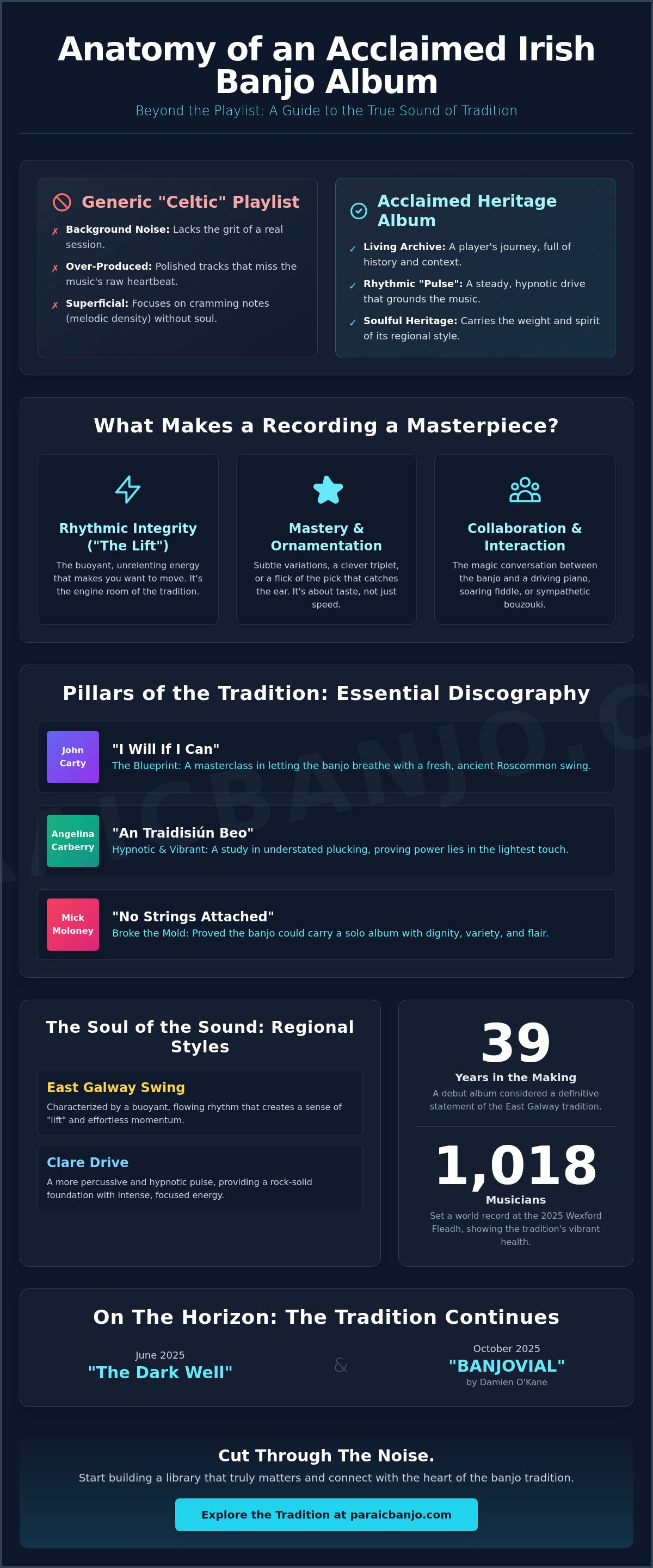
When you look back at the history of the tenor banjo, a few names stand out like lighthouses. They didn't just play tunes; they created a blueprint for every acclaimed irish banjo album that followed. Take John Carty’s "I Will If I Can." It wasn't just a record; it was a masterclass in how to let the banjo breathe. Carty brought a specific Roscommon swing that felt both ancient and fresh. Then you have Angelina Carberry’s "An Traidisiún Beo." Her style is a study in understated plucking. She doesn't need to shout to be heard. It's hypnotic. It’s vibrant. It reminds us that sometimes the most powerful statement is the one made with the lightest touch.
Before these masters, Mick Moloney’s "No Strings Attached" really broke the mold. He proved the banjo could carry a solo album with dignity and variety. It paved the way for the professionalization of the sound we later heard from Kieran Hanrahan. Hanrahan brought a crisp, rock solid clarity to the instrument that helped it find a home on national airwaves. These aren't just tracks on a CD. They are the roots of our craft. For a deeper look at how these historical threads continue to weave through the music today, you might enjoy this Roots of the Banjo Tree review, which highlights how the instrument’s lineage is constantly being reimagined by modern hands.
The Pioneers of the Solo Banjo Album
Moving the banjo from the back of the session to the front of the stage was no small feat. The early pioneers had to capture that raw, "flakin' reels" energy within the sterile walls of a studio. It’s about more than just speed. It’s about track selection. A great album mixes those rare, dusty tunes found in old manuscripts with the session staples everyone knows and loves. This balance creates a record that feels like a real conversation. If you’re looking for that authentic session feel in your own collection, you might find inspiration in the Not Before Time digital album, which captures that same spirit.
Modern Classics and Emerging Masters
The tradition didn't stop in the 90s. We’re seeing a massive wave of new energy. Players like Theresa O’Grady and Enda Scahill are pushing boundaries while keeping one foot firmly in the soil. Scahill’s work on "The Dark Well," released in June 2025, shows how the banjo can collaborate with international sounds without losing its Irish heart. Similarly, the October 2025 release of "BANJOVIAL" by Damien O'Kane and Ron Block proves that the acclaimed irish banjo album is still a vibrant, evolving form. Modern recording technology helps preserve that "acoustic planet" feel, making every pluck of the string sound as if the player is right there in the room with you. These recordings are essential because they show the music is alive, breathing, and often represents a lifetime of work, sometimes 39 years in the making. Go on... dive into these gems!
Regional Mastery: The East Galway and Clare Influence
To truly understand what makes an acclaimed irish banjo album resonate, you have to look past the technical fingerwork and into the very soil of the music. In the world of Irish traditional music, geography is destiny. The "soul" of a recording is often dictated by whether the player leans toward the rolling, melodic complexity of East Galway or the driving, percussive energy of County Clare. These aren't just subtle differences. They represent entirely different ways of feeling the rhythm. While some generic playlists mash everything together, a master level recording respects these boundaries, offering a specific flavor that purists and newcomers alike can feel in their bones.
Páraic Mac Donnchadha’s work serves as a vital bridge between these storied traditions. His debut, a project 39 years in the making, doesn't just pick a side. Instead, it captures the relaxed swing of his East Galway roots while maintaining the rock solid drive necessary for a night of "flakin' reels." It’s this deep understanding of regional nuance that elevates a collection of tunes into a definitive cultural statement. When you hear that vibrant, hypnotic lift in the music, you're hearing decades of session experience distilled into a single, polished performance. Go on... listen closely and you'll hear the history of the West of Ireland in every pluck.
The Pulse of East Galway
The East Galway style is often characterized by a more relaxed tempo that allows for incredible melodic complexity. It’s not about playing fast; it’s about playing with a deep, infectious swing. This tradition owes a great deal to the Ballinakill Ceili Band era, which favored a smooth, flowing sound. On an acclaimed irish banjo album featuring this style, the music feels hypnotic and vibrant. It invites the listener in rather than overwhelming them with sheer speed. It’s a thoughtful, storied way of playing that prizes the "lonesome" quality of a good tune.
Clare: The Rhythmic Powerhouse
In contrast, the Clare style is the ultimate rhythmic powerhouse. It is music built for the dance floor. Here, the focus shifts toward a driving, high-energy pulse that is absolutely rock solid. The banjo becomes a percussive force, pushing the dancers along with every bar. You can feel the connection to the local dance tradition in every set of reels. It’s about that raw, unyielding energy that defines the best sessions. This style proves that the banjo doesn't just play the melody. It provides the very heartbeat of the tradition. Whether it's a solo track or a full band, the Clare influence ensures the music never loses its essential "lift."
How to Evaluate a Traditional Irish Recording
Evaluating a recording is an art in itself. You aren't just looking for clean notes or perfect pitch. You're looking for that elusive "lift." An acclaimed irish banjo album should feel like it's pulling you toward the dance floor. If the rhythm feels heavy or the tempo is dragging, the soul of the music is lost. Listen for the percussive snap of the pick against the strings. It should be vibrant, energetic, and full of life. When the music has that buoyant quality, you know you're listening to a master who understands the heartbeat of the tradition.
Check the instrumentation carefully. In a master-level recording, the accompaniment acts as a rock solid anchor. Whether it's a driving piano or a rhythmic bouzouki, the backing should support the banjo, not distract from it. You want to hear the interaction between the players. It’s that split-second response between a banjo and a fiddle that creates the magic. If it sounds like every instrument was recorded in a vacuum without any natural "give and take," it’ll lack the warmth that defines our community. The best albums feel like a shared celebration rather than a solitary exercise.
The Importance of the "Session Feel"
Most modern "Celtic" music is far too sanitized. It’s often MIDI-perfect and completely lifeless, stripped of the very grit that makes the music real. The best albums preserve the "session feel" where the pulse of the music naturally ebbs and flows. You want to hear the "live" energy that comes from musicians actually playing in the same room. This conversation between players is what makes the tunes stay with you long after the track ends. We don't want over-produced tracks that sound like background noise for a spa. We want flakin' reels that sound like they're happening right in your kitchen.
Why Liner Notes are Essential to the Experience
Never overlook the booklet. A truly acclaimed irish banjo album often includes a detailed masterclass in the form of liner notes. For instance, a 36-page booklet can provide the history of every tune, the lineage of the players who passed them down, and the personal stories behind the sets. This context transforms a simple disc into a heritage gift. It connects you to the community and the 39 years of passion that went into the recording. Understanding where a tune came from makes the listening experience deeply personal and far more rewarding.
To see how a detailed booklet and authentic session feel come together in one package, order the Not Before Time physical CD and experience the tradition as it was meant to be heard. Go on... go for it!
Not Before Time: A New Milestone in the Banjo Tradition
While many lists of the best recordings are a decade old and full of out-of-print gems, the tradition continues to evolve with instant classics that bridge the gap between history and the present. "Not Before Time" is exactly that. It is a definitive statement of East Galway soul and has quickly earned its place as an acclaimed irish banjo album for a new generation. This project wasn't rushed. It was 39 years in the making. Every note carries the weight of decades spent in the corners of crowded pubs and the quiet of home practice. It’s a lifetime of passion distilled into 18 tracks of pure, unadulterated tradition.
The recording process itself was a celebration of community. Rather than a sterile, track-by-track studio build, these tunes were recorded live with 10 master collaborators. This approach preserved that elusive "session feel" we discussed earlier. You can hear the conversation between the banjo and the other instruments. The rhythm is rock solid. It provides the perfect "lift" that session players look for when they want to get their own fingers moving. It’s vibrant. It’s hypnotic. It’s the sound of a master finally stepping into the spotlight with the quiet confidence of someone who knows the tunes inside and out.
A Lifetime of Music Captured
For the purist, this album is a must-have. It captures a specific "soulful" quality in the playing that is often lost in modern, faster recordings. Páraic’s style favors the relaxed swing and melodic complexity of his roots, making every set of flakin' reels feel like a story being told rather than a race to the finish. This isn't just another CD for the shelf. It’s a piece of heritage. Collectors of acclaimed irish banjo album history will recognize the deep respect for the lineage of the tunes, many of which have been carried through the Mac Donnchadha family for generations.
Physical CD vs. Digital: The Collector’s Choice
While digital convenience is great for listening on the go, the physical CD is the true collector’s choice. It comes with an extensive 36-page booklet that serves as a masterclass in musical history. You get the stories behind the tunes, the names of the mentors who passed them down, and the context that makes the music breathe. There is something deeply satisfying about the tactile experience of traditional music. Holding the liner notes while you listen to the hypnotic drive of the banjo creates a connection that a digital file just can't match. It’s a heritage gift for yourself or the music lover in your life.
The journey from the first session to this definitive debut has been long, but the result is a milestone that will be talked about for years to come. Experience the rhythmic soul of "Not Before Time" today and hear what happens when 39 years of dedication meets the recording studio. Go on... go for it!
Bring the Soul of the Session Home
The journey through the history of the tenor banjo reveals a simple truth: the best music is a living archive of a player's life. You've learned how to distinguish the hypnotic swing of East Galway from the driving pulse of Clare. You now know that an acclaimed irish banjo album isn't just about technical speed, but about the rock solid rhythm and "lift" that makes a reel truly sing. Building a collection with these masterworks ensures you're not just listening to tunes; you're connecting with a storied musical tradition that has been centuries in the making.
If you're ready to add a new milestone to your library, there's no better place to start than a project that's been 39 years in the making. Recently featured as a favorite on TheSession.org, "Not Before Time" offers 18 tracks of pure rhythmic mastery recorded live to capture that vibrant session energy. The physical edition includes a detailed 36-page historical booklet, turning every track into a lesson in heritage. Order the Limited Edition "Not Before Time" CD & Booklet today and experience the vibrant, hypnotic soul of the tradition for yourself. Go on... go for it!
Frequently Asked Questions
What makes an Irish banjo album "acclaimed"?
An acclaimed irish banjo album is defined by its rhythmic integrity, or what we call the "lift." It isn't just about playing fast notes; it’s about capturing a rock solid pulse that resonates with the session community. These recordings are often celebrated for their regional soul and the way they honor the masters who came before. When the music feels buoyant and vibrant, you know you've found a masterpiece.
Who is the best Irish banjo player to listen to for beginners?
John Carty and Angelina Carberry are the gold standards for any beginner. Their playing is incredibly clear and maintains a steady, manageable tempo that helps you hear the underlying melody. They don't hide behind excessive speed or flashiness. Instead, they focus on the "lift" and the soul of the tune. Listening to their work is like attending a masterclass in how to play with true traditional heart.
What is the difference between tenor banjo and 5-string banjo in Irish music?
The tenor banjo is the standard for Irish music, usually featuring four strings tuned GDAE. This tuning is an octave below the fiddle, which gives it that punchy, percussive drive needed for reels and jigs. The 5-string banjo is more common in American bluegrass. It uses a different tuning and a finger-picking style that doesn't quite capture the rhythmic "pulse" essential to our traditional sessions.
Why is East Galway style music so popular among banjo players?
The East Galway style is beloved because it favors a relaxed swing and melodic complexity over frantic speed. This "lonesome" and hypnotic quality allows the banjo to act as the heartbeat of the music. It’s a thoughtful way of playing that prizes the story behind the tune. Many players find this style more rewarding to listen to because it feels deeply personal and rooted in a long history of session music.
Where can I buy authentic traditional Irish music directly from the artist?
Buying directly from the artist's website is the best way to support the music and get the most authentic experience. You can find "Not Before Time" right here in our shop as a physical CD, digital album, or individual tracks. Purchasing direct ensures you get the full story behind the 39 years of work that went into this debut. It's the best way to keep the session culture thriving.
Are physical CDs still the best way to listen to traditional Irish music?
Physical CDs remain a favorite for purists because they offer the highest audio quality and a tactile connection to the tradition. Our "Not Before Time" CD includes a detailed 36-page booklet that you just can't get with a stream. It transforms the music into a heritage gift that you can hold in your hands. There is something special about reading the tune histories while the rock solid rhythm fills the room.
What are "liner notes" and why do they matter for Irish music?
Liner notes are the written stories and technical details that accompany a recording. For an acclaimed irish banjo album, these notes are essential because they document the lineage of the tunes and the musicians who passed them down. They offer a window into the community and the history of the craft. Without them, you're just listening to notes; with them, you're experiencing a storied piece of Irish history.
Can I download "Not Before Time" as high-quality digital tracks?
Yes, you can download the full album or individual tracks as high-quality digital files. This is a great option for those who want to take these flakin' reels on the go. While you miss out on the physical 36-page booklet, the digital tracks still carry the same vibrant energy and rock solid rhythm. It’s a definitive statement of a lifetime's passion, now accessible on any device. Go on... go for it!


Comments