The East Galway Banjo Tradition: Uncovering the Soulful Pulse of Irish Music
- Paraic Mac Donnchadha

- Aug 1
- 13 min read
Speed isn't the heartbeat of Irish music, even if the session down the road sounds like a high-speed chase. If you've ever felt like your playing is a bit too robotic or you're just racing to the finish line, you aren't alone. It's a common hurdle for many of us. The true magic lies in the space between the notes, a concept that sits at the very core of the east galway banjo tradition. This regional style isn't about how many notes you can cram into a bar; it's about the "lonesome" pulse and the lyrical expression that makes the banjo sing like a fiddle.
You're about to discover the rhythmic secrets and regional nuances that make this style a cornerstone of traditional Irish music. We'll look at how to identify that specific "lonesome" sound in classic recordings and understand the unique rhythmic "pulse" that defines Galway. I'll also help you find authentic albums for your collection, such as my own project, Not Before Time, a labor of love 39 years in the making. Whether you're planning to attend the Joe Mooney Summer School starting July 18th, 2026, or you're just sitting down with your instrument at home, it's time to find the soulful heart of your playing.
Table of Contents
What is the East Galway Banjo Tradition?
The east galway banjo tradition is more than just a way of playing tunes; it's a melodic philosophy that values the space between notes. While other regions might lean into a fast, driving pace, East Galway musicians have always favored a relaxed tempo and a certain sweetness of tone. This "lonesome" sound isn't about sadness. Instead, it's a deep, soulful expression that mirrors the rolling, unhurried landscape of the region itself. It's the kind of music that invites you to sit back and really listen, rather than just tapping your feet in a blur of speed.
The Roots of the Sound
The bedrock of this style can be traced back to the legendary Ballinakill Céilí Band. In the early 20th century, they helped standardize a regional rhythm that was lyrical and steady. This wasn't the aggressive, percussive sound found in other parts of Ireland. It was a "lilt" that allowed the melody to breathe. When you listen to the masters of this era, you hear a pulse that feels as natural as breathing. It's a rhythmic foundation that I've spent my life studying and cherishing.
Actionable Tip: To truly grasp the original pulse of the region, spend some time listening to early 78rpm recordings from the 1920s and 30s. These are old, physical discs that captured the music before modern production changed the sound. Don't just listen to the banjo players. Listen to the fiddlers and flute players from Ballinakill to hear how they phrase their melodies without rushing the beat.
The Banjo’s Role in the Tradition
In its early days, the banjo was often used as a rhythmic backup instrument, much like its role in early jazz. However, as it moved into the heart of the east galway banjo tradition, it underwent a massive transformation. Players moved away from chordal strumming and toward melodic picking. This shift was made possible by the adoption of GDAE tuning. By tuning the strings to the same notes as a fiddle or mandolin, banjo players could finally mimic the intricate, lyrical phrasing of the flute and fiddle.
Modern groups like We Banjo 3 continue to showcase this incredible versatility, proving that the instrument can carry a lead melody with as much soul as any fiddle. This evolution turned the banjo into a leading voice capable of capturing the "lonesome pulse" that defines the region. It's a journey I've lived through myself while spending 39 years immersing myself in these tunes for my album, Not Before Time. We're talking about a tradition that honors the past while staying vibrantly alive for the next generation of players.
The 'Lonesome Pulse': Core Characteristics of the Style
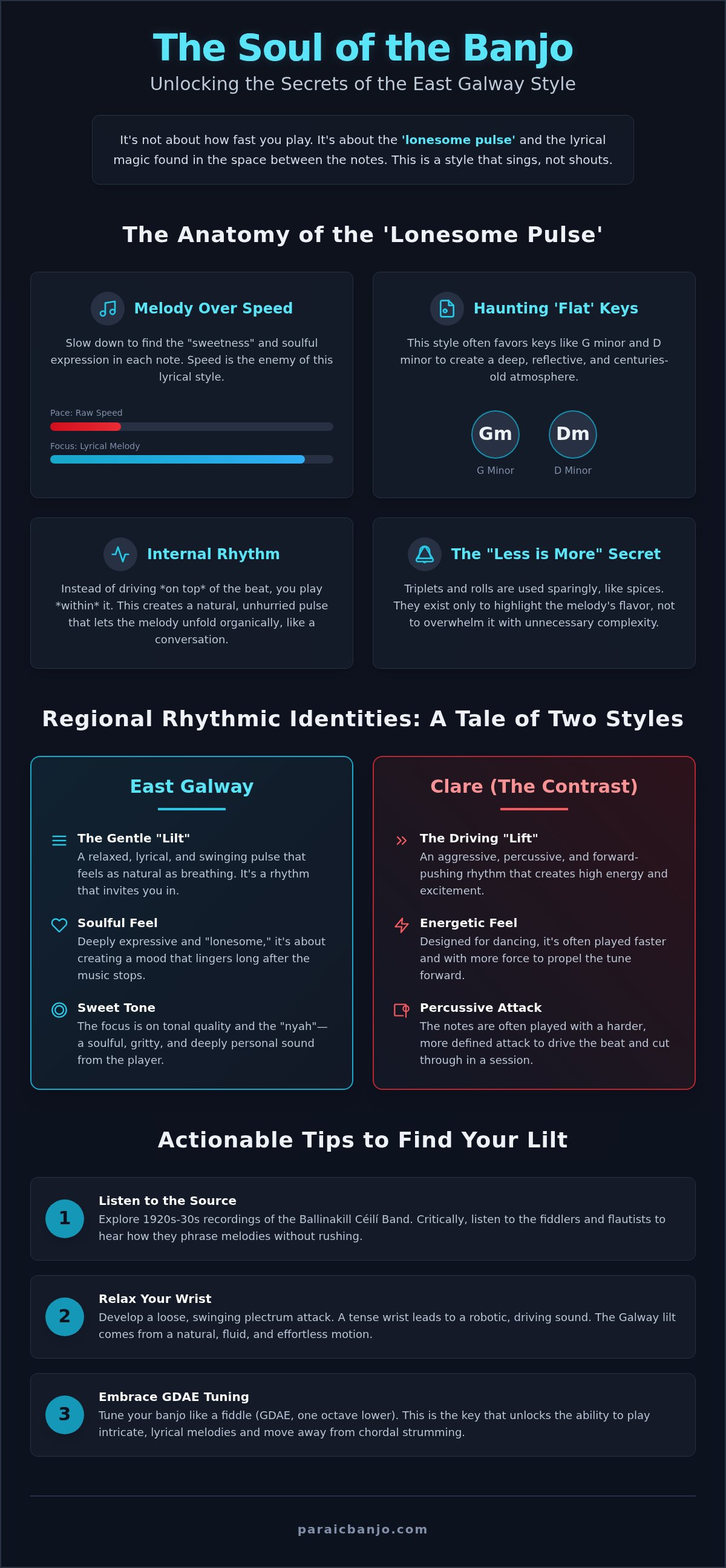
The heart of the east galway banjo tradition isn't found in a metronome. It's found in the "lonesome pulse," a term that perfectly captures the haunting, evocative atmosphere of the region's music. Unlike the bright, bouncy major keys heard in many Irish jigs, Galway music often leans into "flat" keys like G minor or D minor. These tonal choices create a sense of deep reflection. When you play in these keys, the banjo stops being just a percussive tool. It starts to carry a weight that feels centuries old. It's about creating a mood that lingers in the room long after the tune ends.
The rhythm here is "internal." Instead of playing on top of the beat with a driving force, you're playing within it. It's a subtle distinction that makes a world of difference. You aren't pushing the music forward; you're letting it unfold. This approach requires a masterful control of timing. For a deeper stylistic analysis of Páraic Mac Donnchadha and how this rhythmic control manifests in modern playing, the recent coverage in the Irish Echo offers a fantastic perspective.
Ornamentation in this style is like spice in a good stew. Too much ruins the dish. We use triplets and rolls to highlight the melody, not to hide it. Every variation should serve a purpose. If you're repeating a part of a reel, change a few notes to tell a different part of the story. It keeps the listener engaged and shows that you're truly feeling the music rather than just reciting it from memory. If you want to hear how these variations build over a full set, you can browse my digital tracks to find examples of this narrative style in action.
Melody Over Speed
Speed is often the enemy of expression. When you slow down, you find the "sweetness" in the notes. This is where you discover "nyah." It's a Gaelic term for that soulful, gritty, and deeply personal quality in a player's tone. It's hard to define, but you know it when you hear it. It's the sound of a lifetime's passion coming through the strings. If you want to capture this, here's an Actionable Tip: take a reel you know well and practice it at exactly 70% of your usual speed. Focus on the gaps between the notes. Listen to the ring of the banjo. You'll start to hear the "lonesome" character emerging from the silence.
The Modal Influence
The east galway banjo tradition is famous for its haunting modal shifts. Composers like the legendary Paddy Fahey were masters of this. They could take a tune that felt "happy" and suddenly shift it into something far more evocative. These shifts aren't just technical tricks; they're emotional pivots. They change the entire vibe of a session. To understand how these nuances compare to other parts of Ireland, check out our guide on what makes the East Galway style unique compared to the Clare tradition. It's these subtle changes in mood that give the music its enduring power.
East Galway vs. Clare: Understanding Regional Rhythmic Differences
If you've ever crossed the border from Galway into Clare, you'll notice the air feels different. The music follows suit. While the east galway banjo tradition is rooted in a "lonesome" sweetness, Clare music is often celebrated for its "lift." It's a common point of confusion for players. They hear the tunes and feel the energy, but they can't quite put their finger on why a reel sounds so different when played thirty miles down the road. It isn't just about the notes on the page. It's about the rhythmic engine driving the whole performance.
In border regions, these two styles don't just sit side by side; they talk to each other. Many musicians, myself included, grew up with one foot in both camps. This interaction creates a unique hybrid that balances the driving energy of the south with the lyrical flow of the north. On my album, Not Before Time, I've spent 39 years distilling these two influences into 18 tracks that capture that specific cross-border energy. It's about knowing when to lean into the drive and when to let the melody roll. Understanding these nuances is the key to moving past a robotic sound and finding your own voice.
The Galway Lilt
The Galway "lilt" is a smoother, more rolling rhythmic feel. It mimics the local dialect, which is unhurried and melodic. When playing in this style, the banjo stops being a drum and starts sounding like it's singing. The focus is on the long, lyrical phrases rather than the individual "stabs" of the pick. You want the listener to feel like they're being carried along a winding river rather than being pushed down a track.
Actionable Tip: Pay close attention to your backbeat. In many Irish styles, the emphasis is heavily on the "two" and "four" of a bar. To capture the Galway lilt, try softening that backbeat. Don't hit it as hard. This creates a more fluid, "round" sound that allows the melody to take center stage without being interrupted by a sharp percussive attack.
The Clare Lift
In contrast, the Clare "lift" is all about the dance floor. It's a percussive, driving rhythm designed to keep sets of dancers moving. Clare players use the banjo to create a "bouncy" energy that feels like it's constantly pushing forward. This style relies on a strong, crisp plectrum attack that emphasizes the rhythm. If you want to see how this driving energy compares to the relaxed Galway flow, you can explore the Clare music tradition in our detailed guide. It's a different kind of soul, one that's vibrant, rhythmic, and deeply rooted in the pulse of the dance.
Actionable Tips for Mastering the Rhythmic Lilt
Mastering the east galway banjo tradition isn't about finger gymnastics or playing at a breakneck pace. It's about the physical connection between your body and the instrument. The most important place to start is your wrist. If your wrist is stiff, your music will sound robotic and forced. You want to develop a loose, flexible wrist that moves like a swinging pendulum. This allows for a natural, swinging plectrum attack that fits the Galway lilt perfectly. When your wrist is relaxed, the notes start to roll together rather than sounding like separate, jagged strikes.
Another secret to this soulful sound is the "Irish Triplet," which we often call a treble. In the East Galway style, less is definitely more. You don't need to fill every single gap with a flurry of notes to impress a crowd. A well-placed treble should highlight the rhythm and add a bit of grit to the tone. It isn't a display of speed; it's a rhythmic punctuation mark. You can also experiment with "ghost notes." These are notes you pick so lightly they're almost silent. They add a layer of rhythmic texture and keep the tune moving without cluttering the melody with too much noise.
Refining Your Ornamentation
You should generally avoid "over-decorating" a tune when you're aiming for that authentic Galway feel. The melody is the star of the show. If you add too many rolls or triplets, that characteristic sweetness gets lost in the shuffle. Focus on using your ornaments to emphasize the internal pulse of the reel or jig. It’s about being selective rather than exhaustive with your variations.
Actionable Tip: Record your practice sessions on your phone and listen back with a critical ear. Listen specifically for "crowding." If you find it hard to hum the basic melody because of all the extra notes you're adding, dial back the ornaments. Aim for clarity first. The soul of the east galway banjo tradition lives in the tune itself, not the decorations you hang on it.
Building an Authentic Musical Library
You can't play what you haven't truly heard. To get this style into your bones, you need to immerse yourself in the right recordings. Serious collectors should look for traditional Irish session music CDs. There is a massive difference between a polished studio album and the raw, breathing energy of a live session. Live recordings capture the spontaneous variations and the "nyah" that we've discussed, providing a much better template for your own playing.
My own debut album, Not Before Time, was created specifically to serve as this kind of archive. It contains 18 tracks of pure session energy, the result of 39 years of immersion in these tunes. I’ve included detailed liner notes to help you understand the history and lineage of each piece, making it a functional resource for any student of the style. If you want to hear these rhythmic tips in practice, you can buy the digital album or individual tracks and start studying the pulse today.
Active listening is your best teacher. If you're attending the South Sligo Summer School from July 12th to 18th, 2026, or the Scoil Acla Summer School starting July 26th, 2026, pay close attention to the veteran players. Watch their picking hands. Listen for the spaces they leave between the phrases. That silence is where the "lonesome" feeling really grows.
Preserving the Tradition with 'Not Before Time'
Preservation isn't just about keeping old instruments in a museum. It's about keeping the pulse alive in every session and every home. My debut album, Not Before Time, is more than just a collection of tunes. It's the result of 39 years of living within this specific rhythmic world. For decades, I was content to let the music exist in the moment of the session. But eventually, the need to document this specific east galway banjo tradition became a priority. This isn't a sterile studio project. It’s 18 tracks of pure, unfiltered session energy, captured alongside expert collaborators who understand the "lonesome" pulse as deeply as I do.
The album serves as a vital archive for anyone looking to move beyond robotic playing. Think of it as an "audio textbook." You aren't just hearing a banjo; you're hearing how the instrument interacts with the fiddle and flute in a way that honors the old Ballinakill sound. This is where the 39-year wait pays off. Every note carries the weight of a lifetime spent at the heart of the community. It’s a definitive statement that celebrates where we’ve been and where the music is going.
A Masterpiece 39 Years in the Making
The story of this project is one of patience. I didn't want to release something just for the sake of it. I wanted a definitive statement. By recording live, we captured the spontaneous variations and the subtle "nyah" that you simply can't manufacture in a booth. When you listen to these 18 tracks, you're hearing the culmination of nearly four decades of immersion in the east galway banjo tradition.
Get the Authentic Sound
While digital tracks are convenient, the physical CD offers something much deeper for the serious collector. The detailed liner notes are essential. They act as a roadmap, explaining the heritage and lineage of each tune. Understanding who played a tune before you adds a layer of soul to your own performance. Learning to buy traditional Irish music direct from the artist ensures that the tradition remains sustainable for the next generation of masters.
Actionable Tip: Use the liner notes as a research guide. When you find a tune you love on the album, look up the names mentioned in those notes. Search for other recordings by those specific musicians. This "lineage-based" listening is the fastest way to internalize the regional nuances that define the Galway style. It helps you understand the "why" behind the notes.
Supporting independent music is how we keep these regional pulses from fading into the background of a globalized sound. Every track you download or CD you buy directly contributes to the survival of this craft. Bring the heart of the session home-Order your copy of 'Not Before Time' today. It’s been a long road to get here, and I’m thrilled to finally share this journey with you. See you at the next session!
Finding Your Own Lonesome Pulse
Mastering the east galway banjo tradition isn't a race to the finish line. It's an invitation to slow down and find the sweetness in every note. We’ve looked at how the relaxed "lilt" of Galway differs from the driving "lift" of Clare, and how a loose wrist is your best tool for a natural, swinging attack. By focusing on the space between the notes and choosing your ornaments with care, you can move away from robotic playing and start telling a real story with your instrument.
Now it’s time to let the music do the talking. You can experience the rhythmic soul of the West-Order 'Not Before Time' on CD or Digital to hear these concepts in action. This project features 18 tracks of pure, unhurried Irish session energy, a sound refined over 39 years of immersion in the craft. I’ve included detailed liner notes to explain the history and heritage of the music, so you can study the lineage while you listen. Keep the pulse steady and the melody sweet. I can’t wait to hear how this tradition inspires your own unique voice at the next session.
Frequently Asked Questions
What exactly is the 'lonesome sound' in East Galway music?
The 'lonesome sound' is a haunting, evocative quality born from a relaxed tempo and specific tonal choices. It isn't about sadness. Instead, it’s a deep, soulful expression that mimics the unhurried pace of the Galway landscape. You hear it most clearly in the way players handle minor keys, letting the notes ring out and breathe. It’s about prioritizing the emotional weight of the melody over raw technical speed.
How do I make my banjo playing sound more rhythmic and less robotic?
Developing a loose, flexible wrist is the most effective way to move past a robotic sound. Robotic playing usually comes from tension in the hand and a rigid focus on the metronome. Try softening your backbeat and focusing on the internal pulse of the tune. If you practice at 70% speed, you’ll find the gaps that give the east galway banjo tradition its unique, human feel.
Is the East Galway style better for beginners than the Sligo style?
The East Galway style is often more approachable for beginners because of its unhurried, relaxed tempo. While the Sligo style is famous for its incredible speed and intricate ornamentation, the Galway approach prioritizes "sweetness" and melody. Starting here allows you to master your tone and plectrum control without the pressure of playing at breakneck speeds. It’s a solid foundation for any student of Irish music.
What kind of plectrum is best for playing Irish tenor banjo?
A medium to heavy plectrum, usually between 0.60mm and 1.0mm, is generally best for capturing a warm, traditional tone. You want something with enough "give" to allow for smooth triplets but enough stiffness to produce a clear, punchy note. Avoid very thin picks that sound "clackety" or overly bright. Experiment with different materials like nylon or delrin to see which feels most natural in your hand.
Do I need a specific type of banjo to play in the East Galway tradition?
No, you don't need a specific brand, but a 17-fret or 19-fret tenor banjo tuned to GDAE is the standard for this tradition. The GDAE tuning is essential because it allows you to mimic the lyrical phrasing of the fiddle and flute. Whether you play a vintage resonator or a modern open-back, the key is in your setup and how you pull the soulful tone from the strings.
Why are 'flat keys' so common in this regional style?
Flat keys like G minor and D minor are common because they create the haunting, moody atmosphere essential to the east galway banjo tradition. These keys naturally lead players toward more expressive, lyrical melodies. Masters like Paddy Fahey popularized these modal shifts because they change the emotional weight of a session. They move the music away from being just "happy" and toward a more evocative, reflective sound.
Where can I find the best recordings of East Galway banjo players?
Look for authentic session recordings that capture the raw, unhurried energy of the music. My debut album, Not Before Time, was specifically created to archive 18 tracks of this rhythmic style with detailed heritage notes. You can also search for early 78rpm recordings of the Ballinakill Céilí Band to hear the original pulse. These recordings provide the best template for anyone wanting to internalize the regional nuances.
What is the difference between the 'lilt' and the 'lift' in Irish music?
The "lilt" is a rolling, melodic rhythm characteristic of Galway, while the "lift" is the percussive, driving energy found in Clare music. Think of the lilt as a flowing river and the lift as a bouncy dance step. Galway players often soften the backbeat to keep the music fluid. Clare players emphasize the rhythm to keep the dancers moving. Both are soulful, but they serve different emotional purposes.


Comments