The Essence of Irish Music: 5 Myths Debunked by a Banjo Master
- Paraic Mac Donnchadha

- May 18
- 13 min read
The soul of a session isn't found in a dusty history book or a complex sheet of music; it's a living, breathing conversation that happens right here in the room. You might feel overwhelmed by the lightning-fast speed of a reel or feel like an outsider looking in on a crowded pub session. It's easy to get lost in the commercial "Celtic" marketing and miss the essence of irish music. I've spent thirty-nine years chasing that specific spark, and I know how confusing the technicality can feel when you just want to connect with the sound.
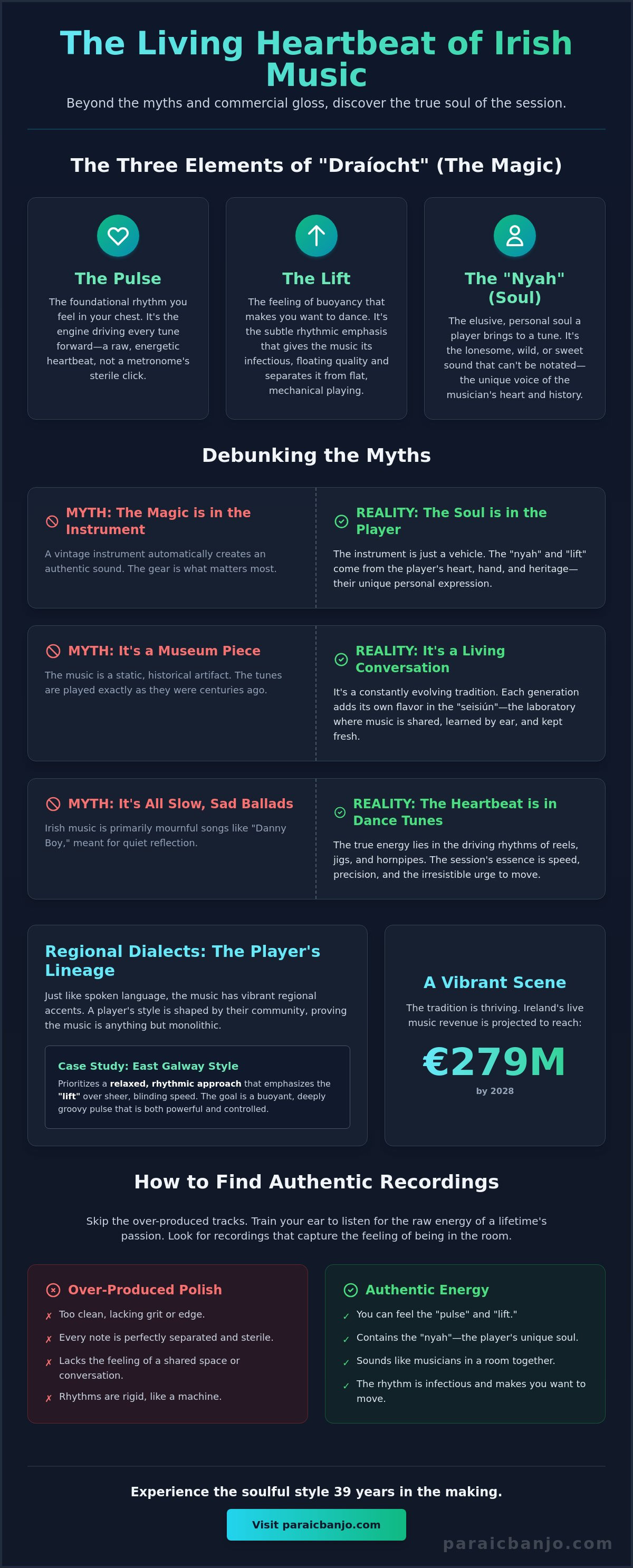
Today, we are going to peel back the layers to find the living heartbeat of the tradition, focusing on the pulse and the "lift" that makes this music so infectious. With live music revenue in Ireland projected to reach €279 million by 2028, the scene is more vibrant than ever, but the heart of it remains simple. I'll debunk five common myths and show you how to hear the difference between a polished commercial product and a genuine, heartfelt performance. We'll explore regional styles and find that rhythmic heartbeat that makes a tune truly sing. It's about the feeling in the fingers and the joy in the room.
Key Takeaways
Discover why the rhythmic "pulse" is the true heartbeat of a tune, helping you finally grasp the essence of irish music beyond the commercial noise.
Uncover the secret of the "nyah" and how a player's personal soul transforms a standard melody into a living, breathing story.
Explore the vibrant regional dialects of East Galway and Clare to see how different landscapes shape the lift and lilt of the music.
Realize why you don't need a history degree to connect with a session, as the music is designed to be felt as a sensory experience first.
Find out how to select authentic recordings that preserve the raw energy of a lifetime's passion rather than settling for over-produced tracks.
Table of Contents
Defining the Essence of Irish Music: It’s Not Just a Museum Piece
The essence of irish music is a pulse you feel in your chest before you ever hear it in your ears. It is not a static thing kept behind glass. It's a living, breathing rhythmic energy that drives every tune forward. Many people get distracted by the high-gloss, over-produced "Celtic" sounds found on television specials. Those recordings are often too clean. They lose the grit. Authentic tradition is raw, session-based, and deeply personal. We call the soul of this music draíocht. It is that elusive magic or soul that a musician brings to the instrument. You can't manufacture it in a studio. It happens in the moment.
This music is a social exchange. It isn't just a performance for an audience; it is a conversation between the players. When we sit down in a circle, we aren't just playing notes on a page. We are sharing a story. My own journey with this sound has spanned thirty-nine years, and I've learned that the heart of the craft is found in the connection between people. It’s the nod across the table when the rhythm locks in. It’s the shared joy of a well-placed ornament. It's about being present.
Myth vs. Reality: Why 'Danny Boy' Isn't the Whole Story
There is a common myth that our music is mostly about slow, mournful ballads. While songs like "Danny Boy" have their place, they aren't the whole story. The real heartbeat of Irish traditional music lies in the dance tunes. Reels, jigs, and hornpipes provide the true energy. These tunes require immense precision. The essence survives in the speed and the "lift" of the session. It’s about the drive of the banjo and the lilt of the fiddle working together to create a wall of sound that makes it impossible to keep your feet still.
The Living Tradition: Why the Music Never Stops Evolving
We don't treat these tunes like fragile antiques. This is a living tradition. Most of us learn by ear, passing melodies from one person to another without a single sheet of paper in sight. This keeps the music flexible. The seisiún (session) acts as a laboratory where tunes are tested and shaped. Each generation adds its own flavor, ensuring the sound never grows stale. A tune might be centuries old, but when it’s played tonight, it’s fresh. It’s a rhythmic conversation that never truly ends. This constant evolution is the essence of irish music.
Myth #1: The Essence is in the Instrument, Not the Player
A common mistake newcomers make is thinking the magic lives inside the wood and strings. They see a vintage tenor banjo or a handcrafted fiddle and assume the sound comes from the gear. It doesn't. While the history and origins of Irish music show us how these tools evolved over centuries, the instrument is really just a vehicle for the pulse. Two different musicians can pick up the exact same banjo and produce entirely different results. One might play the notes with technical precision, while the other makes the tune breathe. This personal touch is where the essence of irish music truly resides.
Old timers often talk about the "nyah." This is a specific, elusive, and soulful quality that a player brings to the notes. It is that slightly wild, lonesome, or sweet sound that can't be written down on a stave. It’s found in the way a player leans into a note or the subtle variation of a triplet. In the East Galway style, for example, we prioritize a relaxed, rhythmic approach that emphasizes the "lift" over sheer speed. This regional dialect proves that the player's intent and their community's tradition are what shape the sound. You aren't just playing a tune; you are expressing a lineage.
The Banjo’s Rhythmic Soul
The tenor banjo often serves as the heartbeat of a session. It has a punchy, percussive nature that cuts through the air. However, there is a massive difference between just hitting the right notes and creating a "lift." Lift is that feeling of buoyancy that makes dancers want to move. The banjo is the perfect tool to showcase this rhythmic essence because its crisp attack defines the timing for everyone else in the circle. When the banjo locks in, the whole room feels the shift.
Soulful Playing: The Connection Between Heart and Hand
I have always believed in a soulful style of playing. It is a connection between the heart and the hand that takes a long time to develop. My debut project has been 39 years in the making, and that time wasn't just spent practicing scales. It was spent learning how to play with feeling. Technical perfection is fine, but it’s the emotion behind the plectrum that matters most. If you want to hear how this connection sounds when it finally clicks, you can explore the tracks on my new digital album. It’s about the joy of the craft, not just the mechanics of the instrument. That soulful connection is what truly defines the essence of irish music for me.
Myth #2: All Traditional Irish Music Sounds the Same
To the untrained ear, a reel might just sound like a fast blur of notes. It is a common misconception that our music is a single, monolithic sound. In reality, the essence of irish music is found in its rich regional dialects. Just as a person from Cork has a different accent than someone from Donegal, the music carries the specific "voice" of the land it comes from. Before the internet and easy travel, musicians were often isolated by mountain ranges and vast bogs. This isolation was a gift. it allowed unique styles to bloom in small pockets across the country, creating a map of Ireland drawn in melodies rather than borders.
Understanding these differences is how you truly begin to "get" the music. It is a living tradition of Irish music that thrives on these local variations. When you sit in a session today, you can still hear the echoes of these old regional masters. You just have to know what to listen for. Tuning your ears to these subtle shifts in rhythm and ornamentation transforms the listening experience from a passive one into a deep, cultural connection. It makes every tune a discovery.
East Galway vs. The Rest: A Rhythmic Comparison
East Galway is where my own heart resides. This style is famous for being relaxed and deeply melodic. We don't chase the clock. While the Sligo style is often fast, bright, and driving, the East Galway approach is more about the "lilt" and the "lift." We focus heavily on variation. You don't just play the tune; you color it. You find new ways to phrase a melody every time it comes around. This sophisticated, laid-back rhythm allows the essence of irish music to shine through without being buried by sheer speed. It is a conversation, not a race.
The Clare Influence: Lonesome and Lovely
Just across the border, the music of County Clare offers something entirely different. There is a "lonesome" quality to Clare playing that is hard to put into words. You hear it in the long, mournful notes of a fiddle or the breathy, rhythmic push of a concertina. Many say the rugged, limestone landscape of the Burren is reflected in the music. It is haunting and beautiful. My own playing has been deeply influenced by this neighborly sound. I love to blend that soulful Clare lilt with the steady, rhythmic pulse of Galway. You can hear this blend of regional flavors throughout the tracks on my debut album, Not Before Time. It is a tribute to the diversity of our tradition.
Myth #3: You Need a History Degree to 'Get' the Music
You don't need to be an academic to feel the soul of a tune. Many people worry they can't appreciate a session because they don't know the 17th-century origins of every jig or reel. This is a total myth. While the background is rich, the essence of irish music is an auditory experience first. You don't read this music with your eyes; you hear it with your heart. The history is the soil, but the sound is the flower. If you can feel the rhythm, you are already halfway there.
The real secret is learning to listen for the "lift." This is that magical moment when the music feels like it's taking off. It’s a collective surge of energy that happens when the players are perfectly in sync. When that pulse hits, the room changes. It’s a physical sensation. You don't need a textbook to tell you when a set of tunes is working. You feel it in your feet. That visceral connection is the true heartbeat of the tradition, far more important than memorizing dates or lineage.
I see liner notes as a bridge rather than a textbook. They provide a bit of context to help you cross over into our world. They offer a glimpse into the lives of the people who played these tunes before us. Knowing a small detail about a composer adds flavor, but it shouldn't be a barrier to entry. The music was made for dancing and socializing, not for silent study in a library. It is meant to be lived.
How to Listen Like a Local
When you walk into a session, don't look for meaning in lyrics. Many of our most powerful pieces have no words at all. Look for the feeling in the rhythm instead. Listen for the ornamentation. These are the little cuts, rolls, and triplets that add character to a melody. In a set of reels, listen for the "drive." It is that steady, relentless momentum that keeps the energy high. It’s about the swing and the lilt, not just the sequence of notes. Once you stop trying to decode it, you start to actually hear it. This is the essence of irish music in its purest form.
The Power of Storytelling Through Tunes
A tune title can hold a whole world of history. A name like "The Fields of Athenry" carries a weight that people feel instantly. This connection between the music and the people who came before us is vital. It’s a human story told through wood and wire. I spent decades gathering these stories to ensure they weren't lost. You can read more about this in my guide on Preserving the Pulse: Why Liner Notes are Essential. It explains how we keep the spirit alive through documentation.
If you want to experience this raw storytelling for yourself, you can explore my full collection of recordings. It’s a journey that doesn't require a single exam or essay. Just sit back and let the pulse do the work.
Experience the Essence: Bringing the Session into Your Home
Too many studio recordings try to polish the life out of a tune. They treat traditional music like a pop song, stripping away the rhythmic grit that defines a real session. If you want to truly hear the essence of irish music, you have to look for recordings that value the "raw" over the "refined." Authentic music thrives on the interplay between musicians, the subtle variations in timing, and the collective energy of the room. You can't capture that with click tracks and over-produced vocal layers. You need the pulse of the moment. With the traditional music market in Ireland projected to reach US$12 million in revenue by 2025, it's clear that listeners are hungry for the real thing again.
Bringing that session atmosphere into your home requires a specific kind of recording. It’s about more than just the notes; it’s about the "lift" we discussed earlier. Look for albums where the instruments breathe together. When the rhythm section locks in with the lead players, it creates a buoyancy that you can feel. This isn't just background noise. It is an invitation to join a storied musical tradition that has survived for centuries because of its infectious energy.
Not Before Time: A Lifetime’s Passion
It took me 39 years to release my debut album, Not Before Time. I didn't want to rush the process. My goal was to capture the East Galway sound in its purest, most soulful form. I wanted every track to feel like a definitive statement of a lifetime's passion. To achieve this, I collaborated with a wide array of expert musicians across 18 distinct tracks. We avoided the sterile environment of modern pop production to ensure the "nyah" and the spirit of the session remained intact. For those who value high-quality audio, the digital album format ensures that every triplet and ornament is heard with crystal clarity. It’s the sound of a community coming together.
Your Next Steps in the Musical Journey
Starting your own collection of authentic music is a rewarding path. You don't have to dive into everything at once. You might start by exploring individual digital tracks to find the regional styles that resonate with you most. If you prefer something you can hold, the physical CD offers a tactile connection to the music. One of the most important parts of this project is the extensive supplementary material. The detailed liner notes act as a bridge, offering background stories and technical insights that help you "get" the music on a deeper level.
Explore individual tracks to discover your favorite reels and jigs.
Read the background notes to connect with the players and their stories.
Listen for the "pulse" rather than just the melody.
Join a community of listeners who value authenticity over commercialism.
The journey into traditional music is one that never truly ends. Every time you listen, you'll hear a new variation or feel a different rhythmic shift. It is a celebration of our national identity and a reaffirmation of the soul. Experience the essence for yourself with Páraic's debut album and become part of this living, breathing tradition. The session is waiting for you. Let's keep the music moving.
Keep the Pulse Alive in Your Own Sessions
We have traveled through the myths that often keep people at arm's length from our tradition. You now know that the heartbeat of a tune isn't found in a textbook or a high-end instrument, but in the "lift" and the "nyah" of the player. Whether it's the relaxed lilt of East Galway or the lonesome soul of Clare, these regional dialects are what give the music its true character. Understanding the essence of irish music doesn't require a degree. It just requires an open ear and a willingness to feel the rhythm—a quality that professional groups like Surefire Trio bring to life during high-energy live performances and celebrations.
I've spent thirty-nine years preparing this specific debut to ensure the raw energy of a live session is never lost. With 18 tracks recorded alongside expert collaborators, this project is a definitive statement of a lifetime's passion. You'll find extensive historical liner notes to guide your listening, acting as a bridge into our storied world. It is a relief to finally share this journey with you.
Bring the authentic pulse of East Galway into your home—Order 'Not Before Time' today
It's time to stop being an observer and start being part of the conversation. Let the music lift you and keep the tradition moving forward. Enjoy the tunes.
Frequently Asked Questions
What is the true essence of Irish music?
The true essence of irish music is the rhythmic pulse that drives a tune forward during a live social exchange. It isn't a static museum piece but a living conversation between musicians. This energy creates a specific atmosphere where the music feels like it's breathing. It relies on the connection between players in the moment rather than just technical perfection or historical accuracy.
What is the difference between Celtic music and Traditional Irish music?
Commercial "Celtic" music is often a polished, over-produced genre designed for mass appeal, while Traditional Irish music is raw and session-based. "Trad" focuses on the intricate ornamentation and rhythmic lift found in local pubs and homes. While Celtic music might use synthesizers or cinematic arrangements, authentic traditional music relies on the acoustic interplay of instruments like the banjo, fiddle, and flute.
Why is the session so important to the Irish music tradition?
The session, or seisiún, serves as the vital laboratory where tunes are shared, learned by ear, and kept alive through social interaction. It's the primary way the tradition is passed down from one generation to the next without the need for sheet music. In this setting, musicians from different backgrounds meet to create a collective sound that is greater than the sum of its parts.
What makes the East Galway style of banjo playing unique?
The East Galway style is defined by a relaxed, melodic pace that prioritizes lift and variation over sheer speed. Unlike the faster Sligo style, East Galway players often lean into the soul of the melody, adding subtle ornaments that make the tune sing. This approach allows the rhythmic essence of irish music to shine through in a sophisticated, laid-back manner that values feeling over fireworks.
Do I need to be Irish to appreciate the essence of the music?
You don't need to be Irish to connect with this tradition because the music is a sensory experience that speaks directly to the heart. Anyone can appreciate the drive of a reel or the lonesome quality of a slow air regardless of their heritage. The global resurgence of interest among young people shows that the rhythmic pulse of a tune is a universal language that transcends borders.
What should I look for in an authentic Irish music recording?
Look for recordings that capture the raw, unpolished energy of a live session rather than sterile studio productions. Authentic albums often feature acoustic instruments recorded together to preserve the natural interplay between musicians. High-quality audio and detailed liner notes are also key indicators. They provide the necessary context to bridge the gap between the listener and the living tradition.
Why are reels and jigs considered the 'heartbeat' of the music?
Reels and jigs are considered the heartbeat because their specific time signatures provide the rhythmic foundation for traditional dance. A reel’s steady 4/4 drive and a jig’s rolling 6/8 lilt create the momentum that defines a session's energy. These dance tunes require immense precision. They are the primary vehicles for showcasing a player's mastery of the rhythmic pulse that keeps the tradition moving.
What does 'lift' mean in the context of an Irish tune?
Lift refers to the sense of buoyancy and rhythmic drive that makes a tune feel like it's taking flight. It's the opposite of a flat or robotic performance. When a musician achieves lift, the rhythm becomes infectious, creating a physical urge for the listener to tap their feet. It’s the secret ingredient that transforms a simple series of notes into a living, breathing piece of art.


Comments