The Heartbeat of the Session: Mastering the Rhythmic Tenor Banjo Style

What if the secret to a driving Irish session isn't how fast you can play your scales, but how you handle the space between the notes? You've likely felt that frustration where your playing sounds like a ticking clock, flat and metronomic, while the fiddler next to you seems to be dancing through the reels. It's a common hurdle for many. Bridging the gap between mechanical picking and that elusive, soulful lift is the key to mastering the rhythmic tenor banjo style and becoming the true engine of the tune.
I understand that struggle because I've spent nearly forty years immersed in this storied musical tradition. This article will help you unlock the secrets of that driving pulse, moving you away from stiff jazz-style strumming and into the heart of authentic Irish picking. You'll learn why right-hand pick direction is your most powerful tool and how regional nuances can transform a dry melody into something vibrant and alive. If you want to hear these rhythms captured after a lifetime of practice, you can find the pulse of the tradition in my digital album, Not Before Time: 39 Years in the Making. Let's get that right hand moving.
Key Takeaways
Discover how to weave percussive drive directly into your melodies, making your banjo the true heartbeat of any session.
Shift your focus to the "engine room" by mastering specific right-hand pick patterns that distinguish the bounce of a jig from the drive of a reel.
Learn to avoid the common "Dixieland trap" by choosing clean, rhythmic picking over heavy strumming that can muddy the music's flow.
Build a rock-solid internal pulse for your rhythmic tenor banjo style using physical anchors like foot-tapping before you even touch the strings.
Witness the power of a lifetime’s practice by listening to the collaborative, driving energy captured on the digital tracks of Not Before Time.
Table of Contents
What is Rhythmic Tenor Banjo? Defining the Irish Pulse
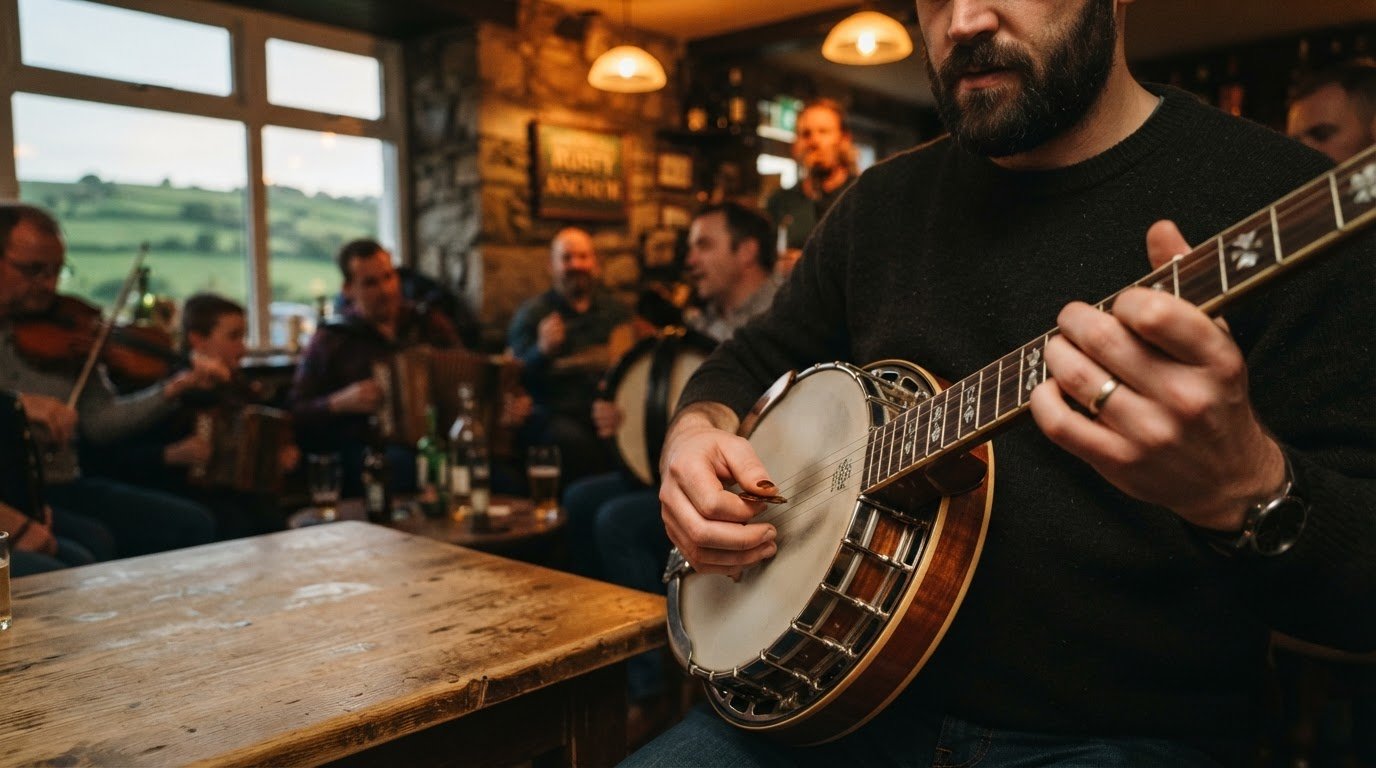
The rhythmic tenor banjo style is far more than just hitting the right notes at the right time. It is the deliberate art of embedding a percussive, driving pulse directly into the melodic line. You aren't just a melody player; you are the session's heartbeat. While instruments like the fiddle provide the soaring lines, the banjo acts as a melodic engine, often working in tandem with the bodhrán to ground the music. This is a massive departure from the history of the banjo in jazz, where heavy chordal strumming is the norm. In the Irish tradition, we use the pick to articulate the tune in a way that mimics the steps of a dancer. If the feet in the room aren't tapping, the rhythm simply isn't there.
Think of your banjo as a drum with strings. Every downstroke and upstroke should contribute to a forward momentum that carries the other musicians along. It’s about the "drive," that feeling of controlled energy that makes a reel feel like it’s flying without ever actually speeding up. You can hear this drive in action throughout my digital album, Not Before Time: 39 Years in the Making, where the goal was always to keep that session energy alive and breathing.
The Difference Between Timing and Rhythm
Many players get caught up in metronomic precision. While playing in time is vital, metronomic playing can often feel stiff or flat. The goal is "lift," a term we use to describe the slight, buoyant swing that gives the music its breath and life. It's about the micro-tensions between notes. In a reel, which is usually in 4/4 time, the rhythm comes from how you emphasize the backbeat to create a sense of forward motion. It’s a physical feeling as much as an auditory one. To truly understand how this lift works in practice, I encourage you to listen to the individual digital tracks from my debut project, where I’ve worked to capture that specific, breathing pulse.
Regional Roots: The East Galway and Clare Influence
My own rhythmic journey is deeply rooted in the East Galway and Clare traditions. These styles are famous for being relaxed and soulful, moving away from the frantic speeds often heard in modern competitions. Here, we value "lonesome" tones, those evocative, resonant sounds that pull at the heartstrings while keeping the feet moving. This soulful Irish banjo music relies on a right-hand technique that is subtle yet powerful. It's about knowing when to let a note ring and when to cut it short to create a rhythmic "pop." My debut album is a direct reflection of these regional influences, celebrating the collaborative spirit of the session. You can pick up the physical CD to hear how these regional rhythms interact with fiddles and flutes in a natural, live setting. Get that right hand moving and feel the lift.
The Anatomy of the Pulse: Essential Right-Hand Techniques
If the left hand is the map, your right hand is the engine. In the rhythmic tenor banjo style, your pick doesn't just strike strings; it dictates the energy of the entire room. Beginners often obsess over fast fingerwork, but a session player with a rock-solid right hand will always be more welcome than a speed demon with a shaky pulse. The secret lies in pick direction. For reels, we generally stick to a steady down-up-down-up pattern to maintain a driving flow. Jigs require a different approach, using a down-up-down pattern that creates that essential, rolling gallop. Mastering these patterns allows you to stop thinking about the mechanics and start feeling the music.
Beyond the basic strokes, we use dampening and ghost notes to add texture. By lightly touching the strings with the palm of your picking hand or the fingers of your fretting hand, you create a percussive click. This isn't a mistake; it's a deliberate choice to add a drum-like quality to the melody. It’s a subtle art that separates the masters from the novices. You can hear this percussive texture clearly on the individual digital tracks from my debut project, where the banjo's rhythmic role is front and center.
Mastering the Down-Stroke Drive
The down-stroke is your anchor. It provides the weight on the beat that dancers rely on to stay in step. To get this right, your wrist must be completely relaxed. Tension is the enemy of rhythm. If your forearm is tight, the music will sound brittle and forced. The lift is the rhythmic tension between the down-stroke and the subsequent up-stroke that gives the music its characteristic bounce. Keep the wrist loose, like you're shaking water off your hand, to let the rhythm breathe naturally.
Ornamentation as a Rhythmic Tool
Don't think of trebles or triplets as mere decoration. In the Irish tradition, these are rhythmic devices used to bridge melodic gaps and add a burst of energy to a phrase. A well-placed treble acts like a drum fill, propelling the tune forward. Similarly, the "cut" and "strike" are used to sharpen the pulse, giving specific beats a little extra bite. They shouldn't hide the melody; they should highlight the beat.
Actionable Tip: To sharpen your timing, practice your trebles on a single muted string. By taking the melody out of the equation, you can focus entirely on the crispness of the rhythmic click. This is how you build the stamina and precision needed for a long session. Once you feel that click in your bones, the tunes will follow naturally. Get that pick moving and stay loose.

Common Rhythmic Pitfalls: Why Your Playing Might Feel 'Flat'
You've focused on your pick direction and your wrist is loose, yet the music still feels a bit lifeless. It’s a common frustration. Often, the issue isn't what you're doing wrong, but what you're overdoing. One of the biggest hurdles is the "Dixieland Trap." Because the tenor banjo has such deep roots in traditional jazz, many players naturally fall into heavy, constant strumming. In an Irish reel, this constant "chunk-chunk" sound kills the melodic flow. The banjo should sing the tune with a percussive edge, not drown it out with chords. When you rely too much on strumming, you lose the ability to highlight those subtle rhythmic nuances that define a session.
Another trap is over-ornamentation. We all love a crisp treble, but throwing triplets at every spare second is like over-salting a fine stew. It muddies the rhythmic water. If the listener can't hear the pulse because of too many "decorations," the drive is lost. Similarly, playing louder is not the same as playing with more intensity. True drive comes from internal tension and the way you attack the string, not just the volume of the sound. You want a focused, biting tone that cuts through the session without overpowering your fellow musicians. You can hear this balance of power and restraint on the physical CD of Not Before Time, where the goal was always clarity over sheer volume.
Breaking the 'Strumming' Habit
Moving from chordal backing to a true rhythmic tenor banjo style requires a shift in mindset. You have to learn when to let the tune breathe. Not every beat needs a strike; sometimes the space between the notes is what creates the lift. It’s about identifying the "skeleton" of the melody and pinning your rhythm to those essential points. If you're struggling to find that balance, take a look at how famous Irish banjo players navigate these waters. They don't just play the notes; they play the rhythm within the notes, choosing their moments to push the tune forward or let it settle into a groove.
The Robotic Metronome Syndrome
Metronomes are fantastic tools for building speed, but they can also lead to a stiff, uninviting rhythm. This "Robotic Metronome Syndrome" happens when your playing becomes too precise and loses its soul. Real Irish music has a natural push and pull. To fix this, try "playing behind the beat." This doesn't mean playing slow; it means placing your notes just a fraction of a second later than a computer would. This creates a relaxed, soulful feel that is much more inviting to other session players.
Actionable Tip: Put away the metronome for a while and practice playing along to old recordings of the masters. Don't just try to match their notes; try to match their heartbeat. Absorb the way they lean into certain phrases and pull back on others. This is how you develop an internal rhythmic engine that feels human and alive. Keep it steady, but keep it soulful.
5 Practical Steps to Develop Your Internal Rhythmic Engine
Building a rock-solid rhythmic tenor banjo style isn't about memorizing tabs. It's about internalizing a pulse so deeply that it becomes second nature. After nearly forty years of playing, I’ve found that the most effective way to improve isn't through complex exercises, but by simplifying your approach. You need to move the music from your head into your hands and feet. Here are five practical steps to get your internal engine humming:
Active Listening: Put on your favorite album and ignore the melody. Focus entirely on the right-hand attack of the banjo. Is it sharp? Is it swinging? Listen for the "click."
Physical Sync: Use foot-tapping to anchor the pulse. Your foot should be the foundation before you even pick up the instrument. If your foot stops, your rhythm will follow.
Simplify: Strip a complex tune down to its bare bones. If you can't play the rhythm of a tune on one string, you haven't mastered its pulse yet.
Record and Review: Use your phone to record a few sets. Listen back specifically for "drift." Do you speed up during the difficult parts? Identifying these gaps is the first step to fixing them.
Session Immersion: Nothing beats playing with others. Learn to lock in with a guitar or bouzouki player to create a unified wall of sound.
If you want to hear how these steps sound when they finally click together, you can explore my individual digital tracks to hear that rhythmic engine in action.
The 'Skeleton Tune' Method
One of the most powerful ways to master rhythm is to stop playing so many notes. In a reel, the strong beats usually fall on 1 and 3. Try playing a well-known reel but remove 50% of the notes. Focus only on the notes that fall on the down-beat. By stripping away the clutter, you force your right hand to emphasize the rhythmic bounce that makes Irish music dance. This exercise builds incredible precision and ensures your pick is always working to support the pulse rather than fighting against it. It's a simple trick, but it's how you build the stamina for a long night of tunes.
Developing a 'Session Ear'
When you're in the middle of a crowded session, you have to listen as much as you play. Your job is to lock in with the accompaniment. If the guitar player is leaning into a specific groove, you need to match that intensity. Your rhythmic tenor banjo style should be flexible, allowing you to push the energy forward during a high-octane set or pull back for something more soulful. You can explore the authentic sound of Irish session music to hear how different instruments interact to create that solid wall of rhythm. Listen for the way the banjo cuts through the mix without ever losing its connection to the overall heartbeat of the room. Keep your ears open and your wrist loose.
Experiencing the Rhythm: 'Not Before Time' and the Art of the Debut
After exploring the mechanics of pick direction and the nuances of the "lift," the final step is to hear how these elements come together in a real-world setting. You can read about the rhythmic tenor banjo style for years, but internalizing that pulse requires immersion in high-quality, authentic recordings. This is where the theory meets the soul of the music. My debut album, Not Before Time, was created to capture exactly that. It isn't just a collection of tunes; it’s a recorded masterclass in how the banjo should sit within a traditional session, providing both melody and a relentless, driving heartbeat.
Recording this project was a labor of love that spanned decades of session playing and musical friendships. To preserve the essential rhythmic drive, I chose to record with a group of incredible musicians rather than in a solitary booth. This "live" feel is vital. When you hear the banjo interacting with the fiddle or the flute, you're hearing the micro-adjustments and the shared pulse that defines our tradition. This collaborative energy ensures the music never feels flat or clinical; it breathes with the same life you’d find in a late-night session in Galway or Clare.
39 Years in the Making
This album represents a lifetime’s passion finally committed to disc. Every one of the 18 tracks is informed by thirty-nine years of rhythmic evolution, from the quiet corners of local pubs to the biggest festival stages. We’ve curated a journey of rhythmic discovery that highlights the subtle differences between driving reels and rolling jigs. The album stands as a definitive statement of rhythmic mastery and East Galway soul. It’s a celebration of the community and the players who shaped my own journey, and I’m thrilled to finally share this milestone with you.
Bring the Rhythm Home
Listening to raw, high-quality recordings is one of the most effective ways to transform your own practice. When you have the physical CD in your hands, you also get the benefit of detailed liner notes that provide the historical context behind the tunes. This background information helps you understand the "why" behind the rhythmic choices, making your own playing more informed and authentic. You aren't just buying music; you're inviting a storied tradition into your home.
Actionable Tip: Try a "shadowing" exercise with your favorite track from the album. Put the music on and play along at a very low volume, focusing entirely on matching the pick attack and the syncopation of the banjo. Don't worry about hitting every single note perfectly at first; just try to lock into the physical sensation of the pulse. This is how you bridge the gap between technical exercises and the emotional heart of the music. Order your copy of 'Not Before Time' and feel the pulse today! I can't wait to hear how it helps your playing. Keep the rhythm alive.
Claim Your Place in the Heart of the Session
Mastering the rhythmic tenor banjo style is a journey that takes you from the mechanical tapping of a metronome into the breathing heart of a traditional Irish session. We've explored how your right hand serves as the engine room and why stripping a tune to its skeleton helps you find the core pulse. By moving away from stiff strumming and embracing the soulful lift of regional traditions, you're not just playing notes; you're creating a dance. It’s about the subtle tension and the shared energy that makes this music feel alive.
If you're ready to immerse yourself in this tradition, my debut project is the perfect companion. It carries 39 years of musical heritage across 18 tracks of pure, rhythmic session energy. You'll hear the acclaimed East Galway and Clare style in its most authentic form, captured with a collaborative spirit that brings the room to life. It’s a definitive statement of a lifetime’s passion, and I’m thrilled to finally share it with you.
Discover the rhythmic soul of 'Not Before Time' - Get the Album Now!
I'm excited to see where your own musical journey takes you next. Keep the wrist loose, stay relaxed, and keep the music moving.
Frequently Asked Questions
What is the difference between rhythm and lead on a tenor banjo?
In Irish music, the banjo often plays the melody, but the rhythmic tenor banjo style refers to how you pick those notes to create a driving pulse. You aren't just playing the tune; you're acting as a melodic percussionist. Unlike jazz, where rhythm means strumming chords, our rhythm is built directly into the melodic line. It’s about the attack and the space between the notes that keeps the session moving.
Do I need a specific pick to play rhythmic Irish banjo?
You generally want a medium-gauge pick, often made of nylon, to get that authentic Irish sound. A pick with a bit of "give" helps you glide through trebles, while enough stiffness ensures a clear, biting tone. I recommend starting with something around 0.60mm to 0.80mm. Experiment with different textures to see which one feels most natural in your hand during a long night of tunes.
How do I play triplets on the tenor banjo without losing the rhythm?
The key to triplets is to treat them as a rhythmic fill rather than a speed test. Ensure your down-up-down motion is crisp and that the final note of the treble lands exactly on the beat. If you find yourself rushing, try practicing the movement on a single muted string first. This helps you focus on the "click" rather than the notes. You can hear this precision in the digital tracks on my album.
What is 'the lift' in Irish music and how do I achieve it?
"Lift" is that elusive, buoyant swing that makes the music feel like it’s dancing. You achieve it by avoiding a perfectly flat, robotic beat and instead adding a slight emphasis to the downbeats. It’s the rhythmic tension that gives the tune its "hop." To really feel it, try tapping your foot to the music before you start playing; the lift starts in your body, not your fingers.
Should I use a metronome when practicing rhythmic banjo?
Use a metronome for your initial technical practice, but don't rely on it forever. While it builds a steady foundation, it can't teach you the natural "swing" of a live session. Once you have the tune under your fingers, switch to playing along with high-quality recordings. This helps you absorb the human push and pull that defines our tradition. My debut album, Not Before Time, is a great place to start.
How can I make my banjo playing sound less mechanical?
To sound less mechanical, you must vary your pick attack and embrace "ghost notes." These are the percussive clicks created when you strike a string that is partially muted. It adds a gritty, drum-like texture to your playing that feels much more organic. Focus on the soul of the tune rather than just the math of the notes. Let the melody breathe and the rhythm will follow.
What are the best Irish banjo albums to listen to for rhythm?
Look for recordings that emphasize the collaborative, live feel of a session. Masters of the East Galway and Clare styles are particularly known for their soulful, rhythmic approach. I spent 39 years honing this sound before releasing my debut album. It features 18 tracks of pure session energy that you can find at paraicbanjo.com to help you internalize that essential pulse.
Is rhythmic tenor banjo different from Dixieland banjo?
Yes, the rhythmic tenor banjo style used in Irish music is quite different from the Dixieland approach. Dixieland banjo is primarily chordal and relies on constant strumming to provide a harmonic backing. In contrast, the Irish style is melodic, meaning we play the tune itself while using the pick to create a percussive drive. It’s a more intricate way of playing that requires a focus on individual note articulation rather than broad chord shapes.

Comments