The Ultimate Listening Guide to Banjo Rhythm in Irish Reels
- Paraic Mac Donnchadha

- Jun 21
- 14 min read
What if the secret to a great Irish reel isn't found in the flurry of notes, but in the tiny, rhythmic breaths between them? For many listeners, the breakneck speed of a session feels like an impenetrable wall of sound. You hear the melody, but the internal clock of the tenor banjo remains a total mystery. This listening guide to banjo rhythm in irish reels is here to help you break through that noise. It's about shifting your focus from the blur of fingers to the actual groove of the tune.
I know how overwhelming it feels when folks talk about lift or swing as if they're simple, everyday concepts. You want to feel the music, not just analyze it. I promise that you'll come away from this with the tools to develop a pro ear for the nuances that define our tradition. We'll look at the steady, lyrical drive of East Galway and the vibrant lift of the Clare style. We're going to dive into the details of live recordings so you can appreciate the craft behind the music. It's a look into the rhythmic world I've spent thirty-nine years exploring. Let's get stuck in and find that heartbeat together.
Key Takeaways
Understand the 4/4 pulse that acts as the "engine room" of any traditional session to help you stay grounded during fast-paced reels.
Use this listening guide to banjo rhythm in irish reels to spot "the lift," a feeling of rhythmic buoyancy that keeps the music from feeling flat.
Compare the soulful, laid-back approach of East Galway with the more driving rhythms of Clare to better appreciate regional diversity.
Master the "Foot Tap Test" and the "Ornamentation Hunt" to sharpen your ability to hear subtle triplets and rolls in a crowded session.
See how the 18 tracks on Not Before Time – 39 Years in the Making serve as a practical masterclass in capturing the authentic pulse of the tradition.
Table of Contents
The Heartbeat of the Session: Understanding Irish Reel Rhythm
Think of an Irish reel as a high-velocity conversation. It’s a dance tune built on a sturdy 4/4 frame, but it’s the energy within that frame that really matters. In any session, the rhythm acts as the engine room. Without a solid pulse, the melody just floats away. While other genres might play these notes with a metronomic "straightness," Irish music relies on a lilt. This is a subtle swing that gives the music its life and drive. If you want to get the most out of this listening guide to banjo rhythm in irish reels, you have to start by feeling that internal bounce.
The banjo is unique because it bridges the gap between the fiddle’s melody and the bodhrán’s beat. It’s a percussive instrument by nature. When you look into the History of the banjo, you see how its construction, a drum head with strings, dictates this dual role. It doesn't just play the tune; it drives the room. After spending thirty-nine years immersed in this tradition, I’ve found that the best players aren't just hitting notes. They're carving out a groove that makes it impossible for your feet to stay still. It is a definitive statement of a lifetime's passion, and hearing it clearly is the first step to playing it well.
The 4/4 Meter: Finding the Pulse
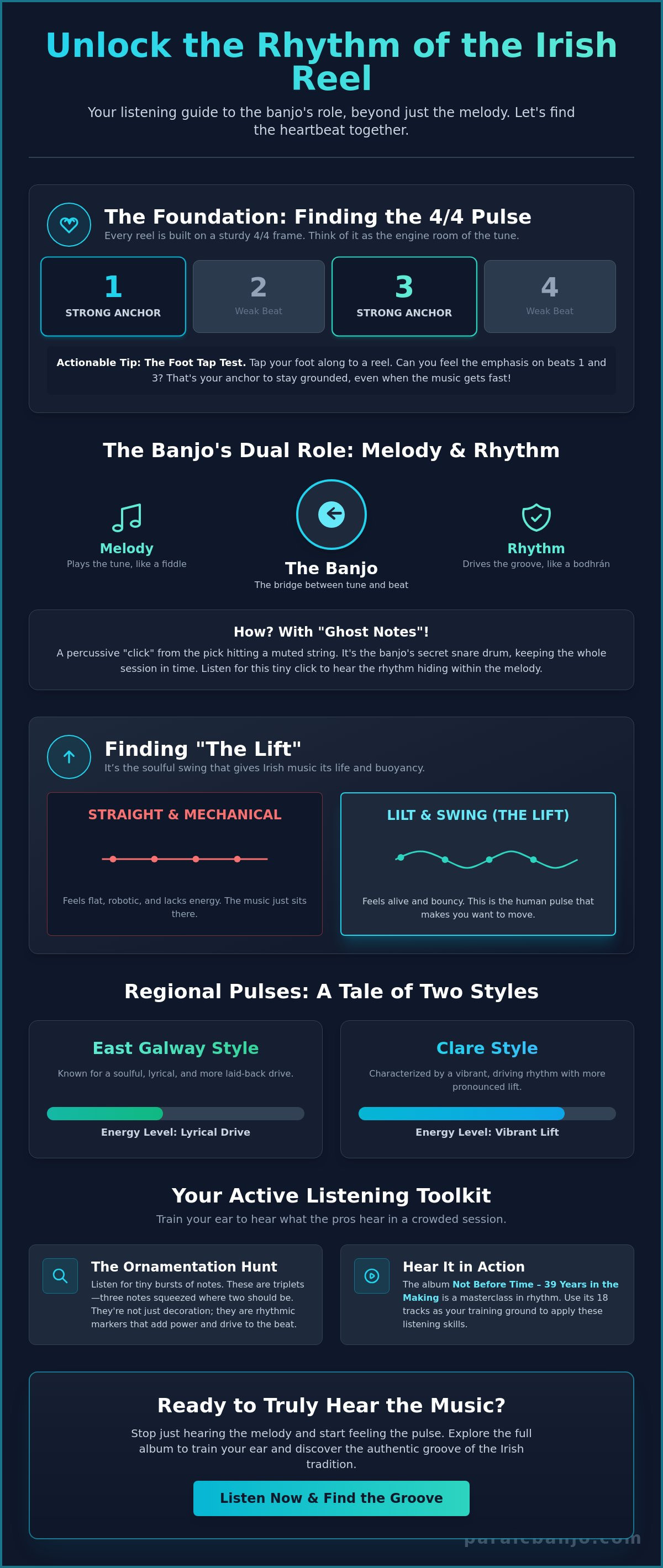
To find the heartbeat, start with your feet. In a reel, you’re looking for four even beats in every bar. Try tapping along, but pay close attention to the first and third beats. These are your anchors. A simple trick for understanding the "backbeat" is to listen for where the dancers would land their feet. There’s a specific buoyancy there that pushes the tune forward. If you’re struggling to hear it, try listening to a single track from the Not Before Time – 39 Years in the Making digital album and focus only on the rhythmic drive rather than the high notes of the melody.
Melody vs. Rhythm: The Banjo’s Dual Role
How does a banjo player keep time while playing dozens of notes a second? We use "ghost notes." These are rhythmic hits where the pick strikes the string, but the left hand mutes the sound. It creates a percussive "click" that acts like a tiny snare drum. This is why the banjo is often called the drum of the melody section. When you listen closely, you’ll hear that click acting as a constant marker. It’s a functional piece of the music that keeps the whole session on track. You can hear this clearly on the physical CD, where the raw energy of the plectrum hitting the strings is preserved in the recording.
Decoding the Banjo’s Role: Beyond the Melody
If you want to understand the true spirit of the Irish reel, you have to look past the notes on the paper. The magic happens in "the lift." This isn't a technical term you’ll find in a classical textbook, but every session player knows it. It’s that feeling of rhythmic buoyancy that makes a tune feel like it’s floating rather than dragging. When you use this listening guide to banjo rhythm in irish reels, try to hear how the music breathes. It’s a delicate balance of tension and release that creates drive, pushing the melody forward without ever feeling rushed. It's the difference between a tune that just sits there and one that demands you move.
Most people assume Irish music is played straight, but the reality is much more soulful. We use a specific swing that gives the music its characteristic lilt. It’s the difference between a mechanical heartbeat and a human one. This pulse is what transforms a simple sequence of notes into a definitive statement of passion. If you’re looking to hear this in action, you can explore the individual digital tracks from my debut project to hear how that swing varies from tune to tune. It's about finding the groove that fits the soul of the melody.
The Secret of the Triplets
A triplet is simply three notes squeezed into the space where two would normally sit. It sounds technical, but it’s really just a burst of rhythmic energy. On the banjo, these are our best friends for adding texture. You’ll hear "clean" triplets where every note is distinct, and "rolling" ones that sound more like a fluid ripple. These aren't just fancy decorations. They are rhythmic markers that emphasize the beat and keep the engine room humming. Listen for the triplets on the first beat of a bar; that’s often where the most power lies.
Phrasing: The Sentences of a Reel
Think of a reel as a story told in musical sentences. Páraic Mac Donnchadha uses phrasing to group notes together, creating a narrative flow that guides the listener. It isn't just a wall of sound. There are tiny pauses, subtle shifts in volume, and moments where the rhythm restarts with fresh energy. This is where the "pro ear" comes in. Instead of hearing a thousand individual notes, you start to hear the phrases. Learning to spot these breaths is the key to moving from a casual listener to someone who truly understands the tradition. It's a skill that took me decades to hone, and it's the heart of every track on the album.
Regional Pulses: East Galway vs. Clare Rhythms
The West of Ireland is the spiritual home of the rhythmic banjo. It’s where the pulse of the tradition beats strongest. When you listen to a reel, you aren't just hearing a sequence of notes; you're hearing a map of where that music was born. This is a vital part of any listening guide to banjo rhythm in irish reels. Understanding these regional pulses helps you move beyond just hearing the melody to actually feeling the heritage behind the plectrum. It’s about recognizing the distinct "accent" of the rhythm.
The tracks on Not Before Time – 39 Years in the Making were deeply influenced by these distinct sounds. I wanted to capture the contrast between the relaxed, soulful drive of the Galway border and the bright, rhythmic lift of Clare. It took nearly four decades of immersion in the session scene to truly understand how to balance these two worlds on one fretboard. It’s a definitive statement of a lifetime’s passion, and you can hear that history in every strike of the string.
The East Galway Soul
East Galway style is famous for its "laid-back" feel. It’s a soulful approach that prioritizes the beauty and exploration of the melody over raw speed. You’ll hear slower tempos that allow the player to dig into every turn and ornament with care. This style is often described as musical rather than technical because it values the emotional weight of the tune above all else. To really grasp this, you can look at the East Galway vs Clare music differences in live recordings. Listen for the way the rhythm sits slightly "behind" the beat, creating a sense of ease and depth that feels deeply personal.
The Clare Bounce
In contrast, the Clare style is all about a steady, rhythmic bounce. It’s infectious. It makes you want to dance immediately. This sound was heavily shaped by the influence of the great ceili bands, where the banjo had to cut through the sound of a dozen other instruments to keep the dancers on the floor. There is a constant, driving focus on the "lift." Try this listening exercise: focus on the very start of each bar. Can you hear the tiny "hop" in the beat? That’s the Clare pulse in action. It’s an energetic force that keeps the session moving forward with a bright, spirited momentum.
The eighteen tracks on my album serve as a practical masterclass in these regional nuances. Whether it's a slow-burning Galway reel or a high-energy Clare set, the rhythm is always the guide. It’s a storied musical tradition I’m proud to share, and I hope these tips help you hear the heart of the West next time you sit in on a session. Happy listening!
Your Active Listening Toolkit: What to Hear in a Great Reel
Developing a "pro ear" doesn't happen by accident; it's a skill you hone over time through deliberate attention. This listening guide to banjo rhythm in irish reels is your roadmap for the next time you step into a session or put on a record. Instead of letting the music wash over you as a single wave of sound, try breaking it down into distinct layers. Start with the basics. Can you find the main beat? That’s Level 1. Try the Foot Tap Test. Focus on the one and the three. If your foot is moving in time with the pulse we discussed earlier, you've found the anchor that keeps the whole tune from drifting.
Once you’ve got the beat, start the Ornamentation Hunt. You’re looking for those little bursts of energy, the triplets and rolls that give the tune its "crackle." Don’t worry about the specific notes right now. Just listen for the rhythmic texture they add. Level 3 is the Interaction Check. Notice how the banjo doesn't just play along with the fiddle or flute; it supports them. It’s a rhythmic conversation where the instruments lock in to create a single, driving force. Finally, Level 4 is about the Emotional Impact. Does the rhythm feel bright and hopeful, or is there a dark, driving tension? The way a player handles the rhythm dictates how you feel as a listener.
Exercise: Isolation Listening
Try this during your next listen. Pick a track and ignore the melody entirely for thirty seconds. It’s harder than it sounds. Focus only on the "thump" of the plectrum hitting the strings. Notice how the volume of that rhythm changes during the "turn," which is the transition between different parts of the tune. Does the player dig in more? Does the texture feel thick or sparse? Try to describe it in one sentence. Is it "grainy," "smooth," or "punchy"? This simple practice will sharpen your ears faster than any textbook. You can practice this right now by picking up the Not Before Time – 39 Years in the Making digital album and focusing on the raw plectrum work in each set.
Spotting the "Soulful" Moments
The best banjo players have a certain "growl" on their lower strings. It’s a deep, resonant sound that adds a layer of grit to the rhythm. Listen for those moments where a player deliberately delays a note by a tiny fraction of a second. This creates a massive rhythmic tension that makes the eventual "lift" feel even more powerful. In our tradition, "perfect" metronomic timing is often less desirable than "human" timing. We want the music to feel alive, not programmed. It’s those tiny imperfections and shifts in drive that make the music feel soulful. It’s a definitive statement of a lifetime's passion, captured in the raw air of a live session. Grab your copy of the Not Before Time – 39 Years in the Making physical CD to hear these nuances in high fidelity.
Immersive Listening: Why Not Before Time is the Perfect Study
To truly master the concepts in this listening guide to banjo rhythm in irish reels, you need to hear them in their natural habitat. While many studio albums are polished until they lose their edge, my debut project was captured with a different goal in mind. I wanted to bottle the raw, unforced energy of a real session. Across the eighteen tracks on Not Before Time – 39 Years in the Making, you aren't hearing a solitary musician in a booth. You’re hearing a conversation between friends, where the rhythm is the common language that keeps us all on the same path.
This album is a definitive statement of a lifetime's passion, representing nearly four decades of immersion in the tradition. It serves as a practical masterclass in East Galway rhythm because it doesn't shy away from the "soulful" imperfections of live performance. When you listen to the physical CD or the digital album, you’re hearing the plectrum hits and the rhythmic "clicks" exactly as they happened in the room. This transparency makes it much easier for you to apply the isolation listening exercises we discussed earlier. You can hear the interplay between the banjo and the other instruments as a living, breathing thing.
Recorded Live: The Rhythmic Truth
In a high-energy session, the "pulse" is everything. Studio-polished albums often use click tracks or heavy editing that can flatten the natural lift of a reel. By recording live, I made sure the "rhythmic truth" remained intact. You’ll hear how the volume and intensity of the rhythm shifts naturally as the tunes "turn" and the energy in the room rises. It’s about bringing that session atmosphere directly into your living room. Pay close attention to how the banjo supports the melody without ever overcomplicating the groove. It’s a delicate balance that only comes from years of playing together in the West of Ireland.
Next Steps for the Trad Music Purist
If you’re ready to dive deeper, I highly recommend spending time with the liner notes. They provide the essential "why" behind the rhythm, offering historical context that you just can't get from a simple tracklist. For those looking to build a serious collection, learning how to buy traditional irish music direct from artist sources is vital. It ensures that the heritage stays alive and that the artists are supported directly. You can start your journey today by picking up the physical CD or the digital version of Not Before Time.
Building a great traditional irish session music cd collection is about finding those recordings that feel authentic and lived-in. I hope this guide has given you a new way to hear the music I love so dearly. It’s been a long road to get these eighteen tracks out into the world, and I’m thrilled to have you along for the ride. Keep your ears open, your heart in the tune, and most importantly, keep your feet tapping! See you at the next session.
Step Into the Heart of the Session
You've now got the tools to hear the music like a seasoned player. Remember that the "lift" and the internal pulse are what give a reel its life; it isn't just about speed. By focusing on the regional pulses of East Galway and Clare, you can start to identify the rich heritage behind every plectrum strike. This listening guide to banjo rhythm in irish reels is just the beginning of your journey into the soul of the West. It takes time to develop a pro ear, but every foot tap brings you closer to the tradition.
If you're ready to put these ears to the test, there's no better way than with 18 tracks of pure, rhythmic session music. My debut project was recorded live with expert collaborators to capture that raw energy you just can't find in a sterile studio. It even includes detailed liner notes on East Galway heritage to help you understand the history behind the tunes. Order your copy of "Not Before Time" and experience authentic Irish banjo rhythm today. Keep those ears sharp and your spirit high. I'll see you at the next session!
Frequently Asked Questions
What is the difference between a reel and a jig in terms of rhythm?
A reel is played in 4/4 time, meaning you count it in fours, while a jig is in 6/8 time, giving it a "rash-of-bacon" triplet feel. In a reel, the rhythm is steady and driving, like a heartbeat. If you're using this listening guide to banjo rhythm in irish reels, try tapping 1-2-3-4 for a reel and 1-2-3, 4-5-6 for a jig. It’s the difference between a steady walk and a lively skip.
Why does the Irish tenor banjo sound so percussive in reels?
The tenor banjo is essentially a drum with strings, which is why it has such a sharp, percussive "click" when the pick hits. Players also use "ghost notes," where they strike a string while muting it with their left hand. This creates a rhythmic hit without a clear pitch. It is a technique that keeps the engine room of the session humming along with a unique, crunchy texture that defines our sound.
Do I need to play the banjo to understand its rhythm?
You don't need to be a musician to appreciate the groove of a great reel. Active listening is a skill anyone can learn by focusing on the "thump" of the rhythm rather than just the high notes. Try the Foot Tap Test we discussed earlier. By isolating the rhythmic pulse, you’ll start to hear the "pro" details that define the tradition without ever having to pick up a plectrum or learn a chord.
What does "lift" mean in the context of Irish traditional music?
Lift is that feeling of rhythmic buoyancy that makes you want to get up and dance. It isn't about playing faster; it's about the tiny bursts of energy and the "swing" between the notes. As you follow this listening guide to banjo rhythm in irish reels, you'll notice a tune with lift feels light and energetic, while one without it can feel flat or heavy. It’s the secret sauce that brings the music to life.
How can I tell the difference between East Galway and Clare styles?
East Galway style is generally more relaxed and soulful, prioritizing the melody, while Clare style has a constant, driving bounce. In Clare music, you’ll hear a distinct "hop" on the beat that pushes the tune forward for dancers. Galway players often sit slightly behind the beat, creating a deep, melodic tension. Both are beautiful, but they offer very different rhythmic experiences for the listener who knows what to look for.
What are triplets, and why are they so common in banjo reels?
Triplets are three notes played in the same amount of time as two regular notes. They act as rhythmic markers that add "crackle" and energy to a tune. Banjo players love them because they mimic the percussive rolls of a drum. When used correctly, they emphasize the main beat and give the reel a sense of forward motion that keeps the session energy high and the dancers moving on the floor.
Is it better to listen to digital tracks or a physical CD for rhythmic detail?
Physical CDs are often superior for purists because they offer higher fidelity and come with detailed liner notes that explain the history of the tunes. While digital tracks are convenient for listening on the go, the physical CD version of Not Before Time provides a tangible connection to the heritage. It is about the full experience of the music, from the raw plectrum sound to the stories behind the notes.
How fast should a traditional Irish reel be played?
There is no single correct speed, but the tradition values a pace that allows the rhythm and melody to breathe. In East Galway, we often favor a steadier, more lyrical tempo that highlights the soul of the tune. If a reel is played too fast, you lose the lift and the subtle rhythmic details. The best speed is one that feels energetic but remains danceable and clear to the listener’s ear.


Comments