The Ultimate Listening Guide to Rhythmic Tenor Banjo: Hearing the Soul of Irish Music
- Paraic Mac Donnchadha

- Jun 29
- 13 min read
What if the secret to master-level Irish banjo isn't how fast you can pick, but how much space you leave between the notes? It’s a common frustration for many listeners. You press play on a session recording and it all feels like a frantic, indistinguishable blur. If you have ever felt like every tune sounds the same or struggled to hear the difference between a Clare reel and an East Galway jig, you aren't alone. This listening guide to rhythmic tenor banjo is designed to help you slow things down mentally so you can finally hear the soul of the music.
I've spent decades immersed in these tunes, and I can tell you that the magic lives in the lift and the pulse rather than raw speed. It's the same steady, rhythmic drive I aimed to capture across the eighteen tracks of my album, Not Before Time. We're going to explore how to identify those crisp triplets and trebles that often get buried in a dense recording. You will gain a clear understanding of the technical terms found in liner notes and develop a deep appreciation for the regional nuances that make this tradition so rich. Let’s start training your ears to hear the heartbeat of the banjo.
Table of Contents
Decoding the Pulse: What is Rhythmic Tenor Banjo?
Rhythmic tenor banjo is a philosophy of playing where the beat and the lift take precedence over how many notes you can cram into a single bar. It is a style that favors the groove over the grind. When you use this listening guide to rhythmic tenor banjo, you'll start to notice that the most respected players aren't the ones racing to the finish line. They are the ones who make the music feel bouncy and alive. This Pulse is the internal clock of the music. It is what keeps a session grounded and makes it danceable. Without it, the tunes might be technically perfect, but they'll lack the spirit that defines our tradition.
In the Irish tradition, the banjo is a bit of a shapeshifter. It carries the melody like a fiddle, but it strikes the strings with a percussive snap that rivals a bodhrán. This is quite different from the rolling patterns of bluegrass or the complex chordal structures of jazz. While the History of the Banjo spans many cultures and constructions, the Irish tenor style relies on a specific swing that emphasizes certain beats to create momentum. It's a dual-purpose instrument; it provides the tune's skeleton while simultaneously dressing it in melodic skin.
The Difference Between Hearing and Listening
Hearing is a passive act. It’s what happens when the music is just background noise while you’re chatting at the bar. Listening, however, is an active hunt. You’re searching for the lift, that subtle upward energy that happens between the notes. The soul of a reel isn't found in a book of sheet music. It lives in the tiny rhythmic variations a player chooses in the heat of the moment. I recommend focusing on the why behind the notes, not just the what. Ask yourself: is that ornament adding a bit of spice to the rhythm, or is it just filling space?
Why Rhythm Matters More Than Speed
There is a common myth that faster is always better. In reality, playing too fast often chokes the life out of a tune and hides the player's true skill. A relaxed tempo gives the melody room to breathe. It allows for the lonesome sound of East Galway to really shine through, giving the listener time to feel every vibration. When the tempo is steady, the ornaments become crisper and the swing becomes more infectious. Rhythmic drive is the heartbeat that makes the listener want to tap their foot. If you want to hear this relaxed, rhythmic approach in a professional setting, you can explore the individual tracks on the album Not Before Time – 39 Years in the Making.
The Anatomy of the Beat: Triplets, Trebles, and Timing
If the Pulse is the heart of the music, then the Lift is the spring in its step. It is that infectious feeling of upward momentum that makes a tune feel alive rather than just a sequence of notes. This listening guide to rhythmic tenor banjo wouldn't be complete without dissecting the percussive "snap" that defines the instrument. When you listen to a master player, you aren't just hearing a melody. You're hearing a wall of sound where the banjo locks in with the fiddle or accordion to create a driving backbeat. This interaction is what gives a session its power.
The secret weapon of the Irish banjo is the triplet. This is a signature three-note ornament played in the space where you might normally expect one or two notes. It provides a sharp, percussive snap that punctuates the rhythm. Closely related are trebles, which involve multiple quick strikes on a single note to emphasize the strong beats in a bar. These aren't just decorative flourishes. They are the rhythmic gears that keep the tune moving forward. When these elements align, the banjo becomes the engine room of the session, providing both the melody and the metronome.
Ornamentation as Rhythm
In our tradition, things like cuts, strikes, and slides aren't just "fancy bits" to show off. They are rhythmic markers. A well-placed slide can stretch the timing just enough to create a "lonesome" feel, while a crisp cut adds a sudden burst of energy. You should listen for the "pop" of a well-executed triplet against the steady pulse of the tune. It should feel like a tiny explosion of sound. Here is a practical tip: next time you listen to a reel, try to clap only when you hear a triplet. It is a fantastic way to sharpen your ear and separate the ornaments from the main melody.
The Role of the Plectrum
The plectrum, or pick, is the voice of the banjo. The angle and weight of that small piece of plastic change everything from the "thump" of the attack to the "ring" of the string. Most players use a "down-up" picking pattern that dictates the rhythmic flow and creates a natural swing. Listen closely to the G-string, the thickest string on the banjo. You can often hear a "soulful growl" when it's struck with intent, providing a deep, resonant contrast to the higher notes. If you want to hear these trebles and triplets in action, you can explore the individual digital tracks from my album to study the percussive snap up close. Each track is a masterclass in how the plectrum shapes the soul of the tune.
Regional Heartbeats: East Galway vs. Clare Banjo Styles
The pulse of the banjo isn't a static thing; it changes flavor as you travel across the West of Ireland. If you've followed this listening guide to rhythmic tenor banjo this far, you know that the beat is everything. However, the way that beat is delivered depends heavily on regional roots. In East Galway, the music breathes with a relaxed, almost horizontal feel. Contrast that with the neighboring county of Clare, where the rhythm is vertical, driving, and full of staccato energy. These aren't just technical differences. They are the distinct heartbeats of two different communities, shaped by decades of session playing and local dance traditions.
History plays a massive role in how these pulses developed. During the ballroom era of the mid-20th century, the rise of the ceili band forced players to adapt their rhythm to fill large halls. This era demanded a specific type of "lift" to keep hundreds of dancers in sync. You can read more about this fascinating evolution in my breakdown of East Galway vs Clare music. Understanding these roots helps you hear the intention behind every pick strike.
The East Galway 'Lonesome' Sound
Listening to the East Galway style is a sensory experience. It feels earthy and rooted, like the smell of turf smoke on a winter evening. It is often called "lonesome" music because of its soulful, minor-key leanings and unhurried pace. In this style, the "long note" is king. Instead of filling every gap with ornaments, the player lets certain notes ring out, creating a deep, rhythmic resonance. It’s music for the player as much as the dancer. It invites you to lean in rather than just jump up.
The Clare 'Lift' and Drive
Clare music is a different beast altogether. It pushes the beat forward with a sense of urgency that is absolutely infectious. You’ll notice a "staccato" picking style here, where the notes are shorter and more detached. This creates a percussive snap that defines many legendary Clare recordings. This driving rhythm is a key indicator for anyone looking to buy traditional irish music that captures a true session feel. To train your ear, try to notice if the banjo player is leaning into the front of the beat or sitting comfortably in the middle of it. That subtle shift is the difference between the Clare "lift" and the Galway "pulse."
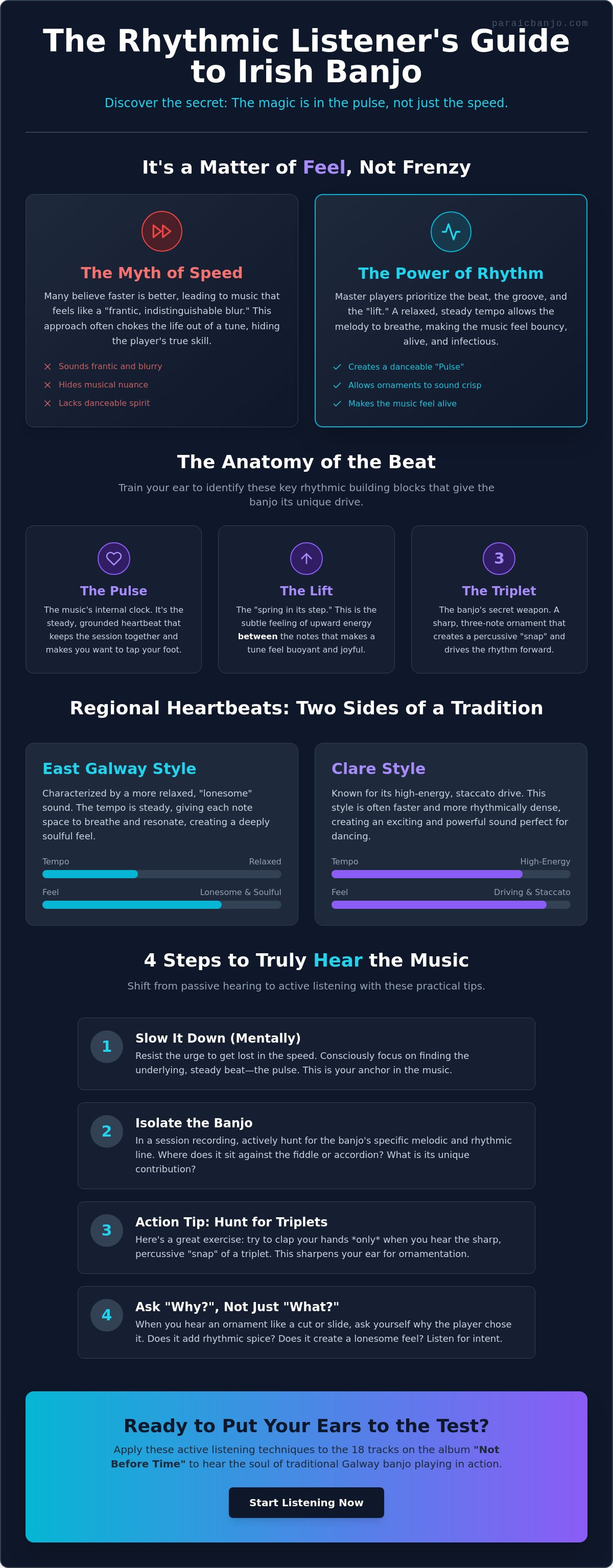
Active Listening: 4 Steps to Hearing the Nuance in Every Reel
Training your ears is a journey that takes patience, but it's the most rewarding work you'll ever do as a lover of Irish music. This listening guide to rhythmic tenor banjo is about moving beyond the surface level. You want to reach a place where you aren't just hearing a melody; you're feeling the intention behind every pick strike. Active listening requires you to be a detective. You have to hunt for the subtle shifts in timing and the percussive "pop" of the ornaments. Here are four practical steps to sharpen your focus during your next listening session.
Step 1: Isolate the Banjo. In a dense session recording, it's easy for the banjo to blend into the fiddle or accordion. Try to "filter" the other instruments out mentally. Pick one track and follow only the banjo from the first note to the last.
Step 2: Find the Pulse. Tap your foot to the underlying beat. Notice where the banjo sits. Is the player pushing "on top" of the beat for extra energy, or are they sitting "behind" it to create a more relaxed, rolling feel?
Step 3: Spot the Ornaments. Listen specifically for those triplets and trebles we discussed earlier. Try to anticipate where they fall in the phrase. Do they happen at the start of a bar to emphasize the beat, or are they used as a bridge between sections?
Step 4: Feel the 'Lift'. This is the most important step. Close your eyes and ask if the music makes you feel like you're moving forward. That upward momentum is the rhythmic soul at work. If you feel a physical urge to move, the player has succeeded.
Using Liner Notes as a Map
I've always believed that a great album should tell a story. That is why I included 36 pages of detailed notes with my debut album. Reading the history of a tune while the track plays helps you "hear" the tradition in the playing. It provides a map for the eighteen tracks, connecting the technical choices I made to the masters who came before me. If you want to dive deep into these stories, you can grab the digital album and liner notes to start your own active listening journey today.
The 'Live' Session Experience
There is a raw energy in a live session that is hard to replicate in a sterile studio. When you listen to a live recording, listen for the interaction between the musicians. You can often hear the "shout" of encouragement or the subtle "nod" that signals a change in the tune. My album features tracks recorded live in Pepper's Bar in Feakle, capturing that authentic atmosphere. For those who value this purity, searching for high-quality traditional irish session music cd recordings is the best way to hear how rhythmic banjo truly functions in its natural habitat. It's about the conversation, not just the notes.
Putting Your Ears to the Test: Exploring 'Not Before Time'
Now that you have the tools from this listening guide to rhythmic tenor banjo, it is time to put your ears to the test. The best way to master these concepts is to immerse yourself in a recording that lives and breathes the tradition. My debut album, Not Before Time – 39 Years in the Making, was designed to be more than just a collection of tunes. It is an 18-track masterclass in the rhythmic, soulful East Galway style. As you play through the record, I encourage you to apply the four steps we’ve discussed. Isolate the banjo line, find the pulse, spot the ornaments, and feel the lift. You’ll notice that the music doesn't rush; it rolls with an earthy, rooted energy that defines our regional sound.
We avoided sterile studio environments to ensure the music felt authentic. Many of these tracks were captured in the heat of a session, where the interaction between musicians creates a unique, spontaneous spark. You won't hear clinical perfection here. Instead, you'll hear the "shout" of encouragement and the percussive snap of the plectrum against the strings. It is a raw, honest representation of how the banjo functions as the heartbeat of a session. If you can hear the "soul" in these tracks, you’ve successfully trained your ears.
The 39-Year Journey to the Pulse
This album is a definitive statement of a lifetime's passion for the instrument. It took nearly four decades to bring this project to fruition because I wanted to ensure every note carried the weight of the tradition. I was joined by a group of expert collaborators who helped create a rich, driving wall of sound that supports the banjo without overshadowing its rhythmic nuances. Every track was recorded live to preserve the infectious enthusiasm and the natural "swing" that can only happen when musicians are playing in the same room. It is a celebration of the long-term development of a personal style, rooted deeply in the soil of Galway and Clare.
How to Secure Your Copy
Whether you are a dedicated collector or a newcomer to the scene, there are several ways to bring this music into your home. For those who want immediate, high-quality audio access to begin their listening journey, the digital album is the perfect choice. If you value the tactile experience, the physical CD comes with a 36-page booklet of liner notes that provide the historical context for every tune. You can even pick and choose individual digital tracks if a particular reel or jig catches your ear. Ready to hear the pulse for yourself? Grab your copy of Not Before Time today! It’s the best way to support the tradition while honing your own musical ear. Happy listening!
Hear the Heartbeat for Yourself
Mastering the Irish banjo is as much about the ears as it is about the fingers. You now have a solid listening guide to rhythmic tenor banjo that helps you look past melodic speed to find the true lift of a tune. Remember that the magic lives in those percussive triplets and the steady, grounded pulse of the East Galway style. By practicing active listening, you can finally hear the difference between a frantic performance and a soulful, rhythmic drive that makes a session feel alive.
This journey doesn't have to end with a few tips. My debut album, Not Before Time, was 39 years in the making and serves as a definitive statement of this tradition. It features 18 tracks of raw, live session music, complete with 36 pages of richly detailed liner notes for the purists who want to know the history behind every note. Experience the pulse; buy 'Not Before Time' directly from Páraic today. It's time to stop just hearing the notes and start feeling the soul of the music. See you at the next session!
Common Questions About Rhythmic Tenor Banjo
What is the difference between a jig and a reel on the banjo?
The main difference lies in the time signature and the resulting "feel" of the rhythm. Jigs are typically in 6/8 time, giving them a bouncy, swinging quality often described as a "humpty-dumpty" rhythm. Reels are in 4/4 time and have a more linear, driving pulse. On the banjo, you'll hear the plectrum accenting every third note in a jig, whereas reels demand a steady, alternating "down-up" picking pattern to keep the momentum moving forward.
How can I tell if a banjo player is using the East Galway style?
You can identify the East Galway style by its relaxed tempo and soulful, "lonesome" atmosphere. Unlike faster regional styles, East Galway players prioritize the "long note," letting certain melodic points ring out rather than filling every gap with ornamentation. It feels earthy and rooted. If the music sounds unhurried and invites you to lean in rather than just dance, you are likely hearing the influence of this specific Galway tradition.
Why are triplets so important in rhythmic tenor banjo?
Triplets are essential because they provide the banjo with its signature percussive snap. Since the banjo has a short sustain, these quick three-note bursts act as rhythmic punctuation that helps define the "lift" of a tune. In any listening guide to rhythmic tenor banjo, you'll find that triplets aren't just for show. They are functional tools used to emphasize strong beats and keep the session's engine running smoothly without needing excessive speed.
Is it better to listen to digital tracks or physical CDs for Irish music?
It often depends on whether you value immediate access or deep context. Digital tracks are perfect for high-quality audio on the go, making it easy to loop a specific phrase while you practice. However, physical CDs like Not Before Time are superior for purists because they include extensive liner notes. These notes act as a map, providing the history and stories that help you truly understand the rhythmic soul of the music you're hearing.
What does 'lift' mean in the context of traditional Irish music?
"Lift" refers to the feeling of upward momentum and infectious energy that makes a tune feel alive. It isn't about speed; it's about the subtle way a player accents certain notes to create a "bounce" in the rhythm. When a tune has lift, it feels effortless and makes the listener instinctively want to tap their foot. It is the rhythmic soul that separates a clinical, robotic performance from a masterclass in traditional playing.
Can I learn to play the tenor banjo by just listening to recordings?
Yes, listening is actually the traditional way most master players learned their craft. By immersing yourself in recordings, you absorb the nuances of phrasing, timing, and ornamentation that sheet music simply cannot capture. While you'll still need to practice the physical mechanics of the instrument, developing a "musical ear" through active listening is the most effective way to understand the heart of the rhythmic tenor banjo style and its regional variations.
Who are some famous rhythmic tenor banjo players I should listen to?
You should start by listening to legends like Barney McKenna, whose steady style set the standard for the modern era. Other masters of rhythmic drive include Kieran Hanrahan and Mike Moloney. Each of these players brought a unique pulse to the instrument. If you enjoy the relaxed, soulful East Galway approach, my own album features 18 tracks that focus specifically on that rhythmic heartbeat. You can find these recordings and more by exploring the individual digital tracks available on my site.
What should I look for in the liner notes of an Irish music album?
Look for details regarding the origin of the tunes and the specific players who influenced the artist. Good notes will tell you where a tune was collected and perhaps mention the technical settings, such as whether it was a live session recording. In a listening guide to rhythmic tenor banjo context, these notes provide the "why" behind the "what," allowing you to connect the sounds you hear to a centuries-old musical lineage and personal passion.


Comments