What is Session Music? From Studio Pros to the Heart of Irish Tradition
- Paraic Mac Donnchadha

- Jul 1
- 13 min read
Updated: Jul 6
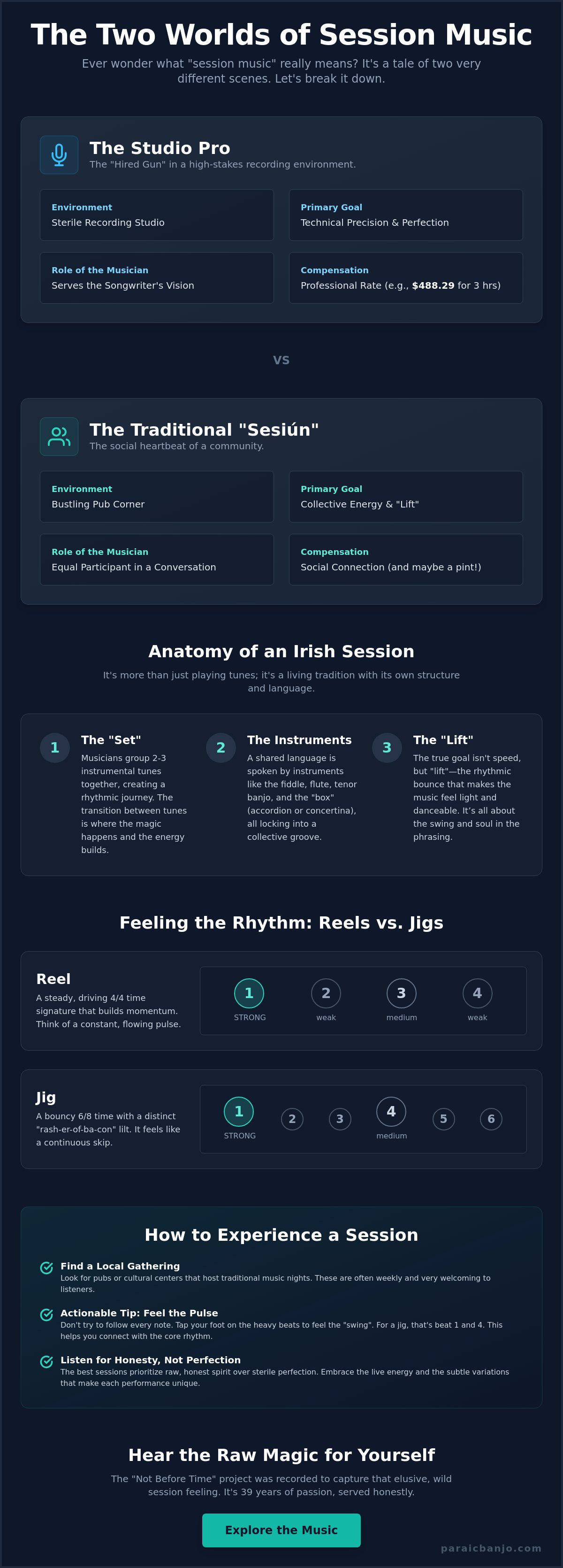
What if the most soul-stirring music you ever heard wasn't manufactured in a sterile studio, but sparked to life in the back of a bustling Irish pub? It's easy to get tangled up when asking what is session music because the term wears two very different hats. You might be thinking of the elite "hired guns" who command professional rates, like the $488.29 AFM scale for a three-hour studio date. Or, you might be dreaming of that raw, social magic where fiddles and flutes weave together in a local tavern. It's a common point of confusion that can make traditional music feel like a closed-off club, but it doesn't have to be that way.
You're about to discover the dual meaning of the term and learn how to experience the raw energy of an authentic Irish music session for yourself. We'll explore the professional world of studio pros and dive deep into the social heartbeat of traditional gatherings. This guide offers practical tips on session etiquette and shows you how to find recordings that capture that elusive "live" feel without the over-produced fluff. Whether you're a curious listener or a budding player, it's time to pull up a chair. Let's explore a storied tradition where the tune is always the guest of honor.
Table of Contents
Defining Session Music: The Professional vs. The Traditional
When you ask what is session music, you're really stepping into two different worlds that happen to share the same name. On one side, you have the high-stakes recording studio where time is money and precision is everything. On the other, you have the warm, dimly lit corner of an Irish pub where the music is a social lifeline. Understanding this divide is the first step toward truly appreciating the tunes. It's the difference between a meticulously crafted product and a living, breathing conversation between friends. For the listener, knowing which "session" you're looking for changes how you hear the heart of the music.
The Studio Session Musician
In the professional recording industry, a session musician is the ultimate "hired gun." These artists are chosen for their incredible technical versatility and their ability to nail a part in just one or two takes. Think of legendary groups like The Wrecking Crew, who played on thousands of hits in the 1960s, or the elite players who gave Steely Dan their signature polished sound. It's a work-for-hire world. A pro might provide a soulful cello line for a ballad in the morning and then switch to a driving rock bass part after lunch. Their job is to serve the songwriter's vision with absolute accuracy, often leaving their own ego at the studio door.
The Traditional Irish Session (Sesiún)
Step away from the mixing desk and into a traditional Irish "sesiún," and the vibe transforms completely. Here, the music is a democratic, community-led event. There is no formal stage and no velvet rope. Instead, musicians sit in a tight circle, creating a shared pulse that invites everyone in the room to feel the "lift" of the rhythm. This isn't just about playing notes; it's about preserving a legacy. In regions like East Galway, the session is where we keep our local identity alive through a relaxed, melodic flow. It’s a place where a teenager can sit next to a master who’s been playing for eighty years, and for that moment, they are equals in the service of the tune.
The way we play in a session is fundamentally different from a solo stage performance. On stage, you might show off with complex variations. In a session, you play for the collective energy. You're looking for that "swing" that makes people tap their feet without even realizing it. If you want to hear that raw, unforced spirit captured on record, you can find it in the Not Before Time – 39 Years in the Making (Digital Album). We worked hard to ensure the recording felt like you were sitting right there in the circle with us. It’s about honesty over perfection, and that’s what makes the tradition so infectious.
The Anatomy of an Irish Music Session
To truly grasp what is session music, you have to look at the "tune" as the currency of the room. In these informal gatherings, we don't play songs with lyrics most of the time. Instead, we trade instrumental melodies that have been passed down through generations. These tunes are rarely played in isolation. We group them into "sets," usually stringing two or three together. This transition from one tune to the next is a pivotal moment. It’s where the energy shifts and the room starts to lift. It’s a shared language spoken by the tenor banjo, the fiddle, the flute, and the "box," which is what we call the accordion or concertina.
The magic happens when these instruments lock into a collective groove. While speed often gets the headlines, any seasoned player will tell you that "lift" is the real goal. Lift is that rhythmic bounce that makes the music feel light and danceable, regardless of the tempo. It’s about the swing and the soul of the phrasing rather than just how many notes you can cram into a second. If the rhythm doesn't make you want to move, the session hasn't found its heart yet.
Reels and Jigs: The Heartbeat
The two most common pulses you'll hear are the reel and the jig. A reel is played in 4/4 time, giving it a steady, driving feel that’s perfect for building momentum. A jig, on the other hand, lives in 6/8 time. It has a distinct "rash-er-of-ba-con" lilt that feels like a constant skip or a bounce. If you’re trying to find the pulse, here’s a practical tip: don't try to follow every note with your foot. Instead, tap on the heavy beats of the measure. For a jig, that’s the 1 and the 4. This helps you feel the "swing" rather than getting lost in the melody. You can hear this rhythmic interplay captured beautifully in many traditional irish session music cd collections, where the focus is on that authentic, unpolished drive.
Regional Flavours: Galway vs. Clare
Even though the tunes might be the same, the way we play them changes depending on where you are. It’s like a local accent for your instrument. In Clare, the music often has a steady, rhythmic pulse that’s incredibly grounded. Move over to East Galway, and you’ll find a style that is often more relaxed and melodic, focusing on the sweetness of the tune itself. Understanding the difference between east galway vs clare music helps you appreciate the subtle nuances that make this tradition so deep. If you're ready to hear this regional soul in action, I invite you to listen to individual digital tracks from my debut album, where the East Galway style takes center stage.
Studio Recording vs. Live Session Energy
A studio can be a lonely place for a traditional player. You're often surrounded by soundproof foam and glass, wearing heavy headphones that cut you off from the natural room sound. It's the polar opposite of a crowded pub where the heat, the clinking of glasses, and the low hum of conversation are part of the performance. When people ask what is session music, they're usually looking for that spark of spontaneous joy. Capturing that "wild" energy inside a sterile recording booth is the greatest challenge we face. If you aim for absolute technical perfection, you often end up killing the very soul of the tune. The music becomes a museum piece rather than a living, breathing thing. It loses the "lift" that makes it special.
The Problem with Over-Production
Purists in the tradition often shy away from "slick" productions. We sometimes call this Celtic pop. While it's technically impressive, it lacks the grit and honesty of the real thing. To find authentic celtic music, you need to listen for the human elements. I want to hear the "click" of the plectrum on the banjo strings. I want to hear the "breath" of the flute player between phrases. These aren't mistakes. They are the textures of a real performance. When a recording is too clean, it loses its connection to the pub floor. It stops being a session and starts being a manufactured product.
Preserving the Live Conversation
The best way to keep that energy is to record the way we play: together. For my debut album, we recorded 18 tracks live in the studio to maintain a consistent vibe. We didn't layer instruments one by one over several weeks. Instead, we sat in a circle and played. This allows for a "live conversation" where musicians can answer each other. If the fiddle player adds a little flair, the banjo can respond in real-time. It creates a sense of momentum that you just can't manufacture with digital editing. It’s about the collective pulse of the group.
Liner notes play a huge role in this experience too. They act as a secret map, giving you the history of where the tunes came from and who taught them to us. This provides the context that makes the listening experience feel deeply personal. If you want to hear how we balanced that studio clarity with raw session heart, you can explore the Not Before Time – 39 Years in the Making (Physical CD). It’s a definitive statement of a lifetime’s passion, captured without losing the spirit of the room. Grab your copy and join the journey.
Actionable Tips: How to Experience Session Music
Stepping into your first session can feel like entering a private club, but I promise you, the door is always open to those who listen with an open heart. When you're trying to find a local gathering, look for pubs that list "trad sessions" on certain nights. You'll usually find us tucked into a corner, huddled around a table. It’s the perfect place to see what is session music in its most natural habitat. You aren't just there to hear a performance; you’re there to witness a community sharing their history through sound. It’s a living, breathing thing that needs an audience as much as it needs the players.
The Listener’s Guide to Etiquette
There are a few unwritten rules that make the experience better for everyone. My biggest piece of advice is this: don’t treat the session like a stage show. It’s a conversation. If you walk in and start shouting over the music, you miss the subtle nuances of the "lift." Wait for the end of a set before you let out a cheer or start clapping. A set is usually three tunes played back-to-back without stopping. Clapping in the middle can break the musicians' concentration as they try to transition into the next reel. If you really enjoy what you hear, the best way to keep the music going is by buying traditional irish music direct from artist. It’s a direct way to support the tradition without it getting lost in big corporate pockets.
Training Your Ear
At first, the music might sound like a whirlwind of notes. To really appreciate it, try to focus on one instrument at a time. Pick out the tenor banjo and follow its rhythmic "pluck" through the set. Notice how it locks in with the fiddle or the flute. You’ll start to hear how the tempo subtly shifts. It isn't a mechanical beat; it’s a human pulse that builds as the energy in the room grows. I always suggest looking for recordings that list the specific "Tune Names." This helps you build your own mental library of the repertoire. Once you know the names of the tunes, you’ll start recognizing them everywhere you go.
If you want to start your own collection with something that carries the true spirit of the pub, I invite you to explore my Not Before Time – 39 Years in the Making (Digital Album). It’s packed with the tunes I’ve played for decades, recorded with the same energy we bring to the corner of the bar. You can grab the full album here and bring a piece of the session home with you today.
Not Before Time: A 39-Year Session Captured
After decades of sitting in that circle, I’ve realized that a session isn’t just a night out; it’s a lifetime of listening. This project has been bubbling under the surface for nearly forty years. I didn't want to rush into a studio just to have a product on a shelf. I wanted to wait until the tunes felt like a part of my own skin. When people ask me what is session music after hearing the energy on this record, my answer is simple: it’s the sound of musical souls who finally found the right moment to speak. Not Before Time – 39 Years in the Making (Digital Album) is my definitive statement on that journey. It’s a celebration of the East Galway style, captured with the help of musicians who understand that the "lift" of the rhythm is sacred.
To recreate that authentic pub feel, I didn't record this as a solitary artist. I brought in expert collaborators to ensure the tracks had that live, conversational spark we discussed earlier. We didn't use click tracks or artificial layers. Instead, we let the 18 tracks breathe, allowing the natural tempo shifts and the "swing" of the instruments to take center stage. It’s a masterclass in the very tradition we’ve been exploring throughout this guide. If you want to hear how a lifetime of experience translates into sound, this is the place to start.
The Soul of the Tenor Banjo
My approach to the tenor banjo is rooted in a rhythmic, soulful style that prioritizes the melody’s heart over sheer speed. On this album, the banjo doesn't just play notes; it drives the set forward with a steady, infectious pulse. Each of the 18 tracks was carefully selected to represent the tunes that have shaped my life. You can read more about the deep history behind these selections in my Not Before Time – 39 Years in the Making pillar post. It’s a deep dive into the stories that make the music what it is today.
A Gift for the Purist
If you’re a collector who values authenticity, the physical version of this debut is for you. The Not Before Time – 39 Years in the Making (Physical CD) comes with extensive historical liner notes. These aren't just names on a page. They are a secret map of the tradition, detailing where the tunes came from and the masters who passed them down. It’s the perfect way to train your ear and deepen your connection to the West of Ireland sound. Here’s a quick tip: follow the liner notes as you listen to identify the subtle regional variations in each set. It transforms the listening experience into a true education. I invite you to explore the tracks and order your copy today to bring the heart of the session into your own home. It’s been a long road, but the music is finally ready for you.
Keep the Music Alive in Your Own Home
You’ve journeyed from the high-pressure recording booths of the professional world to the rhythmic heart of an East Galway pub corner. By now, you’ve seen that what is session music isn't just one thing. It’s a professional standard for some, but for us, it’s a social lifeline built on shared tunes and a collective pulse. You know how to spot the "lift" in a set of reels and how to respect the unwritten rules of the circle. Most importantly, you know that the best music isn't about sterile perfection; it’s about the living conversation between players.
Taking that wild energy home doesn't have to mean settling for over-produced tracks that lose their soul. My debut album features 18 tracks recorded live with a group of expert collaborators to ensure every note carries that authentic session spark. With the East Galway rhythmic banjo style at its core and detailed historical liner notes to guide your ear, it’s a definitive statement of a lifetime’s passion. Bring the authentic sound of an Irish session home with "Not Before Time". Whether you’re an aspiring player or a dedicated listener, there’s always a seat at the table for someone who loves the music. Keep the tunes going!
Frequently Asked Questions
What is the difference between a session musician and a session?
A session musician is a professional hired to record specific parts in a studio, while a "session" is a social gathering of traditional players. The studio pro works for hire to fulfill a songwriter's vision. In contrast, a traditional session is a community event where we share tunes for the joy of the craft. Understanding this distinction helps you know what is session music in its most authentic, social form.
Can anyone join an Irish music session?
Most sessions are open to players, but it is best to have a solid grasp of the repertoire before you jump in. If you are a beginner, look for "slow sessions" specifically designed for learners. Always listen for a few sets first to understand the room's energy. It is a polite gesture to ask the lead musicians if they mind you joining the circle before you unpack your instrument.
What instruments are typically found in a traditional session?
You will almost always hear the tenor banjo, fiddle, flute, and "the box," which is our common name for the button accordion. Other frequent guests include the concertina, tin whistle, and uilleann pipes. While a guitar or bouzouki often provides rhythmic backing, the melodic instruments are the stars. These instruments work together to create the driving, collective pulse that defines the traditional sound.
How long does a typical music session last?
A typical gathering usually lasts between two and four hours, depending on the energy of the players and the pub's hours. It often starts with just two or three musicians and grows as others arrive throughout the night. There isn't a strict setlist or a formal schedule. The music continues as long as the "lift" remains high and the tunes keep flowing between the participants.
Why is it called a "session"?
The term describes the act of musicians "sitting down" for a dedicated period to share tunes. In the Irish language, we call it a "sesiún." It isn't a rehearsal or a formal stage show; it is an informal sitting where the music is the primary focus. This relaxed structure allows the conversation between instruments to happen naturally without the pressure of a ticking studio clock.
Do session musicians get paid for pub sessions?
Most players in traditional sessions do not get paid; we play for the social connection and the love of the music. Occasionally, a pub might pay a "leader" to ensure the music stays at a high standard and starts on time. For the rest of us, the reward is the chance to lock into a great set. It is about community rather than a commercial transaction.
What are the most common tunes played in a session?
Reels and jigs are the bread and butter of the tradition. If you are wondering what is session music in its most common form, listen for the 4/4 drive of a reel or the 6/8 bounce of a jig. You will frequently hear classics like "The Mason's Apron" or "The Kesh Jig." These tunes act as a shared language that musicians from different counties can all speak together.
Is session music the same as "Celtic" music?
Not exactly; session music is a living tradition, while "Celtic" is often a broad marketing term used for commercial recordings. Session music focuses on the raw, instrumental interplay of players in a room. It prioritizes the rhythmic pulse and the "lift" over the polished, vocal-heavy arrangements found on generic compilations. It is an honest, unpolished experience that values the tune above all else.


Comments