What to Listen for in Session Music: Finding the Heartbeat of Tradition
- Paraic Mac Donnchadha

- Jul 31
- 13 min read
Have you ever sat in a crowded pub, surrounded by the blur of fiddles and whistles, and wondered if you were missing the secret language hidden behind the speed? It's easy to feel overwhelmed when a set of reels takes flight. You might find yourself searching for a foothold in the raw energy that feels so different from a clinical studio recording. Understanding what to listen for in session music isn't about counting beats or memorizing every note. It's about learning to feel the pulse of a tradition that's been breathing for generations.
I know that feeling of being a newcomer to the circle. It's a lot to take in. I'm going to help you tune your ears to the subtle "lift" that makes a tune dance and the rhythmic nuances that define the East Galway and Clare styles. You'll learn to identify the unique roles of each instrument and how they collaborate to create that soulful, infectious energy. We'll even look at how the tracks on my album, Not Before Time, serve as a masterclass for these regional sounds. By the time we're finished, you'll be able to hear the difference between a simple melody and a living, breathing piece of Irish history.
Table of Contents
Defining the Two Worlds of Session Music
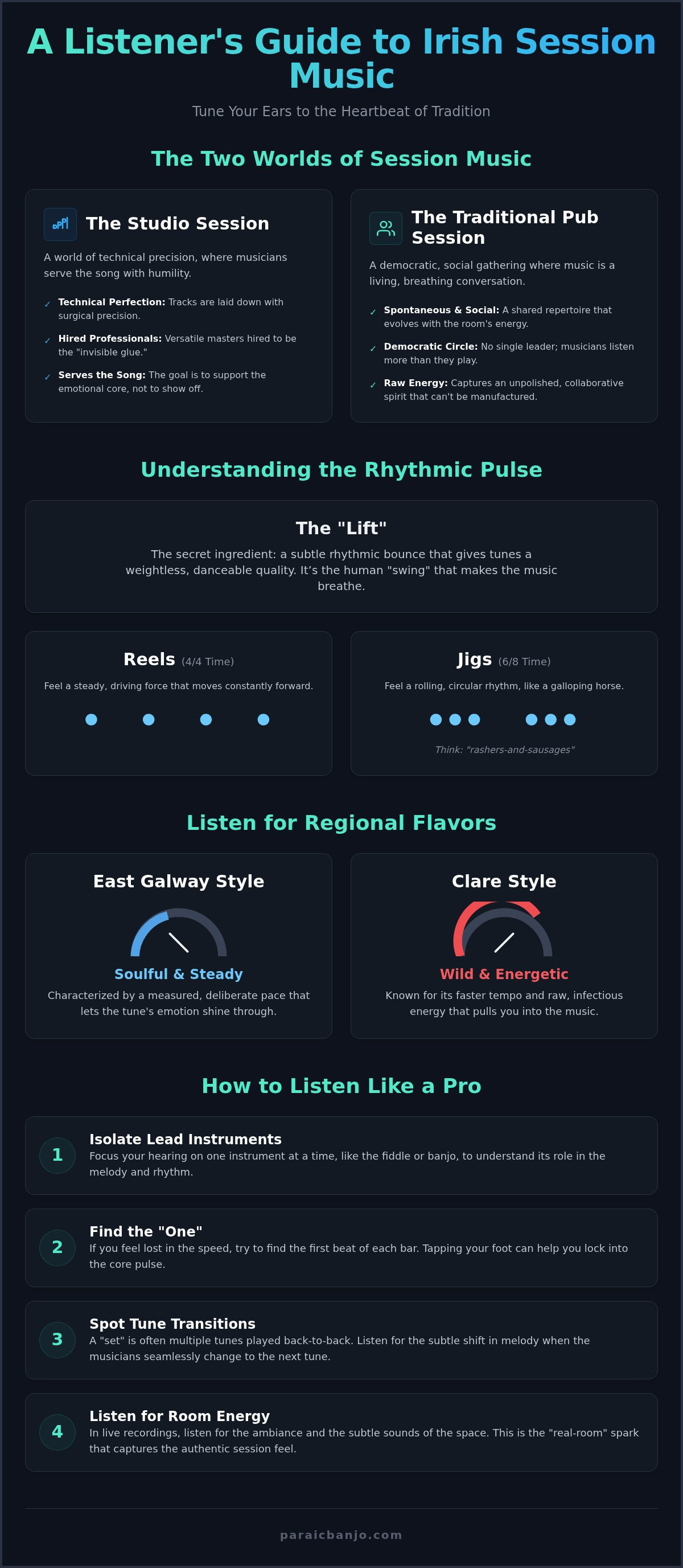
When you hear the word "session," your mind might jump to two very different places. One is a high-tech studio where professional "hired guns" lay down tracks with surgical precision. The other is a warm, dimly lit pub corner where a group of friends shares tunes over a few pints. Knowing what to listen for in session music depends entirely on which of these worlds you've stepped into. While they look different, they share a common soul: the art of the "pulse." In both cases, the best players aren't the ones shouting the loudest. They're the ones listening the hardest.
The Studio 'Hired Gun' Experience
In the professional world, session musicians are the unsung heroes of the music industry. These are technical masters hired for their versatility and their ability to read the room instantly. They aren't there to take the spotlight. Instead, they act as the invisible glue that holds a track together. When you listen to a professional studio session, you're hearing technical perfection served with humility. The goal isn't to show off a flashy solo; it's to serve the song's emotional core and maintain a steady, reliable foundation.
Actionable Tip: To truly appreciate this level of skill, go back and listen to the classic hits of the 1960s. Pay close attention to the work of the "Wrecking Crew." These musicians played on thousands of recordings, and their influence is a masterclass in how to support a lead singer without ever getting in the way. You can apply this same focused listening when you explore my own traditional Irish session music cds, where the focus is always on the collective sound rather than the individual ego.
The Traditional Irish Session: A Living Conversation
The Irish traditional music session is something else entirely. It's a democratic, social gathering. There is no "boss" in the circle. Instead, it's a living room for the community's shared repertoire. Spontaneity is the key ingredient here. Because there's no set program, the music evolves based on who is in the room and the energy of the crowd. It’s a conversation where tunes are swapped like stories. No two sessions ever sound the same, and that’s the beauty of it.
In this setting, the best musicians are those who listen more than they play. They adapt their style to match the "lift" of the group. Learning what to listen for in session music is about recognizing that collaborative spirit. The banjo might provide a sharp, rhythmic drive, while the fiddle adds a melodic flow. They aren't competing. They're collaborating to create a single, driving heartbeat. This raw, unpolished energy is exactly what I wanted to capture on my album, Not Before Time: 39 Years in the Making. By recording live with my fellow musicians, we kept that "real-room" spark that you just can't manufacture in a booth. Whether you're listening to a studio pro or a group of friends in Galway, the goal is always a cohesive sound. No single instrument should dominate. Instead, listen for how the group finds the pulse together. It's that steady, infectious rhythm that makes your foot tap before you even realize you're doing it.
The Soul of the Set: Understanding the Rhythmic Pulse
To truly understand what to listen for in session music, you have to look past the surface melody and find the pulse. This is the steady, driving heartbeat of the room. It isn't just about keeping time like a metronome; it's about the "lift." This is that subtle rhythmic bounce that makes a reel feel like it’s floating rather than just running. When a set has lift, it feels effortless and danceable. Without it, the music can sound heavy or clinical, much like a robotic MIDI file. Traditional players use a natural "swing" to give the notes a human, breathing feel. In many West of Ireland sessions, the tenor banjo acts as the rhythmic engine. Its percussive nature provides a sharp, clear foundation that helps every other instrument stay locked into the groove.
Reels vs. Jigs: Hearing the Time Signatures
Distinguishing between tune types is the first step for any listener. Reels are in 4/4 time. They have a steady, driving force that moves forward with a constant energy. Jigs, however, are in 6/8 time. They have a rolling, circular feel that mimics a galloping horse. We often describe the jig rhythm using the phrase "rashers-and-sausages." If you say that phrase out loud with a bit of a bounce, you’ll hear the triplet pattern that defines the dance.
Actionable tip: If you feel lost in the speed of a session, try to find the "one." This is the first beat of every bar. Tap your toe only on that specific beat. It will keep you grounded and help you hear the underlying structure of the set even when the notes are flying by.
The Interplay Between Instruments
A great session is a complex weave of sound. You have the banjo, fiddle, and flute all playing the same melody in unison, but each adds its own distinct flavor. Listen for the subtle variations in ornamentation. These are the small "extra" notes, like cuts or rolls, that players add to decorate the melody. A roll is a quick succession of notes played in the space of a single beat to add texture and rhythmic interest.
The real magic happens when players listen to one another more than they play themselves. They adjust their volume and timing to match the collective energy of the group. If you want to hear this interplay in a clear, accessible way, you can explore my digital album "Not Before Time." It features 18 tracks recorded live, providing a perfect opportunity to hear how instruments collaborate to create a single, soulful pulse without any one player dominating the circle. It’s a masterclass in the art of the shared tune.
Regional Flavours: Listening for East Galway and Clare Styles
Just as a local accent tells you exactly where a person was raised, a musician's style tells a story of their home county. In the West of Ireland, the border between Galway and Clare isn't just a line on a map. It's a shift in the very soul of the tunes. When you're trying to figure out what to listen for in session music, identifying these regional flavours is like moving from a black-and-white sketch to a full-colour painting. It adds a layer of depth that helps you appreciate why a certain set feels "right" in a specific corner of a pub. It’s about the atmosphere as much as the notes.
East Galway: The Soulful Steady Beat
The East Galway style is often described as "soulful" and "steady." It isn't about blinding speed or flashy technical displays. Instead, it’s about the space between the notes. Players from this region tend to favour a slightly slower tempo, allowing the melody to "breathe" and the rhythm to settle into a deep, infectious groove. This is exactly what I’ve spent my life pursuing. Understanding the east galway vs clare music distinction is vital for anyone who wants to hear the music as more than just background noise.
In contrast, the Clare tradition often carries a "wild" or "lonesome" energy. It can be faster, with a driving intensity that feels like it’s pushing against the edges of the bar. While both styles are beautiful, the East Galway approach is where my heart lies. It’s a rhythmic conversation that values the "lift" I mentioned earlier, but with a more grounded, deliberate feel. It’s a style that invites you to sit back and truly soak in the melody.
Actionable Tip: Next time you listen to a recording, pay close attention to the tempo. If the musicians seem to be leaning back into the beat rather than rushing ahead of it, you’re likely hearing that classic East Galway influence. Try tapping your foot slowly and see if the music feels like it's "sitting" comfortably on that beat.
The Influence of the Masters
My own "ear" for the music didn't develop overnight. It’s the result of 39 years spent sitting in circles with the old-timers, the masters who carried these tunes before they were ever written down. When you know what to listen for in session music, you start to hear the ghosts of these earlier players in modern recordings. You might hear a specific way of "cutting" a note; that's a quick flick of a finger that separates two notes of the same pitch to add a rhythmic "pop." These tiny details are the signatures of the masters.
My album, "Not Before Time - 39 Years in the Making," is my definitive statement on this heritage. I wanted to capture that specific East Galway rhythmic soul that I learned from my collaborators over the decades. It’s not just a collection of tracks; it’s an invitation to hear the tradition as it was meant to be heard. You can pick up the Physical CD to read the extensive liner notes, which I’ve written to act as a guide for your own ear training. They help you connect the sounds you hear to the history of the men and women who kept this music alive for us to enjoy today.
How to Listen Like a Pro: A Beginner’s Ear Training Guide
Now that you’ve got a handle on the regional flavours, let’s get down to the brass tacks of training your ears. Moving from a casual fan to an active listener takes a bit of practice, but it makes the experience so much more rewarding. When you know what to listen for in session music, you aren't just hearing a wall of sound. You’re hearing a structured, intentional conversation between masters of their craft. It’s about peeling back the layers to see how the whole thing is built.
Step 1: Isolate the lead instrument. Pick one voice to follow, like the banjo. Follow the melody as it cuts through the mix, noticing how it interacts with the other voices in the room.
Step 2: Identify the 'Set'. Listen for the "change." Most sets consist of three tunes played back-to-back. There is a split second where the leader signals the next tune; it’s a moment of collective focus where the energy often kicks up a gear.
Step 3: Focus on ornamentation. Listen for the "flicks." These are sharp, quick grace notes that add a bit of sparkle to a phrase. They’re like the seasoning on a good meal, adding texture without changing the main ingredients.
Step 4: Gauge the 'Energy'. Is the session building up to a peak, or is it staying in that deep, steady East Galway groove? Some sets are designed to peak, while others aim for a consistent, hypnotic flow.
Step 5: Check the context. Read the stories behind the tunes. My liner notes provide the historical background you need to understand where these melodies actually come from.
The Art of Active Listening
Active listening means moving the music from the background of your mind to the very front. You want to achieve a state of deep immersion. Close your eyes and try to imagine where each musician is sitting in the room. Can you hear the fiddle to your left and the flute to your right? This is why live-recorded albums are so much better for training your ear than over-produced studio tracks. You get the real room sound, including the natural pauses and the shared breath of the players. If you're ready to put these steps into practice, you can grab the Digital Album and start your own ear training journey today.
Identifying the 'Good' from the 'Bad'
A bad session often feels like "clutter." It happens when too many instruments are fighting for space, and no one is listening to the person next to them. It’s like a room full of people shouting. The hallmark of a great session is when everyone is locked into the same rhythmic pulse. It feels like a single, powerful unit. For purists, this authenticity is far more important than technical perfection. We'd rather hear a few "wrong" notes played with the right soul than a perfect performance that has no heart. When the group finds that shared heartbeat, that’s when the real magic happens.
Bringing the Pub Home: Capturing Live Session Energy on Record
Capturing the magic of a session on a record is like trying to catch lightning in a bottle. You need that raw, unpolished energy we've been talking about. When you are learning what to listen for in session music, you need recordings that haven't been scrubbed clean of their soul. Most studio albums are recorded one instrument at a time in isolated booths. This kills the "conversation" that makes a session special. To keep the tradition alive, seek out independent irish music releases that prioritize the room's energy over digital perfection. This is how we ensure the heartbeat of the West of Ireland keeps thumping for the next generation. When you know what to listen for in session music, every track becomes a lesson in timing and soul.
Supporting the source is about more than just buying a track. It's about preserving a way of life. When you buy direct, you're helping to fund the next generation of recordings that capture this elusive "raw" energy. Authentic recordings provide a baseline for your ears. They teach you what a real room sounds like, without the artificial reverb or heavy editing that plagues many modern folk albums. It’s about the truth of the tune.
The 'Not Before Time' Experience
With 18 tracks recorded live alongside expert collaborators, "Not Before Time" acts as a "session in a box." It represents 39 years of my life spent in those very circles. You aren't just hearing a performance. You’re hearing the interaction between players who have known each other’s styles for decades. It is the perfect tool for your ear training because the sound is honest and transparent. The album focuses on that rhythmic, soulful East Galway style we’ve explored, making it a definitive statement of our regional heritage.
Actionable tip: Start with the very first track on the album. Close your eyes and listen specifically for how the banjo sets the pulse for the rest of the group. Once you hear that driving engine, you'll find it much easier to follow the flute and fiddle as they weave in and out of the melody. It’s a great way to practice the active listening skills we’ve discussed.
How to Buy Direct from the Artist
There is a real joy in buying traditional Irish music direct from the artist. It cuts out the middleman and ensures the support goes straight back into the craft. You can choose individual digital tracks if you want to focus on a specific tune, or the full digital album for instant immersion. Many purists still prefer the physical CD. There’s something special about holding the sleeve and reading the background notes while the music plays. It grounds the auditory experience in a physical piece of history. The wait for this debut has been long, but the result is a definitive statement of a lifetime's passion. Experience the authentic pulse of East Galway-Order 'Not Before Time' now.
Tune Your Ears to the Heart of the Tradition
You now have the practical tools to move beyond the surface speed and find the true heartbeat of the tunes. From spotting the "lift" in a reel to distinguishing the soulful, steady pace of East Galway from the wilder energy of Clare, your ears are becoming tuned to the deep nuances of our tradition. Understanding what to listen for in session music is a journey that never truly ends. It’s a lifelong conversation with the masters of the craft that gets richer with every set you hear. The music is a living thing, and you're now part of the circle.
This is exactly why I spent 39 years preparing my debut album. It’s a masterclass in that authentic East Galway rhythmic style, featuring 18 tracks recorded live to capture the real room energy of expert collaborators. You can Order 'Not Before Time' and bring the authentic Irish session into your home. Whether you choose the digital tracks or the limited edition physical CD with its extensive background notes, you’re taking a piece of this living history with you. Keep listening, keep tapping your feet, and enjoy the craic.
Frequently Asked Questions
Is session music a specific genre or a way of playing?
Session music is a traditional way of performing Irish tunes in a communal, informal setting. It isn't a separate genre from traditional music; rather, it’s the heartbeat of how the music lives. When you sit in a circle, the focus is on the collective sound instead of a solo performance. This format allows the tunes to breathe and evolve through shared energy.
What is the difference between a jam session and an Irish music session?
The main difference is that Irish sessions rely on a shared repertoire of fixed melodies played in unison. In a typical jam session, musicians often improvise new parts over a chord progression. In our tradition, we all play the same tune together. The creativity comes from the subtle ornaments and variations we add to that shared melody.
Why do Irish musicians play the same tune multiple times in a row?
We play each tune multiple times, usually three, to allow the group to find a shared rhythmic pulse. The first time through is often about getting everyone on the same page. By the third time, the music has settled into a deep groove. This repetition is what creates the driving energy that makes Irish music so infectious.
Can I join a session if I only know a few tunes?
You can certainly join, but it's best to wait for a tune you know inside out. Listening is just as important as playing. If a set starts and you don't recognize the melody, it's polite to sit back and soak it in. Joining only when you're confident keeps the session's energy tight and respectful for everyone.
What instruments should I listen for in a traditional Irish session?
You should listen for the core melodic instruments like the fiddle, flute, and tenor banjo. These often carry the main weight of the tune. You might also hear the rhythmic backing of a guitar or bouzouki, or the distinct drone of the uilleann pipes. Each instrument adds a unique texture to the overall conversation.
How do I know if a session recording is 'authentic'?
An authentic recording usually features a live room sound where you can hear the natural interaction between players. When you're figuring out what to listen for in session music, look for tracks that haven't been heavily edited or over-produced. My album, Not Before Time, was recorded live specifically to preserve this raw, honest energy that studio booths often kill.
What does the term 'lift' mean in Irish music?
The term lift refers to the rhythmic bounce and lightness that makes a tune feel danceable. It’s that feeling of weightlessness that occurs when the group is perfectly in sync. When you know what to listen for in session music, you'll notice that lift is what separates a mechanical performance from a soulful, breathing one.
Do session musicians get paid for playing in pubs?
Most musicians in open sessions are not paid a formal fee; they play for the love of the craft and the social connection. However, some venues pay a small amount or provide drinks to session leaders. These are the experienced players who ensure the music stays at a high standard and the energy remains high throughout the night.


Comments