A Guide to Irish Music Sessions: Etiquette, Styles, and the Living Tradition
- Paraic Mac Donnchadha

- 4 days ago
- 15 min read
An Irish music session isn't a performance for an audience; it's a democratic conversation where the most important instrument you bring is your ears. You've likely walked into a dimly lit pub, felt the lift of a fiddle, and wanted to pull up a chair, yet hesitated because you didn't want to break the "flow." It's natural to feel like an outsider when you don't know whether to clap after a set or how to tell a quick reel from a bouncy jig. This is a guide to irish music sessions designed to peel back the mystery of the circle. I'll help you understand the unwritten etiquette and the rhythmic soul of the tradition so you can listen, play, and belong.
We're going to dive into the social nuances that keep a session alive. You'll learn to identify regional styles and discover how to find the authentic recordings that serve as the best teachers. Whether you're planning to join the 800,000 visitors expected at the Fleadh Cheoil na hÉireann in Belfast this August or just want to respect the local players at your neighborhood pub, the music is a living thing. Let's make sure you're ready to be part of the pulse.
Key Takeaways
Learn how to respect the physical "playing circle" and identify the lead musician to ensure the spontaneous flow of the night remains uninterrupted.
Use this as a guide to irish music sessions to help you distinguish between the driving pulse of Clare and the soulful, lyrical pace of the East Galway style.
Arrive early to secure a seat that keeps you close to the tunes but outside the musicians' space, ensuring you're a welcome part of the atmosphere.
Discover why authentic, "live-feel" recordings are the best way to study the tradition's soul and bring that infectious energy into your own home.
Table of Contents
What is an Irish Music Session? Understanding the Living Conversation
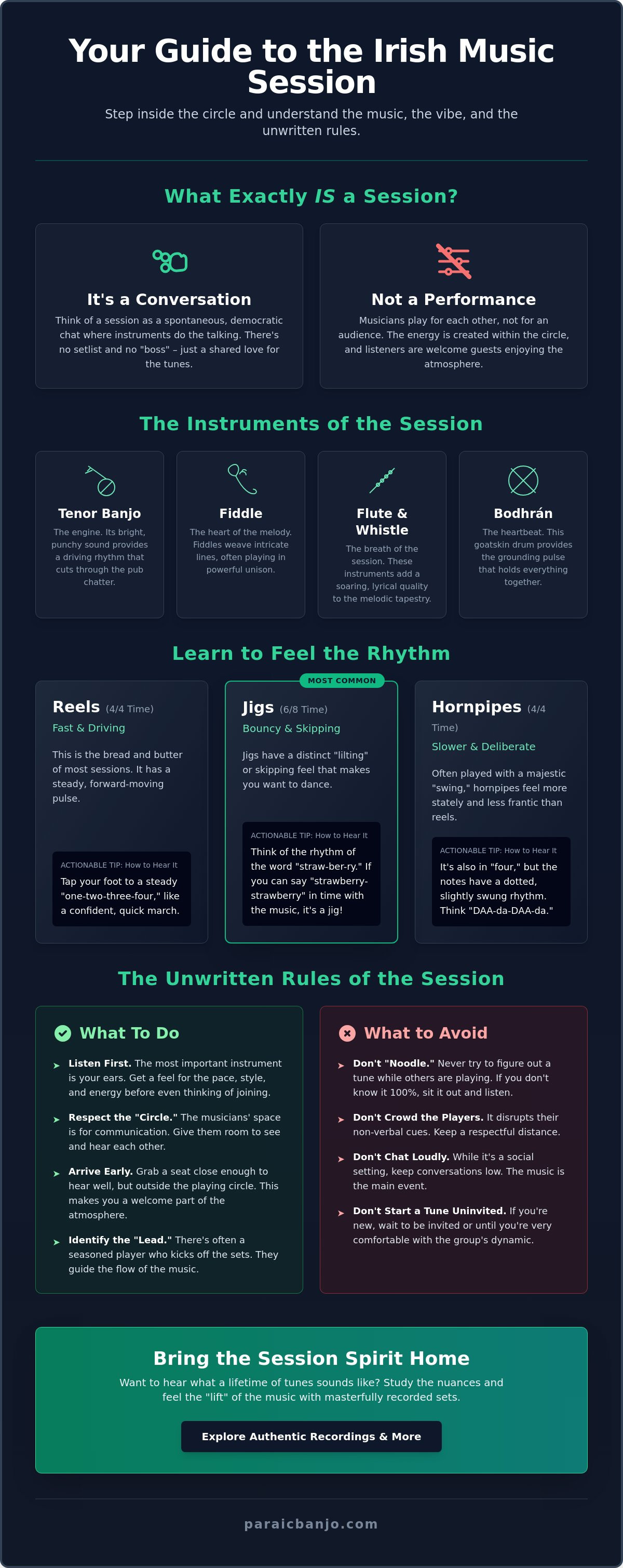
Imagine walking into a corner of a pub where the air is thick with the scent of stout and the bright ring of a tenor banjo. That is the essence of an Irish traditional music session. It's an informal gathering, often called a 'seisiún,' where musicians meet to share tunes they've known for a lifetime. Unlike a rehearsed concert with a set list and a stage, a session is a spontaneous, democratic exchange. It's a conversation where no one is the boss, but everyone is listening. In 2026, these gatherings remain the heartbeat of Irish identity because they aren't stuck in a museum. They live in the 'snug' or the back corner of a local bar, evolving every time a new player joins the circle.
Think of this as a guide to irish music sessions for anyone who wants to move past being just a spectator. The 'snug' isn't just a place to sit; it's a sacred space for an oral tradition that has survived for centuries. It’s about the 'lift' in the music, that feeling when the rhythm takes over and the room starts to breathe as one. If you can't make it to a pub tonight, you can bring that same storied tradition into your living room with the digital album Not Before Time – 39 Years in the Making. It captures that raw, infectious enthusiasm that defines the best sessions.
The Core Instruments of the Session
Every session has its own unique texture. The tenor banjo provides a rhythmic, driving pulse that cuts through the chatter of a busy room. Fiddles, flutes, and tin whistles act as the melodic leaders, weaving intricate lines together in unison. Then there's the bodhrán, a goat-skin drum that serves as the heartbeat. When played with sensitivity, it grounds the music. If you're a fan of that driving banjo energy, individual digital tracks from the Not Before Time collection offer a perfect window into how these instruments collaborate in a master's hands. This variety prevents the music from feeling dry, maintaining a lively pace that mirrors the energy of the people in the room.
Reels, Jigs, and Hornpipes: The Vocabulary
To really follow the flow, you need to know the 'big three' tune types. Reels are the bread and butter of any set. They’re fast, driving tunes in 4/4 time. Jigs have a bouncy, 6/8 rhythm that feels like a double-jump or a skip. Hornpipes are often slower and more deliberate, with a characteristic 'swing' or dotted rhythm that makes you want to tap your toes. You don't need a music degree to spot the difference; you just need to feel the pulse.
Actionable Tip: To tell them apart by ear, try tapping your foot. If you're tapping in a steady, even 'one-two-three-four' like a heartbeat, it’s likely a reel. If your foot feels like it’s doing a 'one-and-a-half, one-and-a-half' skip, think of the word 'strawberry-strawberry-strawberry,' you’ve found a jig. Give it a try next time you hear a set start up. If you want to practice this at home, the physical CD of Not Before Time – 39 Years in the Making comes with extensive supplementary materials to help you dive deeper into these rhythms.
Mastering the Unwritten Rules of Session Etiquette
Walking into a pub where the music is already in full swing can feel like stepping onto a moving train. You want to be part of the energy, but there’s a delicate balance to maintain. A guide to irish music sessions wouldn't be complete without discussing the "sacred circle." This is the physical space where musicians face each other, often tucked into a corner or around a specific table. This layout isn't about being exclusive; it’s about communication. Players need to see each other’s fingers and catch subtle nods to know when a tune is ending. As a listener, respect this boundary. Keep the path clear for the "lift" of the music to reach the rest of the room without crowding the players.
Every session has a "Lead," though they won’t be wearing a badge. This is typically the seasoned player who starts the sets or invited the others. They set the pace and choose which tunes follow one another. If you’re a musician looking to join, the golden rule is that listening is just as important as playing. Never "noodle" or try to find the notes of a tune you don't know while the set is happening. If you aren't 100% sure of the melody, sit that one out. It shows respect for the tradition and keeps the collective sound clean and sharp. If you want to study the nuances of a master's set from your own home, you can find my lifelong work at paraicbanjo.com.
How to 'Read the Room' Before Opening a Case
Before you even think about unlatching your instrument case, pull up a stool and listen for at least twenty minutes. Observe the speed. Is it a "slow session" meant for learners, or is it a high-octane circle of professionals? If the tempo is beyond your current skill, keep your instrument packed and just enjoy the craic. A traditional way to show your appreciation is to buy a round of drinks for the musicians. In 2026, most pub sessions remain free to attend, so a pint for the players is the best "cover charge" you can pay. It’s a gesture that says you value the decades of work they’ve put into their craft.
Advice for Non-Musicians and Tourists
If you're there just to soak in the atmosphere, your presence is what makes the night special. However, keep a few things in mind. Don't clap in the middle of a set. A single "set" usually consists of three different tunes played back-to-back. Wait until the very last note of the final tune fades before showing your enthusiasm. Also, be mindful with your phone. Always ask for permission before filming, as many players find it distracting. If you have questions about a specific reel or jig, wait for the break between sets to chat. Most musicians are happy to share the history of a tune once they’ve had a chance to catch their breath.
Exploring Regional Styles: The Pulse of East Galway and Clare
Irish music isn't a monolith; it’s a tapestry of sounds that changes every few miles as you travel across the West. If you’ve ever sat in a pub in Ballinasloe and then driven an hour to Ennis, you’ve heard the shift. This regional variety is exactly why a guide to irish music sessions is so vital for anyone looking to truly "hear" the tradition. In East Galway, the music possesses a relaxed, lyrical, and soulful pace. It’s a style that breathes, inviting the listener to lean in and catch the nuances of the melody. County Clare, by contrast, offers a pulse that is often more rhythmic and driving. It’s music built for the stone floors of old kitchens, designed to keep dancers moving. Understanding these differences helps you choose the right session to attend, matching the music to your own internal tempo.
I’ve spent decades immersed in these sounds, and I can tell you that the "feel" of a session is everything. It’s the difference between a frantic race and a storied conversation. If you want to bring that authentic, regional spirit into your own home, my work on the digital album Not Before Time – 39 Years in the Making serves as a definitive statement of this passion. It’s not just a collection of tracks; it’s a celebration of a lifetime spent listening to the West.
The Rhythmic Soul of the Tenor Banjo
The tenor banjo often acts as the engine room of a session, providing the "lift" that carries the fiddles and flutes along. It’s about more than just hitting the right notes; it’s about the timing. I’ve always lived by the mantra of "Not Before Time," which is the art of waiting for the beat to land perfectly. This creates a tension and release that is purely hypnotic. Listen closely. Feel the pulse. It’s there in every set. If you’re curious about how these regional pulses differ in practice, you can find a deeper dive into East Galway vs Clare music on my site. It’s a journey through the rhythmic soul of the West that every student of the music should take.
Why Style Matters for Collectors
For those who value the history of the craft, identifying a "pure" style is essential. There’s a distinct gap between the modern, fast-paced "competition" playing often heard at festivals and the heritage-driven music of a local circle. Regional heritage is preserved through specific recordings that refuse to sacrifice character for sheer speed. The East Galway style is a blend of soulful restraint and rhythmic precision. This isn't just theory; it’s a living lineage. When you're looking for recordings to learn from, seek out those that capture the "lonesome" sound of a well-played reel. You can find individual digital tracks from my debut project that highlight this specific, soulful approach, ensuring the tradition stays rooted even as it moves forward.
Actionable Tip: Next time you’re listening to a session recording, try to identify the "breath" between the phrases. If the musicians are constantly pushing the tempo, they’re likely playing in a modern, festival style. If they’re letting the tunes "sit" and settle into a groove, you’ve found the heart of a regional tradition. Trust your ears; they’ll tell you when the rhythm is right.
Practical Tips for Your First Session Experience
Ready to put your knowledge into practice? Finding the right pub is the first hurdle. While websites like 'The Session' are fantastic resources, they aren't always up to the minute. In 2026, the best way to find a real seisiún is still a quick word with a local barman or a glance at the chalkboard by the door. This a guide to irish music sessions focuses on the authentic experience, so look for the unamplified corner rather than a stage with a microphone. If the music is coming through a speaker, it's a gig, not a session. Real magic happens when the sound is natural and raw.
Logistics matter when you're trying to blend in. Arrive at least thirty minutes before the music is scheduled to start. This allows you to claim a seat that offers a great view of the musicians' hands without encroaching on their playing space. As for fuel, a pint of stout or a quiet cup of tea is the standard session companion. It’s about being present without being a distraction. If you want to arrive with a few melodies already under your belt, you can explore my full collection of authentic recordings at paraicbanjo.com.
Finding the Best Sessions in 2026
If you're a musician, look specifically for 'open sessions.' These are designed for people to join in, provided they know the repertoire. If you're there to listen, 'listening sessions' often feature a core group of invited masters and offer a more curated experience. To see the tradition at its most vibrant, head to local festivals. The Willie Clancy Summer School in Miltown Malbay is a prime example. During that week, every corner of the village hums with talent. Avoid the 'tourist trap' bars in city centers that promise "traditional" music but deliver loud, amplified covers. Seek the quiet, unamplified corner where the music speaks for itself.
Building Your Session Vocabulary
The transition from a passive listener to an active one is a rewarding journey. Start a 'tune list' on your phone of melodies you recognise. You'll soon notice that musicians play in 'sets,' which are usually groups of three tunes played back-to-back. Listen for the 'turn,' that split second when the lead musician signals a change to the next melody. It’s a subtle shift that keeps the energy moving. If a reel or jig particularly moves you, wait for the gap between sets to ask its name. Most players are proud of the lineage of their music and are happy to share the history of a tune.
The Active Listener Checklist:
The Lift: Can you feel the rhythmic drive that makes you want to tap your feet?
The Turn: Can you spot the exact moment the musicians switch to a new tune?
The Variation: Listen for how a fiddle or banjo player slightly changes the melody the second time around.
The Conversation: Notice how the instruments 'answer' each other during a set.
This level of focused listening is exactly how I approached my debut project, Not Before Time. It’s about more than just notes; it’s about the space between them. By paying attention to these details, you aren't just watching a performance. You're participating in a living tradition that has survived for generations. Enjoy the tunes, keep your ears open, and the music will do the rest.
Bringing the Session Spirit Home with Authentic Recordings
Many studio albums lose the very thing that makes a session special: the grit, the spontaneity, and the collective heartbeat of the room. They often feel too polished or sanitized. For students and purists, finding 'live-feel' recordings is essential to understanding the music's true character. This a guide to irish music sessions doesn't stop at the pub door; it extends into your own home. You need music that breathes and reacts. These recordings are your best tool for improving rhythmic timing because they don't follow a sterile, robotic metronome. They follow the soul of the players. By practicing along with these tracks, you learn to anticipate the "lift" and the subtle variations that define a master's touch.
Supporting independent artists is how we keep this storied tradition from flickering out. When you buy a record directly from a musician, you're ensuring that the craft has a future. It’s a direct, person-to-person connection that transcends simple commercialism. It’s a vote for the preservation of regional heritage. If you want to dive deeper into the specific pulse of the West, you can find my own lifelong work available as a physical CD, digital album, or individual digital tracks. It’s a way to take the energy of the snug home with you.
Not Before Time: A Masterclass in Session Banjo
After nearly four decades of playing in circles across the country, I felt it was finally the right moment to capture the sounds of my own journey. My debut album, Not Before Time – 39 Years in the Making, serves as a definitive statement of this tradition. It features 18 tracks of jigs and reels, all recorded with the raw energy and infectious enthusiasm of a live session. This project isn't just a collection of notes; it's a celebration of a lifetime’s passion. You can grab your copy of Not Before Time – 39 Years in the Making to hear that rhythmic soul for yourself. It’s a milestone I’m proud to share with the community.
Why Liner Notes are the Secret Weapon of the Purist
The music is only half the story. The Not Before Time collection includes extensive supplementary materials that act as a map for the history of East Galway music. These liner notes are a secret weapon for the purist. They detail the lineage of the tunes, explaining who played them in a smoky kitchen fifty years ago and why they still resonate today. Use them to build your own vocabulary and understand the regional flavor we’ve explored throughout this guide. It’s about being an educated listener as much as a dedicated player.
Actionable Tip: When you're learning a new tune from a recording, don't just focus on the melody. Listen to the "swing" of the rhythm. Try to match your foot-tapping to the banjo’s pulse. This will help you internalize the "Not Before Time" philosophy of waiting for the beat to land perfectly. If you're ready to start your own collection, you can browse the full tracklist and digital downloads here. Whether you choose the physical CD or individual digital tracks, you're bringing a piece of the living tradition into your life. Keep the rhythm steady. See you at the next session!
Join the Living Conversation of the Session
Understanding the unwritten rules of the snug transforms you from a curious bystander into a valued part of the tradition. Whether you’re learning to respect the playing circle or training your ears to catch the lyrical "lift" of the East Galway style, you’re now equipped to navigate any pub with confidence. This a guide to irish music sessions is just the beginning of your journey into the heartbeat of the West. Remember to listen first, buy a round for the players, and let the rhythm guide your feet.
If you want to carry that spontaneous energy home, my debut project is the perfect companion. It features 18 tracks of authentic session-style music recorded with a host of expert collaborators from the Irish tradition. With detailed liner notes sharing 39 years of musical heritage, it’s more than an album; it’s a masterclass in regional soul. Experience the heartbeat of East Galway – Buy the 'Not Before Time' Album Today. I’m incredibly proud to share these tunes with you. Keep the rhythm steady and I’ll see you at the next set!
Frequently Asked Questions
Do I have to be Irish to join a traditional music session?
You don't have to be Irish to participate in this storied tradition. The music has become a universal language, and sessions across the globe thrive on the diversity of players who respect the craft. Whether you're from Dublin or Denver, what matters is your dedication to the melodies and your willingness to listen. It's about the soul you bring to the instrument, not the passport in your pocket.
What is the best instrument for a beginner to start playing in sessions?
The tin whistle is often the most accessible starting point for newcomers because of its low cost and portability. It allows you to learn the core fingerings and ornamentation that are common to all Irish wind instruments. Some beginners also look toward the bodhrán, but this requires a very sensitive ear to avoid overpowering the melody. Starting with a whistle helps you build a solid repertoire of tunes quickly.
Is it okay to talk during an Irish music session in a pub?
Talking is perfectly acceptable in a pub, but you should keep your volume respectful. Avoid loud conversations right next to the musicians' ears, as it can disrupt their focus and the collective "lift" of the music. The session is the background to the social life of the pub, yet the music deserves its own space to breathe. If the room is particularly quiet, follow the lead of the locals.
What is the difference between a 'slow session' and a regular one?
A 'slow session' is specifically designed for learners to play tunes at a manageable, steady tempo. In a regular session, the speed is dictated by the lead musicians and can be quite fast and driving. This distinction is a key part of a guide to irish music sessions because it helps you find a circle that matches your current ability level without feeling overwhelmed by the pace.
Can I join a session if I only know a few tunes on the tin whistle?
You can certainly join in for the tunes you know, provided you step back when the set changes to something unfamiliar. It's common for beginners to play one or two sets and then listen for the rest of the night. This approach shows respect for the flow of the session while allowing you to gain valuable experience. Over time, those few tunes will grow into a vast repertoire.
Why do Irish musicians play the same tune three times in a row?
Playing a tune three times is the standard way to explore its variations and build a rhythmic momentum. It allows the musicians to settle into the groove before transitioning to the next tune in the set. This repetition creates a sense of "lift" that defines the energy of the room. It’s about finding the nuances in the melody rather than just racing through the notes once.
How do I find out the names of the tunes being played?
Using an app like Tunepal or asking a musician during a break are the best ways to identify a melody. If you're listening at home, a guide to irish music sessions often points to the value of detailed liner notes. For example, my Not Before Time – 39 Years in the Making project includes background stories for every track to help you map the heritage and learn the names of the greats.
Is it better to buy a physical CD or a digital download for Irish music?
Buying a physical CD is often preferred by purists who value the extensive liner notes and the tangible connection to the artist's journey. However, a digital album or individual digital tracks offer convenience for modern listeners on the move. Both formats directly support independent artists and ensure the tradition continues to thrive. Choose the one that best fits how you like to experience the pulse of the music.


Comments