Authentic Tenor Banjo Music: 2026 Collector's Guide

What if the most powerful music in your collection wasn't found on a generic streaming playlist, but in the raw, rhythmic pulse of a 39-year-old promise finally kept? You've likely felt the frustration of clicking through digital tracks that sound a bit too clinical, missing that infectious "lift" you only find in a crowded corner of a Galway pub. It's hard to find recordings that capture specific regional styles, like the soulful East Galway tradition, without losing the history and stories that make the music matter. You want a collection that feels alive, not just another sequence of bits and bytes.
This guide will show you exactly how to find and buy tenor banjo music that carries the weight of a lifetime's passion. We'll explore why CD sales have jumped by 16 percent in 2026 as collectors seek out rich liner notes and authentic sound over thin digital files. You'll learn how to spot recordings that prioritize session energy and how to support independent artists directly to keep the tradition thriving. From the drive of a Clare reel to the nuanced phrasing of a master's debut, you're about to discover the definitive tracks for your collection.
Table of Contents
What is Traditional Tenor Banjo Music? (And Why Style Matters)
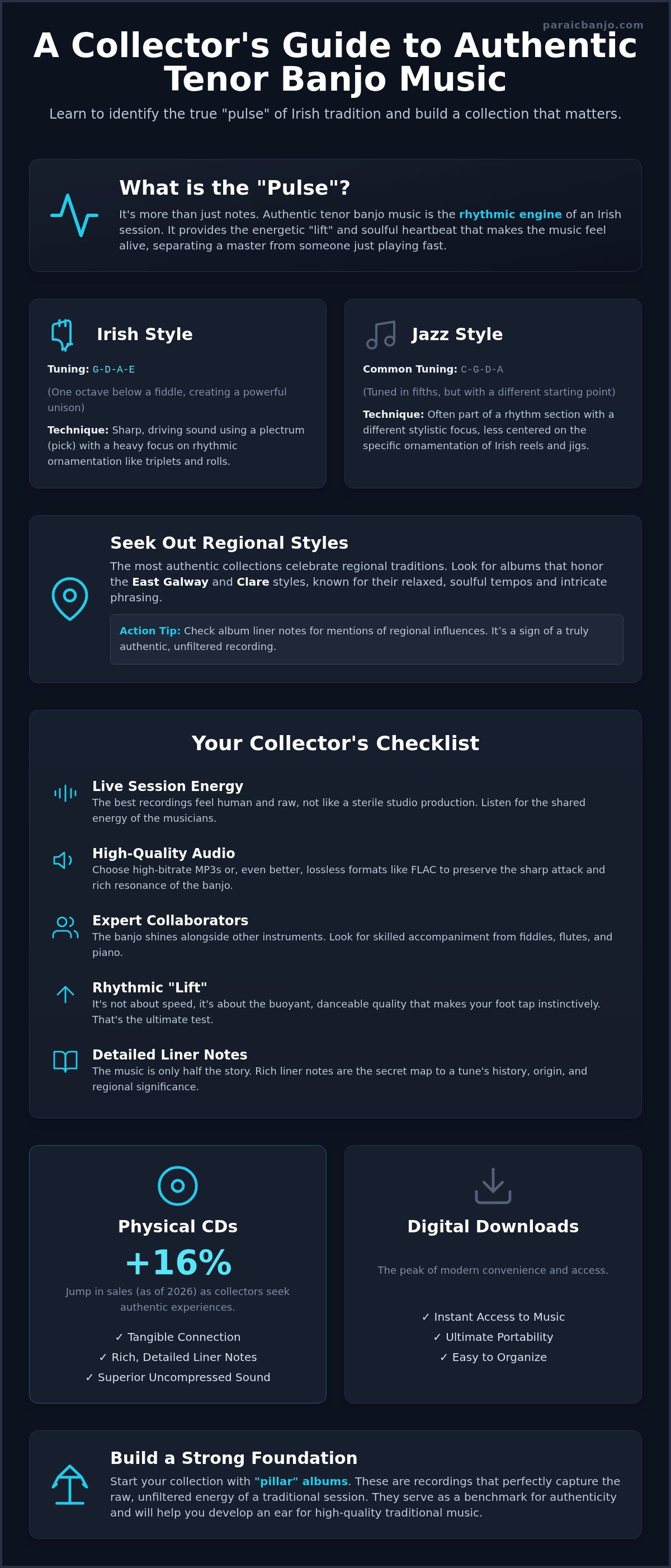
Traditional tenor banjo music is the rhythmic engine of the Irish session. While it might look like a simple four-stringed instrument, it acts as the heartbeat that keeps a room full of fiddles and flutes in time. It's not just about playing the notes; it's about providing the "lift" that makes a reel feel like it's flying. If you're looking to buy tenor banjo music, understanding this role is the first step toward finding recordings that actually move you.
The instrument has come a long way since the early 20th century. Back then, banjos were valued for their volume in loud dance halls. Today, the music has evolved into a sophisticated form of solo mastery. However, the best players never forget their roots. They maintain the "pulse," a specific rhythmic drive that separates a soulful master from someone who is just playing fast. It's a sound that carries centuries of soul within its metallic ring.
The Irish Tenor Banjo vs. Jazz Style
The most significant difference between Irish and jazz styles lies in how the instrument is tuned. In this Tenor Banjo Overview, you'll see that while jazz players often use C-G-D-A, Irish musicians prefer G-D-A-E. This tuning is exactly one octave below a fiddle, allowing the banjo to mirror the fiddle's range perfectly while adding a percussive edge. Irish players use a plectrum, or a small pick, to create a sharp, driving sound. They focus heavily on ornamentation, using triplets and rhythmic variations to add texture to jigs and reels. This creates a lively, staccato energy that is uniquely Celtic.
Why Purists Seek Regional Styles
If you want to build a truly authentic collection, you need to understand regional flavors. The East Galway and Clare traditions are legendary for their relaxed, soulful tempos and intricate phrasing. These styles aren't about showmanship; they're about the conversation between the player and the tune. When you buy tenor banjo music, look for albums that celebrate these specific roots. A recording that honors a regional style usually has a much deeper "pulse" than a generic folk compilation.
Action Tip: Always check the album credits or liner notes before you purchase. Authentic recordings will often mention specific regional influences or the teachers who passed down the tunes. This is a surefire sign that the music has the "raw" and "unfiltered" sound purists crave.
Key Features to Look for When You Buy Tenor Banjo Music
When you set out to buy tenor banjo music, the goal isn't just to find a catchy melody. You're looking for a specific energy. Traditional music is a social art form, so the best recordings often capture the raw, live spirit of a session rather than the sterile perfection of a high-end studio. Look for albums where you can almost hear the shared breath of the musicians. If a recording feels too clean or clinical, it might have lost that essential "pulse" we talked about earlier. Authentic recordings often embrace the tiny imperfections that make the music feel human.
Technical quality is another vital factor to consider. If you're going the digital route, prioritize high-bitrate MP3s or lossless FLAC files. These formats preserve the sharp attack of the plectrum and the subtle resonance of the banjo's skin. You also want to see expert collaborators on the tracklist. A banjo rarely stands alone in the tradition. It thrives alongside the fluid lines of a fiddle or the breathy punch of a wooden flute. Piano accompaniment, particularly in the East Galway style, adds a rhythmic bedrock that helps the banjo shine. When you buy tenor banjo music, checking for these collaborative layers ensures a much richer listening experience.
The Importance of Rhythmic Soul
In the world of reels and jigs, fast isn't always better. A common mistake for new collectors is chasing the highest speed. Instead, look for a player who understands "lift." This is that buoyant, rhythmic quality that makes the music feel light and danceable. It's the difference between a mechanical performance and one that has a true heartbeat. If you want to hear this lift in action, you can browse the tracks on the Not Before Time album to feel that authentic rhythmic drive.
Action Tip: Listen to a sample of a reel. If your foot starts tapping instinctively within the first few bars, you've found the right album. That physical reaction is the ultimate test of traditional music.
Liner Notes: The Secret Map of Irish Music
For a true collector, the music is only half the story. The best recordings include detailed liner notes that act as a genealogy for every track. You want to know where a tune came from, who played it thirty years ago, and why it was chosen. This historical context is vital for understanding the nuances of regional styles like those from East Galway or Clare. Many purists agree that rich liner notes are a hallmark of authentic releases. They turn a simple purchase into a piece of history you can hold in your hands.
Physical CDs vs. Digital Downloads: Which Should You Choose?
When you decide to buy tenor banjo music, you're faced with a modern dilemma: the instant click of a download or the satisfying weight of a physical disc. Both paths have their charms, but the choice often depends on how you want to experience the tradition. Digital downloads offer immediate gratification; you can go from reading about a tune to hearing it in seconds. However, there's something legendary about holding a physical copy of a project like "Not Before Time," which represents a 39-year journey. It's not just a product; it's a definitive career statement you can keep on your shelf.
Independent traditional releases are often printed in limited editions. This means that physical copies can become rare collector's items once the initial run sells out. For audiophiles, the CD remains the gold standard because it provides uncompressed sound. While digital files are convenient, they sometimes lose the tiny, resonant details of the banjo's skin or the subtle click of the plectrum. A physical CD ensures you're hearing the music exactly as it was captured during those live sessions. It also makes for a beautiful heritage gift that can be passed down through a family of music lovers.
The Case for the Physical CD
The aesthetic value of a printed album shouldn't be underestimated. Having the artwork and a 36-page booklet of notes right in front of you creates a deeper connection to the performer. It's a tactile experience that digital files simply can't replicate. On a practical level, CDs are fantastic for long car journeys. If you're driving through the back roads of Clare or Galway where mobile signals tend to drop, your music won't stop just because the internet did. You can order the physical CD to ensure the music is always within reach.
Action Tip: If you're buying a gift, always go for the physical CD. It's much more meaningful to unwrap a piece of art than to receive an emailed link.
The Convenience of Digital Banjo Tracks
Building a digital Irish music library is the best way to keep the tradition with you on the move. Digital albums allow you to carry 18 tracks in your pocket without taking up any physical space. This format is also incredibly helpful if you're a musician yourself. If you're struggling to learn a specific reel, you can often buy individual digital tracks to focus your practice. It's a flexible way to support the artist while getting exactly what you need for your own musical journey.
Action Tip: When purchasing digital files, check that the store offers immediate access. You don't want to wait for a manual email when the urge to listen hits.
How to Build an Authentic Irish Music Collection
Building a library of traditional music is less about filling shelves and more about gathering stories. It's a journey. You want to start with what collectors call "Pillar" albums. These are the recordings that define a specific era or regional style, providing a foundation for everything else you'll hear. Once you've got the basics, it's time to seek out the independent artists. This is where you'll find the raw, unfiltered sounds that streaming algorithms often miss. When you look to buy tenor banjo music, pay attention to the tune lineage. Look for artists who learned directly from the masters of the previous generation. This connection ensures the rhythmic pulse remains intact across the decades.
Joining online communities is another fantastic way to discover "under the radar" releases. Traditional music fans are a dedicated bunch. They often share news about limited-edition pressings or small-batch digital drops that never hit the mainstream charts. By engaging with these groups, you can find the hidden gems that give a collection its unique character. Remember, an authentic collection isn't just about the number of tracks; it's about the depth of the tradition they represent.
Finding Independent Releases
Buying direct from the artist is the most effective way to ensure your support actually reaches the musicians. It's important to distinguish between a "vanity project" and a true "milestone album." A milestone album carries the weight of years of practice and community involvement. For example, some projects take nearly four decades to reach the public. This long-term development guarantees a level of depth and soul that a rushed studio recording can't match.
Action Tip: Check the "About" page on an artist's website. If the project has been decades in the making, you're almost certainly looking at a definitive statement of their craft.
Evaluating Track Lists
A great traditional album should feel like a well-rounded session. Look for a healthy mix of different tune types. You want to see high-energy reels and jigs balanced by the stately rhythm of hornpipes or the emotional depth of a slow air. Diversity in keys and tempos is also vital. It keeps the listening experience fresh and engaging. In the world of traditional music, 18 tracks is considered a very generous standard for a debut. It shows a commitment to providing the listener with a complete musical narrative.
Ready to start your journey?Explore the 18 tracks on Not Before Time to hear the authentic sound of East Galway and Clare.
The Essential Choice: 'Not Before Time – 39 Years in the Making'
If you're looking to buy tenor banjo music that truly represents the living tradition, Páraic Mac Donnchadha’s debut album is the definitive choice. This collection isn't just another studio project. It's the culmination of a lifetime's passion, distilled into 18 tracks that breathe with the energy of a real session. Many recordings today feel polished but hollow. In contrast, this album captures the "pulse" of East Galway and Clare by prioritizing a live recording process. You can hear the rhythmic mastery in every set, making it feel as though you've been pulled into the heart of a traditional session.
The decision to record live was intentional. It ensures that the infectious enthusiasm and the "lift" of the tunes aren't lost behind clinical production. For collectors, this is a rare find in a market often crowded with generic folk music. By choosing this album, you aren't just adding tracks to a library. You're supporting a seasoned master who has spent decades honing his skill within the community. It's an invitation into a storied musical tradition that has been 39 years in the making.
A Lifetime in Every Note
This album serves as a definitive statement of a career spent immersed in the tunes. The significance of the 39-year journey to this first recording adds a layer of legendary status to the debut. Every triplet and every rhythmic variation carries the weight of those years, offering a depth of soul that is hard to find elsewhere. It's a masterclass in the East Galway style, characterized by a relaxed tempo and a deep, soulful drive. You can Experience the soul of the banjo—buy the album here and hear the difference that a lifetime of dedication makes.
What You Get With Your Purchase
When you decide to buy tenor banjo music from this collection, you have choices that suit your listening style. The limited-edition physical CD is a true collector's item, featuring a 36-page booklet filled with detailed historical notes. These liner notes explain the roots of the tunes and the stories of the masters who passed them down. If you prefer the convenience of modern formats, high-quality digital downloads and individual tracks are also available. Both options provide a window into a rich musical heritage that few other releases can match.
Action Tip: Order the physical CD to get the full story. The included booklet acts as an educational guide to the East Galway and Clare traditions, turning your listening experience into a deep dive through musical history.
Bring the Heartbeat of the Session Home
You now have the tools to spot the difference between a clinical studio recording and a genuine musical heartbeat. By prioritizing regional styles like East Galway and Clare, you ensure your collection captures the true spirit of a traditional session. Whether you choose the tactile experience of a physical CD or the convenience of a digital library, your choice helps preserve a living craft. When you decide to buy tenor banjo music, look for that rare combination of history and rhythmic drive that only a lifetime of dedication can produce.
Not Before Time - 39 Years in the Making is the perfect place to start. It's a masterclass. This album features 18 soulful tracks recorded live to preserve that essential session energy. With 39 years of traditional mastery distilled into a single release and secure global shipping available for physical copies, it's a definitive statement of the tradition. Order "Not Before Time - 39 Years in the Making" Directly from Páraic. Happy listening, and may the rhythm keep your feet tapping for years to come.
Frequently Asked Questions
Where is the best place to buy tenor banjo music online?
Official artist websites and platforms like Bandcamp are the best choices for collectors. Buying directly ensures that the majority of your support goes to the musician rather than a third-party streaming giant. For a truly authentic experience, you can visit paraicbanjo.com to secure limited-edition physical copies or high-quality digital tracks. This allows you to own a piece of a 39-year musical journey while supporting the preservation of traditional Irish music.
What is the difference between Irish tenor banjo and standard banjo music?
The primary distinction lies in the tuning and the specific role of the instrument within the genre. While standard or jazz banjos often use C-G-D-A tuning, the Irish tenor banjo is tuned to G-D-A-E. This is exactly one octave below a fiddle, which allows players to mirror intricate fiddle melodies perfectly. The Irish style focuses heavily on triplets and rhythmic ornamentation to drive the high-energy pulse of traditional reels and jigs.
Can I buy individual tracks or do I have to buy the whole album?
You can certainly purchase individual digital tracks if you are looking for a specific tune to learn or enjoy. This flexibility is fantastic for musicians who want to study a particular phrasing or triplet technique. However, buying the full 18-track album provides a much more complete narrative of the East Galway and Clare traditions. It is the best way to experience the rhythmic flow and variety of keys planned by the artist.
Is it better to buy a CD or a digital download for traditional music?
It depends on your priorities as a collector. A physical CD offers uncompressed sound quality and a tangible piece of musical history; these are often accompanied by extensive liner notes. These notes are essential for understanding tune origins. On the other hand, digital downloads provide immediate access and portability for mobile listening. Many fans choose to buy tenor banjo music in both formats to enjoy the best of both worlds while supporting the artist.
Who are the most famous Irish tenor banjo players to listen to?
To understand the evolution of the instrument, you should listen to pioneers like Barney McKenna of The Dubliners or the intricate work of Kieran Hanrahan. For those seeking the specific pulse of regional styles, Páraic Mac Donnchadha’s debut is a modern essential. His work distills decades of heritage into a masterclass of the East Galway style. Exploring these various masters helps you appreciate the different approaches to rhythmic drive and ornamentation within the tradition.
What makes the East Galway style of banjo playing unique?
The East Galway style is celebrated for its relaxed tempo and soulful, melodic phrasing. Unlike more aggressive styles, it emphasizes the "lift" and "swing" of the tune rather than sheer speed. It often incorporates specific rhythmic variations and a close relationship with piano accompaniment. This style feels deeply personal and conversational, making it a favorite for purists who value the emotional depth of the music over flashy technical displays or clinical studio perfection.
Are the liner notes included with digital banjo music downloads?
While digital downloads offer the convenience of instant play, they often lack the full 36-page physical booklets found with limited-edition CDs. However, some high-quality digital stores include PDF versions of the notes. If you want the complete historical map of the East Galway and Clare traditions, the physical CD remains the definitive choice. These printed materials provide the vital context and genealogy that turn a simple recording into a legendary career statement you can hold.
How can I support independent Irish banjo players?
The most direct way to support these artists is to purchase their work from their official websites. Avoiding large streaming platforms ensures your contribution has a real impact on the musician's ability to keep the tradition alive. You can also help by sharing their music with online communities or signing up for their newsletters. Supporting an independent release like Not Before Time helps protect the raw, unfiltered sounds of the Irish session for future generations.


Comments