Exploring Regional Irish Music Styles: A Listener’s Guide to the Tradition’s Soul

What if I told you that the speed of a tune is often the least important thing about it? It is a common trap to think that faster is better, but the real magic lives in the rhythm and the "lift," that infectious bounce that makes you want to tap your feet. If you have ever felt overwhelmed by the sheer vastness of the tradition while exploring regional irish music styles, you are not alone. It's easy to get confused by technical talk or struggle to tell the difference between a commercialized track and a raw, authentic session recording.
I have spent nearly four decades immersed in these sounds, and I want to help you find your way through this beautiful complexity. You will discover how to identify distinct "musical dialects" by ear, from the steady, soulful pulse of East Galway to the sharp, driving energy of Donegal. We are going to look at the cultural history behind the tunes and give you practical ways to build a collection of recordings that truly matter. Let's start uncovering the rhythmic secrets and melodic ornaments that give this music its heart.
Table of Contents
Understanding the Regional Tapestry of Traditional Irish Music
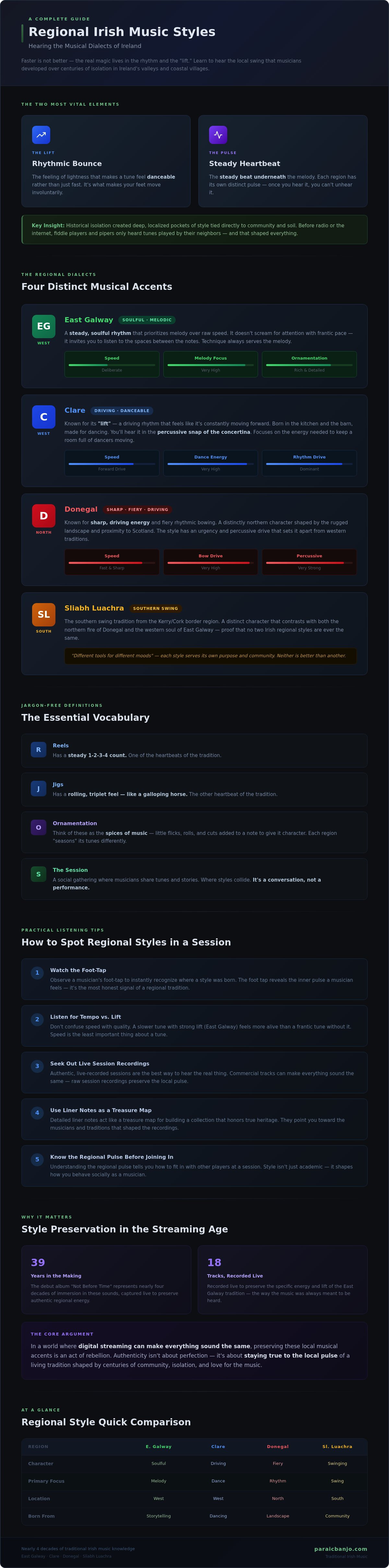
Think of the music as a language with its own set of regional accents. If you have traveled through Ireland, you know a Cork accent sounds nothing like a voice from Donegal. Traditional music works the same way. When you begin exploring regional irish music styles, you are really learning to hear the local "swing" that musicians developed over centuries. Before the arrival of radio or the internet, fiddle players and pipers lived in isolated valleys and coastal villages. They only heard the tunes played by their neighbors. This isolation created deep, localized pockets of style that are tied directly to the community and the soil.
The most vital elements to listen for are the "lift" and the "pulse." Lift is that feeling of lightness and rhythmic bounce that makes a tune feel danceable rather than just fast. Pulse is the steady heartbeat underneath the melody. In my own career, which led to the creation of Not Before Time - 39 Years in the Making, I have focused on capturing the specific lift of the East Galway tradition. It is a soulful, steady rhythm that prioritizes melody over raw speed. Authenticity isn't about perfection; it's about staying true to that local pulse.
Why Regional Styles Still Matter in 2026
In a world where digital streaming can make everything sound the same, preserving these local accents is an act of rebellion. These styles influence how we behave in a session. If you understand the regional pulse, you know how to fit in with the other players. My debut album features 18 tracks recorded live to preserve this exact energy. You can pick up the physical CD to use the detailed liner notes as a guide for your own listening journey. It acts like a treasure map for those who want to dig deeper into the roots.
The Basic Vocabulary: Jargon-Free Definitions
Let’s break down the terms you might hear at a session without getting bogged down in academic talk.
Reels and Jigs: These are the heartbeat of the tradition. A reel has a steady 1-2-3-4 count. A jig has a rolling, triplet feel like a galloping horse.
Ornamentation: Think of these as the spices. They are the little flicks, rolls, and cuts a musician adds to a note to give it character. Each region "seasons" its tunes differently.
The Session: This is where styles collide. It is a social gathering where musicians share tunes and stories. It’s a conversation, not a performance.
To truly grasp these differences, you have to hear the music in its natural habitat. If you want an authentic reference for the Clare and East Galway traditions, you can explore the Not Before Time - 39 Years in the Making digital album. It represents a lifetime of passion distilled into a single project. Dive in and start training your ears to hear the soul of the tradition.
The Rhythmic Soul of the West: East Galway and Clare Styles
Exploring regional irish music styles often begins in the West, where the landscape itself seems to dictate the tempo. East Galway music is a steady, melodic affair. It is deeply soulful. It doesn't scream for attention with frantic speed. Instead, it invites you to listen to the spaces between the notes. This is a sharp contrast to the neighboring Clare style. Clare is known for its "lift," a driving rhythm that feels like it's constantly moving forward. While these two regions are neighbors, they represent two very different ways of feeling the music.
These styles are often grouped together because of their geographical proximity, yet they remain distinct "dialects." If you listen closely, you'll hear that the East Galway style prioritizes the tune's internal beauty, while Clare music focuses on the energy needed to keep a room full of dancers moving. Don't let anyone tell you one is better than the other; they are just different tools for different moods.
The East Galway Influence: A Legacy of Storytelling
The deliberate pace of East Galway mirrors a legacy of storytelling. The pulse is the priority. Technique serves the melody, not the other way around. In this tradition, the banjo or fiddle takes its time, allowing the listener to absorb every ornament. If you want to understand the technical nuances of this specific pulse, you might enjoy reading about East Galway vs Clare Music: A Guide to the Rhythmic Soul of the West.
The Clare Lift: Music Made for Dancing
Clare music was born in the kitchen and the barn. It was made for dancing. This rhythmic drive is the signature of the region. You'll hear it in the percussive snap of the concertina or the driving pulse of the tenor banjo. Clare remains the beating heart of the tradition because that energy is infectious. It’s hard to sit still when a Clare reel is in full swing. The "lift" isn't about rushing; it's about a specific bounce that sits just on the front of the beat.
Actionable Tip: When you are at a session, listen for the "swing" rather than the speed. Speed is often a distraction. A tune can be fast but feel flat. A tune can be slow but feel full of life. Watch the feet of the players. In Clare, the tap is often sharp and driving. In East Galway, it’s a more relaxed, grounded thud. My debut album, Not Before Time - 39 Years in the Making, captures 18 tracks of this live session energy. It’s a great way to hear these styles side-by-side and learn the difference by ear.
The Northern Fire and Southern Swing: Donegal and Sliabh Luachra
When you move your ears away from the West and start exploring regional irish music styles in the North and South, the atmosphere shifts completely. Donegal music carries a distinct "fire" that feels aggressive, staccato, and incredibly exciting. It’s a sharp departure from the steady pulse of Galway. Meanwhile, in the South, the Sliabh Luachra tradition offers a "swing" that is bouncy and rhythmic. These regions prove that the tradition isn't a monolith; it’s a living, breathing map of local identities.
The beauty of these styles lies in their specific rhythmic signatures. While a reel in Clare might feel like a rolling wave, a Donegal reel feels like a crackling flame. Similarly, the music of the Kerry and Cork borders prioritizes the dance above all else. Understanding these nuances helps you appreciate the 18 tracks on Not Before Time - 39 Years in the Making, where I’ve worked to capture that same raw, live session energy that defines these local sounds.
Donegal: Where Ireland Meets Scotland
Donegal music is heavily influenced by its proximity to Scotland. You’ll hear this in the "highlands" and "strathspeys," which are tune types you won't often find in the South. The fiddling here is wild and crisp. To spot this style, listen for short, percussive bow strokes and "double stops," where the musician plays two strings at once to create a drone. It creates a powerful, bagpipe-like sound that is unmistakable. If a tune feels like a frantic but controlled sprint, you’re likely listening to the Donegal fire.
Sliabh Luachra: The Kingdom of Polkas
In the Sliabh Luachra region, which straddles the Kerry and Cork border, the polka is king. While most of Ireland obsesses over reels, this area prioritizes polkas and "slides." A slide is played in a 12/8 time signature, which gives it a fast, rolling feel that is perfect for set dancing. This style is all about the "swing." It’s infectious. It’s bouncy. It’s designed to keep your feet moving on a kitchen floor. The energy here is less about technical flash and more about a communal, rhythmic drive.
Actionable Tip: To identify Sliabh Luachra music by ear, count the beats in a "slide." If it feels like a jig but much faster and more "driven," you’ve found it. If you want to hear how these traditions translate to the tenor banjo, you can explore my individual digital tracks. Each one is a celebration of the rhythmic soul I’ve spent 39 years studying. These recordings aren't just commercial products; they are a definitive statement of a lifetime's passion for the craft.
Practical Tips for Spotting Regional Styles in a Session
When you are sitting in the corner of a dimly lit pub, surrounded by the steam of a pint and the swell of a fiddle, it's easy to get lost in the noise. But exploring regional irish music styles becomes a lot more rewarding when you know how to listen for the subtle clues. You don't need a music degree to do this. You just need to pay attention to the pulse. Start by focusing on the tempo. Is the music a steady, relaxed stroll or a frantic, high-energy sprint? A steady pace often points toward the East Galway or Clare traditions, while that fiery, breathless speed is a hallmark of the North.
Watch the musicians' feet. This might sound strange, but the "tap" often reveals the regional heartbeat. In the Sliabh Luachra tradition, you'll see a bouncy, rhythmic tap that matches the swing of a polka. In Clare, the tap is often sharp and driving, sitting right on the front of the beat to create that famous "lift." You should also listen for the "gaps." Some styles are dense and packed with notes, while others feel airy and spacious. If the music feels like a thick tapestry where every beat is filled, you're likely hearing the heavy ornamentation of the West.
A Listener's Checklist for Your Next Session
To help you narrow it down, keep this simple checklist in mind while you listen:
The Melody: Is it smooth and flowing like a rolling hill (Galway), or is it staccato and crisp like a crackling fire (Donegal)?
The Rhythm: Does it feel bouncy and playful (Kerry) or relentless and driving (Clare)?
The Ornamentation: Do you hear lots of "rolls" and "crans"-those little clusters of extra notes-or is the melody played relatively plain?
Building Your Authentic Collection
If you want to train your ear at home, you need to find the right recordings. Avoid the over-produced, commercial tracks you find in tourist shops. Instead, look for "live" or "unpolished" recordings that capture the raw energy of a session. These tracks preserve the regional "accents" that studio magic often polishes away. I spent 39 years honing my craft before releasing my debut, and I made sure the 18 tracks on Not Before Time - 39 Years in the Making were recorded live to keep that session spirit alive.
Liner notes are your best friend here. They are a treasure map that tells you the "who" and "where" behind every tune. For more advice on finding these gems, check out my guide on How to Buy Traditional Irish Music: A Collector’s Guide to Authenticity. If you're ready to start your journey with a definitive reference for the East Galway style, you can order the physical CD of Not Before Time today. It's a lifetime of passion packed into one authentic collection.
Why Style Preservation Matters: The 'Not Before Time' Journey
Preservation is more than just a dusty archive. It’s a living, breathing commitment to the people and places that gave us these tunes. My own journey has been rooted deeply in the East Galway and Clare traditions. While exploring regional irish music styles, I realized that the most authentic way to honor these "accents" was to let them speak for themselves without the interference of heavy studio production. The music needs room to breathe. It needs to sound like it does in a kitchen or a quiet pub corner.
That’s why Not Before Time - 39 Years in the Making was recorded live. We wanted to capture the raw, unpredictable energy of a session. These 18 tracks serve as a time capsule. They represent a lifetime of listening, playing, and absorbing the specific lilt of my home community. This project isn't just a debut; it's a definitive statement of a lifetime's passion. Owning the physical CD isn't just about having music; it's about holding a piece of regional history in your hands.
The Soul of the Tenor Banjo
There is a common myth that the tenor banjo is only meant for loud, fast playing that drowns out other instruments. I’ve spent my career trying to prove the opposite. In the right hands, the banjo is incredibly soulful. It can carry the delicate, melodic weight of an East Galway reel with just as much grace as a fiddle. It’s about the touch and the timing. If you want to see how this instrument defines the West, take a look at Not Before Time - 39 Years in the Making: The Definitive Irish Banjo Debut.
Join the Tradition
Supporting independent artists is how we ensure these regional styles don't fade into a generic, globalized sound. When you engage with this project, you are helping to keep a specific cultural flame alive. You can explore the tracks through the digital album or pick up individual digital tracks if you prefer a modern setup. However, the limited-edition physical CD is where the real treasure lies. It includes detailed liner notes that act as a guide to the history of the tunes. These notes are a "treasure map" for any serious collector.
Take a moment to listen deep. Find the lilt that speaks to your own soul. Whether it's the steady pulse of a Galway jig or the driving lift of a Clare reel, these styles are waiting for you to discover them. You can order your copy of Not Before Time - 39 Years in the Making and join me in celebrating this storied tradition. It’s been a long road, but the music is finally ready for you. Let's keep the tradition moving forward together.
Find Your Own Place in the Tradition
The journey of exploring regional irish music styles is about learning how to listen with your heart. You have seen how the steady soul of East Galway differs from the driving lift of Clare or the fiery bowing of Donegal. It’s more than just notes; it’s about the people and landscape that shaped every tune. By focusing on the pulse and rhythm, you can now walk into any session and feel the local "accent" for yourself.
This connection to the roots is what I’ve spent 39 years pursuing. My debut album, Not Before Time - 39 Years in the Making, features 18 tracks of live-recorded tradition that capture the true energy of a session. With detailed liner notes included, it serves as a treasure map for your own collection. Experience the soulful rhythm of East Galway. Order 'Not Before Time - 39 Years in the Making' directly from Páraic here.
Keep your ears open and your feet tapping. I'll see you at the next session!
Common Questions About Irish Regional Styles
What exactly is meant by 'regional style' in Irish music?
Regional style refers to the unique musical "accent" or dialect found in specific parts of Ireland. It's defined by the rhythm, ornamentation, and tempo choices that local musicians developed over centuries of isolation. While the tunes might be the same across the country, the way they're played varies. You'll hear these differences in the "lift" or "pulse" that characterizes a specific county's sound and feel.
Can a beginner tell the difference between Galway and Clare styles?
Yes, a beginner can distinguish them by focusing on the rhythmic feel rather than the technical speed. East Galway style is typically more steady, melodic, and soulful, prioritizing the tune's internal beauty. In contrast, Clare music is famous for its "lift," a driving, bouncy rhythm that feels like it’s pushing forward. If the music makes you want to dance immediately, it’s often Clare; if it invites a deep listen, it’s likely Galway.
Is one regional style better for dancing than others?
No single style is "better," but some are more specifically tailored for certain types of dance. The Clare style is legendary for its driving lift, which is perfect for set dancing. Sliabh Luachra is the undisputed kingdom of polkas and slides, offering an infectious energy that keeps a kitchen floor moving. When exploring regional irish music styles, you'll find that the rhythm of the music always mirrors the needs of the local dancers.
Why is Donegal music often described as 'Scottish' sounding?
Donegal music shares a deep connection with Scottish traditions due to the historical movement of people between the two regions. You’ll hear this in the use of "highlands" and "strathspeys," which are tune types rarely found in the South. The fiddling style is often more aggressive and staccato, utilizing "double stops" to create a drone-like sound. This powerful, crisp approach creates a wild energy that feels closer to the Highlands than the West.
What is the best way to start a traditional Irish music collection?
The best way to start is by seeking out authentic, unpolished recordings rather than commercialized studio albums. Look for live recordings that capture the raw energy of a session. Detailed liner notes are essential because they provide the historical context and the "who" and "where" behind the tunes. For a definitive reference, my debut album, Not Before Time - 39 Years in the Making, includes 18 tracks that celebrate these deep regional roots.
Do modern Irish musicians still play in these regional styles?
Many modern musicians still prioritize these regional accents, though it takes a conscious effort in our globalized world. While many players now have a "general" style, dedicated traditionalists work hard to preserve the specific lilt of their home counties. Exploring regional irish music styles remains a vital part of the tradition for those who value heritage. It’s an act of cultural rebellion to keep these local voices alive in a digital age.
How do I find authentic Irish music that isn't commercialized?
Look for independent artists who record live sessions or focus on specific regional traditions. Direct-to-consumer websites are often the best place to find these gems. Authentic music usually comes with extensive background notes and stories about the tunes' origins. For example, my 18-track album was recorded live to ensure the session energy wasn't lost in a studio. Avoid generic "Best of" compilations found in mainstream gift shops.
What makes the tenor banjo a good instrument for regional styles?
The tenor banjo is a fantastic rhythmic and percussive tool that can highlight the "pulse" of a region. While it’s often seen as a loud instrument, it’s capable of incredible soulfulness and melodic detail. It’s particularly effective at expressing the steady, relaxed swing of East Galway or the driving lift of Clare. In my 39 years of playing, I’ve found the banjo is the perfect vehicle for exploring the rhythmic heart of our tradition.


Comments