Authentic Traditional Irish Music: Finding the Soul of the Session

Most "Irish" playlists you find online are just musical wallpaper, missing the raw, rhythmic heartbeat that makes a real session come alive. I know how frustrating it is to sift through generic tracks, searching for a spark but only finding over-polished clichés. You want to feel the lift in a tune and understand why a Galway reel sounds different from a Clare jig, yet the technical talk often makes it feel like an exclusive club. It shouldn't be that way. Music is a conversation, not a lecture.
In this guide, I am pulling back the curtain on authentic traditional irish music from my perspective as a banjo player who has spent 39 years living this tradition. You'll discover how to identify the genuine pulse of a session, understand the social history behind the melodies, and start building a collection of recordings that carry real soul. We will break down tricky terms like ornamentation into plain English and explore the regional secrets that define our tradition. By the time we're done, you won't just be listening to tunes; you'll be hearing the stories and the people behind every note.
Table of Contents
What Makes Traditional Irish Music Truly Authentic?
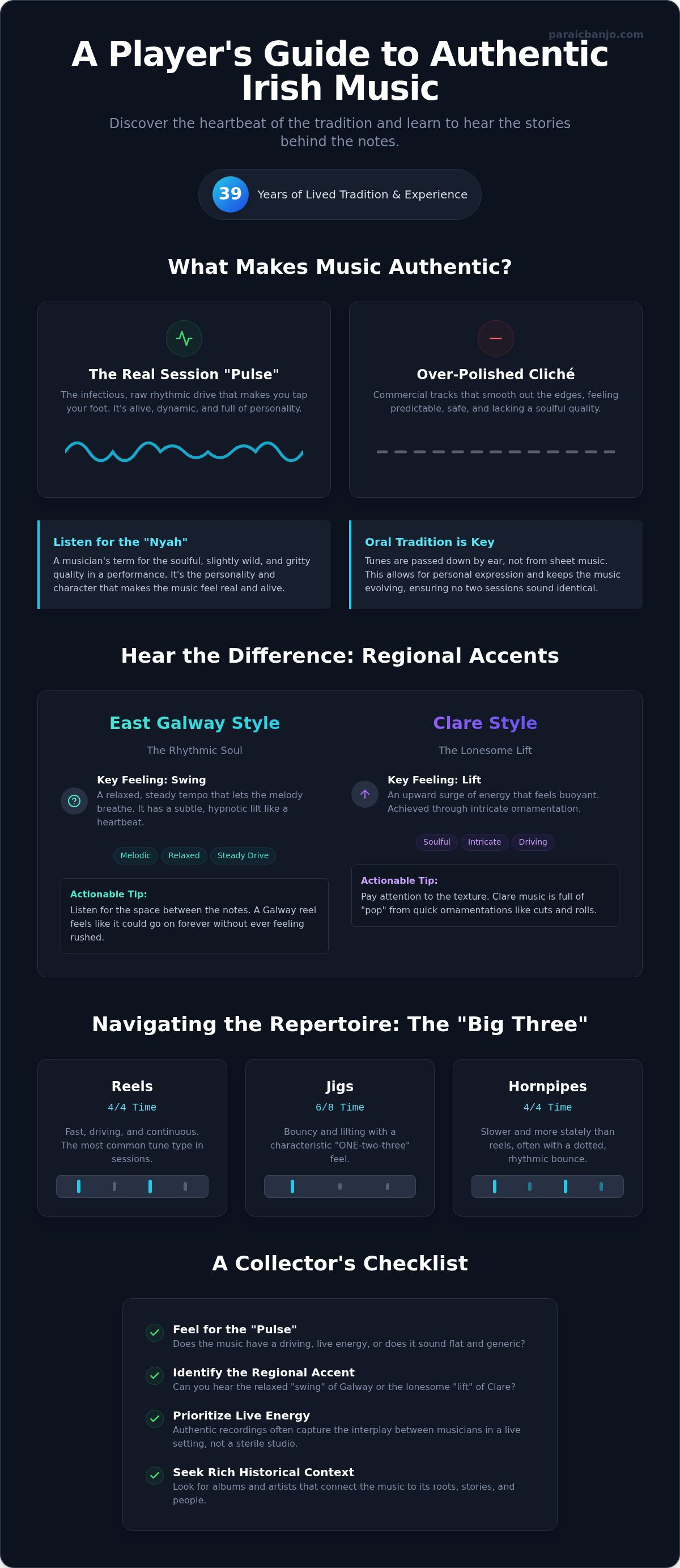
Authenticity in this music isn't just a marketing label you'll find on a streaming app. It's a living, breathing connection to the past. To find authentic traditional irish music, you have to look past the over-produced "Celtic" tracks designed for gift shops. Real trad is an oral tradition. It's passed from one person to another, usually across a kitchen table or in a crowded pub corner. This direct hand-off ensures the music carries the weight of those who played it before us.
The secret ingredient is what we call "the pulse." It’s that infectious rhythmic drive that forces your foot to tap before your brain even realizes what’s happening. Commercial folk often smooths these edges out, making the music feel safe and predictable. But true tradition is raw. It’s session-focused. It’s about the interplay between players in the moment, where the rhythm is just as important as the melody itself.
Actionable Tip: When you listen to a recording, try to catch the "nyah." This is a term musicians use to describe that soulful, slightly wild quality in a performer's phrasing. It’s a bit of grit and a whole lot of personality. If the music sounds too perfect or clinical, it’s probably missing the nyah that defines the soul of the session.
The Role of the Oral Tradition
Historically, tunes weren't written down on paper. They were caught by ear. You'd sit near a fiddler or a piper and try to pick up the melody note by note. For those seeking a comprehensive overview of Irish traditional music, it’s vital to recognize that this lack of sheet music is actually a blessing. It allows the music to evolve while staying rooted.
When a player adds a little "flick" or changes a note, it isn't a mistake. It’s a sign of authentic traditional irish music in action. These variations are expressions of an individual’s musical voice. This freedom is why no two sessions ever sound exactly the same. It keeps the tradition from becoming a museum piece.
Instruments with a Heartbeat
While the fiddle and flute are legendary, the tenor banjo has a special place in the modern session. It’s often the engine room of the group, providing a crisp, percussive drive that keeps everyone on track. The tenor banjo is a 4-string instrument typically tuned GDAE, and it only really became a staple of the Irish tradition in the early 20th century.
The banjo provides the rhythmic backbone that allows the other instruments to soar. It’s about more than just playing the notes; it’s about pushing the rhythm forward with intention. When the banjo, fiddle, and flute lock in together, you get that unmistakable heartbeat that defines the tradition. It's a collaborative energy that welcomes you into the story.
The Rhythmic Heartbeat: Understanding Regional Styles of Galway and Clare
Think of Irish music as a map of voices. Just as a person from Cork sounds nothing like someone from Donegal, authentic traditional irish music carries distinct regional "accents." If you listen closely, you can hear the geography in the notes. For those just starting their journey, the Boston Public Library's guide to Irish Music offers a solid foundation for these cultural nuances. However, the real magic happens when you can distinguish the rolling hills of East Galway from the rugged cliffs of Clare through the rhythm of a reel.
The East Galway Style: Rhythmic Soul
In East Galway, we don't rush. The music is known for a relaxed tempo that lets the melody breathe. It’s melodic and deeply rhythmic, reflecting a landscape that is lush and steady. When I play, I aim for that steady "swing" that makes the tune feel like it could go on forever without ever feeling frantic. It’s about the space between the notes as much as the notes themselves. This style values the clarity of the tune over sheer speed.
Actionable Tip: To hear this style, try to identify the "swing" in a Galway reel. Unlike a standard folk song that might hit every beat with the same weight, a Galway tune has a subtle lilt. It's almost like a heartbeat, where the first of every pair of eighth notes is held just a fraction longer than the second.
Clare Music: The Lonesome Lift
Move across the border into Clare, and the energy shifts. Clare music is often described as "lonesome," a word that captures a haunting, soulful quality. Yet, it remains incredibly driving. The key here is "lift," an upward surge of energy that makes the music feel buoyant. This is achieved through intricate ornamentation like cuts, rolls, and triplets, which add texture and "pop" to the melody. It’s a style that feels both ancient and immediate.
These two distinct traditions are the bedrock of my debut album, Not Before Time – 39 Years in the Making. I spent nearly four decades soaking up these regional secrets to ensure every track captures that genuine session feel. If you want to hear how these styles interplay in a live setting, you can explore my collection of digital tracks to find the rhythm that speaks to you.
Reels, Jigs, and Hornpipes: Navigating the Session Repertoire
Once you've tuned your ear to the regional "accents" I mentioned earlier, the next step in finding authentic traditional irish music is recognizing the structures of the tunes themselves. If you walk into a pub session, you aren't just hearing a random stream of notes. You're hearing a carefully balanced repertoire of reels, jigs, and hornpipes. Each has its own personality and its own job to do in the session.
Think of the Reel as the motorway of Irish music. It's written in a steady 4/4 time, which basically means you can count it "one, two, three, four." It's fast, driving, and often the place where musicians show off their technical speed. If the music feels like a continuous, flowing stream of energy, you’re likely listening to a reel.
Then you have the Jig. This is the rolling, triple-time rhythm that feels like a spinning wheel. We often use the phrase "rash-er-of-ba-con" to mimic the 6/8 beat. It’s playful, bouncy, and has a circular feel that’s different from the straight-ahead drive of a reel. Finally, there’s the Hornpipe. Like the reel, it’s in 4/4 time, but it has a distinct "dotted" rhythm. This creates a heavy-light bounce. It was traditionally played for solo dancers wearing hard shoes, so it has a percussive, grounded feel that’s impossible to ignore.
How to Identify a Reel vs. a Jig
Actionable Tip: If you’re struggling to tell them apart, try the "one-two-three" counting method. For a jig, count "one-two-three, four-five-six" in a quick, rolling loop. If the music fits that pattern, you’ve found a jig. If it feels more like a straight "one-two, one-two" like you’re marching, it’s a reel.
Musicians often gravitate toward reels when they want to push the energy to the limit. They are the gold standard for showing off technical mastery on the banjo or fiddle. However, how these tunes are played depends heavily on the region. You can learn more about how these structures shift in my guide on East Galway vs Clare Music.
The Art of the "Set"
In a session, we rarely play just one tune and stop. We group them into "sets" of three or four tunes played back-to-back. This isn't just to keep the music going; it’s about building an emotional arc. We might start with a steady, melodic reel and then transition into something with more "lift" and speed to bring the room to a crescendo.
The transition is the most exciting part of authentic traditional irish music. It’s that split second where the lead player nods and everyone switches to the next tune together. It’s a rush of adrenaline. When we recorded the tracks for my album, *Not Before Time – 39 Years in the Making*, we kept everything live to capture that exact moment of transition energy. It’s where the soul of the session truly shines.
A Collector’s Checklist: How to Find Genuine Irish Recordings
Finding authentic traditional irish music in a sea of algorithm-driven playlists is like searching for a quiet pub during a city festival. It takes a discerning ear. When you look to buy traditional Irish music, the first thing to check is the production style. Avoid albums that sound like they were made in a clinical, soundproof box. Real trad needs room to breathe. Look for recordings that capture the live energy of a session. You should be able to hear the natural resonance of the wood and the subtle, percussive tap of a player's foot.
Check the credits. A genuine recording will always list the collaborators. In our community, we aren't solitary artists; we're part of a lineage. If an album doesn't tell you who is playing the fiddle or who backed the tracks, it might be a generic studio project. Independent releases are the gold standard. They represent a lifetime of passion rather than a commercial deadline. Supporting these projects keeps the tradition healthy and vibrant.
The Power of the Liner Notes
Think of liner notes as a map. In the world of authentic traditional irish music, knowing where a tune came from is just as important as how it sounds. A great album tells you who the artist learned the tune from, perhaps a neighbor in East Galway or a legendary piper from Clare. These stories provide the regional context that makes the music meaningful. When you read about the history of a set, you aren't just a listener. You're being invited into the tradition itself.
Where to Buy Direct
The best way to support the living tradition is to buy traditional Irish music direct from the artist. This ensures the support goes straight to the people keeping the tunes alive. While streaming is convenient, it often lacks the depth of a full album experience. Collectors often prefer physical CDs. These serve as beautiful heirloom items that preserve the art for years to come. They also usually include the most detailed background notes.
Actionable Tip: If you prefer digital, check for high-quality formats like FLAC or WAV. These files preserve the full auditory experience. They capture the tiny details of ornamentation and phrasing that compressed files often lose. It makes a world of difference when you're trying to hear that elusive "nyah" in a performer’s phrasing.
If you're ready to start your collection with a recording that prioritizes this raw session energy, you can view my album and digital tracks here. Every note on Not Before Time – 39 Years in the Making was chosen to reflect the soul of the West.
Bringing the Tradition Home: The Story of ‘Not Before Time’
The journey to capture the essence of a lifetime’s passion isn't something you rush. For Páraic Mac Donnchadha, it took nearly four decades to feel ready to put his music on record. This wasn't about procrastination; it was about the pursuit of a specific sound that truly represents authentic traditional irish music. The result is Not Before Time – 39 Years in the Making, a project that serves as a definitive time capsule for the banjo styles of East Galway and Clare. It’s the culmination of a life spent listening, learning, and finally, leading.
Waiting 39 years allowed the music to mature. It gave Páraic the time to fully absorb the regional nuances we've discussed, from the relaxed swing of Galway to the lonesome lift of Clare. When you listen to the 18 tracks on this album, you aren't hearing a polished, sterile studio product. You’re hearing the raw energy of a live session, recorded with the "right" sound that only decades of playing can produce. Every track was recorded live to ensure the rhythmic pulse of the session remained intact.
39 Years in the Making
Páraic’s wait was driven by a desire for honesty in the recording. He didn't want to just play tunes; he wanted to document a specific musical community. This is why the album features expert collaborators who share his deep-rooted connection to the tradition. Páraic is widely recognized for a soulful and rhythmic style that prioritizes the melodic flow of the tune over sheer speed. This approach makes the album an essential resource for anyone seeking authentic traditional irish music that feels real and grounded.
Experience the Album
Whether you’re a long-time collector or a newcomer looking for your first genuine recording, you can choose how you want to bring this music home. The digital album offers high-quality tracks for immediate listening, while the physical CD provides something even deeper. The physical copy includes extensive liner notes that act as a guide to the tunes and the people who passed them down. It’s more than just a disc; it’s a piece of history you can hold in your hand, complete with the stories that give the music its soul.
Actionable Tip: When you first listen to the album, try to listen to a full set of tunes from start to finish without interruption. Pay attention to the transition between tunes. This is where you’ll most clearly hear the "pulse" and the collaborative energy that makes a session feel alive. It’s the best way to train your ear to the rhythms of the West.
This album is a celebration of a life spent in the music. It’s a relief to finally share it, and it’s an invitation for you to join that storied tradition. You don't have to search through generic playlists anymore. Explore the tracks of Not Before Time and bring the session home and discover the heartbeat of the West for yourself. It’s been a long time coming, but it’s finally here for you to enjoy.
Take the Pulse of the Tradition Home
Finding authentic traditional irish music is about more than just hitting play; it's about connecting with the rhythmic heart of a living community. We have explored how the "pulse" of a session and the distinct accents of East Galway and Clare define the soul of this art form. You now have the tools to look past over-produced commercial tracks and identify recordings that carry the real "nyah" of the tradition. This music isn't a museum piece. It is a conversation that continues every time a tune is played with heart and history.
If you are ready to immerse yourself in this sound, my debut album is the perfect place to start. It features 18 live-recorded tracks that capture the raw, unpolished energy of a real session, backed by decades of mastery in the East Galway style. Whether you choose the digital version for immediate listening or the physical CD to enjoy the extensive historical liner notes, you are getting a definitive statement of a lifetime's work.
Order "Not Before Time" on Physical CD or Digital Download and bring the spirit of the West into your own home. The music is waiting for you. Keep the tunes alive!
Frequently Asked Questions
What is the difference between Irish traditional music and Celtic music?
Irish traditional music is a specific oral tradition rooted in communal sessions and regional styles. To find authentic traditional irish music, you should look for acoustic instruments and a focus on dance rhythms like reels and jigs. "Celtic" is a broader, often commercial term that includes modern folk, rock fusion, and New Age. It often uses cinematic production that moves away from the raw, session-focused heartbeat of the living Irish tradition.
Why is the tenor banjo so important in Irish music?
The tenor banjo acts as the engine room of a session, providing a crisp, percussive drive that keeps the rhythm steady for everyone else. Its 4-string design and specific tuning allow it to cut through the sound of fiddles and flutes with rhythmic precision. In the right hands, it isn't just a melody instrument; it's a heartbeat that defines the pulse of a set, especially in the driving styles of the West.
What exactly happens during an Irish pub session?
A session is an informal gathering where musicians sit in a circle to share tunes, usually without a setlist or a stage. It's a social conversation where one player starts a set of three or four tunes, and others join in by ear. The etiquette is built on respect; you listen as much as you play. It's a communal experience where the boundary between the performers and the listeners often disappears in the shared rhythm.
Is it better to buy a physical CD or a digital download of Irish music?
Choosing between a CD or a digital download depends on whether you want immediate access or a tangible piece of history. Digital tracks are perfect for listening on the move, but the physical copy of Not Before Time – 39 Years in the Making offers something more. It includes extensive liner notes that act as a map for the music, providing stories and regional context that you just can't get from a simple file.
How can I tell if an Irish music recording is "authentic"?
Authenticity is found in the pulse and the "nyah" of the performance. Look for recordings that prioritize live energy over clinical studio perfection. An authentic traditional irish music recording will usually list all the collaborators and mention the source of the tunes. If the music sounds too polished or lacks the natural resonance of the instruments, it's probably missing the raw, soulful connection that defines a genuine session.
What are the most common instruments found in traditional Irish music?
The core of a session usually features the fiddle, flute, and tenor banjo. You will also frequently hear the uilleann pipes, which are the Irish bagpipes, and the tin whistle. For rhythm, the bodhrán, a goatskin drum, and the acoustic guitar or piano accordion are common additions. Each instrument has a specific role, but they all work together to create that thick, layered sound that makes the music feel like a living force.
What is the East Galway style of banjo playing?
The East Galway style is celebrated for its relaxed, melodic, and deeply rhythmic approach to playing. Unlike faster styles that prioritize speed, East Galway musicians let the melody breathe, focusing on a steady swing that feels pastoral and lush. It's a soulful way of playing that values the clarity of every note. This style is a cornerstone of my work, reflecting the landscape and the people who passed these tunes down.
Can I learn about the history of the tunes through the album notes?
Yes, the liner notes are a vital part of the educational experience. In my debut album, I have included detailed notes that trace the lineage of the 18 tracks back to the musicians who first shared them with me. You will learn about the regional secrets of East Galway and Clare, as well as the social history behind the tunes. It turns your listening session into a journey through the storied traditions of the West.


Comments