The Difference Between Irish and Scottish Jigs: A Musician’s Guide to Celtic Rhythm

You might think 6/8 time is a universal language, but the heartbeat of a Galway session sounds nothing like a Highland gathering. It's a common frustration for musicians and listeners alike. You're sitting in a circle of players, the energy is high, and yet something about the rhythm feels just out of reach. Understanding the difference between irish and scottish jigs isn't about memorizing dry textbooks or academic definitions. It's about feeling the pulse.
I've spent nearly four decades immersed in the East Galway and Clare traditions, and I can tell you that the secret lies in the tiny spaces between the notes. We're going to move past the jargon to find the practical rhythmic keys you need. You'll learn to recognize the rolling, effortless lift that defines Irish music and the sharp, rhythmic snap that gives Scottish tunes their fire. By the end, you'll hear the storied history behind every beat and feel ready to join the tune with confidence. It's time to celebrate the craft. Let's dive into the music together.
Table of Contents
The 6/8 Heartbeat: What Exactly is a Celtic Jig?
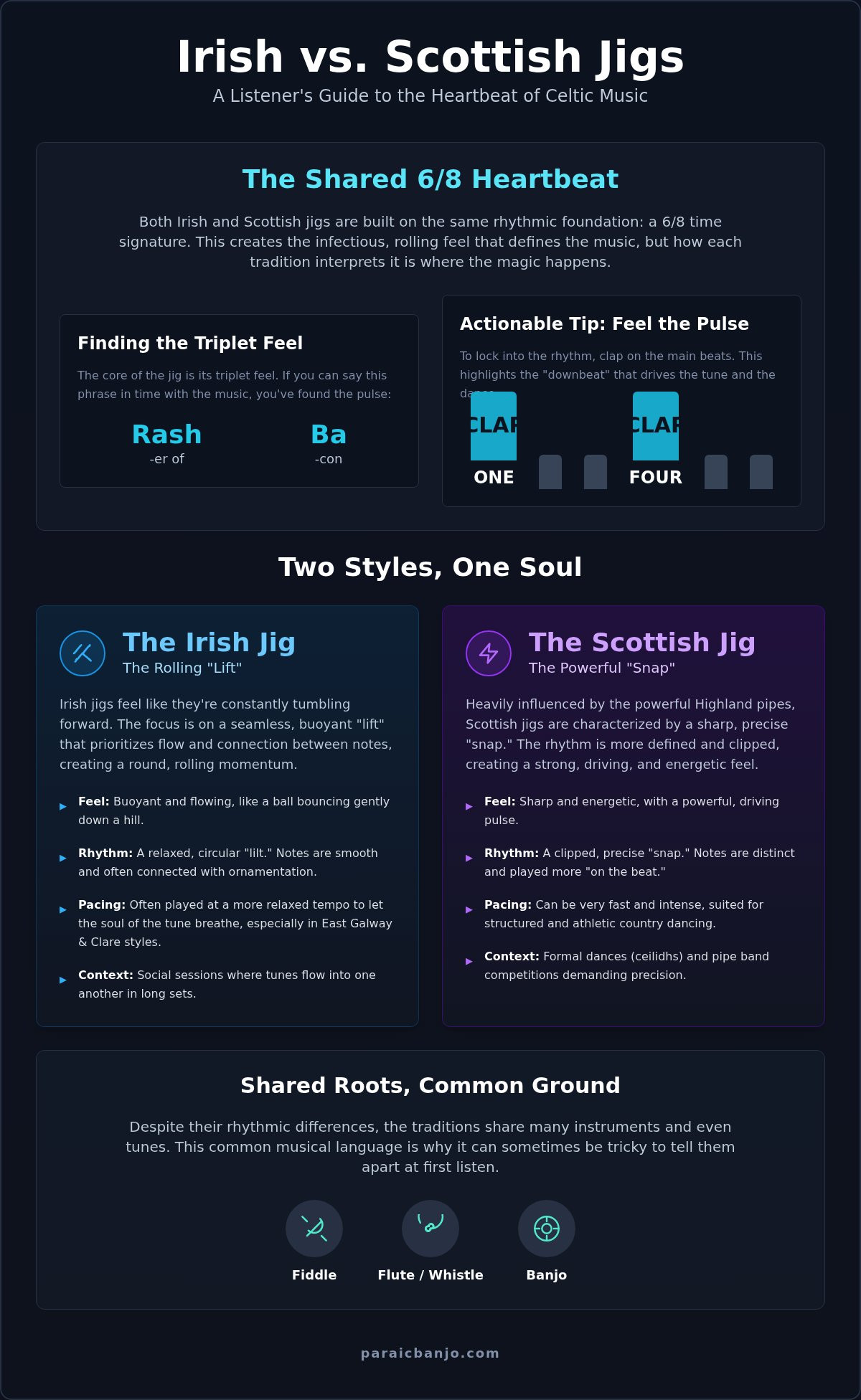
To understand the difference between irish and scottish jigs, you first have to understand the pulse that binds them together. Think of the jig as the soul of the dance floor. It has traveled a long road, moving from the refined royal courts of the 16th century down to the lively, crowded kitchen sessions that define our tradition today. If you've ever found yourself asking, What is a Jig?, the answer is found in the rhythm. It is a piece of music built on a constant, rolling triplet feel. If you can say the phrase "rash-er-of-ba-con" in time with the music, you've already found the heartbeat.
Both traditions rely on this 6/8 time signature. It creates a circular energy that never seems to stop. In my 39 years of playing, I've seen how this rhythm connects people across borders. Whether you are in a pub in East Galway or a hall in the Highlands, the jig is what gets feet moving. It is the foundation of our shared Celtic musical language.
Understanding the 6/8 Time Signature
In technical terms, 6/8 time means there are six beats in every measure. However, we don't count them as a straight line. Instead, we hear them as two distinct groups of three. Think of it as: ONE-two-three, FOUR-five-six. This structure is what creates that infectious "swing" or "lilt" that makes it impossible to keep your feet still.
Actionable Tip:
To find the pulse of any jig, try clapping along. Don't clap every beat. Instead, clap only on the "ONE" and the "FOUR." This mimics the natural weight a musician puts on the strings or the bellows, helping you feel the "downbeat" that drives the dancers forward.
Common Ground Between the Two Traditions
Before we look at what separates them, we should acknowledge how much they share. You'll find the same core instruments in both camps. The fiddle, the flute, and the banjo are staples of the session. In fact, many "National" tunes appear in both Irish and Scottish collections, often with only slight variations in the title or a few passing notes.
This overlap is exactly why beginners often struggle to spot the difference between irish and scottish jigs at first listen. The melodies can be remarkably similar. The real distinction isn't always in the notes on the page, but in the "lift" and the "attack" of the player. As you listen to the tracks on Not Before Time - 39 Years in the Making, you'll hear that specific Irish drive that we'll contrast with the Scottish style in the next section.
The Irish Jig: Flow, Lift, and the East Galway Influence
When you're trying to pin down the difference between irish and scottish jigs, listen for how the Irish tunes never seem to stop for breath. It isn't about the speed. It's about a quality we call the "lift." This isn't a mathematical increase in tempo, but a feeling of buoyancy. Imagine a ball bouncing down a hill; it hits the ground and immediately springs back up. That is the Irish jig. It is a rolling, circular energy that feels like it is constantly tumbling forward into the next bar.
In an Irish session, we prioritize flow above all else. We don't just play one tune; we weave them into sets of three or four. This creates a seamless stream of music where the transitions are as important as the melodies themselves. While organizations like the Royal Scottish Country Dance Society focus on the precise, structured footwork often associated with the Highlands, the Irish tradition often leans into a more relaxed, social atmosphere where the music and the movement blend into a singular, pulsing wave.
The East Galway and Clare Style
My own journey is deeply rooted in the traditions of the West of Ireland. To really get into the weeds of these sounds, you should explore the nuances of East Galway vs Clare music. In these regions, we tend to play at a slightly more relaxed pace. We aren't in a hurry. We want to find the soul of the tune. The tenor banjo is particularly good at highlighting this rhythmic lift. Because the notes are plucked, you can hear that tiny bit of "swing" that gives the music its characteristic Irish lilt.
Identifying the 'Rolling' Rhythm
If you want to train your ear, stop looking at the sheet music and start feeling the weight of the notes. Irish jigs rely heavily on ornamentation. These are the little extra notes, like "cuts" or "rolls," that we use to decorate the melody. They aren't just for show. They act like oil in a machine, keeping the rhythm moving without making it feel mechanical or stiff.
Actionable Tip:
Listen for the "roundness" of the notes. In an Irish jig, the notes aren't clipped short. They seem to bleed into one another just enough to create a smooth, connected sound. If the rhythm feels like a series of soft circles rather than sharp triangles, you're likely listening to an Irish tune.
In our tradition, we define lift as the upward energy at the end of a musical phrase. It is that subtle push that makes you want to tap your feet before the next measure even begins. You can hear this specific lift on every track of my debut album, Not Before Time - 39 Years in the Making. It's a collection that captures that raw session energy I've spent a lifetime chasing. If you want to hear how these rolling rhythms sound in a live setting, you can explore the digital album today.
The Scottish Jig: Precision, Pipers, and the 'Snap'
While the Irish jig rolls like a river, the Scottish jig marches with the precision of a clock. If you’re trying to hear the difference between irish and scottish jigs, you have to look toward the Highland bagpipes. Because pipers can’t stop the air to create silence between notes, they use rapid-fire finger movements called gracenotes to define the rhythm. This has created a tradition of staccato playing. The notes are short, sharp, and detached. It feels pointed. It feels deliberate. It’s a sound that demands attention and provides a rigid structure for dancers.
The most famous marker of this style is the Scottish Snap. This is a rhythmic jerk where a very short note is followed by a longer one. It gives the music a clipped sound that you won't often find in the West of Ireland traditions. In my 39 years of playing, I've noticed that this snap gives Scottish music a more formal, almost military feel compared to the relaxed swing of a Galway session. It’s a definitive statement of cultural pride that has influenced every instrument in the Scottish tradition.
The Bagpipe Influence on Rhythm
Scottish fiddlers and banjo players often mimic this pipy sound to keep that national character alive. They use their bows or picks to create a percussive attack on the string. It’s a technique that mirrors how a piper uses ornamentation to act as a drum. This style is closely linked to the Strathspey, a uniquely Scottish tune type known for its aggressive, jerky rhythm. When you hear a Scottish jig, you are hearing centuries of pipe band history translated onto other instruments.
Irish vs. Scottish Jig: Side-by-Side
To help you distinguish these styles while listening to your collection, I've put together a quick comparison of the two traditions.
Actionable Tip: Listen for the dot-and-cut. This is a specific rhythmic pattern where a long note is followed immediately by a very short one. If the rhythm feels like it is "stepping" rather than "rolling," you are likely hearing the Scottish influence. While my album, Not Before Time - 39 Years in the Making, focuses on the flowing Irish style, understanding this difference between irish and scottish jigs will make you a much more discerning listener at any festival or session.
Spotting the Difference: A Listener’s Actionable Checklist
You’re in the heart of a crowded session, the energy is rising, and you want to know exactly what you’re hearing. Identifying the difference between irish and scottish jigs doesn't have to be a guessing game. I've spent nearly four decades listening to these nuances, and it often comes down to a few key markers. Use this simple checklist to tune your ears to the heartbeat of the music.
Check the Snap: Do you hear a jerky, short-long rhythm that feels like a quick clip? That is the hallmark of the Scottish tradition.
Feel the Lift: Does the melody feel like a rolling wave that keeps you bouncing forward? That is the Irish lift in action.
Analyze the Ornamentation: Are the extra notes sharp and percussive, or do they roll into the melody like a singer’s breath?
Find the Ancestry: Does the tune sound like it was born on the Highland pipes or inspired by a vocal lilt?
The 30-Second Listening Test
Here is a practical trick I often share with students. Close your eyes and try to "lilt" or sing the tune using a simple "da-da-da" sound. If the melody flows smoothly and feels easy to sing without tripping over your tongue, you’re likely listening to an Irish jig. However, if the rhythm feels "jumpy" and forces you to put a sharp accent on certain notes to keep up, it’s almost certainly Scottish. This test helps you internalize the rhythm rather than just thinking about it. Give it a try at your next live session and see how quickly your ear adapts.
Why the Banjo is Your Secret Weapon
The tenor banjo is a rhythmic powerhouse because every note has a clear, percussive start. This makes it incredibly easy to hear exactly where a musician is placing the beat. While a fiddle can slur notes together, the banjo demands precision. On my debut album, Not Before Time - 39 Years in the Making, I focused on capturing that specific East Galway and Clare "swing" that defines our regional style. It’s a sound that’s been 39 years in the making, and it serves as a perfect reference point for anyone trying to master the Irish flow.
If you want to move beyond generic recordings and hear these subtle secrets for yourself, you should buy traditional Irish music that respects these regional nuances. Supporting independent artists who preserve these styles is the best way to keep the tradition alive. You can explore the tracks on my digital album to hear these rhythmic lessons in action and start building your own collection of authentic sounds today.
Bringing the Tradition Home: Why Style Matters in Your Collection
Building a music collection is more than just gathering tracks. It’s about curating a legacy. For many purist collectors, the goal isn't just to find "Celtic" music, but to find the specific, unvarnished sounds of a region. When you understand the difference between irish and scottish jigs, you stop seeing music as a generic background and start seeing it as a map of history. Generic hits often smooth over the very nuances that give these traditions their life. By seeking out authentic recordings, you're helping to keep those subtle rhythmic secrets alive for the next generation.
Supporting independent artists who dedicate their lives to these nuances is vital. It’s the difference between a mass-produced product and a piece of hand-crafted art. When you listen to a musician who has spent decades in the trenches of the session scene, you hear every bit of that experience in the "lift" of their jigs. This is where the story of the music truly lives. It’s in the grit, the pulse, and the personal connections made across a crowded pub table.
The Soul of a 39-Year Journey
My debut album, Not Before Time - 39 Years in the Making, was born from this desire for authenticity. It captures the specific East Galway pulse that I've lived and breathed for nearly four decades. We chose to record the 18 tracks live with expert session musicians because that’s where the music is most honest. Sterile studio tracks often lose the raw energy that defines a true jig. In a live setting, the rhythm has room to breathe and roll naturally.
Actionable Tip:
When you get a new album, don't just hit play. Take the time to read the liner notes while you listen. They provide the historical context and personal stories behind the tunes, turning a simple listening session into a deep musical journey. It helps you visualize the kitchen sessions and the masters who passed these rhythms down.
Start Your Authentic Collection Today
There is a unique pride in buying tenor banjo music direct from the artist. It ensures that the spirit of the tradition is preserved without being filtered through a corporate lens. My album is a definitive statement of a lifetime's passion, rooted deeply in the soil of the West of Ireland. It’s a milestone I’m incredibly proud to share with fellow enthusiasts who value the "lift" and "flow" we’ve discussed today.
You can join this storied tradition by exploring the album today. It’s available as a limited-edition physical CD for those who love the feel of a real disc, or as a high-quality digital download for your modern library. Every track is an invitation into a world of rhythm that has been 39 years in the making. I invite you to visit my shop and discover the difference between irish and scottish jigs through the lens of authentic Irish banjo music. Let's keep the session going together.
Mastering the Pulse of the Tradition
Now that you can hear the heartbeat of the music, you’re ready to step into any session with a fresh pair of ears. You’ve learned that the difference between irish and scottish jigs isn't just about the notes on a page; it’s about the soul of the rhythm. Whether you are chasing the rolling, circular lift of a Galway tune or the sharp, percussive snap of a Highland piper, you now have the tools to identify these storied traditions in the wild. Remember to trust your ears and try lilting the melody to find its natural flow.
If you want to immerse yourself in the true spirit of the Irish tradition, there is no substitute for authentic, live recordings. My debut album, Not Before Time - 39 Years in the Making, brings you 18 live recordings capturing the true session spirit. It represents 39 years of mastery in every track, complete with deeply researched liner notes that share the story behind the music. Experience the authentic Irish lift; Grab your copy of 'Not Before Time' here! Keep listening, keep playing, and let the music guide you home.
Frequently Asked Questions
Is an Irish jig faster than a Scottish jig?
Irish jigs are generally played at a faster tempo than their Scottish counterparts. While speed is a common marker, the true distinction is found in the rhythmic placement rather than just the beats per minute. A Scottish jig might feel slower because of its pointed delivery, whereas an Irish tune uses a rolling momentum to create a sense of urgency. It's about the energy of the session rather than a race to the finish.
What is the difference between a double jig and a slip jig?
The primary difference is the time signature. A double jig is in 6/8 time, consisting of two groups of three beats. A slip jig is in 9/8 time, adding a third group of three beats to every measure. This extra hop gives the slip jig a graceful, airy quality often associated with soft-shoe step dancing. While the double jig is the standard rhythm most people recognize, the slip jig offers a more complex, elongated feel.
Can you dance a Scottish jig to Irish music?
You can try, but the rhythmic mismatch makes it a challenge for serious dancers. Scottish jig steps are designed for the snap and staccato delivery of Highland piping. Irish music focuses on a rolling lift that doesn't always provide the sharp, percussive landing points a Scottish dancer expects. While the 6/8 heartbeat is shared, the way a dancer carries their weight depends entirely on those subtle rhythmic secrets that separate the two traditions.
Why is the 6/8 time signature called a jig?
The term jig likely comes from the Old French word gigue, meaning a fiddle or a lively dance. In traditional music, 6/8 is the signature time signature for this dance because its six beats are divided into two triplets. This structure creates the "rash-er-of-ba-con" rhythm that defines the genre. It has evolved from 16th-century royal courts into the soulful, driving force of the modern kitchen session we know and love today.
Is the tenor banjo used in both Irish and Scottish music?
Yes, the tenor banjo is a staple in both traditions, though it plays a particularly central role in the Irish session. Its percussive nature is perfect for highlighting the difference between irish and scottish jigs. In Ireland, players use it to drive the lift with a swinging pick attack. In Scotland, it might be used to mimic the crisp, clipped gracenotes of the bagpipes. It is a versatile tool for any musician exploring Celtic rhythms.
What does 'lift' mean in Irish traditional music?
Lift refers to the buoyant, upward energy at the end of a musical phrase. It isn't about playing faster; it's about creating a feeling of weightlessness that makes a dancer want to spring off the floor. This rolling quality is what gives Irish music its infectious swing. On my album, Not Before Time - 39 Years in the Making, I focus on capturing this specific lift to ensure the tunes feel alive rather than mechanical.
Are there any famous jigs that are played in both Ireland and Scotland?
Many National tunes appear in the collections of both countries. Tunes like The Irish Washerwoman or The Kesh Jig are recognized by musicians on both sides of the Irish Sea. However, the way they are played changes based on the regional style. An Irish player will lean into the rolling flow, while a Scottish player might add a snap to the rhythm. These shared melodies highlight how our musical histories have constantly intertwined over the centuries.
Why should I buy music directly from an artist instead of streaming?
Buying directly ensures that independent artists can continue preserving these delicate musical nuances. Streaming platforms often overlook the historical context that makes traditional music special. When you purchase Not Before Time - 39 Years in the Making from my site, you get 18 live tracks and detailed liner notes that explain the story of the tunes. It’s a direct way to join the tradition and support the work that goes into mastering these rhythms.


Comments