Famous East Galway Musicians: The Legends Behind the Lonesome Sound

What if the most hauntingly beautiful music you've ever heard didn't rely on breakneck speed, but on the soul-shaking silence between the notes? Many listeners today feel overwhelmed by the frantic, repetitive pace of modern session music where the melody often gets lost in a blur. If you've struggled to distinguish regional styles or find authentic recordings of famous east galway musicians, you're not alone. You are likely searching for something deeper; a sound that feels like an intimate conversation rather than a competitive race.
This guide promises to immerse you in the "lonesome sound," a style defined by its unhurried, lyrical pulse that continues to define Irish music in 2026. We will explore the legacies of legends like Paddy Fahey and the Ballinakill Céilí Band while helping you identify the specific traits of this soulful heritage. You'll learn how to connect with this living history through essential recordings, such as the album Not Before Time - 39 Years in the Making, which serves as a modern gateway to these iconic traditions. It's time to slow down and hear the music the way it was meant to be played.
Table of Contents
What is the East Galway Style? Understanding the Lonesome Sound
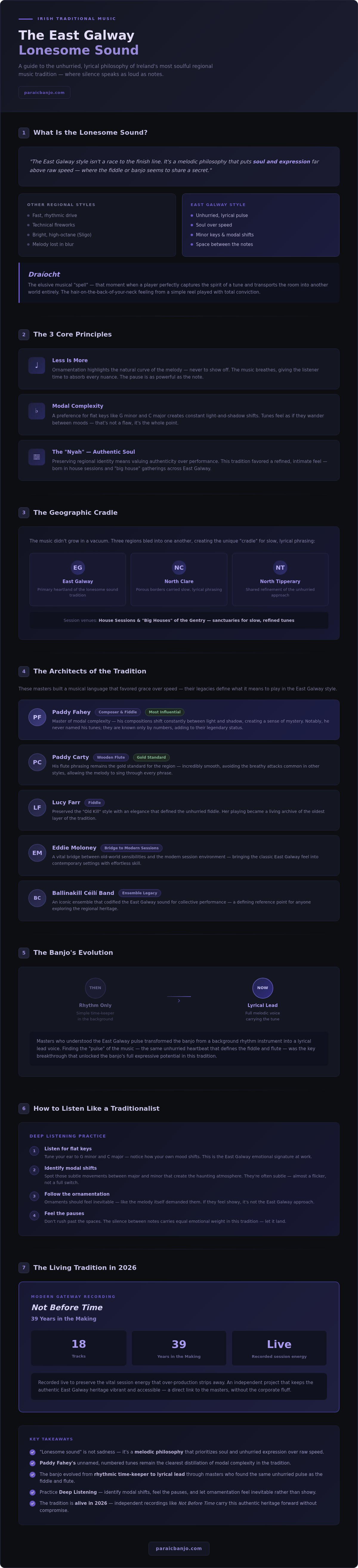
The East Galway style isn't a race to the finish line. It’s a melodic philosophy that puts soul and expression far above raw speed. While other regions might dazzle with technical fireworks, the famous east galway musicians of the past focused on the space between the notes. This creates the legendary "lonesome sound." It's a haunting, evocative quality that feels deeply personal, as if the fiddle or banjo is sharing a secret. This isn't just a style; it's a way of looking at the world through melody.
Much of this atmosphere comes from a preference for minor keys and clever modal shifts. Unlike the bright, high-octane Sligo style that dominated early recordings, the Galway tradition leans into the shadows. Actionable Tip: To really feel this, listen for tunes played in "flat" keys like G minor or C major. You'll notice a distinct shift in your own mood as the music pulls you in. This isn't just about sadness; it's about a profound emotional depth that fast, repetitive tunes often miss. It requires a bit more patience from the listener, but the reward is a much stronger connection to the player's intent.
The Regional Heartbeat: Galway, Clare, and Tipperary
The music didn't grow in a vacuum. The porous borders between East Galway, North Clare, and North Tipperary allowed styles to bleed into one another, creating a unique "cradle" for slow, lyrical phrasing. Historically, the "big houses" of the gentry and local house sessions acted as sanctuaries for these tunes. This environment favored a more refined, unhurried approach to the repertoire. This is where Paddy Fahey and other greats honed a sound that felt both ancient and revolutionary. These musicians weren't just playing notes; they were preserving a regional identity that valued the "nyah" or the authentic soul of the music.
The Philosophy of the Pause
In this tradition, less is truly more. Ornamentation isn't used to show off, but to highlight the natural curve of the melody. By keeping the pace unhurried, the music is allowed to breathe, giving the listener time to absorb every nuance. This leads to what we call draíocht. For those steeped in the Galway tradition, draíocht is that elusive musical magic or "spell" that occurs when a player perfectly captures the spirit of a tune, transporting the room into another world entirely. It’s that feeling of hair standing up on the back of your neck when a simple reel is played with total conviction.
You can hear this same pulse alive today in modern recordings. If you want to experience this unhurried energy for yourself, check out the 18 tracks on Not Before Time – 39 Years in the Making. It’s a direct link to the masters, recorded live to ensure that vital session energy isn't lost to over-production. It’s an invitation to join the tradition without the corporate fluff.
The Architects of the Tradition: Must-Know Fiddle and Flute Masters
To understand the pulse of this region, you have to look at the giants who shaped it. These famous east galway musicians didn't just play tunes; they built a musical language that favored grace over speed. While many other regions were chasing the fast, rhythmic drive of the early recording era, these masters held onto a slower, more deliberate flow. It’s a legacy that rewards the patient listener with layers of subtle emotion and technical depth.
Paddy Fahey stands as perhaps the most influential figure in this entire lineage. He was a master of modal complexity, creating tunes that feel like they’re constantly shifting between light and shadow. Then there’s Paddy Carty, whose wooden flute phrasing remains the gold standard for the region. His playing was incredibly smooth, avoiding the breathy attacks common in other styles to let the melody sing. We also owe much to Lucy Farr, who preserved the "Old Kill" style with an elegance that defined the unhurried fiddle. Eddie Moloney acted as a vital bridge, bringing these old-world sensibilities into the modern session environment with effortless skill.
Paddy Fahey and the Modal Shift
The "Fahey Sound" is instantly recognizable but notoriously hard to pin down. Instead of sticking to a straightforward major or minor key, his compositions often wander through shifts that create a sense of mystery. Interestingly, he never named his tunes; they’re simply known by numbers, which adds to their legendary status. Actionable Tip: If you want to hear this in a live setting, listen for "Fahey's Reel" during your next session. It’s a perfect entry point for recognizing his signature winding melodies and those haunting "flat" notes mentioned earlier.
The Ballinakill Céilí Band Legacy
It’s hard to believe that an ensemble from a tiny village could define the sound of a whole nation. The Ballinakill Céilí Band prioritized a synchronized, collective rhythm over individual flair. This ensemble sound was rooted in specific townlands and emphasized a steady, driving pulse that never felt rushed. You can dive deeper into how this compares to other regional styles by reading this guide on the East Galway vs Clare music connection. This collective approach ensured the music remained accessible and danceable while maintaining its soulful core.
If you're looking to hear these influences captured with modern clarity, the 18 tracks on Not Before Time – 39 Years in the Making offer a direct link to this heritage. It’s a celebration of the masters, played with the same unhurried spirit they championed throughout their lives.
The Banjo in East Galway: From Rhythm to Lyricism
In the early days of the tradition, the banjo wasn't the melodic leader it is today. It was primarily a "time-keeper," providing a steady, percussive clatter that helped dancers keep their footing during a lively set. However, as the regional style evolved toward that haunting, unhurried pulse, the instrument had to change too. The famous east galway musicians of the mid-20th century realized that the banjo could do more than just mark time; it could sing.
This shift from "clatter" to "soul" is what makes the East Galway banjo style so distinct. Instead of a sharp, metallic attack, players began to favor a warmer, more resonant tone. The four-string tenor banjo became the perfect vehicle for this, offering a range that could mimic the lyrical phrasing of the fiddle or flute. Actionable Tip: If you're picking up the instrument, focus on your "pick attack." It should be soft and fluid rather than hard and percussive. Imagine you're drawing the sound out of the strings rather than striking them. This small adjustment is the secret to finding the "lonesome" quality in your own playing.
Mikeen Conlon: The Early Pioneer
Mikeen Conlon was a central figure in this transformation. Coming from a background where he deeply understood the rhythmic drive of the melodeon (a simple button accordion), he bridged the gap between pure rhythm and melody. He was a cornerstone of the Ballinakill sound, ensuring the banjo didn't just sit on top of the music but was woven into its very fabric. His technical setup was modest, but his influence was massive, proving that the banjo could handle the complex modal shifts that define the region without losing its rhythmic heart.
Modern Interpretation: Páraic Mac Donnchadha
Today, this legacy is in safe hands. Páraic Mac Donnchadha has spent decades immersed in this specific community, and his work is a definitive statement of that passion. You can hear this living history in Not Before Time – 39 Years in the Making. This isn't a polished, sterile studio project. It features 18 tracks recorded live to capture that essential session energy that can't be faked. It’s an invitation to experience the tradition exactly as it sounds in the kitchens and pubs of Galway. If you want to hear how famous east galway musicians continue to influence the pulse of Irish music in 2026, this album is your primary gateway. It’s a bridge between the legends of the past and the vibrant, breathing culture of today.
Building Your Ear: How to Listen Like a Traditionalist
Listening to traditional music isn't a passive activity; it’s an art form in itself. To truly appreciate the work of famous east galway musicians, you need to move beyond treating it as background noise. We call this "Deep Listening." It’s about peeling back the layers of a tune to find the pulse, the soul, and the subtle shifts that make this regional style so legendary. When you stop just hearing the notes and start feeling the intent, the music opens up in a completely new way.
The first step is identifying the key. Is the tune in a bright major key, or does it lean into those haunting minor and modal shifts we discussed earlier? In East Galway, you're often listening for that "something in between" feeling. Next, track the rhythm. Instead of a frantic drive, listen for a sense of restraint. It’s a rhythmic tension where the player seems to be pulling back just a fraction, creating a groove that feels unhurried but steady. Finally, listen for the variations. A master never plays a part exactly the same way twice. They might add a subtle roll or change a single note's emphasis during the second turn, keeping the melody alive and breathing.
The Essential East Galway Playlist
If you're looking for a place to start, Paddy Carty’s Traditional Music of Ireland is essential. His phrasing on the wooden flute is the perfect example of the "lonesome sound" in its purest form. Finding authentic celtic music in a world of digital streaming can be tricky, so look for recordings that prioritize the raw, acoustic sound of the instruments. Actionable Tip: Use a pair of high-quality headphones. This allows you to catch the subtle "breathing" of a flute or the soft pick attack of a banjo that often gets lost on cheap speakers.
Reading the Tunes: The Value of Liner Notes
The stories behind the tunes matter as much as the notes themselves. Knowing that a reel was composed for a specific neighbor or learned in a particular townland adds a layer of connection that you can't get from a title alone. Páraic’s album, Not Before Time – 39 Years in the Making, includes detailed liner notes that serve as a historical map of Galway and Clare. Actionable Tip: Try reading these notes while you listen. It anchors the music in a physical place and connects you to the living history of the people who kept these tunes alive for generations. You can get your copy of Not Before Time – 39 Years in the Making here to start your own deep listening journey today.
Keeping the Pulse Alive: The Living Tradition in 2026
The legacy of famous east galway musicians isn't just found in dusty archives or black-and-white photographs. It’s a breathing, vibrant culture that continues to fill the air in 2026. If you visit Ballinasloe from September 3rd to 6th this year for the 13th annual Féile Cheoil Larry Reynolds, you’ll hear the "lonesome sound" echoing through the streets. It’s alive in the hands of new masters like Keelan McGrath, who launched his album The Reel Road at the festival this year, and 2026 All-Ireland champion Joseph Mannion. This music doesn't belong in a museum; it belongs in the hands of people who love the craft.
In a world of corporate streaming "fluff" where algorithms often favor speed over soul, independent artists are the true guardians of the heritage. When you buy traditional irish music direct from artist sites, you’re bypassing the digital noise and directly supporting the preservation of regional styles. For purists and collectors, the physical CD remains the gold standard. It’s about the tactile experience of holding the work and having access to the detailed historical context that only physical liner notes can provide. It’s a definitive statement of intent in a disposable digital age.
Supporting the Next Generation
The tradition is finding new life through events like the Galway TradFest in November 2026. Organized by Music Generation Galway County, this festival focuses on nurturing young talent through masterclasses with tutors like Fergal Scahill and Emma O'Sullivan. While digital downloads make preservation easier, the real work happens in these face-to-face sessions where the "Galway pulse" is passed down. My own project, Not Before Time – 39 Years in the Making, stands as a definitive statement for the 2020s, bridging the gap between the old masters and these emerging voices by capturing the raw, unedited energy of the music.
Your Invitation to the Session
If you want to find authentic music today, look for the small sessions in East Galway townlands or attend the presentations at Ballinasloe Library. The community is open, humble, and always ready to share a tune. You don't need to be an expert to join the journey; you just need to start your collection with the right sounds. I invite you to explore the 18 tracks on Not Before Time – 39 Years in the Making. Whether you choose the physical CD for its rich notes or the digital album for convenience, you’re connecting with a lifetime of immersion. Join the journey by exploring the tracks today and keep this beautiful, unhurried pulse beating for another generation. Talk soon!
Join the Living Legacy of the Lonesome Sound
The journey through the East Galway tradition shows us that the most powerful music doesn't need to shout; it just needs to breathe. We've explored how the unhurried pulse and modal shifts of famous east galway musicians like Paddy Fahey and Paddy Carty created a "lonesome sound" that still haunts and inspires today. By practicing deep listening and focusing on the soul between the notes, you can connect with a heritage that values expression over speed. This isn't a museum piece; it's a vibrant, living conversation happening right now in sessions across the west of Ireland.
You can become a part of this story by supporting the artists who keep the pulse beating. My debut project captures 39 years of immersion in this specific community across 18 live tracks of pure tradition. It features expertly crafted liner notes to guide your ear through the history of every tune. Bring the pulse of East Galway home with 'Not Before Time – 39 Years in the Making' and support the continuation of this soulful craft. It's time to slow down and let the music speak to you. Enjoy the tunes!
Frequently Asked Questions
What makes East Galway music sound 'lonesome'?
The lonesome sound comes from a melodic preference for minor keys and modal shifts that create a haunting, evocative atmosphere. Instead of the bright, major-key drive found in other regions, this style leans into the shadows of the scale. It’s also about the unhurried pace. By slowing the tempo down, players allow the melody to breathe, which gives the music a soulful depth that feels deeply personal to the listener.
Who is considered the most influential East Galway musician?
Many consider Paddy Fahey the most influential figure among famous east galway musicians. His compositions redefined the regional sound by introducing complex modal structures that were previously unheard in traditional circles. While masters like Paddy Carty and Lucy Farr were essential for their phrasing, Fahey’s legacy lives on through hundreds of untitled tunes that are still played in sessions worldwide. His work is the definitive blueprint for the lonesome sound we celebrate today.
What instruments are most common in the East Galway style?
The fiddle and wooden flute are the historical cornerstones of this style, prized for their ability to handle subtle ornamentation. However, the tenor banjo and accordion have also become central to the tradition. In East Galway, these instruments are played with a warmer, more resonant tone than in other regions. The focus is always on a soft pick attack or gentle bellows control to maintain that lyrical, singing quality the region is known for.
Is the East Galway style still played in sessions today?
Yes, the tradition is very much alive in sessions across the region, especially during festivals like the Féile Cheoil Larry Reynolds in Ballinasloe. Local pubs in East Galway townlands still host regular gatherings where the unhurried pulse is preserved. These sessions aren't just for show; they are vital community spaces where the music is passed from one generation to the next. It’s a breathing culture that remains vibrant in 2026.
Where can I find authentic recordings of East Galway musicians?
Finding high-quality, authentic recordings can be difficult in a digital world full of over-produced music. For a modern gateway to this heritage, you can explore the album Not Before Time – 39 Years in the Making. It features 18 tracks recorded live to capture that essential session energy. Whether you choose the limited-edition physical CD or the digital album, you’re getting a direct link to the soul of the famous east galway musicians who defined this beautiful style.
Why is Paddy Fahey so famous in Irish music circles?
Paddy Fahey is legendary because he composed hundreds of tunes that feel ancient yet revolutionary. His music often shifts between major and minor modes, creating a sense of mystery and depth. Interestingly, he never gave his tunes titles, so they are identified only by numbers. This has added a layer of legendary status to his work, making his compositions a rite of passage for any serious traditional musician looking to master the lonesome style.
How does the Galway style differ from the Clare style?
While both styles are rooted in the west of Ireland, they have distinct rhythmic souls. Clare music is often characterized by a steady, driving pulse that is perfect for dancing. In contrast, the East Galway style is more unhurried and lyrical, prioritizing the melody’s emotional curve over a constant rhythmic push. It’s a subtle difference, but once you train your ear to hear the "philosophy of the pause," the distinction becomes clear and profound.
Can I learn the East Galway style as a beginner?
Absolutely, beginners can learn this style by focusing on "Deep Listening" and slowing down their practice. The key isn't to master complex ornaments right away, but to understand the unhurried pulse of the tunes. Start by listening to masters who prioritize soul over speed. While I don't offer banjo tuition, I highly recommend studying the detailed liner notes in physical recordings to understand the history and context behind the melodies you are learning.


Comments