Fingerstyle vs. Plectrum for Tenor Banjo: Choosing Your Irish Sound

You might think the only way to survive a crowded session is by digging in with the heaviest plectrum you can find, but the true soul of the Irish tenor banjo lies in the delicate balance between power and pulse. It is a common struggle; many players feel caught between the rolling fingerstyle of a 5-string and the sharp, percussive snap of a 4-string tenor. If you've ever felt your rhythmic triplets getting lost in the noise or wondered why your favorite irish tenor banjo cd sounds so much punchier than your own practice sessions, you aren't alone. It takes time to find that perfect "bark" that defines the tradition.
I want to help you bridge that gap. We are going to explore the rhythmic and tonal differences between fingerstyle and plectrum techniques to find the perfect approach for your own musical journey. You'll get a clear look at the pros and cons of each style, along with actionable tips for improving your session-level volume. We will even dive into how to match your technique to the iconic recordings that inspired you to pick up the instrument in the first place. Let's get stuck in and find your unique voice within this beautiful, storied tradition.
Table of Contents
The Great Banjo Debate: Fingerstyle vs. Plectrum
Choosing between a plectrum and fingerstyle isn't just a technical decision; it's about deciding how you want to be heard in a room full of music. The plectrum, which is a small flatpick usually made of nylon or plastic, is what drives the modern Irish session. It provides the sharp, percussive attack needed to lead a set of reels. On the other hand, fingerstyle involves using your fingernails or specialized picks worn on the fingers to pluck individual strings. While this offers a beautiful, harp-like resonance, it often lacks the sheer power required for a lively pub environment. This choice defines your voice in the tradition, determining whether you'll be a rhythmic powerhouse or a subtle melodic contributor.
Back in the early 20th century, we saw a massive shift. As the tenor banjo moved from American jazz stages into Irish kitchens and halls, players realized the flatpick was the only way to compete with the volume of the button accordion and fiddle. This transition solidified the plectrum as the standard for the 4-string tenor, creating the driving sound we love today. If you want to hear exactly how this rhythmic plectrum work sounds in a live setting, listen to my irish tenor banjo cd, Not Before Time - 39 Years in the Making. It captures that raw session energy that only a plectrum can provide.
Why Style Matters in Irish Sessions
In a crowded pub, volume and "cut" are your best friends. The cut is the banjo's ability to slice through the wall of sound created by other instruments. A plectrum allows you to strike the strings with enough force to be heard without sacrificing clarity. This is vital when you're playing the lead in fast-paced jigs and reels. If you're struggling to be heard, try using a plectrum between 0.60mm and 0.73mm. This thickness gives you enough flex to master the triplet, a rapid three-note flick of the wrist, while still providing the volume needed for a session leader.
Understanding the Irish Tenor Context
The Irish tenor banjo is a different beast than the 5-string variety used in bluegrass. We use a 4-string setup tuned to GDAE. This tuning is exactly one octave below a fiddle, which means every fiddle tune fingering translates directly to your fretboard. However, this tuning changes the ergonomics of your picking hand. Because the strings are under higher tension, a plectrum is often more efficient for maintaining the rhythmic soul of the West of Ireland. Before you commit to a style, pick up an irish tenor banjo cd and pay close attention to the rhythmic pulse. You'll notice that the plectrum's percussive nature is what gives East Galway and Clare music that infectious, toe-tapping lift.
Mastering the Plectrum: The Irish Session Standard
The flatpick is the undisputed engine of the Irish session. It provides the bite, speed, and clarity required to navigate a set of fast reels without getting drowned out by a boisterous accordion. When you're playing at session speed, your right hand needs to be a rhythmic machine. Using a plectrum allows you to achieve a level of precision that bare fingers simply cannot match in a loud environment. It is the tool that lets you lead the room with confidence. To get that authentic, soulful tone, I recommend experimenting with pick thickness. A pick in the 0.60 mm to 0.73 mm range often hits the sweet spot; it's flexible enough for fast movements but stiff enough to produce a warm, round sound on the lower strings.
Actionable Tip: Hold your pick with just enough pressure to keep it from flying across the room. If you choke the plectrum, your tone will sound brittle and thin. A loose grip allows the pick to "bounce" off the strings, which is the secret to achieving a fluid, natural rhythm.
The signature sound of the Irish tenor banjo is the triplet, often called a "treble." This is a rapid down-up-down strike that mimics the flick of a fiddler's bow. It's not just a decoration; it's a rhythmic burst that injects energy into the tune. Mastering this movement requires a relaxed wrist and a very small picking motion. If you listen closely to a high-quality irish tenor banjo cd, you'll hear how these triplets act as the heartbeat of the melody, pushing the tune forward without breaking the flow.
The Rhythmic Pulse of East Galway
In the East Galway and Clare traditions, the plectrum does more than just hit notes. It creates a specific "lift" or swing that is central to the regional sound. This style relies on precise plectrum control to emphasize the off-beats, creating a soulful, rolling feel. This is why studying a traditional irish session music cd is so valuable for learners. You aren't just listening for the notes; you're listening for the way the pick strikes the string to create that infectious pulse. If you want to hear this rhythmic lift in a live setting, you can explore the digital tracks from my latest album, which was recorded to capture that exact session energy.
Plectrum Pros and Cons
Pro: Provides maximum volume and "cut" for unamplified acoustic sessions.
Pro: It is the most efficient way to execute complex ornamentation like triplets and slides at high speeds.
Con: Poor technique can lead to a "clicky" or harsh percussive sound that distracts from the melody.
Refining your plectrum work is a lifelong journey. It’s about finding that balance between power and finesse. When you get it right, the banjo becomes a soulful extension of your own rhythmic pulse, capable of carrying a whole room of dancers on the back of a single reel.
Fingerstyle Tenor: A Soulful Alternative
While the plectrum provides the rhythmic bark needed for a lively pub, there is a quieter, more intimate world to explore through fingerstyle. Many players believe that plucking with your fingers is reserved for the 5-string banjo, but that isn't the case. Adapting three-finger rolls or clawhammer techniques to the 4-string tenor opens up a range of textures that a flatpick simply can't reach. The "thump" of skin on string creates a woody, organic resonance that feels deeply connected to the instrument's roots. It is a soulful alternative that turns the banjo into a melodic storyteller, especially during solo performances.
If you're listening to an irish tenor banjo cd to study technique, you'll mostly hear the sharp attack of the plectrum. However, fingerstyle is the perfect choice for slow airs and waltzes where sustain and subtle harmony matter more than raw speed. It allows the notes to ring out with a softness that mimics the Irish harp. Actionable Tip: To get the best of both worlds, try using the back of your index fingernail for your downstrokes. It provides a sharper, pick-like attack that helps your melody lines stand out without losing the warm feel of fingerstyle play.
The Clawhammer Tenor Approach
Clawhammer is a rhythmic style where you strike the strings with the back of your nail in a downward motion. On a 4-string tenor, you can still achieve that iconic "bum-ditty" rhythm. The challenge lies in our GDAE tuning, which lacks the high fifth drone string found on bluegrass banjos. You can overcome this by utilizing your open strings as drones. Striking the open G or D strings while playing a melody on the higher strings creates a rich, drone-like effect that fills the sonic space. This technique requires a bit more precision in your right hand, but the reward is a thick, driving sound that works beautifully for solo sets.
Fingerstyle Pros and Cons
Choosing to play with your fingers changes how you interact with the music. It’s a trade-off between power and personality. Here is what you should consider before putting down the pick:
Pro: You get a deep, organic tone that feels warm and personal.
Pro: It gives you the ability to play chords and melody simultaneously, acting as your own accompaniment.
Con: It is significantly quieter than plectrum playing. You'll likely struggle to be heard in a loud, unamplified session.
If you're looking to explore these deeper tones, check out the digital tracks on my album. While I primarily use a plectrum to maintain that session "lift," you can hear the difference that precise rhythmic control makes in the overall pulse of the music. You can find the digital album here to start your listening journey. It is a great way to hear how the rhythmic pulse of East Galway can be captured with clarity and soul.
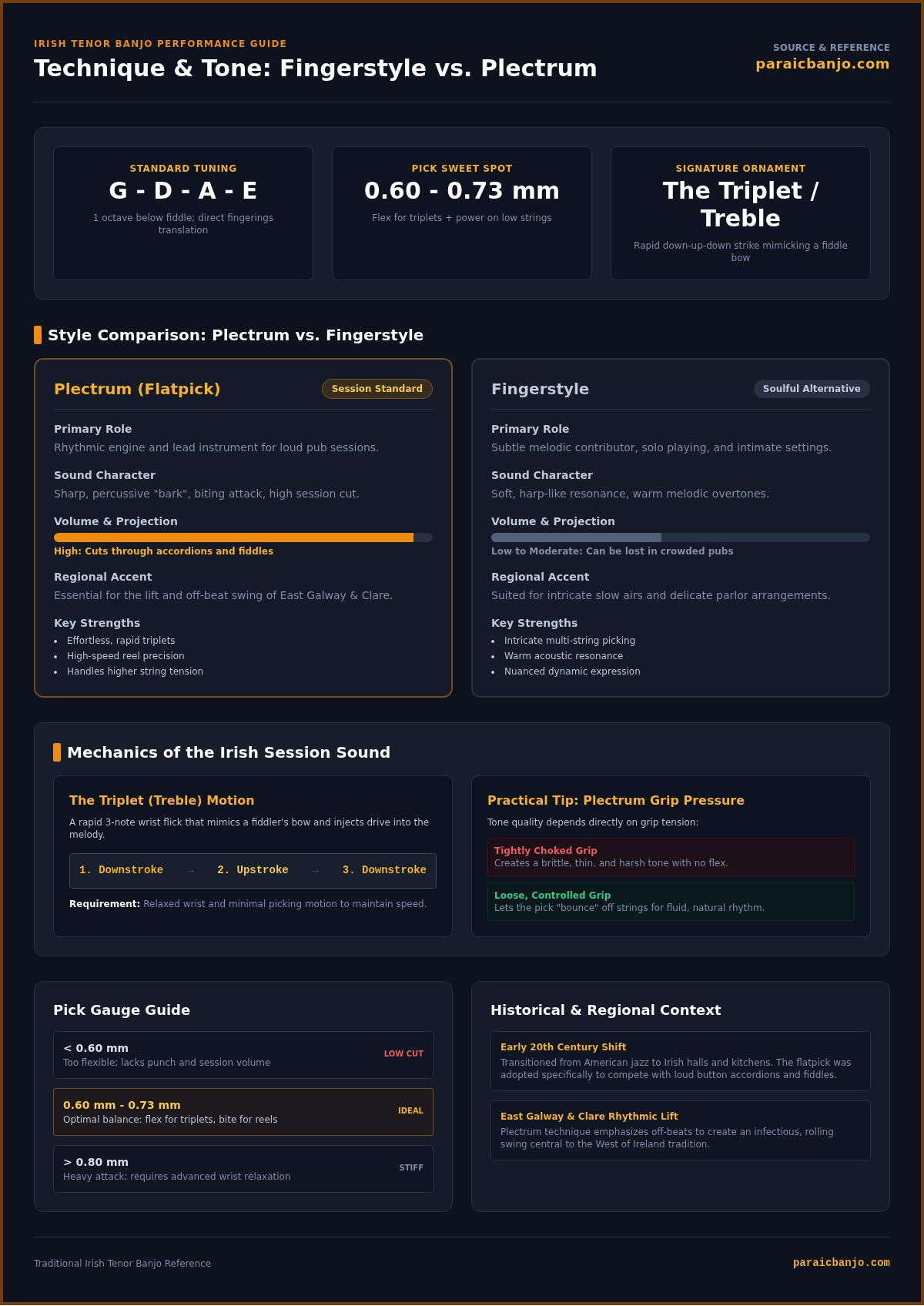
Comparison Guide: Which Style Should You Choose?
Choosing your path in the world of the tenor banjo often comes down to where you see yourself playing. Are you dreaming of leading a lively set in a packed pub, or do you prefer the quiet reflection of a solo performance in your living room? The plectrum offers a bright, percussive "bark" that is perfect for cutting through the noise. Conversely, fingerstyle provides a mellow, woody tone that invites the listener into a more intimate space. If you're just starting out, the plectrum usually has a gentler learning curve for achieving a clean, consistent volume, but fingerstyle might feel more natural if you're transitioning from the guitar or 5-string banjo.
Actionable Tip: Don't just take my word for it. Try both styles on a single track to hear the difference for yourself. Play the first half of a reel with a pick and the second half with your fingers. You'll hear the instrument transform from a driving lead to a soulful, melodic companion. This simple experiment will tell you more about your personal "voice" than any manual ever could. If you want a reference point for that professional plectrum sound, listening to a high-quality irish tenor banjo cd can help you set a tonal benchmark for your own practice.
The Session Player's Framework
There is a reason why 90% of session players stick to the plectrum. In a traditional Irish session, the banjo isn't just a melody instrument; it's a rhythmic engine. The flatpick allows you to blend into the group while maintaining that essential "lift" that keeps the dancers moving. You can find deep inspiration by studying the subtle differences between East Galway vs Clare music. Each region has a unique rhythmic soul, and the plectrum is the tool most players use to capture those specific pulses. It’s about being part of a collective conversation.
The Soloist's Framework
If your goal is to perform alone or in a small acoustic duo, fingerstyle allows you to create a "wall of sound" by playing chords and melody at the same time. This versatility makes your repertoire feel full and complete without needing a backing guitar. My debut album, Not Before Time - 39 Years in the Making, is essential listening for anyone looking to understand how technical precision can elevate a solo performance to something legendary. You can grab your copy of the physical CD here to hear how decades of mastery translate into every strike of the string. Mixing these techniques allows you to adapt to any musical situation with confidence.
Mastering Your Technique: Next Steps for Purists
To reach the heart of this music, you must go beyond the notes on a page. True mastery comes from immersing yourself in the sounds of those who lived and breathed the tradition for decades. Listening to a master like Páraic Mac Donnchadha isn't just about hearing a melody. It is about absorbing the subtle lift and the rhythmic drive that defines the East Galway style. When you pick up a high quality irish tenor banjo cd, you aren't just buying music. You are gaining a textbook on timing. You are learning how a seasoned player breathes life into a reel through precise, soulful plectrum work.
One of the best ways to improve is to study the liner notes. These aren't just lists of tunes. They are maps. They tell you where a tune came from, who played it in the 1920s, and why a certain rhythmic pattern was chosen. Understanding these origins helps you play with more than just your hands; it helps you play with your soul. As you build your practice routine, prioritize the "pulse" of the music over raw speed. A slow tune with a perfect lilt will always sound better than a fast one that lacks a heartbeat. Speed is a natural byproduct of a steady, confident rhythm.
Actionable Tip: Set up a simple recording device during your next practice session. Listen back specifically to check if your rhythm "swings" or if it "drags" behind the beat. It’s difficult to judge your own pulse while you’re focused on complex fingering, but the recording won't lie. Aim for that infectious, driving energy that makes people want to tap their feet.
Building Your Authentic Library
For those serious about the craft, the search for authenticity never ends. Serious collectors should buy traditional irish music in physical formats whenever possible. A physical irish tenor banjo cd offers a level of detail that streaming services often strip away. You get lossless audio quality that lets you hear every ghost note and subtle ornament. More importantly, you get the physical notes that explain the technical nuances of live play. Supporting independent artists this way ensures that these regional styles and specialized techniques are preserved for the next generation of players.
Final Thoughts on Style
At the end of the day, there is no single "wrong" way to play. There is only the way that speaks to you and the tradition you represent. Whether you choose the percussive power of the plectrum or the intimate resonance of fingerstyle, the goal is the same. You are trying to capture the spirit of the West of Ireland in every note you strike. It is a journey of 39 years or more, and every day brings a new discovery. Ready to hear these styles in action? Explore Páraic's debut album today and let the music guide your next steps.
Find Your Pulse in the Tradition
Finding your unique voice on the tenor banjo is a journey that often spans decades. Whether you lean toward the percussive drive of the plectrum for a lively session or the soulful warmth of fingerstyle for solo play, your choice is a personal statement. It's about more than just hitting the right notes. It's about the lift, the swing, and the stories told through every strike of the string. Technique is simply the tool you use to let the music breathe.
If you're ready to truly immerse yourself in this tradition, there's no better guide than a high quality irish tenor banjo cd. My debut album, Not Before Time, represents 39 years of musical heritage distilled into 18 tracks of pure, live-recorded Irish tradition. Each physical CD includes detailed liner notes that serve as a resource for understanding the history and rhythmic nuances of the East Galway style. Experience the rhythmic soul of the tenor banjo. Order 'Not Before Time' on CD. Pick up your instrument, trust your ear, and let the music lead you home.
Frequently Asked Questions
Can you play fingerstyle on a 4-string tenor banjo?
Yes, you certainly can play fingerstyle on a 4-string tenor banjo. It produces a softer, more intimate sound compared to the percussive snap of a pick. This approach is wonderful for slow airs or solo performances where you don't need to compete with a room full of fiddles. You'll find it creates a beautiful, harp-like resonance that brings out the instrument's woody character. It’s a soulful alternative to the standard session style.
What is the best pick thickness for Irish tenor banjo?
Most Irish session players prefer a plectrum between 0.50 mm and 0.73 mm. A thinner pick provides the flexibility needed for those lightning-fast rhythmic triplets. If you want more volume and a punchier low end, you might experiment with a stiffer 1.0 mm pick. The key is finding a balance that lets you "flick" the strings without snagging. Listening to a high-quality irish tenor banjo cd can help you identify the tone you're aiming for.
Do I need a different banjo for fingerstyle vs. plectrum?
You don't need a separate instrument to explore both styles. The same 4-string tenor works perfectly for both plectrum and fingerstyle playing. Some players might adjust their string height or "action" to make plucking easier, but it isn't a requirement. It’s all in the hands. Focus on your right-hand technique first before worrying about hardware changes. The instrument is versatile enough to handle whatever rhythmic pulse you decide to give it.
Why is the plectrum more popular in Irish sessions?
The plectrum is the session standard primarily because of volume and clarity. In a crowded pub, you need that sharp "cut" to be heard alongside button accordions and loud fiddles. Bare fingers often get lost in the mix. A flatpick also makes it much easier to execute the rapid-fire ornamentation that defines the tradition. It's the engine that drives the rhythmic lift of a great set of reels and jigs.
Is it hard to switch from 5-string fingerstyle to tenor banjo?
Switching from 5-string fingerstyle to the 4-string tenor isn't necessarily hard, but it does require some adjustment. You're moving from open-G tuning to GDAE, which mirrors the fiddle. This means your left-hand fingerings will change completely. However, the finger strength and dexterity you've built up will serve you well. It's a fresh way to engage with the music, especially if you love the driving pulse of East Galway and Clare.
How do I get more volume when playing fingerstyle?
To get more volume while playing fingerstyle, try using your fingernails or specialized fingerpicks. This gives you a sharper attack similar to a plectrum. You should also ensure you're playing a resonator banjo, as the wooden back helps reflect the sound forward into the room. While you won't match the raw power of a flatpick, these adjustments help your notes ring out clearly. It's about maximizing the natural resonance of your instrument.
What tuning is best for plectrum-style Irish music?
The definitive tuning for plectrum-style Irish music is GDAE. This tuning is exactly one octave below the fiddle and mandolin, allowing you to use the same finger patterns for every traditional tune. It provides a deep, rich growl on the low strings that is essential for that authentic session "bark." Most players find this fifths-based tuning to be the most ergonomic way to handle fast-paced melodies with a pick.
Where can I hear examples of rhythmic tenor banjo playing?
You can hear definitive examples of rhythmic plectrum work on my irish tenor banjo cd, Not Before Time - 39 Years in the Making. The 18 tracks were recorded live to capture the raw energy of a traditional session. It’s a great resource for anyone wanting to study the "lift" and "swing" of the East Galway style. The detailed liner notes also provide historical context that helps you understand the soul behind the rhythm.


Comments