Stories Behind Traditional Irish Tunes: Finding Meaning in the Music

Imagine sitting in a dimly lit corner of a pub in East Galway, listening to a banjo player pour their heart into a tune that has been played for generations. You might hear a title like "The Rights of Man" and think it is just a catchy name, but that melody actually carries the weight of 18th-century rebellion. It is easy to feel like an outsider when you are faced with confusing titles or academic books that feel too dense to enjoy. You want to feel the music, not just study it like a museum piece.
I understand that frustration because I have spent nearly four decades living these melodies. In this article, you will discover the genuine stories behind traditional irish tunes that give the music its soul. We are moving past the dry facts to find the regional legends and social meanings woven into every bar. You will learn how to use tools like the Irish Traditional Music Archive to dig up your own history and how to spot the rhythmic "lift" that defines different counties. By the time we are done, you will have a much deeper emotional connection to your music collection and the practical skills to keep exploring this storied tradition.
Table of Contents
Beyond the Melody: Why Irish Tunes Carry Secret Histories
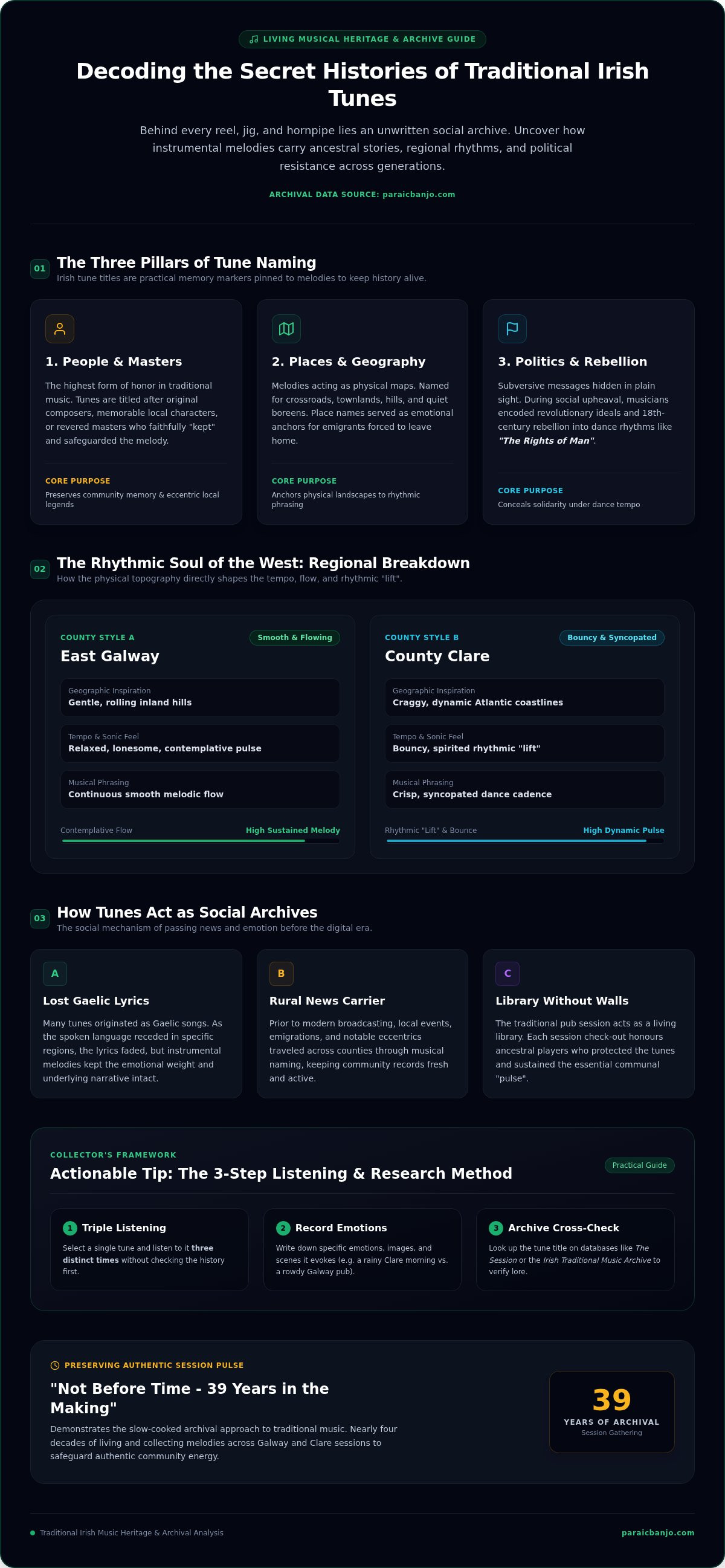
"Tune lore" isn't just a fancy term used by academics; it is the very heartbeat of our tradition. It is that magical crossroads where social history, local folklore, and a sweet melody all shake hands. When you listen to a reel or a jig, you aren't just hearing a sequence of notes. You're hearing a story that has survived for centuries through word of mouth and the steady tap of a foot. These stories behind traditional irish tunes are what transform a simple piece of music into a living, breathing piece of history.
Finding Meaning in Irish Folk Songs vs. Instrumental Tunes
In the old days, many of our tunes started as songs with rich Gaelic lyrics. As the language faded in certain regions, the words were sometimes lost, but the melodies refused to die. The title of a tune often acts as a placeholder for a much bigger story. A brisk reel might carry the frantic energy of a local rebellion, while a slow air holds the weight of a family forced to emigrate. The "feeling" of the music often tells you more than the lyrics ever could. It is a purely emotional archive.
The Social Function of Music in Rural Ireland
Before the digital age, music carried the news across Galway and Clare. If a local character was particularly eccentric, they would likely have a tune named in their honor to keep their memory green. Preserving these stories ensures the "pulse", that essential, living energy, stays in the music. Without context, a tune is just a sequence of notes; with the story, it is a conversation with the past. This connection to the community is why I spent decades gathering the material for my album, Not Before Time - 39 Years in the Making.
The local session is our living community archive. Every time we sit down to play, we are checking out a "book" from a library that has no walls. It is about more than just getting the fingering right; it is about honoring the people who kept these tunes safe for us. If you want to hear these stories told through the strings, you can find Not Before Time - 39 Years in the Making on physical CD or as a digital album.
Actionable Tip: Start a Listening Journal
Before you jump into the history books, try this. Pick a tune you love and listen to it three times. Write down the specific emotions it stirs up or the images it brings to mind. Does it feel like a rainy morning in Clare or a rowdy night in a Galway pub? Once you have your own connection, look up the title on a site like The Session. You will find that your personal "feeling" for the tune often aligns perfectly with its actual history.
The Three Pillars of Tune Naming: People, Places, and Politics
Understanding the names of Irish tunes is like cracking a secret code. Most titles fall into three distinct categories: people, places, or politics. These aren't just random labels; they are the keys to the stories behind traditional irish tunes. When you hear a title, you're looking at a piece of the past that someone thought was too important to forget. It's a way of pinning a memory to a melody so it doesn't drift away with the wind.
Political subtext often hides in plain sight within the music. During times of social upheaval, musicians couldn't always speak their minds freely. Instead, they used dance melodies to carry messages of rebellion or solidarity. A tune like "The Rights of Man" isn't just a catchy hornpipe; it's a nod to revolutionary ideals. By disguising seditious thoughts under a lively rhythm, our ancestors kept their spirits high and their secrets safe from prying ears. It was a clever way to keep the flame of resistance burning in the middle of a crowded kitchen or a noisy pub.
Tunes as Maps: The Geography of the West
The topography of the West of Ireland directly shapes the rhythm of our music. You'll find countless reels named after obscure crossroads, townlands, or hills. This isn't just local pride; the landscape itself influences the style. For example, the East Galway tradition often feels like the rolling hills of the region. It's flowing, contemplative, and smooth. In contrast, the craggy coastlines of Clare might inspire a sharper, more syncopated "lift" in the music. These place-names serve as emotional anchors for those who had to leave home, preserving the memory of a specific field or a quiet boreen through every note played.
Honoring the Masters: The "People" Pillar
Naming a tune after a person is the highest form of respect in our community. Sometimes a tune is named for its composer, but more often, it's named for the musician who "kept" it or played it with such mastery that their version became the gold standard. This creates a genealogical map of players across the decades. When you play a tune associated with a great like Paddy Fahey, you're stepping into a lineage of performers. It takes a certain rhythmic restraint and tonal warmth to honor these names properly. If you're curious about how these histories sound when they're brought to life, you can explore the tracks and detailed notes on my debut album, Not Before Time - 39 Years in the Making.
Actionable Tip: Decode the Townlands
You can often find the exact origin of a tune just by looking at the title. Look for "toponymic" clues, which are words that describe a place. If a title starts with "Bally" (from Baile, meaning town), "Kil" (from Cill, meaning church), or "Glen" (a valley), you're looking at a specific geographic marker. Try searching for these terms on a map of Galway or Clare to see exactly where your favorite melody was born.
The Rhythmic Soul of the West: Stories from East Galway and Clare
Galway and Clare are more than just neighbors on a map; they are the two lungs of the Irish tradition. While they share many of the same melodies, the way they breathe life into them is entirely different. Finding the stories behind traditional irish tunes often means looking at how a melody changes as it crosses the county line. These regional micro-styles aren't just technical choices. They are a way for communities to maintain a distinct cultural identity in a world that is moving faster every day.
In East Galway, the music has a reputation for being contemplative and flowing. The tempo is often slower, which creates space for rich melodic variation and a "lonesome" atmosphere. In contrast, the Clare tradition is all about the "lift." This is a rhythmic, bouncy swing that was engineered specifically for set dancers. It's a punchy, syncopated attack that makes it impossible to keep your feet still. You can discover the nuances in East Galway vs Clare Music: A Guide to the Rhythmic Soul of the West.
The East Galway Banjo Legacy
The influence of the "old-timers" in East Galway is a cornerstone of my own playing. These masters prioritized tonal warmth and melodic restraint over raw speed. On the banjo, this style relies heavily on the "triplet," which is a cluster of three notes flicked quickly in the time usually taken by two. It isn't just a decoration. It's a storytelling device that adds texture and emphasis to the tune's most emotional moments. Preserving this specific regional pulse was my primary goal during the 39-year development of Not Before Time - 39 Years in the Making. It's about honoring that slow-cooked, authentic session energy that you just can't find in a polished studio production.
Clare: The Heartbeat of the Session
Clare music is inextricably linked to the communal house dance tradition. Before the days of modern concert halls, music happened in kitchens and barns. The tunes often have titles that reflect this "house dance" era, celebrating the social bond between the player and the dancer. The "lift" in a Clare reel isn't just about volume; it's about a rhythmic dialogue. It's the sound of a community celebrating its survival and its joy. You can experience these regional styles for yourself when you listen to the tracks on Not Before Time, where 18 tracks capture that raw, live-in-the-room energy of the West.
A Collector’s Guide: How to Uncover the Meaning Behind Your Favorite Reels
So, you have a melody stuck in your head and a title that makes no sense. It happens to the best of us. Unlocking the stories behind traditional irish tunes requires a bit of detective work, but the reward is a much deeper connection to every note you play or hear. You aren't just looking for facts; you're looking for the soul of the music. By following a few simple steps, you can move from being a casual listener to a true guardian of the tradition.
Start your hunt at The Session or the Fiddler’s Companion. These community databases are perfect for finding title variations. A single reel might go by half a dozen names depending on whether you're in East Galway or North Clare. Once you have the aliases, head over to the digital collections at the Irish Traditional Music Archive (ITMA). This resource allows you to hear field recordings and see interactive scores, helping you trace a melody's lineage back to the masters who first popularized it.
For the real grit, check Dúchas.ie. This is the National Folklore Collection, where you can cross-reference tune titles with local oral histories and school projects from the 1930s. However, the ultimate source is often right in your hand. Independent artist releases are the gold standard for context because the musicians themselves have done the heavy lifting. They've lived with these tunes for decades and usually share that hard-earned knowledge in their writing.
Digital Tools for the Modern Purist
Navigating these databases doesn't have to feel like a chore, even if you aren't a tech expert. The trick is searching for "tune families" rather than just single titles. A tune family is a group of related melodies that evolved from a common ancestor, often changing slightly as they traveled between counties. Understanding these connections helps you see the bigger picture of how our music breathes and grows. If you want to dive deeper into building an authentic collection, check out this guide on finding traditional irish music for purists.
The Lost Art of Reading Liner Notes
Streaming services are great for convenience, but they fail the meaning test every time. They give you the audio but throw away the history, leaving you with a list of names and no context. Liner notes are the missing link. They provide the bridge between the artist’s fingers and the tune’s origin, explaining why a specific set was chosen or who taught it to the performer. You can find this level of historical accuracy by ordering the physical CD of Not Before Time - 39 Years in the Making, which includes a 36-page booklet of detailed tune notes.
Actionable Tip: Prioritize Physical or PDF Notes
When you're buying music, always check if the release includes physical or PDF liner notes. These documents are often as valuable as the music itself, containing rare photos, composer attributions, and personal anecdotes that you won't find anywhere else. Don't settle for just the MP3; get the full story so you can truly own the music.
Preserving the Pulse with "Not Before Time - 39 Years in the Making"
It took nearly four decades of sessions, late night tunes, and quiet study to bring this project to life. Not Before Time - 39 Years in the Making is more than just a debut album; it's a definitive statement of a lifetime's passion for the banjo. Every one of the 18 tracks was carefully selected to tell a specific story of the West of Ireland, acting as a bridge between the old masters and the listeners of today. This isn't a rushed studio job. It's a slow cooked heritage piece that finally captures the stories behind traditional irish tunes I've carried with me since I first picked up the instrument. You can read more about the story behind the "Not Before Time" debut album to see how this long journey unfolded.
A Live Recording of Pure Tradition
To keep the soulful energy of a real session, we recorded everything live in the studio. We avoided clinical isolation, which is the common practice of putting musicians in separate soundproof booths to keep their audio tracks perfectly clean. While that works for pop music, it often kills the spirit of a session. Instead, we welcomed acoustic bleed. This happens when the sound of one instrument leaks into another musician's microphone. It creates a warm, cohesive blend that makes you feel like you're sitting right there in the room with us. The rhythmic style of the banjo serves as the heartbeat of the collection, keeping the energy grounded and authentic.
Your Entry Point into Irish Music History
Most commercial "best of" collections treat the music like a commodity, stripping away the context to fit a digital playlist. Not Before Time - 39 Years in the Making takes the opposite approach. I've embraced an "expert as educator" role, providing detailed liner notes for every single track. This makes the album a perfect gift for any Irish music lover or collector who wants to own a piece of history. The integrated 36 page booklet includes the regional origins and tune lineages that are so vital to understanding the stories behind traditional irish tunes. You'll find names of the musicians who passed these melodies down and the specific townlands where they were played.
If you're tired of the thin, compressed sound of streaming services, this is your chance to own a historical artifact. You can order your physical copy of Not Before Time - 39 Years in the Making today and hold the full weight of the tradition in your hands. It's a celebration of the music that has shaped my life, and I'm thrilled to finally share it with you. Good luck with the listening!
Bring the Tradition Home to Your Own Sessions
You now have the keys to unlock the stories behind traditional irish tunes, from decoding townland names to spotting the subtle rhythmic differences between East Galway and Clare. We've seen that these melodies are far more than just sequences of notes. They are social archives that preserve the names of masters and the echoes of old rebellions. By using online databases and prioritizing music with detailed liner notes, you can ensure these histories stay alive for the next generation.
To experience this history in its most authentic form, I invite you to Order the Limited-Edition Physical CD of "Not Before Time". This project was 39 years in the making and features 18 tracks recorded live to capture the raw energy of a real session. The extensive liner notes provide the historical context that digital streaming often leaves behind. It's my definitive statement on the music I love; I'd be honored to have it in your collection. Keep the music playing and enjoy the journey into the heart of the tradition!
Common Questions About Irish Tune Lore
How do I find the meaning behind an Irish tune title?
You can find the history of a melody by searching digital archives like the Irish Traditional Music Archive or community databases like The Session. These platforms allow you to cross-reference titles with historical notes and regional variations. I also recommend looking for physical albums with comprehensive booklets. For example, my debut album, Not Before Time - 39 Years in the Making, includes detailed notes for 18 tracks, providing the exact context you need to connect with the music.
Why do so many Irish tunes have multiple names?
Tunes often traveled by word of mouth, leading to new titles as they moved between different counties. A musician might forget the original name and call it after the person they heard it from or the place they were visiting. This organic process created "tune families" where the same melody might be known as a reel in Galway but have a different title in Clare. It's a beautiful part of our living oral tradition.
What is the difference between a reel, a jig, and a hornpipe in terms of storytelling?
Each rhythm carries a different emotional weight and historical function. Reels are often driving and energetic, capturing the spirit of a lively house dance or a social gathering. Jigs, with their 6/8 time, often feel more playful or "lonesome" depending on the regional style. Hornpipes are generally played at a slower tempo with a distinctive syncopated beat, frequently used to commemorate specific characters or political events through their steady, deliberate pace.
Are the stories behind Irish tunes actually true or just folklore?
Most stories are a blend of documented history and local folklore. While some titles clearly mark historical events like the Land League protests, others are more personal, like a tune named after a local blacksmith who played the fiddle. Even if a story has been embellished over time, it remains "true" to the community that preserved it. These stories behind traditional irish tunes provide the emotional context that keeps the music relevant today.
Where can I find the best liner notes for traditional Irish music?
Look for independent artist releases and physical CDs rather than relying on streaming platforms. Independent musicians often act as educators, investing time into researching the lineage of their repertoire. For instance, the physical edition of Not Before Time - 39 Years in the Making features a 36-page booklet filled with historical context. These booklets are essential artifacts for anyone who wants to understand the deep roots of the tunes they love.
How does regional style affect the meaning of a tune?
Regional style changes the "feeling" and purpose of a melody. In East Galway, a slower tempo and flowing ornaments might emphasize a tune's contemplative or "lonesome" qualities. In County Clare, the focus on the "lift," or rhythmic bounce, makes the tune a functional piece for set dancers. The same melody can shift from a social dance tune to a melodic showcase just by crossing a county border, changing its social meaning.
Can I learn about Irish history through instrumental music?
Yes, instrumental music is a powerful archive of Irish social and political history. Many tunes were originally paired with nationalist ballads or used to preserve the memory of townlands and crossroads that faced depopulation. By studying the stories behind traditional irish tunes, you can uncover hidden narratives of rebellion, migration, and community survival. It's a way of hearing the past through a rhythmic lens that bypasses the dry facts of textbooks.
Why is the East Galway style of banjo playing considered unique?
The East Galway style is defined by its relaxed tempo and focus on tonal warmth. Unlike the fast, aggressive approach often heard in modern sessions, this style prioritizes melodic restraint and subtle ornamentation like the "triplet," which is a quick flick of three notes. It's a soulful way of playing that I've spent nearly four decades perfecting. This approach allows the banjo to breathe, making it the perfect vehicle for telling the old stories of the West.


Comments